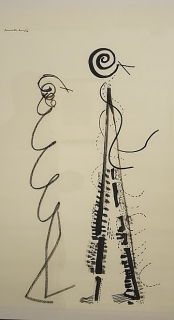
OUR FRIEND THE artist Premlatha Seshadri (born 1947) lives and works in Chennai (Madras). Whenever we visit the city, we meet her. A couple of days ago, she sent us a message to inform us that two of her works were being displayed in Bateman Street, London, by The Noble Sage Gallery. They were hanging in a show, “The Journey So Far …”, to celebrate the gallery’s twentieth anniversary. Today, 31 May 2026, on the exhibition’s final day, we saw her exhibits and those of other artists. Fortunately, we arrived at the show just in time to be guided around it by the gallery’s knowledgeable, friendly owner Jana Manuelpillai.
Premlatha studied art in London at Hornsey Art College and also in Chennai at the Government College of Arts and Crafts (‘GCAC’). Founded as ‘The Madras School of Art’ in 1850, it got its present name in 1962. It was India’s first art school of the type found in Britain. Premlatha was a student of K.C.S. Panniker (1911-1977). One of his drawings was on display at the Noble Sage show. Alongside his and Premlatha’s works, there were other pictures created by artists from Chennai, most of whom had been students at GCAC. Mr Manuelpillai explained how the selection of paintings together formed a sort of genealogy of modern art in Chennai.
The other artists from Chennai whose works could be viewed in the show included: T Athiveerapandian (1966-2025), RB Bhaskaran (b 1942), S Dhanapal (1919-2000), CJ Anthony Doss (1933-2008), P Gopinath (b 1948), Achuthan Kudallur (1945-2022), M Natesh (1960-2024), G Raman (b 1942), AP Santhanaraj (1932-2009), and KM Adimoolam (1938-2008). I imagine that our friend Premlatha knows all these artists and their work.
Although there was remarkable variety in style and composition of the works produced by the Chennai artists on display, those of Premlatha stood out from the others. The website of Noble Sage explained:
“Seshadris work has, through its differentiation, defined the contours of the Madras Movement of the early 1960s. Disinterested in Tamil Nadus rich Dravidian Hindu artistic heritage, and therefore flying in the face of much of Pannikers teaching, her art only has its driving line in common with other artists in Chennai such as A.P. Santhanaraj, L. Munuswamy and R.B. Bhaskaran. However her employment of this line is quite different. Seshadri has for many decades been inspired by the simplicity and truthfulness of Zen poetry and literature and applied this thinking to her line and her content.”
Indeed, the two pictures we saw at the exhibition share something in common with the way that Picasso was able to capture a great deal (in some of his works) using only a few brush strokes judiciously, Although quite unlike anything produced by Picasso or Japanese artists, whose works come to mind when seeing her creations, Premlatha is able to express a great deal apparently simply, but in fact, quite sophisticatedly.
I am very pleased that Premlatha alerted us to the exhibition. Not only did we get a chance to view her works, but also seeing the show and hearing Mr Manuelpillai’s lucid discourse was a brilliant introduction to a body of artistic creation of which I was unaware: The Madras Art Movement also known as ‘The Madras Movement’).

