
THE ARTIST BORIS Anrep (1883-1969) was born in St Petersburg, Russia. At first, he studied law at Imperial School of Jurisprudence in St. Petersburg, and graduated in 1905. Three years later, he abandoned the law, and went to Paris to study art. In Paris, he met many of Britain’s leading cultural figures. At the outbreak of WW1 until 1916, Anrep served in the Russian Army. In 1917, he was called to London to serve as Military Secretary to the Russian Government Committee. After that, he never returned to Russia.
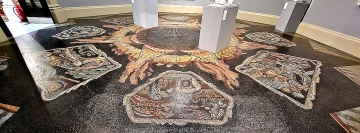
After a visit to Italy where he saw the wonderful Byzantine mosaics in Ravenna, Anrep decided to begin making mosaics, and it is for these that he is rightly remembered. During WW1, the floor of an octagonal room in London’s Tate Britain was badly damaged by bombing. It had contained a collection of artworks by William Blake (1757-1827). In 1923, after he had been commissioned to make mosaics in several places in London, Anrep was asked to create a mosaic floor in the octagonal room. This work of art, upon which you can walk without being stopped, consists of eight illustrated panels, each one containing some words from “The Proverbs of Hell” from Blake’s “The Marriage of Heaven and Hell” (written in 1790). The panels form part of a colourful mosaic that covers the entire floor of the room. Sadly, part of Anrep’s work is covered by small display cases containing works of art by other artists. Nevertheless, most of the mosaic is visible, and is well worth seeing.
Another place to see Anrep’s mosaic work is on the main staircase of the older part of London’s National Gallery. However, there the crowds make viewing of his work far more difficult than at the Tate Modern.
When Anrep died, he was cremated at Golders Green Crematorium, a place I walked past countless number of times during the first three decades of my life – whenever I travelled between my family home in Hampstead Garden Suburb and Golders Green station. It was only long after I had stopped living in that area that I ‘discovered’ Boris Anrep and his art.
 yamey
yamey 