
OF THE TWO Tates in London, Tate Modern and Tate Britain, I prefer the latter. Yesterday, 29 May 2026, while strolling in the Tate Britain, I entered Room 18, and came across a collection of paintings by an artist who was new to me. With the title “Prunella Clough: Urbscapes”, this was a display of thirteen paintings by Prunella Clough (1919-1999).
Prunella was born in London. In 1937, she enrolled at the then Chelsea School of Art. While there, she received tuition from the British sculptor Henry Moore. During WW2, she worked as a cartographer in the Office of War Information. During her whole life, she resided in London.
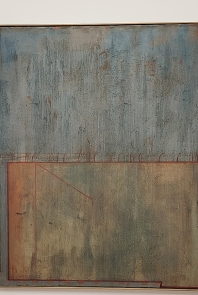
Prunella was fascinated by what she described as ‘urbscapes’: urban and industrial landscapes. These are depicted in the paintings being shown in Room 18 until 8 November 2026. Almost abstract, each of the pictures is a landscape or part of one. However, at first glance, the viewer might be forgiven for imagining that he or she is looking at abstract art. One of the paintings that I saw from a distance before reaching Room 18 looked a bit like something created by Mark Rothko, but close up one can see that it is a tall blank wall. According to the Tate’s website:
“Clough maintained that ‘nothing that I do is “abstract”. I can locate all the ingredients of a painting in the richness of the outside world, the world of perception.’”
This same website also quotes the artist as having said (in 1949):
“Anything that the eye or the mind’s eye sees with intensity and excitement will do for a start; a gasometer is as good as a garden, probably better.”
The artist Patrick Heron is reported (in the Tate’s website) to have said about Prunella’s work:
“… her paintings are machines for seeing with.”
And I can see what he meant. Prunella Clough was able to transform the mundane into to something visually intriguing. I am pleased I discovered the exhibition of her works, even if I stumbled on it quite accidentally.


This exhibition was my introduction to Clough too. By the Canal was my favourite – very imposing