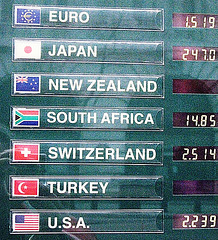
Dollar to Dirham,
Rupee to Rand,
From my pocket to another


Dollar to Dirham,
Rupee to Rand,
From my pocket to another

Common sense is one of the least common traits found amongst human beings. It is uncommon to chance upon someone with common sense. There are plenty of intelligent and very bright people around, but most of them lack common sense and often wisdom also.
When I was a pupil at Highgate School in north London between 1965 and ’70, all of the teachers except one had degrees from either Oxford or Cambridge. The exception, Mr B, had been at a training college just east of the City of London. Mr B taught an unacademic but practical subject: woodwork. I was not any good at his craft and luckily I missed most of the classes on account of my having broken my arm during the woodwork term. Amongst all of the teachers at Highgate, Mr B had the most common sense, in fact more common sense than all of the rest of the staff combined.
Another person, who was brim-full of common sense, was one of my aunts. For various reasons, probably not completely unrelated to losing her father at a young age, she did not shine at school. Yet, throughout her long life she approached everything with straighforward down-to-earth common sense.
I am not sure whether the following anecdote was a manifestation of my aunt’s common sense, but I will relate it anyway. Once when she was at a party, a stranger introduced himself to my aunt as follows:
“I am a neo-Platonist. What do you do?“
Cool as a cucumber my aunt answered:
“I am a cabbage.”
Thus, she put pay to her pretentious new acquaintance, and ended what might have become a tedious conversation.
My photograph (above) shows a well-known London landmark. For those who are unfamiliar with London, the picture depicts the Houses of Parliament, which contains the House of Commons. During the current discussions regarding the UK’s future relationship with the EU, many intelligent Members of the House of Commons are demonstrating a worrying shortage of common sense.

Stone vessels stand ornamentally
Beside a pool:
Call them urns, please
Photo taken in London near Lancaster Gate at the northern end of the Serpentine Lake
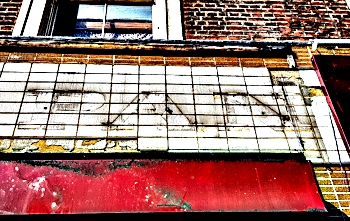
“… and set off after the cab. He dismissed it by Panzer’s Delicatessen on Bayswater Road…”
So, wrote Frederick Forsyth in his novel The Fourth Protocol.
If you look for Panzers today, you will not find it in Bayswater. There is a Panzer’s delicatessen in St Johns Wood, but it is not the same firm.
The shop was on Bayswater, facing the Czech Embassy, between Linden Gardensand Claricarde Gardens. Panzers was still in business in 1985. It closed sometime after that (before 1993).
A couple of days ago, I noticed that the shop front of a recently closed branch of the wine retailer Oddbins was being renovated. The sign board above the display window had been removed, revealing some old tiling. Barely discernable on the tiling were three letters ‘PAN’, these being the first three letters of ‘Panzers’. For a brief time, the remains of the now long-gone delicatessen mentioned by Frederick Forsyth may be seen by passers by. Soon, it will either be removed or covered up.
This long lost shop also appears in another well-known novel, 84 Charing Cross Road by Helene Hanff. She wrote:
“She painted until one and then drove me down to Kensington for lunch …
… She took me to a little Italian place for lunch, down near where she and Leo live, called Panzer’s Pasta and Pizza …”
A photograph taken in the 1970s shows that there were two Panzers close to each other in Bayswater (see: https://rbkclocalstudies.wordpress.com/2018/09/20/notting-hill-gate-the-other-high-street/). I have posted a detail from it. The branch, whose sign was partially revealed recently is marked with a red arrow. The other branch, which I suspect was the one in Helene Hanff’s book, is marked with a yellow arrow:

During my early years in dental practice, I came across two instances of people living in houses without kitchens.

The first instance concerned one of my fellow dentists. He bought a house from a lady, who only used a microwave oven. Her home had no kitchen. My colleague had to convert one of the rooms in his new home into a kitchen.
The second example was also connected with dental practice. It was the home of one of my dental nurses, whom we shall call ‘S’. She was a delightful young lady, who worshipped the late Marilyn Monroe. Sadly, her eyesight was not quite adequate enough for working in a dental surgery. She and the senior dental surgeon in the practice decided that she should seek another type of employment, which she did. On her last day of working with me in my surgery, I gave S a small bottle of Chanel No 5 perfume as a ‘thank you present’. S was thrilled. I could not have chosen a better present. S told me that Chanel No 5 was all that her heoine Marilyn Monroe wore in bed. Well, I had no idea about the filmstar’s habits, but I was pleased that inadvertantly I had chosen the right gift for my visually-challenged dental assistant.
If you are now thinking that I have strayed from my subject, you are wrong. While S was working in our practice, she revealed that her mother hated cooking, so much so that there was neither kitchen nor dining room in the house where S lived with her family. S told me that the family ate every meal, including breakfast, at restaurants and cafés near their home.
Maybe I am too conventional, but I was surprised to learn that people who are able to afford accomodation with a kichen or kitchenette choose not to have one. In complete contrast, my wife told me that some of her ancestors lived in homes (in India) with two widely separated kitchens: one for meat and one for vegetarian food.
Amazing how much historical information may be obtained by studying a neglected stone…
The Pil Garden in the centre of the city of Bhavnagar (in the Saurashtra district of Gujarat) is a pleasant place to relax. Triangular in plan, the park is named in honour of Sir James Braithwaite Peile (1806-82)[1]. Educated at Oxford University, he entered the (British) Indian Civil Service in 1855. He went to India the following year. He learnt Gujarati and worked in many places in Gujarat including Bhavnagar. Between 1874 and ’78, Peile served as a Political Agent in Saurashtra. He helped to coordinate the activities of the numerous heads of Princely States in the area, including that of Bhavnagar. He also helped organize famine relief during the great famine of 1877. Peile gained the respect of the heads of the Princely States. Mr Peile described the Kingdom of Bhavnagar as follows:
“With flourishing finances and much good work in progress. Of financial matters I…
View original post 1,072 more words

A branching shadow
On a grassy green patch:
A tall tree stands nearby
Kensington Gardens on a warm spring afternoon, the first proper sunshine for quite a few days

While eating our dinner one tropical evening in a lovely restaurant in Fort Cochin (Kerala, India), I looked up and noticed that high up on the wall overlooking us there was another diner, definitely not a vegetarian.
Clinging to the wall
An insect in its jaws:
A gecko stares at me
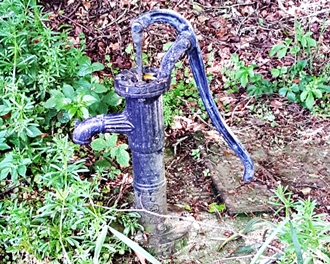
Neglected and lost,
Once essenti-al:
Now a disused water pump
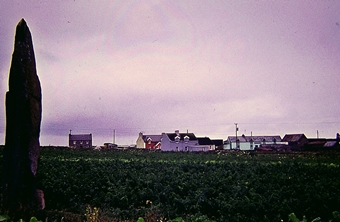
A long time ago, I remember seeing an advertisement issued either by Aer Lingus or the Irish tourist board, which said:
“In Ireland, it rains every fifteen minutes for a quarter of an hour”
During my first visit to the Republic of Ireland (Eire) back in 1976, I stayed with some friends in their secluded country house far south of Dublin. Remote as it was, it had a telephone, but it was without a dial. To use the ‘phone, it was necessary to lift the receiver and then turn a small crank several times. This crank sent a signal to the operator at the exchange, who then connected you to the switchboard. Next, you told the operator which number you required, and he or she then tried to connect you.
One night, there was a fierce storm with much wind. On the morning following, one of our party wished to make a ‘phone call. After several attempts to alert the operator with the cranking mechanism, we concluded that the storm had damaged the line connecting the house to the exchange. We thought that it would take many days before this would be repaired. One of my friends suggested that we got in the car and followed the telephone line to discover how and where it was damaged.
Soon, we found the place where the problem had occurred. The wind had caused the two wires that led to the house to become tangled in the branches of the tree. One of my friends stood on the roof of our vehickle and using a long stick, a branch that had been brought down by the storm, managed to disentangle the wires. When we returned to the house, we discovered that the problem had been resolved. Life was so simple in those days!

 yamey
yamey 