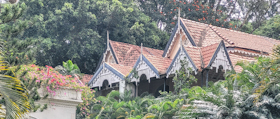
EVERY PUB HAS its own characteristics. Some of these establishments are more distinctive than others. The Ship and Shovell pub in Craven Passage near to Charing Cross station distinguishes itself from all other London pubs by being housed in two separate buildings separated by a public thoroughfare.
The two houses that house the pub’s two halves were built in the early 1730s, but have been modified since then. Until 1998, one building was The Ship pub and the other, facing it, was a separate establishment, The Shovell pub. Shovell either refers to coal workers who laboured in the area, or to Admiral of the Fleet Sir Cloudesley Shovell (c1650 –1707), who died at sea near the Isles of Scilly. In 1998, the two pubs were united when their two separate underground cellars were connected to each other with a common kitchen.
So, after 1998, what had once been two pubs became one but housed in two separate buildings. As a sign outside one of the parts of the pub reads, The Ship and Shovell is:
“The only London pub in two halves”
When I next visit it, I will have half a pint in one half and another half in the other half.
I am writing a book about visiting places in England. Here is a part of the introduction to the book. As it is only a draft, please feel free to comment on it, and also to let me know whether it would entice you to want to read further. What I have written is below this photograph.
This is what I have written:
There are plenty of remarkable places in England. For as the author Daniel Defoe (1660-1731) wrote in his “A Tour Through the Whole Island of Great Britain”:
“In travelling thro’ England, a luxuriance of objects presents itself to our view: Where-ever we come, and which way soever we look, we see something new, something significant, something well worth the travellers stay, and the writer’s care…”
What Defoe wrote so many years ago in the mid-1720s, is still true today. My book is about exploring a selection of places in England, especially many of them that are not on tourists’ usual itineraries. I have written about locations, which have intrigued me. Although some of them will not be familiar to most readers, I hope they will be found to be interesting. I have visited most of them since the onset of the covid19 pandemic in early 2020.
For about 10 years prior to 2020, we did not own a car. When the covid19 lockdown regulations began to ease a little in the UK, and greater freedom of movement was permitted despite the high prevalence of the infectious disease, we felt the need to roam around – to ‘escape’ from our neighbourhood. However, we had become uneasy about using public transport. So, in May 2020, when car showrooms reopened, we acquired a car, and began making day trips into the countryside. At that time, staying in hotels etc was not allowed. After a few months, it became possible to stay in hotels, guest houses, and so on.
Before the onset of the pandemic, we had, like so many others, chosen to holiday out of England, believing places abroad to be more interesting than our own country. During the pandemic, we were compelled to travel within its confines. And having travelled extensively in England during the last 5 years, we have discovered that the country is as least as interesting as many lands across the sea on the mainland of Europe. This book gives an account of some of the places we have been to in England since May 2020, and a few that we had already seen before the pandemic.
MANY THOUSANDS OF authors aspire to ‘make their name’ by publishing their writing. Most of these people hope to follow in the footsteps of, say JK Rowling, and to achieve fame and become a bestselling author. This hope is exploited ruthlessly on social media, especially, so I have noticed, on Facebook and X (formerly ‘Twitter’).
Every day, I notice a steady stream of advertisements promising to convert your piece of writing into a bestseller. Some ads offer to convert your manuscript into a book that looks as if it has been produced by a recognised commercial publishing house. Other, provide editing and mentoring services. Yet more of them, promise to promote your book on social media. Some will guide you as to how to make your book more prominent on Internet search engines. And others will review your book any number of times. There are even websites that will write the text of your book using AI. All these services naturally attract fees, and these can in some cases be quite hefty. If despite using these miraculous sounding services, your book neither sells well nor achieves great acclaim, you might be considerably out of pocket.
The problem is that very few of the myriad books written have either any outstanding literary merits or appealing features. The services offered in the ads offer profits and huge readerships on the horizon. But will they materialize, or will they remain mirages that fade away after you have parted with your money? I have never used any of the services that I have seen advertised. I wonder whether they would be honest enough to say that despite their best efforts, the submitted work is likely to be a failure, or do they not care.
Here is a brief excerpt from my book “88 DAYS IN INDIA: A JOURNEY OF MEMORY AND DISCOVERY”, In this sample, I am writing about pigeons in Jaipur (Rajasthan) and elsewhere:
“While we were being driven around the city, we passed areas where food and water were being distributed to some of the city’s many pigeons. The provision of food for pigeons (as well as street dogs and other animals) is commonly found in many other cities and villages we have visited in India. In Jaipur, we saw vendors selling passersby seeds for the birds. Earlier in 2024, when we were in Istanbul, we saw similar vendors at an area (near the Spice Bazaar) where pigeons were plentiful. As a child during the early 1960s, my parents used to buy me cones full of corn for feeding the pigeons in the Piazza Signoria in Florence (Italy). Long ago, I remember pigeon feed being sold in London’s Trafalgar Square. However, now Londoners regard pigeons as pests, which should not be fed. One of London’s former Mayors, Ken Livingstone, who ended selling of pigeon food in the square in 2001, called pigeons: “rats with wings”.
Although feeding pigeons has caused India’s population of these creatures to increase to alarmingly high levels, Shreemoyee Chakraborty (quoted in an article published by theprint.in in November 2024) noted: “In India feeding pigeons is not just a habit; it has a religious and cultural significance as well.”
In an online article about Vastu Shastra (published on vastulabh.com), it was pointed out that: “Pigeons have long been associated with Goddess Lakshmi, the deity of wealth and prosperity. According to Vastu Shastra, pigeons are believed to bring positive energy and good fortune into the home. However, there are differing opinions and specific guidelines on how to interpret their presence.”
So, it is likely that feeding these winged creatures in India has a good chance of continuing despite the occasional attempts of some municipal authorities, including in Jaipur, to reduce their population.“
If you wish to purchase a copy of this book, hasten to Amazon’s website:
WE ARE REGULAR theatregoers. We enjoy live theatre. In some indescribable way watching a live theatre performance engages the viewer to a far greater extent than does watching a cinematographic production (a ‘movie’). During a live theatre performance, the actors seem to physically affect the audience in a way that almost feels physical. Because of this, we have been reluctant to see any of the specially televised live performances of plays being held at the National Theatre on the Southbank.
Well, yesterday evening, 4 September 2025, we bit the bullet and watched a televised, live screening of the play “Inter Alia” by Suzie Miller, which was being performed at the National Theatre that same evening. We had back row seats at the Picture House cinema in Finsbury Park. The cinema has a huge screen and an excellent sound system. Our seats were comfortable.
We were amazed at how wonderful it was watching the televised live production. The camera operators, who were filming the play at the National Theatre whilst we watched it on the screen did a superb job. We watched the play as if through the eyes of someone seated in the best seat in the theatre. We saw what we would have seen had we splashed out for the most expensive seats in the house. The filming was not done from multiple angles, but only as we might have watched it while seated in the theatre. And the most surprising thing was that, unlike in a movie, it felt as if we were as much engaged with the actors as if we had been in the theatre with them.
For less than the price of the cheapest seats in the theatre, we had the best view of the play and were able to hear every word perfectly. Apparently, we were not alone. The cinema was full, and while we were watching, the same show was being watched in about 600 cinemas in the UK, and would later be available worldwide. Our first experience of National Theatre Live, as the televised performance is named, has got us ‘hooked’.
ACCORDING TO ITS website, the small restaurant in Soho’s Poland Street called The Kati Roll Company (‘KRC’):
“… serves authentic street Kati Rolls just like the ones in Kolkata, India.”
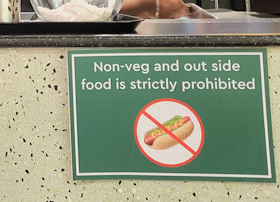
The restaurant is attractively decorated, with its wall covered with fragments of Hindi film posters and a corrugated iron ceiling. It has several tables and chairs. Food is ordered from a counter at the far end of the rectangular dining area, and is delivered a few minutes later. I could not see the kebabs being prepared, but if they are truly kati kebabs, they should have been grilled on bamboo skewers. The roll, wrapped in paper consists of a spicy meat or vegetarian filling enclosed in a rolled-up roti, which the restaurant described as a ‘paratha’.
Kati Roll Company, London
KRC was, according to its website, started:
“… by Payal Saha shortly after she moved from her hometown of Kolkata to New York City. Without any experience running a restaurant, she let her desire for authentic kati rolls drive her passion.”
Well, it was with great interest that today, 3 September 2025, I visited and ate at KRC in Poland Street. I was curious to see how their rolls compared with those at Nizams in central Kolkata. I have written quite a lot about this restaurant in my latest book “88 Days in India: A Journey of Memory and Discovery”. Here is a short excerpt from my description of the rolls at Nizams:
“The kathi roll consists of a kebab (usually chicken or mutton, or potato for vegetarians) wrapped, with or without a cooked egg (like an omelette), in a rolled up flaky paratha. Onions and chillies can also be included in the roll. The paratha is heated in a large amount of oil on a tava (a circular, concave metal hotplate). It is the same one that was installed when the restaurant first opened. According to an article in The Telegraph Online (dated August 2024), the tava weighed 185 Kg in 1932, but through constant use it has lost weight. By 2024, it weighed 80 Kg. Until 1964, the kebabs were grilled on iron skewers. After that, the metal skewers were replaced by cheaper bamboo sticks, known in Bengali as ‘kathi’. The rolls have always been served, wrapped up in paper so that the customers (often in the early days, British men out on the town with Indian ladies) did not get grease on their fingers whilst consuming them. Interesting as the history is, it pales into insignificance when you bite into one of Nizam’s kathi rolls. I do not know how they achieve it, but the taste of Nizam’s kebab filled rolls surpasses that of every other kebab roll I have eaten. Year after year, Nizam’s manages to maintain the high quality and magical flavour of their products.”
After having eaten at Nizams many times, I waited with great interest for the 4 kathi rolls we had ordered in Poland Street to be served.
The fillings in the KRC rolls were tasty enough, and if you have never eaten at Nizams, you would think that they taste pretty good. The so-called parathas in which KRC’s rolls are wrapped seemed more like rotis than what I was expecting. In contrast, the parathas that enclose the fillings at Nizams are, as mentioned above, flaky, almost as much as Malabar or Kerala parathas, but oilier. Although I enjoyed the rolls at KRC, and will happily eat there again, they are not nearly as satisfying and tasty as those at Nizams. However, it is much easier and quicker for us to reach KRC in Soho than it is for us to get to Nizams in Kolkata.
PS: My book, which contains a chapter about eating in Kolkata, is available from Amazon:
THREE MILES NORTH of Basingstoke, there is a magnificent stately home, The Vyne, which is now owned by the National Trust. Set in fine grounds alongside a long, thin lake, this edifice is a wonderful mixture of architectural styles and features.
The present house began its life as a Tudor mansion built between 1500 and 1510 for William Sandys, 1st Baron Sandys, Lord Chamberlain to King Henry VIII. It remained a possession of the Sandys family for most of the time from when it was constructed until 1653, when it was sold to Chaloner Chute (died 1659), who was a lawyer and the Speaker of the House of Commons during the Commonwealth. Because he felt that the Vyne was too big for his requirements, he had much, but not all, of the Tudor mansion demolished. Fortunately, several of the beautiful rooms with elaborate wood panelling were saved, along with the Tudor chapel.
The rest of what remained of the original building was converted to a version of the Palladian Style. This included adding a neo-classical portico to the north side of the hose, facing the lake. In the eighteenth century, one of Chaloner’s descendants, John Chute, influenced by his friend Horace Walpole, redesigned the interior of the chapel, adding trompe l’oeil features and also installed a very spectacular staircase in the house. The staircase is in the neo-classical style. It must have impressed those who visited the Chutes, and it still dazzles the visitor today. Although there are many fine artefacts to be seen in the house, this staircase was, for me, the ‘star of the show’.
When John Chute died childless, The Vyne was inherited by his cousin Thomas Lobb, who then changed his surname to Chute. After that, few changes were made to the house. The house remained in the Chute family until 1958 when Charles Chute bequeathed the estate to the National Trust.
RECENTLY WHEN WALKING in an an orchard in Hampshire, we found that the trees were literally groaning beneath the weight of apples growing upon them. Seeing all of these ripe fruits brought back memories of visiting family friends, who lived in Kent, during my early childhood.
Whenever we went to their home, we were given a lavish lunch. The dessert was always apple pie. The apples were covered with a topping of pastry. What fascinated me was that the centre of this topping was always raised above the rest of it. Beneath this centrally located curved mound, – and this is what used to fascinate me – there would be a ceramic cup buried amongst the cooked apples. Discovering a cup buried in an apple pie tickled my imagination, and always puzzled me. I believe that it is normal practice to insert something to support the pastry topping, but when I was less than 10 years old, I did not know this. Our friend who used to cook this apple pie for us is, sadly, no more,
Incidentally, in recent years, some of the best apple pie I have tasted is that served at The Only Place in Museum Road, Bangalore (south India). Its recipe was introduced to the restaurant by the American wife of Haroon, who founded the restaurant many years ago.