An artist in Turkey with a famous Albanian ancestor

ALI PASHA OF TEPELENE (1740-1822) was born an Albanian in what is now Albania. He ruled the Ottoman pashalik of Yanina (Ioannina in Greek) with a large degree of autonomy. One of his descendants was Naciye Hanim. She married Lieutenant Colonel Abdurrahman Ziya Bey,

Naciye and her husband had only one child, a daughter called Melek, who was born in 1896 (in Istanbul) and died in 1976 ( in Munich, Germany). She became a renowned painter, sculptor, and writer (books and articles). I would not have heard of her had we not visited the magnificent Sakip Sabanci museum of art at the village of Emirgan on the European shore of the Bosphorus. At this place there was an excellent exhibition of Melek’s life and works. With information both in Turkish and English, it was an enlightening experience.
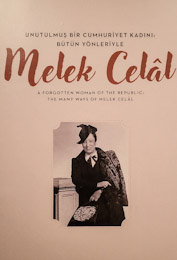
From an early age, Melek showed signs of artistic ability. She was brought up in an intellectual atmosphere. The Turkish poet Niğar Hanim encouraged her to take up painting. Her first lessons were with her uncle the soldier and painter Kâzim Bey. Later, she attended the Académie Julian in Paris. She also attended the School of Fine Arts for Women in Istanbul. While in Paris, Melek worked with various well-known French artists in their studios. Soon, she was recognised as an accomplished artist. This is evident from the many portraits and still-life’s on display in the exhibition.

In addition to painting and sculpting, Melek was a prolific writer of articles and books. She was also involved ed with Turkish politics during the period when the Ottoman Empire was dying and Ataturk’s modern Turkey was in its infancy. Her first book was published in 1938. In 1959, she published a book in French to introduce western readers to the delights of the Topkapi Palace complex in Istanbul. Many of her publications are on display alongside her paintings and one sculpture.

Melek married twice. First with Mr Celal in 1917. They had a son, and Celal died soon after that. In 1956, she married Dr Lampé, a physician. He died before she did. Melek died whilst being treated in a hospital in Munich.

Melek was one noteworthy descendant of Ali Paşa of Tepelene. There were others, who became famous Turkish intellectuals, including the writer Ebüzziya Tevfik(1849-1913), another writer Abdülhak Şinasi Hisar (1887-1963) and the author and poet Nâmik Kemal (1840-1888). These people of Albanian descent were not alone in shaping Turkey – both Ottoman and modern – in various ways, both peaceful and otherwise. I had heard about some of them, but Melek and her art are a wonderful discovery.
RELICS OF A GREAT INDIAN WRITER AT A LIBRARY IN CALCUTTA

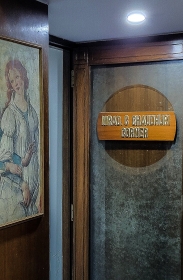
THE CALCUTTA CLUB (in Kolkata) was founded in 1907. Unlike other ‘elite’ clubs in existence at that time, it admitted members regardless of their ethnic background. The Club has a library consisting of several rooms arranged in a line, each one connecting to the next. At the far end of the library, there is a locked door bearing the label:

“Nirad C Chaudhuri Corner”.

Nirad Chaudhuri was one of 20th century India’s great writers. Born in 1897 at Kishoreganj – a place that is now in Bangladesh, but was then in British East Bengal – he died in Oxford (UK), having passed his 101st birthday. He was an original thinker whose views have not been shared by everyone. He wrote about India and its history in an incisive way that was not fettered by the conventional ideas of his contemporaries. In the 1970s, he shifted from India to England, and settled in Oxford. A few years ago, we met and were befriended by his son Prithvi – now a physically and intellectually active octogenarian. When we are staying at the Tollygunge Club (in south Kolkata), we often meet him after breakfast to chat and enjoy cups of coffee.

During one of our morning meetings, he told us how his father’s books and other possessions were shipped to India after his demise. He mentioned that some of these things are now stored in a room at the library of the Calcutta Club in what has been called the ‘Nirad Chaudhuri Corner’. As we expressed interest in seeing this, he said that he would ring the relevant Calcutta Club committee member to arrange for us to view his father’s collection. Although the Club feel they were given the items, Prithvi said that he had simply lent them. The matter is currently being contested in court. He told us that although there is much to see at the Calcutta Club, some of his father’s collection – notably his collection of books written in French – have been stored elsewhere.

The following day, we visited the Club’s library, where a librarian showed us to, and then unlocked, the Nirad Chaudhuri Corner. Apart from books that belonged to Nirad, there are paintings and other objects. One of these is the Royal Proclamation that was written when he was awarded the honour of the Commander of the British Empire (‘CBE’) in 1992. There are also several objets d’art including decorative ceramics (plates and cups), an ancient Egyptian sculpture, some wine glasses, a bottle of vintage port, a set of the first UK metric currency coins to have been issued, and many other things. The paintings include a well-executed hand-painted copy of a picture by Monet – a famous French impressionist. Prithvi told us that when his father bought the painting, he paid a great deal of money for it. Some of the family disapproved, but as Prithvi rightly said, it was his own money.

After examining the Corner, we walked back through the library. On the way, I spotted a small, framed manuscript. It was labelled “Original Signature of Mr Satyajit Ray Membership No. R211”. For those who do not know, Satyajit Ray (1921-1992), born in Bengal, was one of India’s most famous film directors.

Thanks to Prithvi, we were able to see a fascinating collection of possessions once owned by a great Indian writer. Almost hidden in the Calcutta Club’s library, I doubt that many of its members have seen it or are even aware of its existence.

Brief profile of an author: a bit of self publicity!

Adam Yamey is the author of several books, including: “Albania on my Mind”; “Scrabble with Slivovitz;” (Once upon a time in Yugoslavia); “From Albania to Sicily”; “Exodus to Africa”; “Rediscovering Albania”; “Aliwal”; “Bangalore Revealed”; “Indian Freedom Fighters in London (1905-1910)”; “Imprisoned in India”; “Beneath a Wide Sky: Hampstead and its Environs”; “Beyond Marylebone and Mayfair: Exploring West London”.

His latest book is:

“Golders Green & Hampstead Garden Suburb: Visions of Arcadia”

Buy a copy here: https://www.amazon.co.uk/gp/product/B0BHG873FB/

Born in 1952 in London, he attended Highgate School, and then University College London. After a doctorate in mammalian physiology, he became an undergraduate once more and qualified as a dental surgeon. After 35 years in general dental practice in Kent and London, he retired in September 2017.

Adam married a lady from India in 1994, and, since then, has been visiting her native land frequently. India has become his second home. He is a keen traveller. The periods between his journeys are usefully and enjoyably employed with: family, cooking, writing, photography, blogging, cinema, theatre, and exploring the many delights that London has to offer.

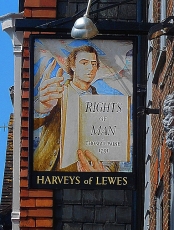
Rights of man

BULL HOUSE STANDS on the High Street immediately beneath the remain of the castle that dominates the Sussex town of Lewes near Brighton. Its neighbour is an older, half-timbered edifice that now houses The Fifteenth Century Bookshop, a supplier of second-hand books, which was unfortunately closed when we passed it on a Sunday morning.

In the year 1768, the owner of Bull House, a tobacconist named Samuel Ollive, and his wife Esther, took in a lodger, who had arrived in the town. This man was an excise officer aged about 31. His name was Thomas (‘Tom’) Paine (1737-1809). 1n 1771, Paine, already a widower, married Elizabeth Ollive, daughter of Samuel and Esther. At of that time, he became involved in the Ollive’s tobacco business as well as the administrative affairs of the town of Lewes. A year later, as part of a campaign to improve the remuneration of excise officers, he published a pamphlet. “The Case of the Officers of Excise”. Tom enjoyed lively discussions and debates at the town’s ‘Headstrong Club’, which met at the White Hart Inn on the High Street. This hostelry can still be seen today.

The year 1774 found Tom in trouble. He had been accused of being absent without permission from his position as excise officer. Also, his marriage failed, and he separated from his wife Elizabeth. To avoid a spell in a debtors’ prison, he sold all his possessions. He left Lewes and went to London, where he was introduced to the revolutionary Benjamin Franklin (1706-1790), who recommended that Tom should emigrate to North America. Tom set sail from England and arrived in Philadelphia in November 1774.

The pamphlet that Paine wrote in Lewes was followed by many more published writings. Amongst these is his best known, “The Rights of Man”, published in 1791, in London, England, where Tom had returned in 1787. This work is described in a guidebook to Lewes as “…the bible of English-speaking radicals.” Whether Tom ever returned to Lewes after his first excursion to what is now the USA, I do not know. If it ever occurred, it is not mentioned in my guidebook, and I have not found any reference to it.

Maxim and Ivy: to Russia with love

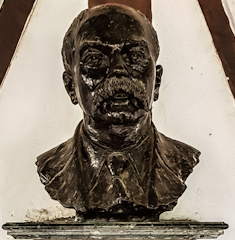
MEIR HENOCH WALLACH-FINKELSTEIN (1876-1951) is better known as Maxim Maximovich Litvinov. A Bolshevik revolutionary, he became an important Soviet diplomat. In 1930, Stalin appointed him People’s Commissar for Foreign Affairs. Earlier on, shortly after the 1917 Russian Revolution, Maxim was sent to London as the Soviet government’s plenipotentiary representative in Great Britain. While in London, he met and married the writer Ivy (née Low; 1889-1977). I have recently discovered that their lives partially overlapped with mine, not temporally but geographically.

BLOG IVY 5

Ivy was living in London’s Hampstead when she and Maxim were courting. They had met in about 1918 at the home of Dr David Eder (1865-1936), a Zionist socialist and a pioneer of psychoanalysis in Britain. David, whom Ivy regarded as a father figure, and his family lived in Golders Green (actually, in Hampstead Garden Suburb at 103 Hampstead Way, not far from our family home).  According to Ivy’s biographer John Carswell (in his book “The Exile: Ivy Litvinov”):

“Over tea in the Express Dairy in Heath Street where they often met, Ivy helped Maxim to improve his English – throughout her life she adored improving people’s English – and she did more: she guided him in reading English literature.”

Today, the building that used to house the Express Dairy in Heath Street is a branch of the Tesco supermarket empire. However, the building still bears the name ‘Express Dairy’ and the date 1889, the year that Ivy was born.

Ivy’s biographer John Carswell (1918-1997) was the son of one of Ivy’s closest friends, the writer and journalist Catherine Carswell (1879-1946). Ivy met Catherine, a close friend of the writer DH Lawrence who lived in Hampstead, after she had written a favourable review of Ivy’s novel “Growing Pains”, which was published in 1913. Catherine lived in Hampstead at Holly Mount. To be close to her friend, Ivy moved to Hampstead. John, who was born at Hollybush House in Holly Hill, met Ivy several times and has written a good account of her life. It reads well and is extremely informative not only about Ivy but also about her husband.

Ivy and Maxim moved to Russia with their two young children in about 1920 and lived there, with small occasional breaks, until the late 1950s. One of these breaks was when Maxim was appointed Soviet Ambassador to the USA between 1941 and 1943. Her stay in the USSR was also punctuated by short holidays abroad. Living in the USSR, Ivy continued her writing as well as teaching English. Long before he died, Maxim fell out of favour with Stalin and lived in fear of arrest and probable execution. However, he died of natural causes in 1951, just in time to miss Stalin’s last great, but unfulfilled, plan, the anti-Semitic ‘Doctors’ Plot’. On his deathbed, he said to Ivy:

“Englishwoman, go home”.

It was not until 1960 that Ivy did return to England.  But, in 1961, she returned to the USSR, where she remained a pensioned widow until July 1972, when she returned to the UK. She settled in Hove, where she lived the rest of her life. Until her dying day, Ivy wrote, published, and was actively involved with the literary world.

Long before her last visit to England, Ivy had made brief visits. In July 1930, Maxim was appointed People’s Commissar for Foreign Affairs. Soon after his promotion Ivy accompanied him to Geneva. That same winter, the Litvinovs paid a visit to London. John Carswell, then twelve years old, recalled:

“She took me to a Christmas show of which even the name now escapes me; but what is still vivid is the tall, dominating, fur-coated figure sweeping me across the wintry promenade outside the Golders Green Hippodrome, to a torrent of commentary.”

Reading about Carswell’s memory of Ivy taking him to a Christmas show at the Hippodrome reminded me of seeing pantomimes at this same theatre when I was about John’s age or maybe a year or two less. until the mid-1960s, the Hippodrome (built as a 3000-seat music hall in 1913) was a very active repertory theatre, where many plays that would eventually end up in the West End were premiered. In addition to plays, operas and Christmas pantomimes were staged there. In the 1960s, it became a BBC television studio, and lately it has become a venue for Islamic meetings. Like Carswell, I cannot remember what shows I saw there as a child, but I do remember being impressed by the size and fittings (seats arranged in galleries, boxes, and the vast stage) of the Hippodrome. It was as least as impressive as the grandest of West End theatres.

I enjoyed reading Carswell’s biography not only because it provided some insight into what life was like in the Soviet Union during Stalin’s rule but also because it introduced me to the life of an intriguing woman writer whose love for Maxim led her to spend a large part of her life in the USSR. Another thing that appealed to me is that Carswell provided me with new aspects of the history of Hampstead, a part of London which I know well and where I grew up. It is with some reluctance that I will return this enjoyable biography to our local public library.


RUDYARD KIPLING IN BOMBAY

KIPLING WAS BORN IN BOMBAY

IN 1857, THE YEAR OF THE FIRST INDIAN War of Independence, the British opened the first school of art in Bombay. It was named the ‘JJ SCHOOL OF ART’ after Sir Jamsethjee Jeejeebhoy, who donated much money towards its establishment.

We were very fortunate that a friend arranged a private tour of the campus for us. It began after we had eaten Yemeni food at the Hotel Stars on Chakala Street near Mohammed Ali Road.

We were shown the workshops and studios, many of which were built at the time of the School’s founding. The standard of work done by the students is high. We visited workshops for printing, textile weaving and printing, sculpture, metalwork, and ceramics. The walls of the largest part of the sculpture department are lined with models of great works by both western and Indian classical sculptors. This large room reminded me of images of how the Royal Academy in London looked long ago. Our guide explained that the JJ was modelled on the Royal College of Art in London.

We ended our tour at a building resembling a large English country house built in the Arts and Crafts Movement style of the late 19th century/early 20th century. This rustic looking edifice, which was built by 1865 long before the Movement flourished, used to be the residence for the deans of the School.

In 1865, Lockwood Kipling(1837-1911) and his new bride arrived in Bombay. Lockwood, an artist who created works in wrought iron, had been appointed Professor of Architectural Sculpture at the JJ. Soon after this, he was appointed Principal of the JJ and took up residence in the house already described. It was in this house that his son, the eminent author Rudyard Kipling(1865-1936), was born. The house is currently being restored beautifully.

The JJ also has a noted School of Architecture. This was founded by the British to train Indians to become architectural draughtsmen rather than architects. Their role was to draught the detailed plans of designs for buildings conceived by British architects. Likewise, the original colonial idea behind the JJ was to train Indians to carry out the ideas formulated by British artists. Today, the JJ no longer trains its students to be technicians to execute the plans of others, but educates them to enhance the creative life of India.

Finally, we learnt that many of the great buildings of British Imperial India were designed by architects in Great Britain, who never ever set foot in India. For example, the Deans’ house, where Rudyard Kipling was born, was built from a plan that was originally drawn up in England for a house that was never built in its intended location. Kipling’s birthplace was built from plans for a caretaker’s lodge for the Viceregal residence in Shimla, which never got built.

Now that I have seen where Rudyard Kipling was born, I feel that it is high tome that I read something he wrote!