Station with no trains

THERE ARE NO MORE trains running to the picturesque town of Clare in Suffolk. Between 1865 and 1967, trains running on the Stour Valley Line between Marks Tey (in Essex) and Shelford (in Cambridgeshire) stopped at Clare Station. In 1961, you could leave London’s Liverpool Street Station at 8.30 am and reach Clare at 10.44 am (www.disused-stations.org.uk/c/clare/).  

On a recent visit to Clare in August 2021, we decided to take a look at what remains of Clare Castle, which was built shortly after 1066 by Richard fitz Gilbert (1035-c1090), who took part in the Norman invasion of England (1066). To reach the remains of this structure, we walked across a large car park, at the far end of which is the attractive Clare Castle Country Park. The north side of the park is occupied by a tall conical mound, the motte of the former castle. On top of this, there is a short length of ruined, curved walling. Running east from the base of the motte, is a length of wall with one archway, presumably a wall that formed part of the castle’s bailey. These features are all that can be seen of the former castle. Exciting as this might be for historians, the park contains some other structures of historic interest. They are not as old as the castle, but fascinating, nevertheless.

Clare railway station

The Country Park contains the platforms, station buildings, and the goods shed of the former Clare Station. These have all been preserved well and employed as leisure facilities for visitors to the park. The main station buildings on platform 1 contain a waiting room with its old fireplace and ticket office. Built in 1865 to a standard design used in 30 Great Eastern Railway stations, this building now serves as an eatery and café. Across the grassy strip, where the tracks used to be laid, is platform 2, with its own waiting room, now used as a visitors’ centre and souvenir shop. A short distance away from the old platforms, the former goods shed still stands. With an old-fashioned goods crane outside it, the shed contains toilets and other facilities for visitors. Clare’s signal box no longer exists as it was destroyed by fire in the late 1960s.

The line that used to run through Clare was closed in 1967 as part of a plan devised by Dr Richard Beeching (1913-1985), who became Chairman of the British Railways Board in 1961. Beeching was instructed by the British Government to devise a plan to increase the efficiency of British Railways. This was eventually executed and involved the closure of many stations, including Clare, and of many miles of track, including the Stour Valley Line. The last passenger train to stop at Clare was on the 4th of March 1967. Although trains used the line for a short time after this, none ever stopped at Clare again.

A visit to Clare is worthwhile because it is small town with many historic buildings and an attractive parish church. We visited recently on a Saturday morning when a small street market was in full swing. The town has several shops selling antiques and a few cafés, apart from that in the former railway station. We had visited Clare several times before, but it was only on our latest visit that we came across the old railway buildings. In this period when there is great concern about global warming and ‘saving the planet’ seeing the station and its platforms reminds us that Beeching’s plan to close so many lines was short-sighted because a good network of mass rail transport could contribute to reducing the current dependence on road transport and might reduce pollution. Thinking back to the 1960s, the time of Beeching’s plan, I do not recall that there was much concern about the future of our planet in those days.

A village, a school, and Jemima Puddleduck

LONG MELFORD IN Suffolk is a village that I have passed through several times. It was only during our most recent visit in August 2021, when we stopped there to see its church and Melford Hall that I realised that the place has a connection with Highgate School (in north London), which I attended between 1965 and 1970.

Melford Hall sits on land that was once owned by the abbots of St Edmundsbury. As with all monastic property, it passed into the hands of King Henry VIII when he ordered the dissolution of the monasteries in the 16th century. The king with an eye to profit rather than the prophets sold the properties he had confiscated to wealthy buyers (nobles, merchants, and lawyers). Melford Hall and its lands were sold to a local lawyer, William Cordell (1522-1581). His father was a personal assistant (‘steward’) to Sir William Clopton, a lawyer and owner of Kentwell Hall at Long Melford. Young Cordell was sent to study law at Lincolns Inn and was called to the Bar at the early age of 22. An active politician during the reigns of Queens Mary I and Elizabeth I and a founder of the Russia Company, William Cordell acquired great wealth. It was he that bought the estate at Long Melford along with its stately home, Melford Hall. In addition, he married Sir William Clopton’s granddaughter, heiress to estates in Lincolnshire and Yorkshire.

Cordell did not build Melford Hall, but he did modify it in various ways. However, he did build the nearby Hospital of the Holy and Blessed Trinity in 1573. Situated across from the cathedral-like parish church, this was an almshouse for 12 aged men and women. The Great Church of The Holy Trinity stands behind and above the almshouse. It is a superb example of 15th century gothic architecture and is distinguished by having a separate Lady Chapel, which cannot be entered from the church, at its east end. It is one of the only parish churches in the country, which was never part of an abbey, to have such a feature. Within this fine church, Sir William Cordell’s elaborate sculpted tomb can be found in the chancel to the right (south) of the high altar. He died childless.

Amongst other important roles, William Cordell became Recorder of London. He succeeded his acquaintance, another lawyer from Lincolns Inn, Sir Roger Cholmeley (c1485-1565). Sir Roger was the founder of Highgate School during the final months of his life. This is the school I attended many years later.

Thomas Hinde, author of “Highgate School. A History” wrote that after Cholmeley, William Cordell was the school’s greatest early benefactor. Connected with two other educational establishments, St Johns College in Cambridge and Merchants Taylors’ School, Cordell became a Governor of Highgate School in 1576.

When I was at Highgate, it only admitted boys. Some pupils, including me, were day boys, and others were boarders. The boarders lived in one of four houses: School House, The Lodge, Grindal House, and Cordell House. Grindal was named to commemorate Bishop Edmund Grindal (c1519-1583), who helped establish Highgate School and Cordell was named to honour William Cordell. Until We visited Long Melford, I had no idea about the reason for giving Cordell House its name.

Returning to Melford Hall, once the home of William Cordell, it has passed through many generations of the Hyde Parker family, who acquired the hall and its grounds in 1786 from a descendant of both William’s sister and his cousin, Thomas Cordell. In 1890. The Reverend Sir William Hyde Parker (1863-1931) married Ethel Leech (1861-1941) in 1890. Ethel had a cousin, who has become extremely well-known, the children’s author Beatrix Potter (1866-1943). She used to visit the Hyde Parkers at Melford Hall, where she stayed occasionally. She used to draw and sketch many features of the hall and its grounds. We were shown one of the bedrooms in which she used to sleep. Nearby in a glass-fronted display cabinet, you can see a toy duck, wearing the outfit that Beatrix had created for it. This duck was the inspiration for her book “The Tale of Jemima Puddleduck”, which was first published in July 1908.

I had seen photographs of Melford Hall, which made me want to visit it, and I was not disappointed. However, I had not expected to learn that the Hall and the village have connections with both Beatrix Potter and one of the earliest benefactors and governors of the secondary school I attended in Highgate. Our visit to Long Melford certainly broadened our minds, as the popular saying goes. I will leave you with how GK Chesterton, who attended St Paul’s School rather than Highgate, expressed this idea in his “The Shadow of the Shark”:

“They say travel broadens the mind, but you must have the mind.”

Shopping surprise in Suffolk

WE TRAVELLED TO HADLEIGH in Suffolk to see its church, its mediaeval guildhall, and its Deanery Tower. After viewing these buildings on a drizzly afternoon, we walked along the High Street, looking at some of the lovely old buildings along it. Several of them have coloured pargetting (decorative plasterwork).  Then, we spotted MW Partridge &Co on the corner of High Street and George Street. From the outside, there is nothing remarkable about this hardware store.

Stepping inside Partridges is like entering an enormous. well organised Aladdin’s cave. Apart from food and plants, there is almost nothing that cannot be found in the shop. One room leads to another, and then another, and yet another, each filled with everything that you might ever need to maintain your home and garden. Remarkable as this is, what is truly fascinating is that apart from one room built as an annexe in the 20th century, the rest of the shop is supported by old-fashioned timber beams and pillars.

According to the company’s history (www.partridgeshadleigh.co.uk/index.php?main_page=about_us), there has been an ironmongery business on the spot since 1823, if not before. In 1823, the ironmonger and iron founder Thomas Pritty acquired the business from a Charles Pretty (or ‘Pritty’). After passing through a couple of other owners, Maitland Walter Partridge and Daniel Partridge of Kersey bought the concern in 1929. This partnership did not last long, and in 1934 Maitland and his sister Edith registered the name M W Partridge & Co. Partridges have been in business ever since.

Eating securely at Baltic Amber

HAVERHILL IS IN SUFFOLK, close to where this county’s border meets those of Cambridgeshire and Essex. It is not a place that is near the top of Suffolk’s list of attractions. It does not rival, for example, Lavenham, Bury St Edmunds, Long Melford, and Southwold, to name but a few. However, we chose to spend a couple of nights there. When exploring the town’s dining opportunities, one place caught my attention. It is a restaurant/bar named Baltic Amber.

On the establishment’s website (www.balticamberrestaurant.com/), there is a pair of sample menus. One is in English and the other in Lithuanian. The restaurant was established by a Lithuanian family in March 2020. Despite this, there are only a few Lithuanian dishes on the menu. When we visited, of the five Lithuanian dishes, one must be ordered a day in advance, and, sadly, another was unavailable.

On arrival at this modern place next door to a large Travelodge hotel, we were met at the entrance by two burly but extremely friendly uniformed security guards. One of them checked our names on a list which was attached to a clip board. We asked them if they were expecting trouble. They answered, half jokingly, that they were there to “… keep out the riff-raff to allow diners to enjoy their meals peacefully.” Then, we were led inside and met by a waitress, to whom the security guard said: “table 24”. We were greeted by the lady, who turned out to be Lithuanian and she showed us to our table. I practised the three words of Lithuanian, which I know, on her and later on the owner. Both seemed pleased with my efforts.  The interior is modern and almost Scandinavian in design. The chairs at the tables were comfortable. Outside the restaurant, there are tables and chairs as well as a couple of fire-pits around which diners can be seated and kept warm.

Lithuanian potato pancakes with soured cream

We sampled Mead Vilnius, and aromatic spirit, rather like the Czech Becherovka. We also tried a Lithuanian beer. We ordered one of the Lithuanian dishes to share as a starter. Made of grated potatoes, which were fried and served with thick soured cream, they had a great resemblance to the Jewish dish, ‘latkes’. We followed that with Beef Stroganoff and Duck in an orange sauce. Both were above average both in quality and quantity.

The restaurant was full. The other diners, probably locals, were all having a good time, as did we. The place has good service and a pleasantly lively atmosphere. I am glad that I ‘discovered’ this place and would happily go again.

After Armageddon? An art installation

ORFORD NESS IS a desolate strip of land on the Suffolk coast. Separated from the rest of the county by the lower reaches of the River Alde, it was used for testing military technology during much of the 20th century. While it was in the hands of the military, it was strictly out of bounds for everyone except those who were authorised to be there. It was a highly secret military area, more about which I plan to write soon.


In the early 1990s, the Ness was handed over to the National Trust, who developed it and the decaying remains of the military establishment as a visitor attraction and nature reserve.
This Summer (2021), an organisation called Artangel, who “…collaborate with artists who defy boundaries to give form to extraordinary ideas,” (www.artangel.org.uk/about_us/), have placed several intriguing art installations on Orford Ness. One of these, which I particularly liked, is called “The Residents”. It was created by Tatiana Trouvé, who was born in Calabria and grew up in Dakar, Senegal.


Her installation is housed in a concrete structure half buried in shingle and called Lab 1. It was in this bunker, built in the 1960s, that detonators for Britain’s atomic bombs were tested for their resistance to vibration and other forces that might set off detonators at inappropriate times, for example, when being carried in aircraft.


Like most of the rest of the deserted military establishment on Orford Ness, Trouvé’s collection of objects in the disused, dilapidated bunker, creates an intense feeling of a post-Armageddon world. The artist populates the space with a variety of objects, such as suitcases, cloth bags, books, quilted mattresses and rugs, and a transistor radio. All of these objects look as if they have been discarded by people fleeing an horrific disaster. All of them are painted to look life-like, but none of them are real; they are all cast in either aluminium or bronze. This is also the case for the life-like seashells attached to the gate through which the observer looks at this created scene of despair.


Surrounded by acres of shingle covered with distorted, rusting fragments of metal and discarded lumps of concrete, the installation housed within Lab 1 gave me the feeling that I was being given a glimpse of what I hope never to experience: the world following a nuclear catastrophe.

Drums in Afghanistan

RUDYARD KIPLING PUBLISHED his story “Drums of the Fore and Aft” in 1889 (www.kiplingsociety.co.uk/rg_foreandaft1.htm). Based on an incident that occurred in the Second Afghan War (1878-1890), most likely during a battle at Ahmed Khel in 1880, his tale includes the story of two drummer boys, who, fortified with rum and courage, march up and down the battlefield playing the tune of the song, “The British Grenadiers”, which, incidentally, we used to sing at school in the early 1960s. Although the British defeat their enemy, the boys are killed.  Well, I doubt that I would have ever known about this story had we not recently visited Woodbridge on the backwaters of the coast of Suffolk.

Much of Woodbridge is located on the slope of a hill. Its picturesque Market Hill is high up on this incline. It contains many buildings that have been in existence for several centuries. In the centre of the square, stands the Shire Hall, a rectangular brick building with stone trimmings and gables at both ends of its roof. The gables give the building a somewhat Dutch appearance. The edifice is believed to have been built in about 1575 by a local worthy, a politician and member of the court of Queen Elizabeth I, Thomas Seckford (1515-1587). Since then, it has been modified a little, but not to its detriment.

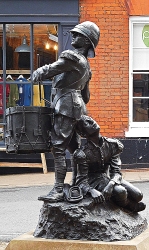
Just outside the eastern end of the Shire Hall, we found a sculpture depicting two young soldiers. One is standing, beating a drum, and the other is sitting on the floor looking upward, a discarded bugle at his feet. A plaque next to the sculpture reads as follows:

“’Drums to the Fore and Aft’. Gifted to the Town by the Duchess of Albermarle following her husband’s wishes in January 1980. Sculpted by Arnold, 8th Earl of Albermarle. Re-sited to this position in March 2018.”

When I saw this, I wondered about the aristocratic creator of this lifelike sculptor.

Arnold was Arnold Allan Cecil Keppel, 8th Earl of Albemarle (1858-1942), soldier, courtier, and Conservative politician (https://en.wikipedia.org/wiki/Arnold_Keppel,_8th_Earl_of_Albemarle). Educated at Eton College, he fought in the 2nd Anglo-Boer War (1899-1902) after having been an MP for Birkenhead between 1892 and 1894. On becoming the 8th Earl, he took his late father’s place in the House of Lords. His wife was born Lady Gertrude Lucia (1861-1943). As she died in 1943 and the town only received the sculpture in 1980, it seems to have taken a long time for her late husband’s wishes to be fulfilled. At least that is what I thought until I looked into the story behind this work of art.

As for the sculpture in Woodbridge, Wikipedia includes the following about Arnold Keppel’s relationship with it:

“He is credited with sculpting the statue of the two drummer boys from Rudyard Kipling’s story ‘The Drums of the Fore and Aft’ that now stands in Woodbridge, Suffolk.”

The Recording Archive for Public Sculpture in Norfolk & Suffolk, a database of sculptural works within the two counties, has the following information about the sculpture (http://racns.co.uk/sculptures.asp?action=getsurvey&id=373):

“8th Earl of Albemarle Sculptor(s). Private commission by 8th Earl of Albemarle. 1901, the cast may be later since the foundry only adopted the name A.B.Burton in 1902, after the death of the other partner, A.J. Hollinshead.”

An illustration in the Archive’s website shows a plaque, which I did not see. This provides the information that the sculpture was given to the town in January 1980 in memory of Walter Keppel, the 9th Earl of Albermarle (1882-1979). Another photograph shows that the sculpture is signed “Albermarle 01”. ‘Albermarle’ was Walter’s father, and ‘01’ refers to 1901. Having learned all of this, I now realise that the sentence I read on the plaque, “Gifted to the Town by the Duchess of Albermarle following her husband’s wishes in January 1980.”, refers not to the 8th Earl’s widow, but to the widow of his son, Walter.

The sculpture is well executed, showing that its maker was a competent artist. A search of the Internet revealed that in addition to the sculpture in Woodbridge, he also drew portraits (e.g. https://auctions.roseberys.co.uk/m/lot-details/index/catalog/299/lot/116339?uact=5&aid=299&lid=116340&current_page=0). Otherwise, I can find hardly anything else about his artistic output. That said, if the sculpture in Woodbridge is the only example of his modelling, it is something that the late 8th Earl must been pleased with.

A country church with a thatched roof

SNAPE MALTINGS ON Suffolk’s River Alde is a famous venue for music (mainly) and the other arts. It is the home of the Aldeburgh Festival, started in 1948 by the composer Benjamin Britten (1913-1976) and his partner, the singer Peter Pears (1910-1986). We have yet to attend a concert there, but we have eaten a fine lunch in its beautifully designed River View eatery. From the Maltings, you can enjoy views across the water meadows and if you look carefully enough, you can spot the tower of the Church of St Botolph in the tiny village of Iken across the river.

St Botolph, who died in about 680, is believed to have brought Christianity to Iken in about 654. He is the patron saint of boundaries, and, because of this, also of trade and travel. The present church dedicated to him is curious because its nave has a thatched roof. It was preceded by a minster built by Botolph but destroyed by the Danes in the 9th century. In 870, a Saxon timber church was constructed. This has also gone. It was replaced by a stone edifice, the beginning of what we can see today.

The Norman flint-rubble nave of the current church was built between about 1070 and 1110. The western tower, also with flint and other masonry was constructed soon after Robert Geldeny and William Baldwyn bequeathed money for its construction in 1450 and 1456 respectively. During the Reformation in the 16th century, various changes were made to the church’s interior to conform with the restrained liturgical requirements of the Reformed Church. This would have included whitewashing over colourful frescoes and destruction of stained glass and other decorative features.  By the 19th century, the church was becoming somewhat dilapidated. Between 1850 and 1860, restoration works were undertaken. A new chancel was constructed in the style of the early 14th century on the foundations of the original mediaeval chancel. It was designed by John Whichcord (1790-1860) of Maidstone in Kent.

In 1942, during WW2, the whole of the population of Iken was evacuated so that the area could be used for battle training. The church was also closed. It reopened in 1947 after the villagers returned to Iken. During the 1950s, they did much work to improve the condition of their church. In 1968, sparks from timber being burnt nearby set fire to the thatched roof of the church. The nave was badly damaged, but the chancel survived. Today, visitors to the church would not be able to imagine that it had suffered such a conflagration, so well has it been repaired.

Inside the church, several things attracted my attention. The most fascinating is the Saxon cross shaft in the northwest corner of the nave. Covered with bas-relief Celtic-style carvings this 4 ½ foot fragment of a stone cross (possibly, originally 9 feet in length) was created either in the 9th or 10th century. Near to this, there is a lovely octagonal stone font, which is 15th century. It is covered with superb carvings, some of which depict the emblems of the four Evangelists. These are separated from each other by angels. The wooden altar reredos, a panel behind the altar, was carved by Harry Brown of Ipswich and dedicated in 1959. It bears a bas-relief of The Last Supper, which Mr Brown based on the famous painting of that occasion by Leonardo da Vinci. I have mentioned a few of the items within the church that I found interesting but there is plenty more to see, all listed in an informative booklet on sale in the church.

From the boundary of the graveyard surrounding this lovely church, you can catch glimpses of the River Alde, which flows nearby. Visitors to Snape Maltings should spare some time to visit the church at Iken. It is so nearby yet feels so far away.

Harnessing the tide to grind grain

GRAIN CAN BE GROUND between two parallel circular stones, one of which was rotating. The grain was fed between the stones which broke it up to form flour. The rotation was usually powered by harnessing either the energy of wind (as in windmills) or of flowing water (as in watermills).

Many watermills are powered by water flowing in streams or rivers. At Woodbridge in Suffolk, a different system is employed. At high tide, the sea water enters a pond next to the water mill via a channel fitted with a one-way valve that allows water to enter the pond but not to leave it. The water that has accumulated in the pond can be released from it by a valve that allows the water to escape via a mill wheel fitted with paddles, rather like the paddle wheels on old-fashioned paddle steamers. The water flowing out of the pond causes the wheel to rotate. This rotation is transmitted to the grain grinding stones via a series of cogwheels. The mill at Woodbridge is an example of what is known as a ‘tide mill’.

There has been a mill on the site of the Woodbridge tide mill since the 12th century. There was some kind of tide mill on the spot since at least 1340. The present tide mill buildings have been standing since at least the beginning of the 19th century. It might well be the mill that was rebuilt in the 17th century.

Today, the tide mill is open to the public. It is still in working condition and used to produce flour. Visitors, including us, are shown the mill in action, subject to there being sufficient water stored in the pond. We were fortunate to see this remarkable piece of engineering in action.

Jacob’s cross in Lavenham

HAD IT NOT BEEN FILLED WITH parked cars, Market Square in Lavenham (Suffolk in East Anglia) would probably be recognisable to those who lived in the town several hundred years ago. The square is surrounded by old buildings, many of which are half-timbered. The most impressive of these is the Guildhall that was built in 1529. This large building attests the former wealth of the town, when it was an important centre of the wool trade in East Anglia. In its heyday, cloth from Lavenham was sent all over Britain and exported to Holland and Spain via the port of Ipswich. During the reign of Henry VIII (1509-1547), Lavenham was the fourteenth richest town in England.

Lavenham boasts a 16th century market cross. Market crosses were erected to indicate that an area had been designated as being a market square by a bishop, or a baron, or the monarch. Lavenham’s market cross is made of stone. A three stepped pyramid supports a slender column surmounted by a stone sphere. A metal plate informs the visitor that:

“The market cross was erected in 1501in accordance with the will of William Jacob”.

So, who was William Jacob?

Jacob was one of Lavenham’s wealthy clothiers, involved in the wool textile trade. Despite his surname, it was highly unlikely that he was Jewish because most Jews had been expelled from England in the 13th century (and it was not until the mid-17th century that Jewish people began returning).  According to text on the website deverehouse.co.uk:

“William Jacob was the tenth wealthiest clothier and businessman in England, making an annual profit of 67 marks and with a gross turnover of 223 whole cloths (a gross turnover of £12m in today’s money, around 400 marks).  On his death he paid for the erection of the market cross that is still there 520 years later.  He did not branch into “straites” or “narrow cloths” and within 25 years of his death the cheaper narrow cloth was dominating the market and Jacob’s family were seeking other work.”

In his will, dated 1500, he wrote:

“I will have a cross made of my perpetual cost that shall be set upon the market hill in the village of Lavenham.”

The cross that was erected in Lavenham in 1501 was a copy of the market cross already present in the city of Cambridge. The Cambridge market cross has long-since disappeared. The stepped base is all that remains of the cross paid for by Jacob’s estate. The slender shaft that now stands on it was put up in 1725. It is interesting to note that far away in Florence (Italy) Michelangelo was beginning work on his famous statue of David in 1501. That sculpture was completed in 1504. Although many visitors come to Lavenham, many more visit Florence.

Suffolk was the most important clothmaking county in 15th/16th century England. William Jacob was one of the county’s 100 clothiers in business between 1480 and 1500. Other counties had far fewer members of this trade. Although William Jacob was the tenth most wealthy, the wealthiest was Thomas Spring III (c1474-1523) of Lavenham. By 1500, Suffolk was the most industrialised and urbanised county in Britain, but by 1700, the county had become a rural backwater. Suffolk and much of the rest of East Anglia might be regarded as a bit of a backwater nowadays, but it is a largely picturesque one with wonderful landscapes and a great architectural legacy due to its past prosperity during the golden age of the wool trade.