IN 1604 THE COURT of the KIng’s Bench made a judgement in the case of Peter Semayne v Richard Gresham. It was a trial during which Peter Semayne was suing his tenant Richard Gresham for an outstanding debt. The Court found against Semayne on several counts, one of which was: “It is not a felony for a man to defend his house to the death.” In 1605, the lawyer and politician Edward Coke (1552-1634) summarised the case in the fifth volume of his “Reports”. Amongst his conclusions about this case, he wrote:
“… the house of every one is to him as his castle and fortress, as well for his defence against injury and violence, as for his repose …”
And by the eighteenth century, the words “An Englishman’s home is his castle” had come to encapsulate what had been decided in law during the trial mentioned above.
Visitors to the British seaside cannot miss seeing rows of single storey beach huts close to the beach. Holidaymakers and local inhabitants hire or purchase these tiny huts to store their deckchairs; bathing equipment; simple cooking equipment; and other items to make spending a day at the beach enjoyable. Each hut is its owner’s or tenant’s small dwelling by the beach. However, as we learned during a visit to Minnis Bay in Kent, nobody can spend the night in a beach hut. They have to be vacated and locked up at the end of the day. Seeing people using these small structures, I felt that they regarded their huts as extensions of their homes, but unlike their actual dwellings, these temporary homes cannot be regarded as their castles.
IT WAS UNUSUAL for my parents to take us on holidays at the seaside during my childhood. Mostly we went to cities, such as Bruges, Florence, and Delft, where there were plenty of artistic treasures to be viewed. Yet, one year when I was less than 10 years old, we spent a holiday at a hotel in a small place, Maidencombe, which is a few miles east of Torquay in Devon. All I can recall of this trip was staying in a country house hotel that had a beautiful flower-filled garden.
Yesterday (4 June 2025), my wife and I stopped at Maidencombe. I could not recognise anything, and I believe that the hotel where we stayed over 60 years ago has disappeared.
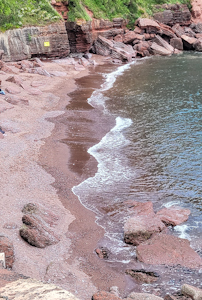
We followed signs to the Café Rio, which is reached down a winding staircase that clings to the slopes of a hillside overlooking a secluded cove surrounded by striated red rocks. The hillside is covered with luxuriant vegetation. The café is on a terrace above a small beach, where intrepid swimmers were enjoying the sea. We ate a light lunch on this terrace, and enjoyed the view.
I am pleased we visited Maidencombe but I can not stop wondering why my parents chose to go there instead of one of our usual culturally rich destinations. What or who influenced them to select Maidencombe? I will most probably never know.
THE VICTORIAN AUTHOR Charles Dickens (1812-1870) visited Broadstairs, a seaside town in east Kent frequently. During a recent visit to the town in August 2024, we saw three buildings which are associated with the famous author.
The Royal Albion Hotel hosted Dickens several times. Nearby, there is what is now the Dickens House Museum. This was the home of Miss Mary Pearson Strong, who was the inspiration for Betsey Trotwood in “David Copperfield”.
On a hill overlooking both the popular Viking Bay Beach and other parts of Broadstairs, there is a large building with castellations. This was built in 1801 as Fort Howe. It was, and still is, a private residence. It was here (and at the Albion Hotel) that Dickens used to write while staying in Broadstairs. The author leased the house from the 1840s until 1852. Some people claim that the house was the inspiration of the title of Dickens’ novel “Bleak House”, but this is by no means certain.
At thus point, I must admit that I have not read any Dickens apart from highly abridged versions of “A Christmas Carol” and “Oliver Twist”. Having now visited Broadstairs, I feel there is a good chance that I might tackle a full novel, maybe “Bleak House” or “David Copperfield”. Which would you recommend?
IN OCTOBER 2022, we visited the Isle of Wight and went around Osborne House, which Queen Victoria and her consort Prince Albert had constructed as a holiday home near the seaside on the north coast of the island. A largely unattractive Victorian pile, its saving grace is the Durbar Hall, which is a near perfect example of the Indo-Saracenic style of architecture that can be found in many places in India. Recently (in February 2023), we visited another royal summer palace located close to the sea. It is the Vijaya Vilas Palace close to Mandvi in the former Kingdom of Kutch, now a part of the Indian State of Gujarat.
The Vijaya Vilas was completed in 1927. It was built by Kutch’s ruler Maharao Kengarji III as a summer resort for his son and heir, the Yuvraj Shri Jayarajii.
Architecturally, it resembles older Rajput palaces, and is a fine example of the Indo-Saracenic style. It and its various oriental decorative and structural features were made by craftsmen from Bengal, Jaipur and other places in Rajasthan, Saurashtra, and Kutch. The predominant material used is sandstone , of which there is no shortage in Kutch. It seems that the palace suffered little damage during the 2001 earthquake, which badly affected the Maharao’s palaces in nearby Bhuj (the capital of Kutch).
Inside the palace there are rooms with furniture that would not look out of place in many English stately homes. There are many framed photographs of the royal family, their guests, and the many wild animals that were shot. One of these was a leopard that was shot by someone inside the palace. One of the window panes has a bullet hole that is said to have been made by the bullet that killed the creature. There are also photographs that record the many times that scenes in Bollywood movies were shot in the Palace.
One photograph shows the US General Dwight Eisenhower seated in a jeep. This picture was taken in Europe during WW2. I have yet to discover what, if any, connection existed between Eisenhower and the royal family of Kutch.
Visitors can visit the rooms on the ground floor, and can ascend to the roof from which there are superb views of the sea and the flat countryside around the palace. The first floor, which is private, is the residence of members of the former royal family.
Although not as old as it looks, Vijaya Vilas, is a superb example of the kind of palace typical of those older ones that can be seen in Rajasthan. To my taste, Vijaya Vilas is a much more lovely and harmonious edifice than Victoria and Albert’s seaside home on the Isle of Wight.
BEFORE REACHING MADEIRA, many people insisted that we should visit Reid’s Hotel in Funchal and to take afternoon tea there.
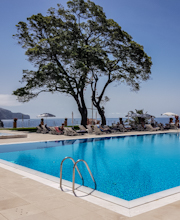
Pool at Reid’s Hotel in Madeira
Located in the western part of Funchal, Reid’s was founded by William Reid, a Scotsman
who arrived in Madeira in 1836. The hotel was his idea but he died before it was
completed (in 1891). The massive seafront establishment was designed by George Somers
Clarke and John Thomas Micklethwaite. It is not great architecture.
Since its opening, the hotel has hosted many famous guests including
Winston Churchill, Albert Schweitzer, George
Bernard Shaw, and Rainer Maria Rilke. Apart from its celebrated guests, the establishment
is famed for its afternoon teas. We decided against partaking of this treat because
it contains far too many sugary confections. We had morning coffee and a pot of
tea by the swimming pools on a terrace overlooking the ocean. By Funchal standards,
it was costly (10 euros) but not outrageously so.
Undoubtedly, Reid’s is luxurious with good service. Its position
overlooking a rocky cove is superb even though it is located in a part of Funchal,
which resembles unexciting slightly upmarket seaside resorts on Italy’s Adriatic
coast. However, the well-appointed hotel seemed somewhat sterile. If sun and sea
is your top priority, then Reid’s is the place to go if you can afford it. However,
it lacks the charm of other places in Funchal.
Well, we did visit Reid’s as people had suggested before we left London but I must say that it is not my ‘cup of tea’.
GENESIS CHAPTER 28 describes a dream experienced by the biblical Jacob. In it, he dreamt that there was a ladder set on the earth that reached up to heaven. In his dream, he watched angels of God ascending and descending what is now called ‘Jacob’s Ladder’.
The small town of Sidmouth on the coast of Devon has its own Jacob’s Ladder. Unlike the one seen in the dream, it neither reaches heaven nor is it being used by angels. Often rebuilt, Sidmouth’s Jacob’s Ladder is made of wood and consists of three flights of stairs which connect Connaught Gardens with the magnificent stretch of sandy beach (at the western end of Sidmouth). This lovely, gently curving strand, known as Jacob’s Ladder Beach, is flanked by red stone cliffs and is about a mile in length. The views from the top of the Ladder and the café in the Connaught Gardens are spectacularly beautiful.
The Ladder was first constructed in 1853 on the instruction of Mr Lousada of nearby Peak House. It was rebuilt in the late 19th century, and then again following WW2. The Connaught Gardens on the clifftop overlooking the beach were first laid out in 1934 by the Gardens Department of Dartington Hall Ltd.
It is unusual features such as Sidmouth’s Jacob Ladder that give many British seaside towns great character and individuality, and makes them fun to visit.
MOST OF SOUTHEND in Essex was built after the Victorian era. The town on the estuary of the River Thames was and still is the nearest seaside resort to London. According to “Encyclopaedia Britannica”, Southend:
“…became fashionable as a seaside resort when visited by Princess Charlotte of Wales in 1801 and by her mother, Princess Caroline (wife of George IV), in 1803.”
Originally, Prittlewell, once a village north of Southend but now one of its suburbs, was the only settlement in the area now occupied by the modern town of Southend. South east of it on the coast was a tiny village called Leigh, which is now the much larger Leigh-on-Sea. The resort now known as Southend-on-Sea was developed at the end of the 18th century in Prittlewell’s southern district of South End. Today, more than seven miles of buildings extend from Leigh-on-Sea through Southend to Shoeburyness.
The High Street, part of a road heading south from Prittlewell, runs from near Southend Victoria Station towards the sea, ending at the edge of a steep slope that falls to the seashore below. Various roads and a lift can be used to descend this incline. At the top of the slope, the High Street meets the eastern end of Royal Terrace. At the corner where these two streets meet, stands the Royal Hotel. Next to the hotel and lining Royal terrace, numbers 1 to 15 were built in the 1790s at the same time as the hotel. These were backed by the Royal Mews, a road still in existence. These constructions were part of a then new phase of development of the town, which was known as ‘New Town’.
The hotel, a fine Georgian edifice, opened with a grand ball in 1793. Princess Caroline House that adjoins the hotel. number 1 the High Street, is a listed building, which looks as if it is contemporary with the hotel. The gardens on the slope in front of the hotel and the Terrace are known as The Shrubbery and were originally for the exclusive use of residents in the Terrace, but now they are open to the public. According to www.southend.gov.uk/historic-southend/history-southend/2:
“The Terrace was named “Royal” following visits by Princess Caroline, wife of the Prince Regent, in 1803 and for a short time attracted fashionable society. But difficult access from London by road and river discouraged further development until the construction of the railway in 1856. Royal Terrace is the only surviving Georgian terrace in Southend.”
Just east of the High Street and dominating the shoreline is the massive Park Inn Palace hotel, formerly the The Metropole. Built in 1901, this hotel that looks like an oversized liner had 200 rooms, a billiard room, and a splendid ballroom. During WW1, it was temporarily used as a Royal Naval Hospital. An online article (http://beyondthepoint.co.uk/first-world-war-southend-the-palace-hotel/) related:
“The Palace Hotel was built in 1901 and served great use in the war effort. Messrs Tolhurst; the owners of the hotel, were generous enough to offer the building up for free as a naval hospital for the rest of the war. Its glorious five star interior would’ve been quite bizarre with hospital beds placed amongst its lounges and ballrooms. It held possibly the world’s first purpose-made x-ray department. It recently underwent refurbishment by Park Inn to bring it back to its former glory.”
Both hotels overlook both the sea and Southend Pier. The older, Royal Hotel, is less of a blot on the landscape than the Palace hotel.
MUCH OF FOLKESTONE, a seaside town in Kent, is perched on slopes leading down to cliffs overlooking the shoreline. The Leas, a wide promenade running along the top of the cliffs to the west of the centre of the town, affords fine views of the beaches and rocks far beneath it. Various staircases, a lift (out of action nowadays), and paths lead from The Leas down to the seashore and the park that runs alongside it. The most fascinating of these, The Zigzag Path, begins close to a cast-iron bandstand a few yards west of the statue of the scientist/physician William Harvey. I loved it so much that I walked down it three times in the three days we spent in Folkestone recently.
With five hairpin bends and a couple of short tunnels as well as blind ending caves, The Zigzag Path takes pedestrians down from the Leas at 150 feet above sea level to lower than 42 feet above the sea. The path is like a winding mountain road in miniature and provides endlessly changing views of the seashore and the trees and other vegetation growing near it. In more detail:
The steep path was built for Folkestone Corporation in the early 1920s. The first attempt was not brilliant. So, the Corporation employed Mr Pulham of the company of James Pulham & Son, who specialised in the construction of rock gardens, follies, and grottoes (https://en.wikipedia.org/wiki/James_Pulham_and_Son). The company’s founder, James Pulham (1820-1898) was the inventor of a manmade (anthropic) rock-like material known as Pulhamite. This composite material simulates the appearance of natural rock so successfully that sometimes geologists are fooled by it. Pulhamite is a mixture of sand, Portland cement, and clinker, which is sculpted over a core consisting of rubble and crushed bricks (https://en.wikipedia.org/wiki/Pulhamite). The Zigzag Path was built with Pulhamite. While walking down the path, I spotted several places where the surface of the Pulhamite had worn away leaving fragments of brick exposed. If I had not seen this, I would have found it difficult to believe that the path was not created using natural rock. Recently, interesting ironwork railings have been added to the side of path facing the sea. These incorporate metal features that resemble plant tendrils wrapping around a support.
The wonderful Zigzag Path is just one of many of the Pulham’s ornamental creations. A full listing can be found in “Rock Landscapes: The Pulham Legacy: The Pulham Legacy: Rock Gardens, Grottoes, Ferneries, Follies, Fountains and Garden Ornaments” by Claude Hitching and Jenny Lilly. A visit to Folkestone would not be complete without experiencing the beautiful and rather fantastic Zigzag Path, preferably by descending it. If you decide to ascend it, you will have done sufficient exercise not to need to visit the gym that day.






 yamey
yamey 