Threads and holes
Modernist art in full glory
A fine piece by Hepworth
YESTERDAY, 22nd February 2022, we saw an exhibition at the Pace Gallery in central London’s Hanover Square. The gallery stands facing a conventional sculptural depiction of William Pitt the Younger (1759-1806), created in bronze by Sir Francis Chantrey (1781-1841). I have been reading a great deal about Pitt in a wonderful, recently published biography of King George III by Andrew Roberts. What is being shown in the Pace gallery until the 12th of March 2022 is far from purely representational, as the exhibition’s title, “Creating Abstraction”, suggests.
The exhibition contains works by seven female artists: Carla Accardi (1924-2014), Leonor Antunes (b. 1972), Yto Barrada (b. 1971), Saloua Raouda Choucair (1916-2017), Kim Lim (1936-1997), Louise Nevelson (1899-1988), and Barbara Hepworth (1903-1975). Most of these names were new to me apart from Nevelson and Hepworth. The latter interests me greatly not only because one of her sculptures is near the gallery on the southeast corner of John Lewis’s Oxford Street department store, but also because for a while she lived and worked in an area that fascinates me: Hampstead.
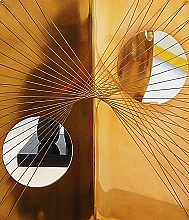
There are several of Hepworth’s works on display at Pace. One of them, “Two Forms”, was created in 1934. By then, she had been living and working in Hampstead for about seven years. For the first few years, she was living with her first husband, the sculptor John Skeaping, and then after 1931 with her second, the painter Ben Nicolson. In 1939, she left Hampstead.
Hepworth was not the only ‘modern artist’ living in Hampstead in the 1930s. I have described the active and highly productive artistic scene in the area in my new book “Beneath a Wide Sky: Hampstead and its Environs”. I have also explained why it was that artists like Hepworth, her contemporary Henry Moore, and many others were attracted to Hampstead between the two World Wars. Their reasons for congregating in the area differed somewhat from those of earlier artists, such as Constable and Romney, who were attracted to the place many years before. Read my book to discover why Hampstead easily rivalled Montmartre in Paris as a ‘mecca’ for artistic activity. The book is available as a paperback and a Kindle e-book from Amazon: https://www.amazon.co.uk/dp/B09R2WRK92
AT FIRST GLANCE, the lower floor exhibition space at the Barbican art gallery in London resembles the lighting department of a furniture store such as Habitat. It is full of lighting units with Japanese-style paper and bamboo shades. After a moment, you will notice that these lighting units are not run-of-the-mill illuminations; they are interestingly shaped works of art lit up from within. These lamps are part of an exhibition of the artistic creations of Isamu Noguchi (1904-1988). Born in Los Angeles, he was the son of a Japanese father and an Irish American mother. The first 13 years of his life were spent in Japan, where he began learning carpentry whilst helping his mother building their family house. From these early skills, it was not long before he embarked on what was to become a highly productive creative career, making works from a wide variety of materials from wood and stone to metals and plastics and … you name it.
Noguchi studied sculpture at the Leonardo da Vinci Art School in New York City. In 1927, he was given a grant to travel to Paris. It was there that he was apprenticed to the Romanian-born sculptor Constantin Brâncuși (1856-1957), who introduced him to abstraction. After learning much from the great sculptor in Paris, Noguchi abandoned pure abstraction and moved towards depicting the living world. However, his experiences working with Brâncuși influenced his artistic output for the rest of his life. After Paris, Noguchi travelled extensively, learning about techniques and philosophies, especially Chinese and Japanese. In 1929, he first met the architect and inventor Richard Buckminster Fuller (1895-1983), whose ideas about science and technology chimed with his. In the exhibition, there is a shiny chrome-plated bronze bust he made of Buckminster Fuller in 1929. There are also a couple of models he created in collaboration with Buckminster Fuller. Noguchi’s interest in science was not only expressed in sculptures but also in stage settings for ballet performances choreographed by Ruth Page and for performances by Martha Graham.
During WW2, although it was not required for him to enter one of the camps where the Americans ‘cooped up’ potential Japanese enemy aliens – Japanese who lived in the USA – Noguchi volunteered to be confined in a camp in Arizona. By doing so, his aim was to create an arts programme that would ease the lives of those confined in the camp. The barren landscape surrounding his camp proved to be yet another influence on his creative output.
Amongst the many exhibits in the Barbican’s show, there are, in addition to the lighting units, several pieces of furniture designed by Noguchi. One of these is a triangular plate glass tabletop supported by two interlocking timber supports. I have seen this elegant item for sale in upmarket furniture shops, but until I saw the exhibition, I had no idea it had been designed by Noguchi as long ago as 1944. It is still being made today. The wonderful variety of lighting sculptures, which at first reminded me of lampshades that were trendy in students’ rooms in the 1970s, are examples of ‘Akari’. Noguchi began creating them in the early 1950s, and despite their fragile nature, they are still in good condition now. One of the gallery invigilators told us that the translucent paper used to construct these lamps is made from mulberry tree bark. Known as ‘Washi’, this handmade paper can also be made from the bark of some other tree species.
As with other exhibitions at the Barbican gallery, the artworks are well-displayed and beautifully lit. If you go to this exhibition, you should not miss the video film in which Noguchi talks about his life and art very eloquently. And while you are watching it, you can sit on stools and a bench Noguchi designed. Prior to visiting this show, I had heard of Noguchi and seen a few of his works. The exhibition, which continues to the 23rd of January 2022, has truly opened my eyes to what a magnificent artist he was.
THE CORONET CINEMA in London’s Notting Hill Gate was renamed The Print Room a few years ago. Once a cinema, it is now a theatre. Like other theatres, it was closed for a long time during 2020 and early 2021 because of the covid19 lockdowns. During this prolonged period of closures, a statue was placed upon the dome that stands above the theatre’s main entrance. In my book “Walking West London” (freely available as a pdf file from https://adamyamey.co.uk/walking-west-london/), I wrote about the Coronet/Print Room as follows:
“… the former ‘Coronet Cinema’. This was designed as a theatre by WGR Sprague (1863-1933) who designed many of London’s theatres. It opened in 1908. By 1923, the Coronet had become a cinema, and remained so for many years. Apart from the screen, the fittings inside the auditorium were those of an unmodernised Edwardian theatre. Until smoking was banned in all public places, the Coronet was one of the last cinemas in London which permitted smoking (but only in the balcony seating). Between 2004 and 2014, the Coronet doubled up as both a branch of the Kensington Temple Church and, also, as a cinema. And, in 2015 the Coronet reverted to being used as a theatre, now called ‘The Print Room’. This sensitively restored theatre puts on interesting plays, which are well-produced. The bar, which is located beneath the stage in what was once the stalls area of the cinema, is worth visiting to see its ever changing, tastefully quirky décor. In 2020, the theatre was redecorated and a statue by the British sculptor Gavin Turk (born 1967) has been placed upon the dome above the building’s main entrance. The new artwork replaces one that was removed many decades ago.”
When I wrote this, the sculpture was enshrouded in a tarpaulin. Only recently, the covering has been removed and the sculpture can be seen in all its glory. The artwork depicts the artist Gavin Turk posing as the famous artist Sir Joshua Reynolds (1723-1792) just as he appears his sculptural in the Annenberg Courtyard of Burlington House in the grounds of the Royal Academy. When seen from the east, the new sculpture looks like a painter holding a palette and his brush. However, when seen from the west, the viewer might be led to believe that the statue is of a man holding a gun. I feel that the sculpture is a great addition to the landscape of Notting Hill Gate, but a bit too high above ground level to be able to see it easily with the unaided eye.
LONDON’S PARKS ARE filled with surprises of historical interest. The Terrace Gardens overlooking a bend in the River Thames at Richmond are no exception. A short path leads from a larger one to a cave in the side of a well vegetated slope. The entrance to the cave is topped with a semi-circular arch and its is closed by a locked iron gate. There is little to be seen inside the small cave. The pathway leading to the entrance is lined by barrel shaped concrete blocks
An informative plaque at the start of the path explains the history of this small, rather well-concealed cave, now known as Spring Well. From this we learn that the cave, formerly believed to have been an icehouse, was part of Richmond Wells. The latter were:
“…a place of entertainment from 1690 to 1750. In 1755, the buildings were demolished and replaced by Cardigan House as a residence for the sixth Earl of Cardigan.” (https://historicengland.org.uk/listing/the-list/list-entry/1001551).
The Wells were closed because local residents felt that they attracted rowdy and badly behaved visitors.
Cardigan House was purchased by John Willis (1820-1899) in the 19th century. Willis was the proprietor of a shipping company, John Willis & Sons of London, which owned several clippers. One of these boats, a tea clipper, can still be seen in its full glory downstream from Richmond at Greenwich: The Cutty Sark, visited by many tourists. The barrel shaped concrete blocks near the entrance to the cave are possibly, according to the information panel nearby, moulded from barrels carried by the Cutty Sark. I like the idea, but who knows whether this was really the case after such a long time.
Near to the now disused spring, another surprise awaits the visitor. It is a sculpture of a voluptuous naked woman seated on a dolphin. Carved in Portland stone in 1952 by Allan Howe, she depicts the goddess Aphrodite (‘Venus’ in Latin). From her seat on the dolphin, the goddess has a wonderful view of the Thames far below her. When she was unveiled, many locals regarded her as being in ‘bad taste’, but she has survived the test of time and is perfectly acceptable nowadays. A statue of Aphrodite might not be regarded as a great surprise in a park, but the local people’s name for here, ‘Bulbous Betty’, might be.
PARKWAY LEADS GENTLY uphill from Camden Town Underground station to a short road called Gloucester Gate, which leads to the Outer Circle that runs around Regents Park. Much of Gloucester Terrace runs along what looks like a bridge, which is lined on its north side by red-coloured, decorative stone parapet.
The bridge traverses a grassy dell that does not appear to contain any kind of watercourse. I wondered why such an elaborate bridge had been built to traverse what appears to be merely a grassy hollow. Well, when it was built, it did cross a waterway, the Cumberland Market Branch of the Regent’s Canal known as ‘The Cumberland Arm’ (www.londonslostrivers.com/cumberland-arm.html). This waterway, built in 1816, ran for about half a mile from the Regents Canal to a basin near Euston Station, running for most of its length parallel to Albany Street. During WW2, the Cumberland Arm, which had up until then been used to transport freight, was used to supply water to firefighting appliances. By the end of the war, the canal had been filled with rubble from buildings destroyed by bombing and then covered with topsoil. All that remains of the Cumberland Arm is a short blind-ending stretch of water near Regents Park Road, on which there is a large floating Chinese restaurant and a few moorings for narrow boats.
The Gloucester Gate bridge with its decorative parapet and elaborate cast-iron lampstands also includes two interesting memorials. One of these relates to the fact that the bridge was constructed by the St Pancras Vestry, the then local authority governing the area (www.andrewwhitehead.net/blog/the-most-pointless-bridge-in-london). There is a bronze bas-relief depicting the martyrdom of St Pancras. It was a gift of William Thornton and sculpted by the Italian Ceccardo Egidio Fucigna (c1836-1884), who died in London. St Pancras (c289-303/4) was born a Roman citizen. He converted to Christianity and was beheaded for his beliefs when he was 14 years old (https://en.wikipedia.org/wiki/Pancras_of_Rome). The bronze relief on Gloucester Gate bridge shows a young man being mauled by an animal, possibly a lion. Why this motif was chosen when the saint was beheaded puzzles me.
Near the St Pancras panel, also on the bridge, there is an old but elaborate drinking fountain. A metal plate attached to it has faded letters that read:
“Saint Pancras Middlesex.
This fountain and works connected therewith were presented to the Metropolitan Drinking Fountain Association on the (?) day of August 1878 by
Matilda
Richard Kent esq. Junior Churchwarden 1878.
The figure … cast in bronze was designed by Joseph Durham ARA.” (https://victorianweb.org/sculpture/durham/1c.html)
The fountain, known as ‘The Matilda Fountain’, is part of a miniature cave made with granite boulders. A sculpture of a milkmaid stands above the cave. At her feet, there is a wooden pail with two handles. The girl with a rich crop of hair on her head is depicted shielding her eyes from the sun with her right hand as she stares into the distance. Cast in bronze, the female figure and the pail were sculpted by Joseph Durham (1814-1877). Matilda might possibly have been Richard Kent’s wife, but the plaque does not specify this. The sculpture is not unique; several other copies of it, all by Durham, exist. One of these, dated 1867 and called “At the Spring/Early Morn”, can be seen in Blackburn’s Town Hall (https://victorianweb.org/sculpture/durham/1d.html).
Today, the bridge is redundant since the canal was filled-in long ago. However, it is used by many people walking to and from Regents Park and its zoo and a steady stream of vehicular traffic crosses it. Although it has outlived its original purpose, the bridge serves as a reminder of a once important element of London’s continuously evolving transportation system.
THERE IS A SUPERB Vietnamese eatery on London’s Bermondsey Street, called Caphe House. After eating a tasty banh mi, a baguette filled with meat and fresh vegetable, a dish no doubt inspired by the French occupation of Vietnam, and a pho, a clear broth with meat, vegetables, and noodles, we crossed the road to examine a sculpture. This eye-catching artwork had not been present when last visited Caphe House, sometime before the pandemic and well before October 2019. It consists of a row of seven piles of stone carvings of differing heights, resembling short totem poles. Made of Portland stone, Bath stone, marble and other materials found in the River Thames, this was created in 2020 by Austin Emery and members of the local community. Over 100 members of the community made carvings in a workshop, and these have been assembled by Emery to create what we saw, an artwork named “Cornerstone”. Cornerstone also incorporates fragments from Southwark Cathedral, Westminster Abbey, London Bridge Station, and bones from the Thames.
After admiring this unusual and intriguing sculpture, I spotted a notice nearby. It relates to the history of Tanner Park, where the sculpture stands, and includes the following:
“… Originally part of the grounds of Bermondsey Abbey the site of the Park was later in use as a Tannery …”
Reading this notice, I realised that this was the first time I had seen mention of an abbey at Bermondsey.
There had been an abbey in Bermondsey since the early 9th century (https://en.wikipedia.org/wiki/Bermondsey_Abbey). This was centred on the site of the present-day Bermondsey Square, about 390 yards south of the Cornerstone sculpture. The abbey to which the notice at Tanner Park refers was a Benedictine abbey, which was dedicated to St Saviour and was founded in the early 11th century. A wealthy religious establishment, it was, like so many other similar institutions, dissolved by King Henry VIII in the 16th century, in 1537. But where was it?
By 1822, only tiny fragments of the abbey were still standing. Today, nothing remains, although occasional archaeological digs have exposed parts of it, albeit temporarily. Fathome’s map of Southwark compiled in 1643-48 shows that then the abbey was still standing intact in its grounds (https://www.british-history.ac.uk/old-new-london/vol6/pp117-133). According to one writer (https://knowyourlondon.wordpress.com/2018/07/06/bermondsey-abbey/), who does not give the source(s) of his information, the site of the abbey was:
“The abbey lands extended from the present church of St Mary Magdalene, across today’s Tower Bridge Road.”
A map included by this writer marks the abbey church as lying along Abbey Street with the nave to the west of Tower Bridge Road and the chancel east of it. A wall plaque (www.londonremembers.com/memorials/bermondsey-abbey) which I have not yet seen informs that the abbey:
“… occupied ground between Bermondsey Street, Abbey Street, and Grange Walk…”
The church of St Mary Magdalen stands on Bermondsey Street just before its crossing with Abbey Street. This stands on the site of a church that existed in 1290 and which served lay workers of the abbey. This was demolished in 1680, but the late mediaeval tower was kept. It was rebuilt ten years later. During the 19th century, the exterior was covered with rendering and various other architectural modifications were made both internally and externally (https://en.wikipedia.org/wiki/St_Mary_Magdalen_Bermondsey). Apparently, the church’s mediaeval arches are visible inside the tower behind the organ and the church also contains some mediaeval stone capitals that might well have been parts of Bermondsey Abbey. St Mary Magdalen is the oldest surviving building in the area. It is open occasionally. I have entered it once, but that was long before I knew about the mediaeval remnants it contains.
Despite the fact that Bermondsey Abbey is now merely a historical memory, Bermondsey Street is an interesting place to visit. Amongst its attractions are Peter Layton’s glass studio, where you can watch glassblowers creating fantastic artworks in glass; Rachel Eames Gallery, which often has good exhibitions of contemporary artists’ works; The Fashion and Textile Museum; The White Cube (Bermondsey), which hosts spectacular shows of contemporary art; and the Cornerstone sculpture, described already. I suggest starting your visit with an early lunch at Caphe House, rounding it off with Vietnamese filter coffee, and ending it with another good coffee at the cheekily named, quirkily decorated Fuckoffee café.
ACCIDENTALLY, WE BOARDED a bus, which we believed would take us to Gunnersbury station in west London, but instead it took us to the edge of Chiswick Business Park furthest away from the station. This meant that we had to walk through the business park, and this was no bad thing.
The business park has been built on land that used to be owned by the Rothschild family, who owned nearby Gunnersbury Park for much of the 19th century and the early part of the 20th. In 1921, a bus company built a 33-acre bus maintenance establishment on the site where the Rothschild’s used to have orchards and where today the business park stands. This was closed in 1990, and various architects, including Norman Foster, drew up plans to develop the site with buildings around a central ‘piazza’.
Eventually, after gaining planning permission, the first building was completed at the end of 2000. Gradually, the rest of the buildings were constructed. The site was completed in 2015. The result is spectacular. The buildings are uncompromisingly modern, almost sculptural, and, most importantly, pleasing to the eye. They are arranged around an attractive lake or pond, complete with waterfalls, a bridge, and some metal sculptures. A number of small spherical glass and metal ‘meeting pods’ have been placed close to the water feature and there are several refreshment kiosks dotted around the place.
In 2019, a long footbridge, suspended from a series of giant oxidised steel hoops was constructed between the place where our bus (route 70) terminated within the business park and Chiswick Park Underground station. It is an elegant piece of engineering.
We have often passed the Chiswick Business Park whilst travelling by car or bus along Chiswick High Road that forms its southern border, but never bothered to walk in it. Today, we did, and it was a pleasant new experience.
CLOSE TO SELFRIDGES, there is a less well-known attraction for Londoners and visitors to London. We visited it today, the 7th of October 2021, for the first time since we last went there in March 2017. Back then, I wrote about the place and posted my piece, reproduced below, on a travel website. When we went there today, we found an attractive temporary art installation, “Sonic Bloom” by the artist Yuri Suzuki (born 1980). This colourful and imaginative artwork is supposed to emit sounds, but when we visited it was silent. The café that we saw when we went to the place, Brown Hart Gardens, has been replaced by a new one run by a Sicilian. Far from offering the usual café fare, this decorative, stylish eatery serves pizzas, lasagnes, burratas, caviar, champagne, as well as coffee.
NOW HERE IS WHAT I WROTE BACK IN 2017:
“I have often walked south from Oxford Street along Duke Street, and always noticed the raised pavilion with a dome on the right. It stands in what appears to have once been a square. The dome surmounts four neoclassical porticos each supported by a pair of columns with florid capitals. I have always wondered about it, but until recently did nothing about researching it. It was only lately that I explored it and its companion on Balderton Street, which runs parallel to Duke Street.
We had arrived early in Balderton Street, where we were meeting foreign guests at their hotel, The Beaumont. With time to spare, we took a closer look at these pavilions. Staircases on either side of both pavilions lead from street level to a raised or elevated roof garden, which is about twelve to fifteen feet above street level. There is also a lift. The garden looked recently designed, and at the Balderton Street end there is a modern café that looks like an elegant glass shoe box.
The raised structure with its roof garden, café, and pavilions occupies the centre of a rectangular ‘square’ surrounded by mostly residential blocks on three sides and the aforementioned hotel on its fourth. It occupies the space that would usually contain a garden in London squares.
The garden and the building upon which it stands form the centrepiece of Brown Hart Gardens.
Duke Street, which runs along the eastern edge of Brown Hart Gardens was laid out on the Grosvenor Estate in the early 18th century. It was extensively re-developed in the 1870s. The Duke Street Gardens, as Brown Hart Gardens was originally named, were laid out in in the 1880s. The blocks of flats built around the gardens date from this period.
From “Survey of London: Volume 40, the Grosvenor Estate in Mayfair, Part 2 (The Buildings)”, we learn that:
“…plans were in preparation for the complete rebuilding of Duke Street and for the blocks of industrial dwellings that were to be built around Brown Hart Gardens in 1886–8. The new Duke Street appears to have been conceived as a street of shops with somewhat better-class flats over, acting as an intermediate zone between the blocks round Brown Hart Gardens to the west…”
When the gardens and its surrounding buildings were being planned, The Duke of Grosvenor, the landlord of the Grosvenor Estate, wanted (according to the Survey, quoted above):
“… to have a ‘cocoa house’ or coffee tavern and a public garden. The coffee tavern was dropped for want of an applicant, but the I.I.D.C.’s contract included an undertaking to clear a space and provide a communal garden on the site between Brown Street and Hart Street. The duke soon took over the garden scheme except for the surrounding railings, and in 1889 it was constructed to the layout of Joseph Meston …”
The same source adds:
“…The simple garden included a small drinking fountain at the east end, a urinal at the west end and a shelter in the centre; trees were also planted. None of these features was to survive long…”
These features disappeared as did the garden itself. For, in 1902 the street level gardens were cleared away to make way for the construction of the Duke Street Electricity Substation. Partly above ground and partly below, this electrical facility was completed in 1906. It was built for the Westminster Electric Supply Corporation to the designs of C. Stanley Peach (a leading architect of electrical installations), with C. H. Reilly as assistant. The domed pavilions at either end of it were part of the original design. The Survey describes the building well:
“As built, the sub-station rose to a greater height than had been contemplated but retained Peach’s original layout, with a tall ‘kiosk’ or pavilion and steps at either end, a balustrade all round, and Diocletian windows along the sides to light the galleries of the engine rooms, which occupied deep basements.”
The company had managed to persuade the Grosvenor Estate to demolish the gardens because they said that they were being used by disreputable types. Of course, the presence of the new electricity building deprived the residents of the square of their garden. The residents protested. The electricity company laid out a garden on the roof of the substation, using trees planted in tubs. According to the Survey (quoted above):
“…the ‘garden’ is perhaps the only place in London where quarrelling is specifically forbidden by law.”
The garden survived until the early 1980s, when the then lessees of the plot, the London Electricity Board, closed it to the public.
In late 2007, the City of Westminster decided to spend money on improving public spaces. On the 7th of December 2007, its Press Department issued a release that included the following:
“Brown Hart Gardens, which has a closed off elevated 10,000 sq foot stone deck with two listed early 20th century domed features – is one of three schemes set to benefit from a proposed multi-million renewal of the open spaces and streets surrounding three of Grosvenor’s sites across Westminster… The proposals could see Brown Hart Gardens become a distinctive destination, opening up the square for the first time in two decades and possibly adding some much-needed greenery to the area.”
The gardens were re-opened to the public after more than twenty years.
In 2012, the gardens were closed once again, but this time for a short period. They opened again in 2013, having been fully and beautifully refurbished by the Grosvenor Estate.
The restored roof garden contains a café, currently managed by the Benugo chain. This contemporarily designed café is almost entirely surrounded by huge glass windows, making the place feel light and airy. Situated at one end of the Brown Hart Gardens roof garden, this place offers a lovely view of this horticultural oasis. So, finally, the former Duke of Grosvenor’s desire to have a café in his square has been realised.”
SO, THAT is what I wrote in 2017.
As mentioned at the beginning, Brown Hart Gardens has changed a little bit (for the better) since we visited in early 2017. So close to busy, brash Oxford Street, this lovely area provides a peaceful oasis for the weary shopper. It is so near the commercial hubbub yet feels so remote.
I VISITED BARCELONA in the late 1960s. One of the sights I saw was a museum dedicated to Pablo Picasso. Before entering that place, the artist’s works somewhat puzzled me. In the museum, there were some of Picasso’s earliest paintings. They were straightforward rather than abstract, and extremely well executed. The artist’s talents were immediately obvious. As I moved from room to room, the works on display became increasingly abstract. By seeing his progression from figurative to abstract, I began to appreciate his greatness as an artist, and I began to understand why he is regarded as a brilliant creator by many people. By the time I had finished looking around the museum, I had been converted from being sceptical about Picasso to becoming yet one more of his fans. More recently, I saw an exhibition showing the artistic development of Roy Lichtenstein from his earliest to his latest creations. No longer was he just a creator of entertaining pictures based on American comic strips, but I could see that he was an artist of great competence. Like the foregoing examples, a visit to the Cartwright Hall Museum in Bradford and seeing some of David Hockney’s earliest works also enhanced my appreciation of this highly prolific visual artist.
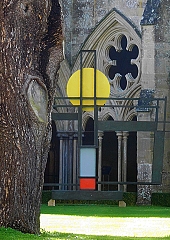
Bradford in Yorkshire is not far from the city of Wakefield, where Barbara Hepworth (1903-1975) was born. She was baptised in the city’s fine cathedral. Until today, I had mixed feelings about Hepworth’s works. There are some that I like very much, including a Mondrian-like crucifix at Salisbury Cathedral and a Naum Gabo inspired work attached to the eastern side of the John Lewis shop on London’s Oxford Street. Also, I have enjoyed visits to Hepworth’s studio and garden in Cornwall’s St Ives. However, as beautifully executed as her works are, I did not become terribly keen on her artistic output until today, the 18th of September 2021.
What converted me and increased my appreciation of Hepworth as an artist was today’s visit to the Hepworth Wakefield Museum. We arrived to discover that for the time being the whole museum is filled with works by Hepworth, beginning with her earliest and ending with her latest. The temporary exhibition, “Barbara Hepworth: Art & Life”, continues until the 27th of February 2022, and should not be missed.
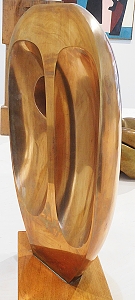
As with other abstract artists, such as Picasso, Hepworth began learning the basics of figurative representation. Her earliest carvings and drawings were created superbly competently but give no hint of which directions her creative output was soon to follow. Had she not developed any further, she would have been regarded as a skilled, if not too exciting, sculptor. However, Hepworth soon became involved artistically, and in one case maritally, with leading artists of the twentieth century. Contact with them and their ideas can be detected in some of the works she created as she moved from purely representational to highly abstract. It was particularly interesting to see a small carving with a hole in it, the first of her many works to have holes in them. The idea of the holes is to allow light to flow through her sculptures. It was not only other artists who inspired Hepworth’s creation but also the forces of nature, which unconsciously sculpt rocks, trees, and other natural features in the landscape.
It was interesting to see the life-size prototypes of some of Hepworth’s works I have admired in the past. It was wonderful, for example, to be able to get close to the full-size model sculpture which is now high up on the wall of John Lewis in Oxford Street.
Once again, seeing a collection of works illustrating the progression of an artist’s output from student days until the achievement of fame and beyond has helped me to increase my appreciation of an artist about whom I had some reservations. Today’s visit to the Hepworth Wakefield has moved Barbara Hepworth a long way up my ladder of great artists and removed any doubts I had about her works.
Finally, here is something that intrigues me. Hepworth, like Picasso and also my late mother, had what might be described as traditional basic artistic training, just like the European and western artists who created during the many centuries before the 20th, yet all three of them (and many others) moved from expressing themselves with figurative works to abstract creations. However, unlike the artists who flourished before the latter parts of the 19th century and never strayed into the world of artistic abstraction, those who created during after the late 19th century (including the Impressionists) strayed away from the purely figurative/representational. Why this happened is no doubt the subject matter of much art historical literature, which I have yet to read. As I wrote the previous sentence, it occurred to me that the move towards abstraction (and other forms of art that do not appear to give the viewer a straightforward recreation of nature) coincided with the advent of photography. The photograph can give the illusion of being a true image of the world, leaving the artist to explore other more imaginative representations of what he or she has seen.