IN THE 1980s, I used to make regular visits to see my friends who lived in the part of Yugoslavia, which is now the independent Republic of Bosnia. The influence of the Turkish occupation of the region for many years was very evident – from Turkish coffee to fine mosques.
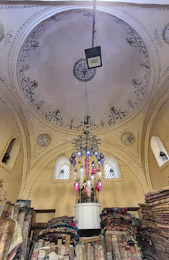
Many years before I began travelling to Bosnia, Üsküplu Gazi Yahya Paşa (died 1506) was appointed Ottoman governor of Bosnia in 1480. He also held other important positions in the empire. He married a daughter of Sultan Beyazit II. He was philanthropic. One of the many things he did for Istanbul was to build a school which stands in Kadirga, a part of Fatih district of the city. This building with two domes still stands and was recently restored by the local municipality.
The former school now houses a shop that sells traditionally designed objects – everything from earrings to large woven carpets. The walls and domes of the interior of the building have been painted so as to recreate the place’s original decor.
This building is one of a huge number wonderful relics of the Ottoman Empire, which can be found whilst strolling around Istanbul. Fortunately, many of these old buildings have informative labels attached, with information both in English and Turkish.
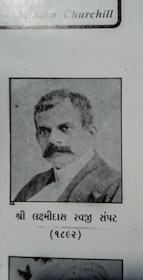
“My wife’s mother’s great grandfather was one Laxmidas Ravji Sapat (aka Sampat), who was born in the mid-19th century, or a bit earlier. Along with Gokaldas Parekh, Laxmidas was one of the first teachers in the Alfred High School in Bhuj (founded by Rao of Cutch, Pragmalji II in 1870). It is likely that he was its headmaster for a time. I have yet to see it, but his portrait hangs in the school. One of my wife’s relatives, also a descendant of Laxmidas, arranged to have it restored a few years ago. In 1890, Laxmidas left the school. Later, along with his son-in-law, Cullyanji Murarji Thacker, he went to London (UK) to become a barrister. He studied for the Bar at Middle Temple and was called to the Bar on the 27th of June 1900, along with his son-in-law, Mr Thacker, who was my wife’s mother’s grandfather.” (https://adam-yamey-writes.com/2023/02/02/running-in-the-family/)
Laxmidas Ravji Sapat
Today, the 25th of November 2023, we visited the Alfred School in Bhuj in search of the portrait of Laxmidas Ravji Sapat. We were shown a board on which the headmasters of the school were listed. On it we discovered that Laxmidas had been headmaster between 1888 and 1892. He was the school’s eleventh headmaster. It appears that he left the school two years later than I had been told.
As for the portrait of Laxmidas, the officials at the school had no knowledge. They suggested we try the museum next door. Part of this now owns the school’s original building, which was restored after the 2001 earthquake that destroyed much of Bhuj. Despite being part of the museum, the old school building stands disused and being renovated.
At the Bhuj Museum, we asked about the portrait. We were told that it is not in the museum. So where is it? In a few days time we will return to the school to visit its current headmaster. Maybe, he might know where it is. Until then, watch this space!
OUR FRIEND MIKAEL is an accomplished creative quilter (maker of quilts). Some of her artistic quilting is on display alongside works by other quilters in London’s Swiss Cottage Library until the 26th of July 2023. I must admit that when I learned that we were going to see an exhibition of quilts, my heart sank a bit. However, I am glad we went. I had no idea how creative and imaginative quilt makers can be. Well displayed in Swiss Cottage Library, there is a collection of extremely artistic contemporary quilts, which are well worth seeing. Far from simply being scraps of material stitched together, the quilters have used their imaginations and skills to create artworks which are not only beautiful but superbly innovative.
Until I entered Swiss Cottage Library today, I cannot recall having been inside it since about 1965 when I left the nearby Hall School, aged 13. I have passed its distinctive exterior often but never bothered to go inside. I was at the school between 1960 and 1965, and I remember visiting the then new library after it opened in November 1964. It was designed in the Modernist style by Basil Spence (1907-1976), who was born in Bombay. He based his library on the design of several that he had visited in Scandinavia. All that I can recall of the new library was that its shelves contained a far better range of books than our local library in Golders Green. Being a pupil in the area, I was able to borrow books from the Swiss Cottage Library, which I used to visit often because I found it to be so wonderful.
Although I can remember the superb collection of books that existed in 1964-1965, I could not recall the appearance of the library’s interior. It was only today when we visited the quilting show that I appreciated what a superb job had been done by Basil Spence and his team. Even though it was designed in the early 1960s, the style of the well-lit spacious interior has not dated at all. The interior of the library is far more intelligently conceived than most new British buildings created in the last few years. It is uplifting to wander around the various peaceful spaces within the library. If it were nearer home, it would be a place where I would want to go regularly to read and write.
I am grateful that Mikael invited us to see the quilting exhibition not only because it contained aesthetically pleasing works of art but also because I got to go back inside the library. Although I was not particularly interested in architecture when I was 11, my fascination with it began to grow a few years later. There was even a brief period in my life when I toyed with the idea of becoming an architect. Even though I did not pursue that profession, my love of good architecture – both modern and historical – has persisted. I believe that now, in my retirement, my appreciation of great buildings (such as Swiss Cottage Library) is greater than it has ever been. Even if you miss the quilting exhibition, it is worth making a detour to see Spence’s wonderful creation – both inside and outside.
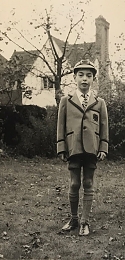
IN 1960, when I was 8 years old, I was accepted as a pupil at the Hall School in London’s Swiss Cottage area. Recently, I received some photographs of me in my newly acquired Hall School uniform. They were taken in the garden of our house in Hampstead Way in the Hampstead Garden Suburb, Maybe, it is fortunate that the photographs are in black and white because the Hall’s uniform was pink trimmed with black. The Hall’s ‘logo’ was a black Maltese cross – also a symbol used by the German army. I remember occasionally, children from other schools used to shout “Nazis” at me and my friends when we were wearing our uniforms in the street. The photographs were taken by my uncle Felix, who was born in South Africa.
When Felix came to London from South Africa in the second half of the 1950s, one of his first jobs was working in a photography shop in London’s Holborn. Like other members of my mother’s family, he was a keen photographer. His grandfather, my great grandfather, opened a photography studio in King William’s Town in the Eastern Cape in 1880. It was while Felix was working in the shop that the photographs of me in my new uniform were taken.
I remember the occasion vividly. Felix arrived at our house in the Suburb, carrying with him a great deal of equipment borrowed from the shop. Most of it was professional lighting on collapsible stands. Felix spent some time setting up a photographic studio in our living room. There were wires all over the place, and every electric socket in the room was used to power the lighting. I was positioned in a suitable pose. When he was ready, my uncle began switching on the lights. Then, it happened. The house’s electrical fuses blew, and all the lights went out. I remember that my parents were not too pleased with what had happened.
Because of the electrical problem, the much-wanted photographs, which were to be sent to relatives in South Africa, had to be taken outside in the garden. Seeing these pictures six decades later brought that occasion to the forefront of my memory.
Felix was a delightful, kindly man. He was everyone’s friend, and never harboured a grudge against anyone. Although he never had any children, I believe that he regarded the whole world as his family.
IN THE MID 1970s, I attended a series of evening lectures given by the art historian Ernst Gombrich. They were held in the Mary Ward Centre in London’s Bloomsbury.
Sign post at Loreto House School
In January 2023, we visited Sister Marilla, who works for Loreto House School and College in Middleton Row in the heart of Kolkata. My wife attended the school for several years in the 1960s. The two educational establishments are part of a larger organisation, the Loreto branch of the Institute of the Blessed Virgin Mary (‘IBVM’). When Sister Marilla told us that the IBVM was founded by Mary Ward (1585-1645), I immediately thought of the Mary Ward Centre in London, and was a bit surprised because I had always assumed that the Centre was named after a 19th century woman.
My assumption was correct. The Centre is named after the novelist Mary Augusta Ward (1851 – 1920), not the Mary Ward, founder of the IBVM.
The earlier Mary Ward (b 1585) was born in Yorkshire – Roman Catholic during the time that Roman Catholicism was outlawed in England. She felt the need to take up holy orders and instead of becoming yet another Catholic martyr, she wanted to do something worthwhile and practical. She went to Flanders where she joined the Poor Clares in St Omer.
To cut a long story short, she became, to oversimplify a lot, a female version of a Jesuit, but not a member of the Jesuit Order. After leaving St Omer, she founded the Poor Clare House for English women at Gravelines. There, and later elsewhere, she taught women about the Roman Catholic faith. In about 1609, she returned to England, where she gathered women to teach girls about the banned faith. Mary Ward suffered many hardships, including imprisonment in Germany, before succumbing to ill health in England
Leaping ahead in time, this group founded by Mary Ward, which had to surmount much criticism from the Jesuits and members of the Roman Catholic hierarchy, was the seed that germinated to become the officially recognised IBVM in 1877.
Followers of the group she had founded in 1609, established the Bar Convent in York in 1686. It was from here in 1821 that the IBVM Loreto branch was founded in Dublin by Teresa Frances Ball.
On the 12th of October 1928, 18 year old Albanian Agnes Gonxha from Skopje (now in North Macedonia) joined the IBVM at their Loreto Abbey at Rathfarnham in Ireland. She left Ireland on the 1st of December 1928, and landed at Kolkata on the 6th of January 1929. From there she travelled to Darjeeling, where on the 24th of May 1931, as a novice, she made her First Profession in Darjeeling’s Cathedral of the Immaculate Conception. In this church she made her Final Profession on the 24th of May 1937.
Next, Agnes was sent to the Loreto Convent at Entally in Kolkata. At first, she taught catechism and geography at Loreto St Mary’s Bengali School, which was on the campus of the convent. Eventually, she became the school’s headmistress.
On the 10th of September 1946, whilst travelling to a retreat in Darjeeling, she decided that her true calling was to work with the poor in the slums of Kolkata. By that time, she was known not as Agnes Gonxha but as the now much more familiar Mother Teresa. The order she founded, The Missionaries of Charity, maintained a warm relationship between it and the IBVM. Internationally famous, she died in 1997.
Had it not been for our visit to Sister Marilla and the informative booklets she gave us, it might have been a long time before I discovered the two Mary Wards and the connection that one of them had with both my wife’s school and Mother Teresa.
SOME YEARS AGO, I bought a book in the antique shop on Princess Street in Fort Kochi. It is a modern reproduction of a book published in about 1910. Its subject matter, mostly in English, is a detailed description of the benefits of living in Cochin. Its intended audience was Gujarati speaking people thinking of settling in the area. It was aimed at Hindus, Moslems, Jains, and Parsis.
A few days ago (in February 2023), I purchased a recently published book by Bony Thomas called “Kochiites”. It describes the many different communities that have settled in Kochi. One brief chapter is about the small group of Dawoodi Bohri, Shia Moslems, who live south of the historic centre of Kochi. Another is about the Hindu and Jain Gujaratis (and Kutchis), whose communal activities are centred along the 1 mile long Gujarati Road. As my wife has roots in Kutch and the rest of Gujarat and we enjoy visiting those parts, we decided to take a stroll along Gujarati Road, which is in the Mattancherry District of Fort Kochi. It was Sunday morning.
Gujarati Road runs in a north south direction. We began our exploration at the Jain temple and moved southwards. At the Jain temple, we were not the only tourists. My wife was the only visitor who could speak in Gujarati with the lady who showed us around the spotlessly clean Mandir. Its interior has a beautiful inlaid multicoloured floor and the inside of the main dome was a replica of the kind of domes with concentric ridges that one sees in mediaeval Hindu and Jain temples, as well as in mosques constructed during that period. Photography was not permitted within the temple.
Our next port of call was the shop of Chamanlal H Mithalwala. For many generations, this shop, owned by Gujaratis, has been selling Gujarati sweets and farsan (savoury snacks). We were able to buy some freshly made dhokla. However, we were told that khandvi always runs out in the early morning on a Sunday, soon after it has been made. The owner is Kutchi, as are many of the folk who live near Gujarati Road.
The Sri Jalaram Dham, a Hindu temple frequented by Gujaratis and financed by them, is almost opposite the sweet shop. Built quite recently (2012), it is not particularly noteworthy architecturally. It contains several brightly coloured idols and a small tulsi tree grows outside. The priest (pandit) told us he came from Rajkot, and almost all of the worshippers are Kutchis.
Just to the south of the Jalaram Dham, we reached the Sri Cochin Gujarati Vidyalaya, a Gujarati school in which most of the teaching is done in English. Founded in 1920, it has about 3000 pupils and covers education from lower kindergarten to college entry.
Within the school’s compound, there is a Hindu temple – about 140 years old. Its ceiling is decorated with larger than life bas-relief lotus flowers. We spoke with a trustee of the temple, who showed us some of the original idols and explained that in the area there are about 200 Gujarati families. Of these, 48 are Kutchi Bhatias, about 100 are other Hindu Gujaratis, and the rest are Jain. The temple is Shaivite. Our informant told us about another temple, which is Vaishnav and is frequented by the local Kutchi Bhatias. This interested us because my wife’s mother was a Kutchi Bhatia.
As can be seen all over Gujarat, there is a chabutra (dovecote) next to the temple. There is another one at the Jain temple, mentioned above
We continued south along Gujarati Road, passing the Gujarati Bhavan (which we did not enter) and several wonderful fruit and vegetable stalls.
Near the fruit and veg shops, which are located near the southern end of Gujarati Road, there is yet another temple – the Shri Navneeta Krishna Mandir. This is the Vaishnav temple used by many of the Kutchi Bhatias. The main temple was locked up, but behind it there was a lot of activity. This was centred around the mandir’s gaushala (cow shelter), where cows are provided with a pleasant home.
Worshippers were feeding the cows and calves. They were also placing cloths on the cows before handing them to the priest who was standing amongst the congregation. We were asked to touch one of these cloths before it was handed to the priest. The congregants took it in turns to touch the priest’s feet, and receive a blessing.
Near to the temple, there is a large housing compound, all of whose residents are Kutchi Bhatias. One sweet couple invited us into their ground floor flat, saying to us: “Welcome to our home. As guests, you are gods.” We chatted with them both in English and Gujarati. They gave us lovely cups of chhaas (buttermilk, a typical Kutchi drink). They offered to cook us lunch, but we declined because we had to get somewhere else. This charming couple, Deepika and Harish, did not want us to leave. When we did eventually go, I felt that we had been in the company of genuinely warm-hearted loving people.
Before setting off for Gujarati Road, I was worried that it might offer little of interest. How wrong I was! Although I have only briefly summarised our experiences, we saw many interesting places and met many friendly people. Over the years I have been falling in love with Gujarat and Kutch. This small outpost of people from that part of India in Kerala has only increased my affection for Kutch and Gujarat.
[NB Kutch, which is now a large district in the State of Gujarat, was an independent kingdom until 1947. Even today, no self-respecting Kutchi likes to be called a Gujarati!]
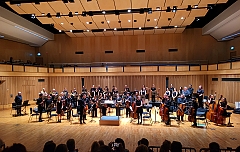
DURING AN INTERVAL of a concert given in Thaxted’s parish church, someone sitting close to us asked whether we hade ever been to a performance in what she described as the ‘superb concert hall’ in nearby Saffron Walden. We had no idea that the small Essex town had a concert hall of note. Always keen to enjoy classical music and to have an excuse to visit Essex, we booked for a concert given on the 12th of August 2022 by both the Essex Youth Orchestra and the Essex Young People’s Orchestra.
The concert hall, which has seating for audiences of over 700 people, was opened in late 2013. It is attached to Saffron Walden county high school, and was financed by a private donation of at least £10 million. This is believed to be the largest private donation to have been made to a state school. The hall is used both for school purposes and for public performances. The venue attracts ‘big names’ in both the classical and non-classical music worlds. For example, the Autumn 2022 programme includes concerts by: the Hallé Orchestra, Isata Kanneh-Mason, the London Philharmonic Orchestra, Lady Smith Black Mambazo, Courtney Pine, The Sixteen, the Pasadena Roof Orchestra, and so on. In addition to these better-known performers, there is a host of others.
The air-conditioned hall is beautiful. It is spacious, and fitted with adjustable acoustic panels and its walls are lined with birch wood. We heard a wide range of compositions beautifully performed by the two orchestras. The acoustics were fantastically good. The sound quality within the hall rivals that of the best concert halls in London. A small grumble is that the seating is not overly comfortable, but that did not detract from our enjoyment of the music performed by some of the best young musicians in Essex. Saffron Walden is not far from London, but it feels like it is much further away. If you do not mind night driving, it would be feasible to drive to and from Saffron Hall to enjoy an evening concert, but my suggestion is to spend a night somewhere near the hall and to enjoy Saffron Walden, its concert hall, and its rustic surroundings.
I HAVE PASSED IT often, and have long been curious about it, but until today I have not bothered to find out about it. I am referring to a small chapel on the corner of Kensington Place and Newcombe Street, which leads to the south side of a space where a weekly farmers’ market is held (on Saturday mornings). Called the Bethesda Baptist Church, its congregation was established in 1866. The building resembles a style commonly used in the late 18th century. According to a history of Kensington Place (www.hillgatevillage.com/the-facts), the chapel was constructed in about 1824. Over the years, it has been used by various Baptist sects. Currently, it is the home to a congregation, who believe in Restricted Communion and Particular Redemption. This sect was founded in 1866.
Bethesda Chapel, Kensington
Currently, I am reading about a clergyman, Conrad Noel (1869-1942), who believed fervently that the church should be both democratic and all-embracing. So, it was with some interest that I stumbled across a chapel in which people believing in ‘Restricted Communion’ gather to worship. The sect is a branch of the Strict and Particular Baptists, who follow the decrees of High-Calvinism. If you are finding this a bit difficult to follow, then you are not alone. Let me take a stab at giving a simple explanation of what the congregation in the Bethesda Chapel believe: a set of beliefs that are new to me. One website that seemed to clarify them well is www.sbhs.org.uk/membership/strictbapt/, from which I have attempted to extract the following information.
‘Strict’ refers to ‘restricted communion’. Unlike many branches of the Christian Church, which permit anyone who believes and loves Jesus Christ to partake in Holy Communion, the Strict and Particular Baptists believe that Communion should only be offered to those “who have been baptised by immersion as believers”. The above-mentioned website explained:
“Strict Baptists see baptism as a rite by which believers testify to their faith in Christ, and associate it with church membership. The Lord’s Supper is for those who have joined the church in this way.”
As for ‘particular’, this lives up to the common meaning of the word. The Strict and Particular Baptists believe that:
“…Christ died to make certain the salvation of a definite number of people whom he has purposed to save, rather than to make possible the salvation of an indefinite number of people who might choose to believe.”
That is, only the ‘select’ few, known as the ‘Elect’, will be saved. The sect does not accept infant baptism, even by immersion, as being sufficient to become part of the Elect. Another website (www.baptists.net/history/2022/07/the-articles-of-faith-of-the-gospel-standard-churches/) explained what is required to become a member of a Strict and Particular Baptist sect such as that which uses the Bethesda Chapel:
“At a regularly constituted church meeting … the candidate (whether already a member of another church or not) shall make a verbal confession of faith, and declare what he or she believes God has done for his or her soul. If accepted by a vote of the majority of members present and voting, signature in the church book to the Articles of Faith and Rules will be required. Thereafter, at the earliest convenient opportunity, the person shall, unless previously baptised by immersion, be so baptised in the Name of the Father, and of the Son, and of the Holy Ghost; and be formally received into church fellowship at the next observance of the Lord’s Supper.”
The Articles of Faith, and there are many of them, are strict. Thus, despite my oversimplification, it would seem that the Strict and Particular sects are, unlike the open-door church espoused by Conrad Noel, extremely exclusive and restrictive.
PS: A little way west of the Bethesda Chapel, there is an institution that is, unlike the chapel, far from exclusive: it is open to all children regardless of faith, providing they live in its catchment area: Fox Primary School. This state school, which was founded in 1842, is housed in modern buildings. I mention it as a postscript because its walls are decorated with several attractive, colourful mosaics.
WALKING PAST UNIVERSITY College School (‘UCS’) in Hampstead’s Frognal, I spotted something that reminded me of my schooldays, both at the Hall School (in Swiss Cottage) and Highgate School (…in Highgate!).
A part of the brick wall enclosing the grounds of UCS is inscribed with initials. Some of the bricks also have circular depressions. Those which have not been filled in have interiors which are parts of spheres. The bricks on the walls of the schools I attended used to be spotted liberally with similar circular, spherical concavities.
The concavities, which are never more than about 1.5 inches in diameter, were created using the edges of coins. If the edge of a coin is placed firmly against a brick and the twisted left and right repeatedly, the sharp coin gradually wears away the brick and creates a concavity as described.
In the days long before mobile telephones were even the stuff of dreams, mining out brickwork and inscribing one’s initials provided a perfect way for school kids to pass a few idle moments and to leave one’s mark.
ON SUNNY EASTER Sunday (2022), we took a morning walk along the Thames Path from the Black Lion pub (and the excellent Elderpress Café facing it) to Dukes Meadows, upstream from the pub. Dodging the endless stream of mostly courteous joggers and less polite cyclists, we enjoyed splendid views of the River Thames and the many old buildings lining Chiswick Mall. Several of the buildings were covered with flowering wisteria.
The Fantastic Herons
The river was well-populated with waterfowl including swans; geese of various kinds; ducks; a pair of cormorants resting on a buoy; and several herons. The latter were either standing on the sand and mud at the waterside or in the water close to the bank. Eventually, we reached Dukes Meadows, which consists of fields formerly part of the estate of nearby Chiswick House.
Near the Hammersmith end of the Meadows, we saw a metal sculpture, ‘The Fantastic Herons’, on top of a tall pole. Created by the artist Kevin Herlihy (born 1962) along with pupils from Cavendish Primary School and unveiled in 2004, it depicts three herons standing on a nest. Like most of Herlihy’s creations which often depict animal life, it is made from recycled waste materials. Funded by Singapore Airlines, who held a series of art workshops in the school, it is an appropriate sculpture for the area as herons can often be standing by, or in, the Thames flowing past the Meadows.






 yamey
yamey 