ROSNEFT IS A Russian company that supplies oil to India. The company has sponsored an exhibition, “Dream Vision”, that we visited in Bombay’s branch of India’s National Gallery of Modern Art (NGMA). The show will continue until 15 January 2026.
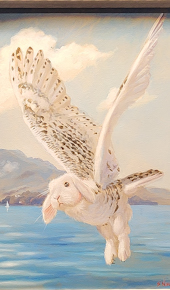
The works on display are by a People’s Artist of the Russian Federation, Nikas Safronov (born in the USSR in 1956). So far, he has painted portraits of at least 300 notable people, including one of President Donald Trump.
By Nikas Safronov
The portraits are not on display at the NGMA. Instead, there are about 40 of his well-executed paintings. Each of them is painted in a classical style that cannot be described as adventurous. However, most of the paintings contain whimsical or Surrealist elements. Some of the works contain Indian subject matter. The paintings are displayed in a large room onto whose walls and ceilings video images are projected.
Although this is by no means one of the best exhibitions I have seen, it is interesting to see what is being produced, and approved of, in Russia, which has become culturally isolated from much of the world beyond its borders. In fact, this exhibition is part of what the Hindustan Times (30 December 2025) described as part: “… of a broader Indo-Russian cultural initiative, Dream Vision positions art as a form of cultural diplomacy…”
Today, 2 January 2026, we were discussing this exhibition with a friend, who knew of the initiative, and had recently attended an event that had been part if it: a ballet performed by dancers who had come to India from St Petersburg.
Although I have reservations about the profundity of the artworks we saw at the NGMA, I was pleased to have seen the show and to have viewed what kind of work is being produced by an artist who is currently highly regarded in Russia.
A DISTINCTIVE BUILDING stands opposite the Art Deco Winter Garden (built by 1936) high above the seashore of Ventnor on the south side of the Isle of Wight. With a tower overlooking the sea, the edifice facing the Art Deco structure was which was built in 1846 by the Reverend Richard John Shutte (1800-1860), who had once been a canon at St Paul’s Cathedral. It was named St Augustine Villa (see photograph below), and now houses a hotel and restaurant.
Several Russians opposed to the Imperial Romanov regime, including the writer Ivan Turgenev(1818-1883) visited Ventnor during the 19th century. Amongst these was Alexander Herzen (1812-1870), who was the ‘father’ of Russian Socialism’. In 1852, he and his family began living in England for several years. During this sojourn, he made some visits to the Isle of Wight. In September 1855, Herzen stayed in Augustine Villa, which he had rented. However, he was not alone as the commemorative plaque on the Villa notes. He stayed there with Malwida von Meysenbug (1816-1903).
Now, I had already heard of Herzen. I became familiar with his name when watching a trilogy of plays by Tom Stoppard about 19th century Russian Socialism. However, I had never come across Malwida von Meysenbug until I saw that plaque in Ventnor. A writer, she was born in Kassel (Germany) and was a friend of both Friedrich Nietzsche and Richard Wagner. By the time that Herzen and Malwida had their holiday in Augustine Villa, she was living with Herzen’s family and helping to look after his children. Alexander’s wife Natalia had died in 1852, and he had hired Malwida to educate his children.
Malwida was much more than a mere governess as the UCL academic Sarah J Young explained in her excellent, highly informative article (http://sarahjyoung.com/site/2011/11/10/in-herzens-footsteps-a-visit-to-ventnor/). In this essay, Dr Young gives excerpts from Malwida’s published “Memoirs”. The following is particularly interesting:
“We spent happy days in beautiful Ventnor. In the evenings we were usually with the Pulszkys, who were spending the summer there. Therese’s mother, an educated and intelligent Viennese lady, had come to visit them, and this made for many a pleasant hour with her keen humor and wit. The Kossuths were also there, and he was much more pleasant in a more intimate setting than he had been at the formal gatherings in London. At the time, our thoughts were preoccupied by the war Russia had started with Turkey. Herzen, more so than the others, was very excited. He prophesied the Russian defeat and wished for it, since he believed it would lead to the downfall of autocracy.”
The Kossuths, were members of the family of the Hungarian revolutionary Louis Kossuth, whom Herzen was extremely excited to have met during his stay in Ventnor. Another exiled Hungarian revolutionary, Ferenc Pulszky (1814-1897) was also staying with his family in Ventnor at the same time as the Herzens and the Kossuths. Pulsky’s wife, Theresa, and Malwida spent time drawing together in Ventnor, and made several competent sketches of Ventnor and its surroundings,
Dr Young also quoted Herzen, who noted in his diaries that Malwida:
“… spent all her time in the water …”
From what Dr Young and others have discovered during their research, Malwida was out of the sea long enough to create works of art depicting the seaside resort.
Herzen liked Ventnor but had some reservations as he wrote in a letter (quoted from Dr Young’s article):
“For three days the weather has been like June – and I’m bathing recklessly in the sea. But before that there were four days of storms, rain and bitter cold … If it were not so boring, I would live here, but there are no resources at all. And getting to Ryde is expensive … “
Many years have passed since Herzen and Von Meysenbug holidayed in Ventnor. Slightly less time has elapsed since the future Mahatma Gandhi visited Ventnor in 1890 and 1891. According to one source (www.bonchurchvillage.co.uk/post/bonchurch-gandhi), Gandhi:
“… had wanted to study medicine but his father had objected, and his studies were in law. He was a prominent member of the London Vegetarian Society, and that may have led to his staying at Shelton’s Vegetarian Hotel at 25 Madeira Road in Ventnor, in January 1890 and again in May 1891, on the second occasion addressing a Vegetarian meeting in Ventnor.”
In his autobiography, Gandhi wrote of the following experience in Ventnor:
“My cowardice was on a par with my reserve. It was customary in families like the one in which I was staying at Ventnor for the daughter of the landlady to take out guests for a walk. My landlady’s daughter took me one day to the lovely hills round Ventnor. I was no slow walker, but my companion walked even faster, dragging me after her and chattering away all the while. I responded to her chatter sometimes with a whispered ‘yes’ or ‘no’, or at the most ‘yes, how beautiful!’ She was flying like a bird whilst I was wondering when I should get back home. We thus reached the top of a hill. How to get down again was the question. In spite of her high-heeled boots this sprightly young lady of twenty-five darted down the hill like an arrow. I was shamefacedly struggling to get down. She stood at the foot smiling and cheering me and offering to come and drag me. How could I be so chicken hearted? With the greatest difficulty, and crawling at intervals, I somehow managed to scramble to the bottom. She loudly laughed ‘bravo’ and shamed me all the more, as well she might.”
I do not think that Gandhi made any other visits to Ventnor or elsewhere on the Isle of Wight.
Today, Ventnor is still delightful and although much has been modernised since the Victorian era, it still retains an almost unspoilt old-world charm. I fancy that were it possible for Herzen and Malwida and their revolutionary friends to return today, they would find much in Ventnor that they would easily recognise.
Seeing the plaque on Augustine Villa made me curious about Herzen’s stay in Ventnor and the identity of Malwida von Meysenbug. By reading up about it, I learned of other noteworthy visitors to the town, and as I did so my interest in Ventnor has increased considerably.
THE NATIONAL SYMBOL of Russia, both before and after the Communist era, is a bird with two heads, two necks, and a single body – the double-headed eagle (‘DHE’). I have long been interested in this imagined creature because it appears on the flag of Albania, a place that has interested me for many years.
While walking along the riverfront in Dartmouth (Devon), our friend pointed out a historic cannon positioned with its barrel pointing towards the water. On the top of the barrel there is a small bas-relief depicting a DHE.
The cannon was manufactured in the Russian city of Briansk in 1826. It was captured from the Russians in the Crimean War (1854-1856) and is one of several Russian cannons brought to England after or during that conflict.
We have visited Dartmouth many times before, but barely noticed the old cannon. Had our friend not told us of the origin of that cannon, one of many disused artillery pieces that can be found serving as ornaments all over England, I would have been unaware of this example of a double-headed eagle in Dartmouth.
JOHN LINNELL (1792-1882) painted the Kensington gravel pits in about 1811. The picture hangs in London’s Tate Britain These pits lay alongside Bayswater Road and Notting Hill Gate. They provided gravel for building projects in England and as far away as Imperial Russia.
Today, the pits no longer exist. They have been built over, but street names such as St Petersburg Place and Moscow Road commemorate the fortunes made by selling gravel from these pits to Russia.
You can discover more about this and much more about Paddington and Kensington and points further west in my book “BEYOND MARYLEBONE AND MAYFAIR: EXPLORING WEST LONDON” (see https://www.amazon.co.uk/gp/aw/d/B0B7CR679W/
THE BIENNALE IN Venice was first held in 1895. The original international bi-annual art exhibition was contained in public gardens at the Eastern end of the city of Venice in the Castello district.
Initially, there was a Central Pavilion, opened in 1894. Later, various participating countries built national pavilions, the first being Belgium in 1907. The latest is the Australian pavilion, built only a few years ago.
The national pavilions reflect both the politics and architectural styles prevailing at the time they were built. Therefore, they are at least as interesting as the artworks that take up temporary residence within them at each exhibition.
I will discuss two of the pavilions in this short essay, and hope to write about some of the others at a later date.
The Russian pavilion bears the date 1914 and several double-headed eagles. It was constructed before the 1917 Revolution, and has some traditional Russian architectural features.
Next to the Belgian pavilion, stands the Spanish one. First constructed in 1933, its facade was replaced by a modern brick one in 1952.
Both the Spanish and the Russian pavilions appear to be empty, but for quite different reasons. For the 2022 Biennale, the artist Ignasi Aballi (born 1958 in Barcelona) has left the pavilion empty but shifted its internal walls in an attempt to correct a discrepancy between its original architectural plan and what ended up being constructed. The result is an empty pavilion with a strange internal layout. It was at first disconcerting to discover a pavilion empty of artworks, but soon it became pleasurable to see the strange vistas and connections between neighbouring rooms.
The Russian pavilion, unlike the Spanish, is closed. But it is also devoid of exhibits. Russia was not invited to the Biennale this year. The reason for this was Mr Putin’s unwise decision to invade his neibour, Ukraine.
Here is an excerpt from my new book about Hampstead in north London:
For many centuries, Hampstead has been the haunt of people involved in creative pursuits. So, it was no surprise that the former Express Dairy opposite Louis (patisserie) had at least one interesting cultural connection. In February 1916, the Bolshevik revolutionary Maxim Litvinov (1856-1951) proposed to his future wife Ivy Low in the café inside that branch of Express Dairy. Ivy, a novelist, was born, please note, in 1889 (she died in 1977). At the time he became acquainted with Ivy, Litvinov was with Lenin in London. Ivy did occasional typing for Maxim, and it was not long before they were attracted to one another. Passionate about cinema, he took her to watch films with him and one day he ‘popped the question’ in the Express Dairy. After they married, they lived in Hampstead until the outbreak of the Russian Revolution in October 1917. They did not return to Russia immediately because in January 1918 Maxim Litvinoff was made First Proletarian Envoy to the Court of St. James’s.
According to Zinovy Sheinis in his biography of Maxim first published in 1988, Maxim often went to Hampstead to meet his friends the Klyshkos, who lived on Hampstead High Street. Nikolai Klyshko (1880-1937) was a Bolshevik revolutionary of Polish parentage, who had settled in London and was a fluent Russian speaker. For a brief period, Litvinov lived in Hampstead with Klyshko and his English wife. Sheinis wrote about Maxim’s meeting with Ivy:
“They had met at a friend’s house. Then at a gathering of the Fabian Society. Litvinov was impressed by her knowledge of Tolstoy and Chekhov. Putting on weight, red-haired, of average height, well-mannered, and not very talkative, he made a big impression on the young writer. Her mother, the daughter of a colonel in the British Army, naturally wanted a different match for her daughter and certainly did not want to see her married to an insecure emigre from Russia. As for his religious background, Ivy Lowe simply never gave it a thought. She was herself from a family of Hungarian Jews who had taken part in the Kossuth uprising; in her girlhood she had been a Protestant, then had been converted to Catholicism. The choice of religion was her private affair and concerned no one else.”
After their marriage, they lived in a house, owned by Belgian refugees, in Hampstead’s South Hill Park (number 86). While there, Sheinis related:
“Friends sometimes gathered there in the evenings to discuss the political news; then an argument would flare up, developing into a fierce squabble. It always seemed to Ivy that her husband and his guests would any moment start flinging chairs at one another. At the very height of the dispute, when it was almost at boiling-point, she would leave the kitchen, go into the room, and announce that tea or coffee was ready. The disputants would calm down and drink their tea in peace.”
He also wrote that Ivy:
“… was not interested in and did not understand the political activities of her husband and his friends. To her, it was an alien world. In London, after the October Revolution, she asked her husband if he knew Lenin. Maxim replied that he had known Lenin for a long time. But she had no idea that letters from Lenin were coming to their house and that her flat was the headquarters of Bolshevik emigres.”
Later, they lived in a tiny house in West Hampstead. After that, Litvinov, having become a Soviet diplomat, moved from Hampstead. Despite not being officially accredited by the British, Sheinis noted:
“The Litvinovs were even invited to receptions. Though Soviet Russia was not yet recognised, its powerful influence reached standoffish London, Ivy Litvinova recollected.”
By 1921, the Litvinovs with their two young children, at least one of whom was born in Hampstead, settled in Moscow. Although Litvinov held high governmental posts in the Soviet Union and outside it (as a Soviet diplomat), he and Ivy, like so many other citizens in Stalin’s Russia, were constantly in fear of being arrested and/or killed.
WHILE AWAITING TAKE-OFF from Lisbon’s main airport, our aeroplane was ‘parked’ beside the largest aircraft I have ever seen. Operated by Maximus Air Cargo company, its nose was pointing upwards towards the sky. It was being loaded with freight through an enormous aperture at its front end. The aeroplane was so large that it dwarfed the numerous workers around it and the forklift trucks being used to load its cargo. Even the Airbus 320 craft standing nearby seemed tiny in comparison. As we had to wait for what seemed like ages before we taxied to the runway for take-off, I had plenty of time to stare at it and to take photographs through the window next to my seat. My curiosity increased when I observed that the ‘plane had its make written on the raised section of its nose: Antonov 124-100.
The Antonov aircraft were built mainly during the years that the Soviet Union was in existence. The company that built these freight carrying ‘planes is named after the aircraft designer Oleg Konstantinovich Antonov (1906-1984). Born in the Moscow region, he was the son of a civil engineer. From 1923 onwards, he was deeply involved in aircraft engineering and design. By 1938, he was the leading designer in the aircraft plant headed up by AS Yakovlev (www.antonov.com/en/biography). And in May 1946, he headed up his own aircraft design plant, based in Novosibirsk. By 1948, ‘planes designed by Antonov and his team were being manufactured in Kiev (Kyiv in what is now Ukraine). In 1952, Antonov and his design bureau moved to Kiev. Antonov’s team began designing the AN 124 heavy transport aircraft in the early 1970s. The AN 124’s maiden flight was in 1982, but the vehicle only became known to the world at large when it was exhibited at the Paris Air Show in 1985. The AN 124s were produced at two factories: one in Ulyanovsk (now in Russia) and the other at Kiev (now in Ukraine). One special feature of the AN 24’s design is that its landing gear with 24 wheels is designed both for landing on rough terrain and to enable the ‘plane to kneel down so that its front entrance can be lowered to make loading and unloading easier. About 55 of the AN 124 craft were built between 1982 and 2004. According the uk.flightaware.com website, the AN 124 (registration UR-ZYD), which we saw on the 17th of June 2022 had flown from Leipzig to Lisbon that day and was about to fly on to Cairo (Egypt). It flew to Kigali (Rwanda) from Cairo on the 18th of June. Another website ( www.planespotters.net/airframe/antonov-an-124-ur-zyd-maximus-air-cargo/ejn4jx) revealed that UR-ZYD was built just over 18 years ago, in about 2013/14, making it one of the last to be built.
Maximus Air Cargo, which operates the AN 124, which I saw, is an Abu Dhabi based company, which specialises in transporting larger than usual objects. The company owns one Antonov 124-100, about which its website (www.maximus-air.com/fleet/antonov-124-100) noted:
“The heaviest of the heavyweight cargo lifters. It has a unique self-contained multiple winch and overhead crane system capable of self loading / unloading 120 tonne from front or rear. Can carry 21x Toyota Land Cruisers or 4 x Mi 17 MTV Helicopters without breaking a sweat.”
The aircraft’s maximum range is 6710 nautical miles (‘nm’), but when it is carrying its maximal pay load (120,000 Kg), this reduces to 2420 nm.
I had heard of the Antonov aircraft before, but the example I saw in Lisbon is the first I have seen ‘in the flesh’. I found that seeing this giant was very exciting.
MANY MARKET PLACES in English and Scottish towns have what is called a ‘market cross’. These are often elaborate and ornate structures. One definition of such a building is (according to Wikipedia): “… a structure used to mark a market square in market towns”. Some of them include crosses (of the Christian variety), others do not. A market cross can range in design from a simple cross or obelisk to a significant structure, sometimes serving as a covered shelter.
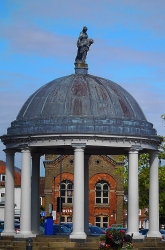
The market cross in Swaffham, Norfolk, is in the form of a circular shelter topped with a lead covered dome supported by eight plain columns with Doric capitals. The dome is surmounted by a statue of the Roman goddess of corn and agriculture, Ceres. She is depicted holding in her left hand a cornucopia filled with vegetables, and in her right a bundle of heads of corn. This market cross with its statue that harks back to pre-Christian religion does not contain or otherwise display the cross associated with Christianity.
The market cross is a distinctive and attractive feature in the centre of Swaffham’s large, triangular marketplace. Also known as the Butter Cross, it was designed by a Mr Wyatt, who might possibly have been the architect James Wyatt (1746-1813), who specialised in both neo-classical and gothic revival styles. It was completed in 1783 for the politician George Walpole, 3rd Earl of Orford (1730-1791), grandson of Sir Robert Walpole, 1st Earl of Orford (1676-1745), who became Britain’s first prime minister. George Walpole, founder of The Swaffham Coursing Club (i.e., hare coursing) in 1776, the first such club in England, was extremely extravagant. To raise money, this decadent and bankrupt fellow sold his grandfather’s collection of 204 old master paintings, which used to hang in Houghton Hall (Norfolk), to Catherine the Great of Russia in 1778. The sale was arranged by James Christie, founder of Christie’s auction house and raised £40,555. Seventy of these paintings were returned briefly to Houghton Hall for a temporary exhibition held there in 2013 (www.tretyakovgallerymagazine.com/articles/%E2%84%964-2013-41/walpole-paintings-houghton-hall-brief-homecoming).
According to a brief history of Swaffham by David C Butler, the market cross in Swaffham was known as the Butter Cross because trading in butter was carried out beneath its dome. In the 18th century, large amounts of locally produced butter were sent to London, where it and other butter from the district was known as ‘Cambridge Butter’.
Restored in 1984, the eye-catching domed structure is, according to David Butler, now a designated scheduled ancient monument. However, it appears to have been ‘de-scheduled’ and re-designated as a ‘listed building’ (https://historicengland.org.uk/listing/the-list/list-entry/1269570). I am unsure what to make of this, but that need not bother you should you happen to pass through Swaffham, the childhood home of Howard Carter, the discoverer of the grave of Tutankhamun, and the birthplace of Admiral Sir Arthur Knyvet Wilson (1842-1921), a hero of the Anglo-Egyptian War of 1882. Should you wish to sit and contemplate the decadent earl’s contribution to Swaffham, I suggest you have a refreshment at an outside table next to a café named after the Ancient Egyptian king discovered by Carter.
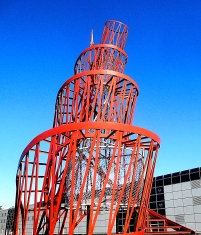
THE MARXIST SOCIETY of the University of East Anglia had just held a meeting around it, so we were told by someone working in the Sainsbury Centre for Visual Arts on the university campus in Norwich. The object around which the political gathering was held is a 35 feet high model of a structure that was never built full size. The Russian architect Vladimir Tatlin (1885-1953) had planned to build a futuristic tower in Petrograd (aka ‘Leningrad’ and ‘St Petersburgh’), an example of Constructivism. The tower, which was to have been 1300 feet high, was planned to celebrate and house The Comintern (3rd International). Hoping to rival Paris’s Eiffel Tower and to symbolise the modernity of Soviet Russia, the tower was never built.
Model of Tatlin’s tower with the Sainsbury Centre behind it
Sometime, back in the early 1970s, it was decided to construct a model of the Tatlin Tower near the Hayward Gallery on London’s South Bank. This was not a simple task because the structure is complex, and proper detailed blueprints were unavailable. To make a model of the Tatlin Tower that was faithful to the designer’s original idea, and which would not topple over, the services of a structural engineer were required. My uncle Sven, who worked for the firm of Felix Samuely and Partners, proved to be the man for the job. Working with the project’s director, Jeremy Dixon, my uncle had to unravel the plans of the structure using photographs of a 17-foot model of the tower that Tatlin had created in 1920 and a few existing images of plans that Tatlin had prepared. There were inconsistencies between Tatlin’s plans and the model produced in 1920. In 1971, Dixon:
“…built small models in balsawood to get it right, and he worked with Sven Rindl of consulting engineer Felix J Samuely & Partners, who generated detailed freehand drawings as they talked” (quoted from “Blueprint”, December 2011)
Dixon wrote about this in Sven’s obituary as follows:
“I particularly remember working with him on the reconstruction of the remarkable tower that Vladimir Tatlin produced as a monument to the Third International, the communist organisation founded in 1919, for the Art in Revolution exhibition at the Hayward Gallery in 1971. The project required us to go back to first principles to reinvent its extraordinary geometry and structure.
Sven would sit listening and commenting during our complex voyage of discovery, and at the same time he would be drawing. These drawings would be remarkable, elegant, three-dimensional sketches straight off the sketch pad, finished and complete. They were graphic works of art as well as documentation of engineering ideas.”
The model was built with timber inside the Hayward Gallery before being exhibited outside it in 1971 as part of an exhibition called “Art in Revolution: Soviet Art and Design since 1917”.
Forty years later in 2011, another model of the Tatlin Tower was produced, this time made of a more durable material, steel. Once again, the project was overseen by Jeremy Dixon. The completed model was first displayed in the courtyard of London’s Royal Academy. In an advance notice of the project (www.architectsjournal.co.uk/archive/ra-unveils-tatlins-tower), my uncle, who had died in 2007, was given a prominent mention:
“The 10.5m high steel structure in the Annenberg Courtyard was designed by architects Jeremy Dixon of Dixon Jones Architects, Christopher Cross, Christopher Woodward and engineer Sven Rindl. The tower will form part of the Royal Academy’s forthcoming exhibition, Building the Revolution: Soviet Art and Architecture 1915-1935 which opens on 29 October 2011.”
I remember going to view the model and then seeing a small exhibition about it and its construction. The exhibition, which was held inside the Royal Academy, included images of some of the beautifully drawn plans and diagrams created by my uncle.
The steel model of the Tatlin Tower, which was exhibited at the Royal Academy in 2011, has been lent to the Sainsbury Centre by the academy. Painted in red, this model of an experiment in futuristic architecture stands outside and close to the magnificent building that houses the Centre. The edifice, which is now over 40 years old, but looks like new, was designed by the architects Norman Foster and Wendy Cheesman.
We had no idea that there was a model of Tatlin’s tower next to the Sainsbury Centre when we visited it in September 2021. My wife and I were pleased to see this reminder of a much-missed relative whom we both loved dearly.
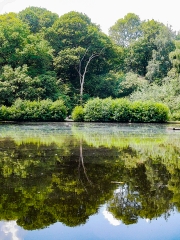
QUEENSMERE POND on Wimbledon is surrounded by woodland. It was dug in marshland to celebrate the Diamond Jubilee of Queen Victoria in 1897. In the 1830s, the area was a popular duelling ground.
In 1984, the corpse of a former Soviet spy Boris Hatton was discovered in the pond. On the 1st of March 1984, The London “Times” newspaper reported:
“Mr Boris Hatton, formerly Baklanov, a former assassin with SMERSH, part of Soviet wartime military intelligence, may have committed suicide or he may have been murdered. Dr Paul Knapman. the coroner at a Westminster inquest, recorded an open verdict, saying ‘It is not impossible that there may be other sinister factors in view of his past’.
Mr Hatton, aged 59, the son of prominent Soviet Commu-nist Party member between the wars, had been a strong swimmer and never spoke of suicide, the court was told.His son Phillip, an accountant. of Westerham, Kent, said that his father defected after the Second World War because SMERSH, wanted him to assassinate dissidents against Communism which his conscience would not allow.”
For 10 years he worked as a researcher at The Daily Telegraph.”Well, I would never imagined that this had happened when I watched a swan with its cygnets swimming lazily by the edge of the lovely pond.



 yamey
yamey 