A French photographer in a former French colony and Julia Margaret Cameron

JULIA MARGARET CAMERON (1815-1879) was a Victorian photographer, who pioneered artistic photography.  Rather than using her cameras to attempt to slavishly reproduce reality in her prints, she used cameras and processing techniques to produce an artistic interpretation of her subject matter. It has been said that some of the images she created influenced a few of the Pre-Raphaelite painters, who were amongst her friends. 


In Julia’s honour, there is an annual prize for women photographers: The Julia’s Margaret Cameron Award. One of the winners of the award in 2024 is the French photographer Muriel Pénicaud. Born in 1955, she served in the French government as Labpur Minister from 2017 to 2020. A self taught photographer, she began taking photographs when she was 11 years old.


There are two exhibitions of Muriel’s work currently (January and February 2025) showing in the former French colony of Pondicherry in the south of India. One of them is at the Kalinka gallery in Kasturba Gandhi street, and the other is at the more centrally located ‘The Spot’: a bar-cum-restaurant (it serves good food).
 

The majority of Muriel’s photographs on display are in black and white. One of the few coloured ones show a red shoe lying beneath a pile of discarded shoes in drab colours. This image is the photographer’s reaction to the piles of murdered victims’ shoes that can be seen at the Auschwitz concentration camp.


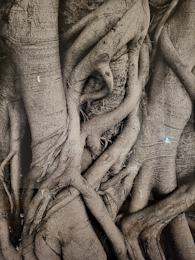
What Muriel achieves in most of her images is the conversion of a mundane sight, say a tree trunk or a bird’s plumage, into a work of art. Without resorting to tricks of focusing and experiments with processing, as did Julia Margaret Cameron, Muriel, like Julia did, transforms the ordinary into the visually extraordinary in  subtly delicate ways. She creates a new way of looking at the world by making her subject matter look intriguing.  She deserves a prize that honours the pioneer of artistic photography: Julia Margaret Cameron.


You can read more about Julia Margaret Cameron in my book “Between Two Islands: Julia Margaret Cameron and her Circle.” This book (also Kindle) is available from Amazon,  e.g., https://www.amazon.co.uk/gp/aw/d/B0BZFCVLX9/  

A photographer and his works exposed at a garden in Chennai

SUNIL GUPTA IS a renowned photographer. He was born in 1953 in New Delhi, and migrated to Canada with his family in 1969. With a degree in accountancy and a diploma in photography, he moved to London (UK) in 1983. There, he married another photographer Charan Singh. Much of Sunil’s work relates to themes of sexual identity, migration, race, and family.

While we were in Chennai, the parents of another photographer, Varun Gupta, told us about the exhibition of Sunil Gupta’s works currently (January 2025) being held in the garden of the Government Museum in Chennai. The show is part of the Chennai Photographic Biennale, of which Varun is one of the founders.

The show is being held in the open air. We saw it when the air temperature was hovering around 29 degrees Celsius. In addition, crowds of schoolchildren were enjoying their packed lunches on the ground amongst the walls upon which the photographs were hanging. The show has been arranged to produce what could be termed an autobiography expressed by photographs.

There is no doubt that Sunil’s photographs are visually superb as well as being of great interest.

While I was looking at the images, many of which are artistic as well as informative, I began to wonder whether photography limits the expression of a photographer’s innermost feelings more than is the case for a creator who is painting or sculpting. The photographer, like other visual artists, can compose his/her pictures, regulate their appearance, and edit them. However, the light coming through the camera lens dictates the final product however many adjustments etc are made. In contrast, the light coming through the eyes of a sculptor or a painter (or a printmaker) impinges on the artist’s brain, and what eventually results reflects the effect that the image projected into the brain has on the creator’s innermost feelings about the subject matter.

Having said this, which I hope makes at least a little sense, I must admit that I do enjoy making photographic images and I hope that my photographic skills will be improved by viewing great works such as we saw at the exhibition of Sunil Gupta’s photographs in Chennai.

Finding a box of photographs and rediscovering a forgotten artist

UNTIL ABOUT 1991, my widowed father resided in my childhood home in northwest London. For as long as I can remember, there was a collection of black and white photographs in a cardboard Kodak photographic paper box. The photographs contained images of sculptures, which my mother Helen Yamey (1920-1980) had created at St Martins School of Art in London during the later 1950s and first half of the following decade. In 1991, my father married again, and moved from our childhood home to another address. Every now and then, after my father moved, I used to ask him what had happened to the photographs. He used to reply that he did not know where they were. Maybe, he suggested, they were stored somewhere in the garage of his new home. He died in 2020. After that, I thought that it was extremely unlikely that I would ever set eyes on the photographs again.

A year or two after my father’s demise, his widow, my stepmother, arranged to meet me at a café. When she arrived, she was carrying a plastic carrier bag, which she handed to me. To my great delight, I found that it contained the Kodak box filled with photographs of my mother’s sculptures. I posted a few of these images on the Internet. Some months after that, my friend Edesio mentioned that he was impressed by the images of my mother’s sculptures, and suggested to me that I should write something about my mother and her art. This I have done.

When I began writing my mother’s biography, our daughter Mala, who is an art historian and a curator, sent me a pdf file containing the contents of a catalogue of an exhibition held at London’s Grosvenor Gallery in the 1960s. It contained mention of some of my mother’s work that appeared in the exhibition. Mala did a little more research and discovered the existence of catalogues of other exhibitions in which my mother’s sculpture was included. I investigated these catalogues and came across a few more, I was surprised by what I discovered.

During the first half of the 1960s, my mother’s sculptures were selected to appear in exhibitions alongside artworks created by artists, many of whom are now quite famous. These include, to mention but a few, David Hockney, Henry Moore, Barbara Hepworth, Howard Hodgkin, Bridget Riley, Kim Lim, and LS Lowry. These exhibitions were held when I was between 8 and 13 years old. In those days, I was not particularly interested in my mother’s artistic activities and was too young for the names of these artists to mean anything to me. In addition, I do not recall even having been told that my mother was participating in exhibitions, let alone showing her work alongside that of these now famous creators.  So, until I studied these catalogues more than 40 years after my mother died, I had no idea that for a while she was in the vanguard of 20th century British sculpture. Had I not been stimulated into beginning to write about her, I would not have known that my mother, who never boasted about her achievements, had been an artist of such a high calibre.

I have written my memories of my mother in a book called “Remembering Helen: My Mother the Artist” (available from Amazon: https://www.amazon.co.uk/dp/B0DKCZ7J7X/) . In it I have tried to describe her upbringing; what she was like as a mother; and her achievements in the world of sculpture. I have included many of the images I found in the box of photographs, and our daughter has written some insightful notes on her grandmother’s sculptural styles and the techniques. I hope that my book will help bring my mother’s artistic  achievements out of obscurity. Modest as she was, I feel that it would be good if she were to get at least a little of the fame she deserved.

Wonderful India (as it was) in English, Bengali, and Urdu

IN A SECONDHAND BOOKSHOP in Thame (Oxfordshire) I purchased a book called “Wonderful India”. It must have been published by 1943 because inside its front cover there is the name of its first owner, LW Morris, and next to that he added “Royal Air Force, Calcutta, July 1943”. The book is trilingual. Its text is written in Bengali (Bangla), English, and Urdu. It was published by The Statesman and Times of India Book Department. The Statesman is a newspaper that was founded in 1818, and published simultaneously in Calcutta, New Delhi, Siliguri and Bhubaneswar. The Times of India was founded 20 years later. The gloriously illustrated book, which covers pre-Partition India, as well as Sri Lanka, Burma, and Nepal, contains no text in Hindi. In British India, the official languages were English and Standard Urdu, and later Standard Hindi (https://en.wikipedia.org/wiki/Languages_with_legal_status_in_India#History). Oddly, for many years Bengalis were opposed to using their language as an officially recognised one, for a long time preferring to use Persian for formal (especially commercial) use (https://thespace.ink/bengali-and-persian-in-british-raj/). Yet despite this, the book I found favours Bengali and omits Hindi. I suspect that  because the book might well have been published in Bengal, the Bengali script has been included. Hindi written in the Devanagari script only became the official language of India in September 1949, several years after “Wonderful India” was published.

Dhaka (now in Bangladesh)

The book covers all the regions of pre-Independence India as well as some of its neighbours. It is rich in black and white photographs, many of which are superb examples of photographic technique. Each picture is captioned in Bengali, English, and Urdu. The only pieces of prose are the general introduction (which includes a photograph of Mahatma Gandhi) and introductory paragraphs at the beginning of each section. The Urdu introduction is at the rear of the book, and is next to a picture of Jawaharlal Nehru. There is no picture of any member of the British Indian hierarchy.  

Bangalore, a place which I have visited often, is given only one sentence at the beginning of the section on Mysore and Coorg:

“The British retain some territory at Bangalore, which is the administrative headquarters of the state, while Mysore is the capital.”

There are three photographs of the city, Sadly, not the most interesting in the book.  To compensate for this, the book is filled with pictures of touristic sights and daily life of India as it was before WW2 had ended. The book provides a fascinating window on a part of the world that has in many aspects changed beyond recognition.

The importance of being methodical

I HAVE NUMEROUS albums full of photographs that I have taken in India and many places in Europe over the years since about 1993. Before that date, for about 10 years, I used to take pictures on slide film, and have them processed into slides for projecting. I still have most of these, and each one is labelled. For some mysterious reason, when I began putting my photographic prints in albums, I hardly ever labelled them. Consequently, I have a vast collection of – dare I say it – interesting photographic prints taken at locations I can either not remember or can only vaguely recall.

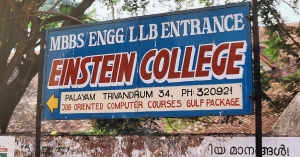
Yesterday (5th August 2023), I chose to look at one of my albums randomly chosen from a box containing several of them. As I flicked through the pictures, I came across one showing an advertisement for an institution called Einstein College, somewhere in India. The location was easy to identify because the college’s address was in the city of Trivandrum (Thiruvananthapuram) in Kerala. Having looked on the Internet, I see that the college still exists.

Two other prints were stored close to the college photograph in the album. So, I guessed they might also have been taken in Trivandrum. One of them shows a building with geometrically decorated walls and numerous small roofs. At first, I thought it might be a temple, but then I wondered whether it was the palace-like museum in Trivandrum, which houses a fine collection of paintings by the Keralan artist Ravi Varma. I checked on the Internet, and discovered my picture shows apart of the museum’s exterior. The third print shows what looks like an enormous terracotta coloured ‘multi-storey’ pigeon coop. It is a cylindrical structure with some helical decorative features. The edifice bears a sign that reads “India Coffee House”. Using that clue, I found that is one of the three branches of the India Coffee House chain in Trivandrum.

Had I labelled these photographs, I would not have needed to do any detective work to identify them and their locations. Sadly, many of my unlabelled prints do not have obvious clues that can help me identify them, and most likely they will remain a mystery. The moral of this story is that it pays to be methodical and systematic occasionally.

Photographs taken in a garden

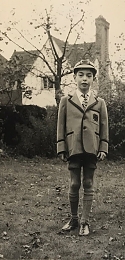
IN 1960, when I was 8 years old, I was accepted as a pupil at the Hall School in London’s Swiss Cottage area. Recently, I received some photographs of me in my newly acquired Hall School uniform. They were taken in the garden of our house in Hampstead Way in the Hampstead Garden Suburb, Maybe, it is fortunate that the photographs are in black and white because the Hall’s uniform was pink trimmed with black. The Hall’s ‘logo’ was a black Maltese cross – also a symbol used by the German army. I remember occasionally, children from other schools used to shout “Nazis” at me and my friends when we were wearing our uniforms in the street. The photographs were taken by my uncle Felix, who was born in South Africa.

When Felix came to London from South Africa in the second half of the 1950s, one of his first jobs was working in a photography shop in London’s Holborn. Like other members of my mother’s family, he was a keen photographer. His grandfather, my great grandfather, opened a photography studio in King William’s Town in the Eastern Cape in 1880.  It was while Felix was working in the shop that the photographs of me in my new uniform were taken.

I remember the occasion vividly. Felix arrived at our house in the Suburb, carrying with him a great deal of equipment borrowed from the shop. Most of it was professional lighting on collapsible stands. Felix spent some time setting up a photographic studio in our living room. There were wires all over the place, and every electric socket in the room was used to power the lighting. I was positioned in a suitable pose. When he was ready, my uncle began switching on the lights. Then, it happened. The house’s electrical fuses blew, and all the lights went out. I remember that my parents were not too pleased with what had happened.

Because of the electrical problem, the much-wanted photographs, which were to be sent to relatives in South Africa, had to be taken outside in the garden. Seeing these pictures six decades later brought that occasion to the forefront of my memory.

Felix was a delightful, kindly man. He was everyone’s friend, and never harboured a grudge against anyone. Although he never had any children, I believe that he regarded the whole world as his family.

Images of my mother’s sculptures rediscovered

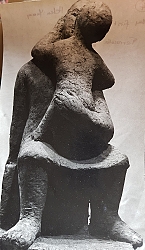
MY LATE MOTHER (Helen Yamey: 1920-1980) trained as a commercial artist in Cape Town (South Africa) before WW2. In 1948, she came to London to marry my father. In London, she painted and, according to my father, took lessons from the great Stanley Spencer (1891-1959). Around the time when I was born (1952), my mother began making sculptures. The first of these was a terracotta mother and child. Maybe, she was depicting herself with me in her arms.  By the 1960s, she was working in the sculpture studios of St Martins School of Art, which was then near Foyles bookshop on Charing Cross Road. There, she was in the company of artists such as Anthony Caro, William Tucker, Philip King, and William Turnbull. At least one of these now famous artists taught my mother how to weld and solder.

My mother exhibited her works in important art galleries at least twice. In late 1961, she exhibited at the Institute of Contemporary Art in a show called “26 young Sculptors”. In 1962, she exhibited sculptures at the Grabowski Gallery, along side works by Maurice Agis and David Annesley. Although she sold a few of her creations, she did them more for pleasure than for profit.

My mother was a perfectionist. She destroyed much of what she created. However, at some time during the 1960s, she had a series of professional photographs taken of some of her mainly abstract works. These were kept in a yellow Kodak photographic paper box in a drawer in our home in Hampstead Garden Suburb. As a teenager, I used to look at them occasionally and wonder what became of some of the creations recorded in these photos.

My mother died in 1980 and my father remarried 11 years later. After remarrying, he and my stepmother moved from our home in Hampstead Garden Suburb to another house (near Primrose Hill). After the move, I used to ask him what had happened to the photographs of my mother’s sculptures and other family photos. Each time I asked, he would say that they were stored somewhere, possibly in the garage of his new home. After a while, I gave up hope of ever seeing these pictures again because it was clear to me that Dad had little or no interest in these photographs and in addition he could not imagine why anyone else would find them interesting. My father died, aged 101 and 6 months, in 2020. What with covid19 and its associated problems, we did not see his widow, my stepmother, again until recently this year (2022).

When, at last, we met her, she arrived carrying a plastic carrier bag, which she handed to me. To my great delight, it contained the box of photographs described above and another filled with family photographs taken mainly in the late 1950s. My stepmother told me that she had found them when she was sorting things in the garage of the house where she and my father had lived.

The photographs of my mother’s sculptures all bear the name of the photographer: Joseph McKenzie, ARPS (95 Blenheim Gardens, Wallington, Surrey). According to Wikipedia, Joseph McKenzie (1929-2015) is regarded as “father of modern Scottish photography”. More relevantly in the context of my mother’s works, he taught photography at the St martins School of Art.

Some of the photographs have notes written on their backs. The handwriting is my mother’s. One of the pictures, that of the mother and child has the words: “my first ever sculpture, terracotta, mother and child, 24””. Some of the other photos have information about the size and the material of the work depicted.

About 10 years before she died, my mother became disillusioned and practically gave up making sculptures. Although she made a few abstract images in pen and ink and a few carvings in alabaster, her abandonment of sculpture making as a full-time activity left a great hole in her life.

I have taken pictures of the photographs, and they can be seen on:

http://www.ipernity.com/doc/adam/album/1323344

Approaching infinity?

camera_240

Have you ever wondered how many photographs are being, or have been, taken on digital cameras?

Apparently, to date over 50 billion photos have been posted on Instagram, well over 250 billion on Facebook, about 30 to 40 million images PER DAY on Twitter (that is  at least 10,950,000,000 per year), over 175 billion on Pinterest.  On New Years Eve 2017,  Whatsapp users posted 13 billion images plus 5 billion videos. This adds up to a huge number of pictures. But, not everyone uploads their digital pictures and videos to social media, or at least not every picture they have taken. So, this means that in addition to those which are uploaded, many, many digital images are being created every microsecond.

If they are not shared via the internet, what happens to the galaxy of photos and videos being created? Some are briefly looked at and then deleted. Others are kept to show selected acquaintances. A few are used to illustrate books and articles and some are printed on photographic paper.

One of the joys of old-fashioned film photography was the excitement of waiting to see how your photos or videos looked after the film was developed. Digital photography reduces the delay between snapping and seeing the result from several hours to a week (as it used to be) to a very few seconds. Yet, even with this almost instantaneous result, there is excitement to see what the image looks like. 

The ease of use of cameras installed in mobile ‘phones has resulted in the huge numbers of pictures and videos being made. The numbers of images taken already and those yet to be taken must surely reaching that impossible to reach number, namely infinity!

Sharing photos

butterfly


I was given my first camera, a Kodak Brownie’, when I was about 7 years old. Since that time I have owned a variety of cameras and camera ‘phones and I have taken many thousands of pictures. 

In the early days, I used to have prints made from negatives. Later, I became converted to colour slide (‘diapositive’) film and produced many colour slides. With the arrival of computers and the Internet into my life, I reverted to film that produced prints and when it became available, I had digital images of my photographs put on compact discs. Nowadays, I hardly ever have prints made from my digital images.

Ever since I first began taking photos, I have enjoyed showing them to other people: relatives, friends, colleagues, and whoever else showed even the tiniest bit of interest. However, when you present people with an album full of photographs or arrange a slide projection session, most folk begin to lose interest fairly fast. Many of them have agreed to look at someone’s pictures mainly out of politeness, rather than genuine interest.

All of that has changed with the advent of social media and Internet sites for displaying photographs. People need only look at pictures when they are interested and for as long as they want without risking offence to the photographer. Often, if they want to, viewers can express their approval and/or make comments. What is more, the viewers need no longer be confined to the friends and acquaintances of the creator of the images. It is possible to make images available to everyone, who uses the Internet. Some may not be happy with that, but I am. My desire to ‘show off’ my pictures to as many people as possible has been fulfilled!

I find that apart from sites like Facebook, the website ipernity.com is a superb place to post pictures. Other users of the site are often both appreciative and helpful with their comments and suggestions. My Ipernity page is http://www.ipernity.com/home/adam 

PLEASE TAKE A LOOK!

Gandhi, Lenin, Stalin

gandhi

Non-violent Gandhi 

Beside three leading men

Who faced fate with force


This mantle-piece at Shaw Corner, the home of George Bernard Shaw at Ayot St Lawence in Hertfordshire, bears the portraits of (from left to right) Mahatma Gandhi, Felix Dzerzhinsky, Vladimir Lenin, and Josef Stalin. Shaw met all of these men.