ALMOST EXACTLY TWO years ago (in December 2023), we spent a few nights in the Moti International hotel in a street leading off Bombay’s bustling Colaba Causeway. Despite its impressive sounding name, this hotel was curiously interesting.
It is housed in Moti Mansion, a large house built by a Parsi family in about 1900.
Moti Mansion in November 2025
We had not booked the hotel in advance, but walked in to enquire whether we could stay fir a few nights. The young man at the small reception desk asked us: “Are you married?”
We told him that we were and then he said: “I have to ask you because, you see, my grandfather who lives with us on the top floors, is an old fashioned orthodox Hindu.”
Our ground floor room was adequate, air-conditioned,and had a decent attached bathroom. Sadly, the windows had been painted over. So there was no daylight. When we asked for a kettle, the young man explained: “Yes, but I must charge you an extra 100 rupees for three days of electricity.” We were happy with that.
On our last morning, we met the boy’s mother. She showed us the buildings impressive main wooden staircase. She explained that many of the rooms in the building were occupied by long-stay guests.
Today, 19 November 2025, we walked past Moti Mansion. Its street facing facade wast partly hidden by scaffolding and almost all the windows were covered over with wooden boarding.
I wonder what the future holds for this charming edifice.
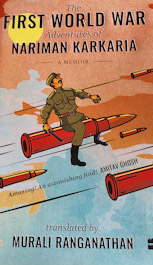
I HAVE JUST FINISHED reading a fascinating book gifted to me by my wife’s cousin. Most of the text is a Parsi’s experiences of fighting for the British during the First World War. Unlike other books about Indian soldiers who fought during that conflict, which deal with statistics and a general overview, this one contains the personal reminiscences of an individual who experienced the battlefronts first-hand.
The book is a translation from Gujarati of the memories of a Parsi (a Zoroastrian) from the town of Navsari in Gujarat – Nariman Karkaria (1895-1949). At the age of only 15, Nariman, wishing to see the world, ran away from home, and with hardly any money in his pocket, reached Hong Kong. From there, he slowly travelled through China to Siberia. His impressions of the places he visited are recorded in his often entertaining book.
When WW 1 broke out, Nariman travelled across Russia and through Scandinavia before embarking on a ship to Newcastle in the UK. From there, he reached London, where he enlisted in an English regiment. After detailing the training he received, he describes his journey to the Western Front in France.
In addition to describing the conditions on the battlefields of France, Egypt, Palestine, and Greece, vividly and often in great detail, Nariman portrays his fascination for seeing new places and people in a delightful way. Reading his memoir, I was infected with his enthusiasm for seeing the world.
Near the end of WW, Nariman spent time in Jerusalem, which he describes most interestingly. His accounts of Tbilisi, Istanbul, Baku, and post-WW1 London are fascinating. I was intrigued reading about daily life in Tbilisi and Baku as they were only a short time before the Russian Revolution.
Nariman’s writings portrayed him as a a genial person, whom it would have been fun to have met. His prose is easy to read and never dull. As the translator, Murali Ranganathan, explained in his introduction to the book, what Nariman wrote is a rare account of the travels and wartime experiences of an adventurous young Indian man from Gujarat.
This is a book well worth reading not only because of its unique perspective of WW1 but also its highly agreeable narrative style.
ANYONE WHO KNOWS Calcutta well might wonder what made us stroll along Ezra Street. We had just left St Andrews Kirk (completed in 1818), where we heard the start of a Sunday service in Nepali, when I realised we were not far from Ezra Street. The Street is named after a trader David Joseph Ezra (died 1882) of Baghdadi Jewish heritage. But that is not why we visited the street.
My wife’s sister-in-law was brought up in number 48 Ezra Street in a house that my wife remembered as having been a glorious, picturesque old building. We wanted to see what, if anything, was left of the residence.
The ruined agiari
On our way along the street, we spotted a board that read “Rustomjee Cowasjee Church”. We entered the building and saw nothing that looked remotely like a Parsi fire temple (agiari). Instead, we found ourselves in a series of dimly lit chandelier and fancy lamp showrooms. We asked about the “Parsi Church”, and were shown the way to it. By the way, it seems that if a place of worship is neither a ‘mandir’ nor a ‘masjid’, then it is described by locals in Calcutta as a ‘church’ – be it a church, a synagogue, or an agiari.
The agiari behind the lamp shops is no longer in use. It is falling to pieces and unsafe to enter. It stands behind a verandah whose roof is supported by sturdy pillars with Doric capitals. It must have been magnificent in its heyday. We saw two plaques – one in English, and the other in Gujarati. Although it is in a poor condition, Kolkata Heritage has listed it as a ‘Grade 1’ monument. It was built in about 1839.
Number 48 Ezra Street has been demolished and replaced by an unattractive new building. Outside its main entrance, there is a memorial plaque in English. It records that the Russian adventurer, linguist, musician, writer, and translator, Gerasim Stepanovich Lebedev (1749-1817), opened a theatre on the site of number 37 Ezra Street, which faces number 48. His theatre was the first in Calcutta to employ Bengali actors and actresses. The first performance was in November 1795.
According to Wikipedia: “Lebedev lived in Calcutta (now Kolkata), then the capital of British India, for about ten years. During his stay, he started to learn Hindi, Sanskrit and Bengali from a local schoolteacher named Golokhnath Das. In exchange, Lebedev had to teach Das violin and European music. With the support of a Russian doctor, then practicing in Calcutta, he was soon established as a musician. Tickets for his musical programmes were priced at Rs. 12. Lebedev was the first person to use Indian tunes on Western musical instruments” The British colonial authorities became unhappy with Lebedev being in India, and expelled him in 1797. Eventually, he returned to Russia, where he was employed by the Russian Foreign Ministry. But before reaching his native land, he stopped off in London, where he published his “Grammar of the Pure and Mixed East Indian Languages”.
Although we saw nothing of the house in which my wife’s sister-in-law lived during her childhood, our stroll along Ezra Street allowed us to discover the well hidden remains of a Parsi agiari as well as introducing us to the Russian indolgist, GS Lebedev.
MY MOTHER-IN-LAW STUDIED medicine at the Grant Medical School in Bombay. One of her fellow students, Perin, was her good friend. Perin, a member of Bombay’s Parsi religious community, was related to the Readymoney family, Parsis, who were prominent and successful in Bombay. You might be wondering why I am telling you this and what it has to do with anything of greater interest. Well, bear with me and join me in Regents Park.
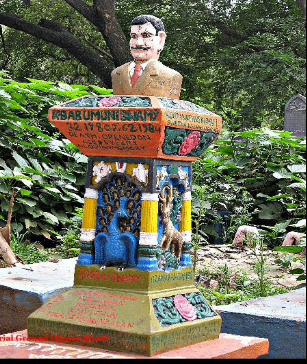
Cowasji Jehangir Readymoney
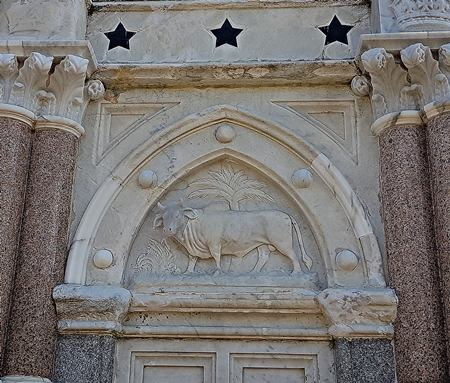
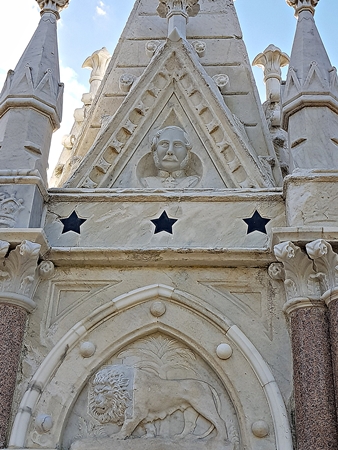
The Broad Walk is a long straight promenade that stretches from the Outer Circle near Marylebone Road at the south of Regents Park northwards through the park to Outer Circle next to the London Zoo. Near the south eastern corner of the Zoo, there is a gothic revival style Victorian water fountain on the Broad Walk. Well-restored recently, it is no longer working. The structure, which is made of pink granite and white stone, looks like a typical flamboyant 19thy century public drinking fountain that can be found in towns all over England, but closer examination reveals that this is not so typical. Amongst its many decorative features there is a cow standing in front of a palm tree; a lion walking past a palm tree; the head of Queen Victoria looking young; and the head of a moustachioed man wearing a cap of oriental design.
The man portrayed on the drinking fountain was its donor, Sir Cowasji Jehangir Readymoney (1812-1878), who was related to my mother-in-law’s friend from medical school. Readymoney was born into a wealthy family that had moved to Bombay from the Parsi town of Navsari (in present-day Gujarat), close to where the first Parsis might have landed in India many centuries earlier. Cowasji began working as a warehouse clerk at the age of 15. Ten years later, he had become a ‘guarantee broker’ in two leading British-owned firms in Bombay, a lucrative position. By the age of 34, he was trading on his own account. In 1866, he was appointed a Commissioner for Income Tax. This form of taxation was new and unpopular in Bombay, but Cowasji made a success of its collection.
In recognition for his services to the British rulers of India, Cowasji became a Justice of the Peace for Bombay and, soon after, was made a Companion of The Most Exalted Order of the Star of India. He was a great philanthropist, providing money for building in Bombay: hospitals; educational establishments; a refuge for the destitute; insane asylums; and decorative public drinking fountains. In addition to these good causes in Bombay, he made donations to the Indian Institute in London. In recognition of his philanthropic works, he was made a Knight Bachelor of the United Kingdom in 1872.
Three years before being knighted, Readymoney financed the construction of the drinking fountain in Regents Park. It is his face that appears on it. It was, as a noticed affixed to it reveals, his:
“… token of gratitude to the people of England for the protection enjoyed by him and his Parsee fellow countrymen under British rule in India.”
The Parsi community in India, like the Jewish people in that country, was and still is a tiny proportion of the Indian population as a whole. It felt that its survival would be ensured by showing allegiance to whomever was ruling India, the British in Readymoney’s lifetime. The fountain was inaugurated by Princess Mary of Teck (1833-1897), a granddaughter of King George III, under whose watch the USA was detached from the British Empire.
The fountain, which makes for an eye-catching garden feature, was designed by Robert Keirle (1837-1914; https://borthcat.york.ac.uk/index.php/keirle-robert-1837-1914-architect?sf_culture=en), architect of The Metropolitan Free Drinking Fountain and Cattle Trough Association. Keirle also designed a drinking fountain for another Indian, The Maharajah of Vizianagram. This was erected in 1867 at the northern edge of Hyde Park, close to Marble Arch, but it was removed in 1964 (https://theindiantrip.com/uk/vizianagaram-city/info). All that remains of it today is a small stone memorial, which I have walked past several times.
Usually, we spend several months in India, the country where my wife was born, but because of the current pandemic we will have to delay our next trip, for goodness knows how long. Seeing things in London with Indian association, like the Readymoney Fountain in Regents Parks helps us, in a strange way, to maintain out ties with a country for which both of us have great affection.
LOOKING A BIT LIKE A GRUBBY SWISS chalet, Yazdani Restaurant and Bakery is in a busy lane within a stone’s throw of Bombay’s elegantly designed Horniman Circle. Named after the Persian city of Yazd, where one of the nine Athash Behrams (the highest grade of Zoroastrian fire temples) still stands, this establishment was founded by a Parsi family in the very early 1950s. It has been suggested that the premises occupied by Yazdani were previously occupied by a Japanese bank.
Yazdani, which looks as if it has not been redecorated for many decades is one of Bombay’s many ‘Irani cafés’, which were founded by Iranian zoroastrian refugees, who had fled to India (in the early 20th century) from other parts of Asia to escape religious persecution. Irani cafés, like Yazdani, retain a nostalgic charm, providing an atmosphere that transports the customer’s imagination back to a gentler and simpler past. Sadly, the number of Irani cafés in Bombay is diminishing.
It was at Yazdani, when I first visited it a year ago, that I bit into my first bun maska. It was love at first bite. What is it, you may well ask, that gave me so much pleasure? It is simply a round bread bun, often very soft, filled with a generous, if not excessive, amount of butter. Some of the buns available at Yazdani contain bits of raisin and others, the brun maska, have crisp crusty coverings (similar to ‘crusty rolls’ available in England).
Bun maska has become popular outside Bombay.For example, I have discovered good ones in Ahmedabad (at Lucky’s and also at the New Irani Restaurant).
In addition to bun maska and brun maska, Yazdani sells bread, apple pie, and a variety of delicious biscuits. Everything is baked on the premises at Yazdani, which calls itself “La Boulangerie”. Tea is served at simple tables within sight of the aging glass fronted cabinets that are constantly being restocked with freshly baked products. It is common for customers to dip bits of bun maska into the tea.
On one wall, there is a large poster in German advertising Bauernbrot. Apparently, Yazdani is popular with German visitors to Bombay. Portraits of various Parsi personalities also hang on the walls.
Unless you are gluten intolerant or trying to lose weight, a visit to Yazdani is a real treat, and not a costly one.
A few footsteps away from Yazdani, stands another treat. This is the Peoples Book House. It is a small extremely well stocked bookshop which supplies mainly, but not exclusively, left wing books. Whatever your political leaning, you are likely to find fascinating books here (in English, Hindi, and Marathi, mainly). In its window, you can spot, for example, “Das Kapital” and books about Karl Marx translated into Marathi. I bought what promises to be an interesting book about the naval mutiny in Bombay that occurred just after the end of WW2 (early 1946), an event that hastened the British decision to quit India for good.
So, visit Yazdani to fill your stomach and Peoples Book House to feed your brain.
Death is a morbid but fascinating topic, as is disposal of the dead. Many people living outside India, including myself, believe that the corpses of Hindus are only cremated. At least, I believed this until about 15 years ago, when I visited a Hindu burial ground in Bangalore.
In a Hindu Burial Ground in Bangalore
I have visited two Hindu cemeteries in Bangalore, one of them being next door to a major electric crematorium in the city centre. When I have asked about Hindu burials, I have been told that some sects of Hindus favour burial rather than cremation.
Recently, I read an article about Hindu burials (in Calcutta) by A Acharya and S Sanyal in the “Mint” newspaper (Bangalore), dated 24 Nov 2018. Here is a brief digest of the points contained within it.
1. Certain groups of Hindus are traditionally immersed or buried.
2. These groups include:
A. Saddhus or ascetics who perform their own mortuary rites when they become saddhus, and are considered to be dead to the social world, living ghosts one might say.
B. Some young children, especially those who have not yet developed visible teeth. Also, some parents prefer to bury their dead offspring, rather than watching them being cremated.
C. Lepers. It used to be feared that a leper’s body might release an infectious vapour during cremation.
D. Some members of the following communities prefer to bury their dead to avoid the dominating behaviour of the Hinduism of the Brahmins: dalits, Vaishnav, Hela, and Kaburpanthi.
3. Sometimes, burial is cheaper than cremation. In Calcutta, burial can cost half of the charge of cremation.
4. Burial of Marwaris and Vaishnavites is more costly than for others because these two groups bury their dead with lots of salt, which they believe speeds disolving the flesh off the bones.
This newspaper piece has helped me to understand the existence of cemeteries where Hindus are buried. I assume that at least some of what has been written about Calcutta also applies to Bangalore.
On a parting note, I used to believe that the traditional method of corpse disposal amongst the Parsis was to feed their dead to the vultures. A Parsi friend of ours died in Bangalore, which has Towers of Silence for the corpses of Parsis, was buried in a Parsi cemetery in Bangalore. I have visited that cemetery, which is located in the district if Malleswaram and is for Parsis only.
All of this goes to show that making generalisations about India is inadvisable. So, before you assert that Hindus do not eat beef, hold your tongue! Some sects of Hindus have eaten beef since time immemorial. If the present government in India bans the consumption of beef, it will not be only Christians and Muslims who will be affected, but also several million Hindus.
There is a decorative drinking fountain on the Broadwalk in London’s Regent’s Park. The fountain looks like a typical Victorian gothic structure, which it is. Closer examination reveals bas-relief panels that depict: a bull standing by a palm tree; a lion next to a palm tree; and the head of a man wearing an oriental hat. This fountain would not look out of place in Bombay, which is full of structural souvenirs of the Victorian era. This should not surprise you when you learn that the fountain was a gift of Sir Cowasjee Jehangir Readymoney (1812-78) from Bombay.
Cowasjee, who was born in Bombay, received little education before becoming a warehouse clerk in Duncan, Gibb & Co. in that city. In 1837, he moved into a more lucrative job. Nine years later, he opened his own business. In 1866, he became a Commissioner of Income Tax in Bombay. Later he became a Justice of the Peace.
Readymoney lived up to his name, becoming very wealthy. He invested huge amounts of money into a wide variety of good causes including social housing (similar to that erected by Peabody in the UK) in Bombay, The University of Bombay and an Indian Institute in London. A year after being made a member of the Order of the Star of India in 1871, he was made a Knight Bachelor of the UK. These honours were awarded to recognise his great philanthropic contributions.
The fountain in Regent’s Park, which no longer issues water, was erected in 1869, nine years before Readymoney’s death. His main residence was in Bombay’s Malabar Hill district.







 yamey
yamey 