FORT KOCHI IN Kerala was occupied by three European powers: first by Portugal, then ny the Netherlands, and then by the British until 1947. It was whilst the British were in charge that a small jail was built on what is now Tower Road. Next to a police station and close to a string of roadside seafood restaurants, there is a gate that leads into the Jail of the Freedom Struggle. This prison was built by the British at a forgotten date during the 19th century. One clue to its age is that some of its roof tiles can be dated to 1865. The prison has a row of eight cells, each equipped with a 6 foot long concrete bed.
The prison, which might have been used as a transit establishment for prisoners waiting to be taken elsewhere, is said to have held leading freedom fighters such as Mohammed Rehman, Accamma Cherian, and K J Herschel, A K Gopalan, E M S Namboothiripad, and Abdurahiman Sahib. However, this is not known for certain. The prison, which had become disused and dilapidated, was restored in 2009, and opened as a museum.
In February 2023, we visited Fort Kochi to explore the 2022 Kochi Muziris Art Biennale. Unconnected with this major event, we visited an exhibition of artworks being displayed in the former prison. This included both paintings and sculptures. What made it an usual exhibition is that the exhibits are all contained within the cells behind strong iron doors with vertical bars. The doors that once prevented the prisoners from leaving the cells now prevent visitors from entering them.
AT THE TICKET desk of the Barbican Gallery we were hesitantly asked if we knew about the exhibition of Carolee Schneemann (1939-2019) because it contains some sexually explicit exhibits. We said we knew roughly what we were heading for.
The exhibition is laid out on two floors and visitors are given a suggested route that allows one to see the gradual development of Schneemann’s work from abstract and semi-abstract painting through to highly adventurous installations and happenings (to use a word that assumed a special meaning in the 1960s).
The artist’s earlier works are on the upper floor. Dissatisfied with the relative flatness of painting on canvas, she began adding a third dimension to her paintings. Soon she was producing collections of objects in boxes, rather like the kind of things produced by Joseph Cornell. Unlike Cornell, who filled his boxes and frames with intact objects, Schneemann filled hers with damaged objects, such as rusty musical boxes and fragments of broken glass.
Much of Schneemann’s work became involved with the human body and sexual experiences, as depicted from the female point of view. In many of her creations, she used her own body as a prop. For example, there is a film recording of a ‘happening’ during which she painted glue on her naked body and then applied scraps of paper to herself, creating a human collage. Many of her other works either defy description or if described might disturb the squeamish or prudish reader.
Later in her career, she moved from depicting the body and sexual matters to political comment and protest. Most of these often powerful works are in the form of videos and installations.
I much preferred the earlier works on the upper floor. They were created as timeless artworks that could be looked at whenever. The more adventurous and innovative works on the lower floor are mostly almost static records of events that would have been seen to full and maximum effect when they took place in real life so many years ago. That said, this exhibition was both exciting and interesting.
THE CORRIDORS LEADING to the spectacular Durbar Room in Osborne House on the Isle of Wight are lined with portraits of people born in pre-independence India, either painted or photographed during the 19th century. Most of these images depict members of the Indian aristocracy (e.g., rulers of Princely States). A few depict less exalted persons, such as craftsmen and the designer of the Durbar Room.
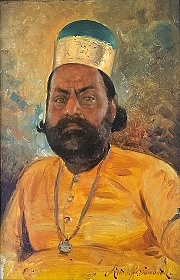
Maharajah Duleep Singh (1838-1893), who surrendered the Koh-i-Noor diamond to Queen Victoria, is portrayed in a few pictures, notably one by the famous German artist Franz Xaver Winterhalter (1805-1873). Many other paintings were created by the Austrian painter Rudolf Swoboda (1859-1914). Queen Victoria liked his painting style and commissioned him to create more than 40 portraits of Indian people. In 1886, the queen paid for him to travel to India, and gave him £300 in travelling expenses. Her instructions to the young artist were:
“The Sketches Her Majesty wishes to have – are of the various types of the different nationalities. They should consist of heads of the same size as those already done for The Queen, and also small full lengths, as well as sketches of landscapes, buildings, and other scenes. Her Majesty does not want any large pictures done at first, but thinks that perhaps you could bring away material for making them should they eventually be wished for.” (www.rct.uk/collection/403755/gulzar).
Many of these can be seen hanging in Osborne House. Amongst his many Indian portraits, there is at least one painted not in India but in England. Queen Victoria had several servants, who were born in British India and the Princely States associated with it. The best known of these ‘imported’ servants was her favourite Mohammed Abdul Karim (1863-1909), her ‘munshi’ (teacher), who helped her study Hindustani, which she learned to write competently in the Urdu script. Amongst Swoboda’s paintings of Indians hanging in Osborne House, there is one of a non-Indian, a lady from Cyprus, and another, a Cape Malay woman from Cape Town (South Africa). Why they are there, I have not yet found out, but maybe Swoboda spotted them at the Colonial Exhibition held in London in 1886.
Not all the portraits of Indians are painted. Some of them are hand-coloured photographs. A few of these photos are signed by their creators, one of which was the photographic studio of Gobind Ram and Oodey Ram in Jaipur. Along with a studio in Calcutta the Ram brothers were pioneers in photography in 19th century India. One source (www.indiatoday.in/lifestyle/whats-hot/story/tryst-with-colonial-india-205124-2014-08-22) stated:
“Apparently, studio photography was practised by many Maharajas as a means of leisure, mostly using their courtesans as subjects. The Ravi Varma Studios of Calcutta and Gobind Ram-Oodey Ram Studio in Jaipur are just two examples.”
As can be seen at Osborne, these photographers also made portraits of the maharajahs and their families.
Although Queen Victoria loved Osborne House, I cannot see its appeal apart from the wonderful Durbar Room. For me, seeing this lavishly decorated hall and the collection portraits of the Indian people are the main delights of this otherwise rather gloomy residence.
THERE IS A ROOM in Knole House (near Sevenoaks in Kent), which contains several portraits painted by Joshua Reynolds (1723-1792). One of them is a self-portrait. Near to this, there is a portrait of a man with a red cap, seated cross-legged. His youthful face has Chinese features. The sitter is Wang-y-tong (‘Huang Ya Dong’: born c 1753). Reynolds painted him in about 1776.
Wang was one of the earliest known Chinese people to have visited England. He came over following in the footsteps of an earlier Chinese visitor, the artist Tan-Che-Qua (c1728-1796), who arrived in London in 1769. Tan met King George III, and his work was shown at the Royal Academy in 1770. In about 1770, Wang was brought from Canton to England by John Bradby Blake (1745-1773), an employee of the East India Company. Blake was a naturalist and was interested in Wang’s knowledge of cultivating Chinese plants, and their uses. Wikipedia noted:
“Wang visited the Royal Society on 12 January 1775. In a letter of 1775, he is said to be about 22 years old. He was visited at Blake’s house, where he discussed the manufacture of Chinese ceramics with Josiah Wedgwood, and acupuncture with physician Andrew Duncan.”
It also describes how Wang became a page to Giovanna Bacelli (1753-1801), who was a mistress of John Sackville, 3rd Duke of Dorset, who owned Knole House. Wang lived at Knole, and was educated at the nearby Sevenoaks School. He returned to China by 1784, at which date he was working as a trader in Canton.
Wang’s portrait hangs amongst those of many famous men painted by Reynolds, including Samuel Johnson and David Garrick, as well as the 3rd Duke. The latter is said to have paid Joshua Reynolds 70 guineas (almost £76) to paint Wang’s excellent portrait. Wang was well-received in England. It would be interesting to learn what he thought about life as he found it at Knole and other places he visited in England.
AT THE TATE Britain, I visited the exhibition of paintings and drawings by the artist Walter Sickert (1860-1942). Amongst these, I was interested to see one which depicts a stretch of the platform at what is now Bayswater Underground station. In Sickert’s time, this station was called ‘Queens Road (Bayswater)’. Painted in 1914-15, this station was the closest one to his then home in Kildare Gardens (off Westbourne Grove). In the painting there is a man seated on a bench beneath an advertisement for Whiteleys. This was a department store, whose history I have described in my book “Beyond Marylebone and Mayfair: Exploring West London”*. Here is a shortened extract:
“Queensway was the home of a large department store called Whiteleys. Created in nearby Westbourne Grove by William Whiteley (1831-1907) in 1863, it moved into its large home on Queensway in 1911. After going through various transformations over the years, eventually becoming a shopping mall with restaurants and a cinema, it closed in 2018 … Since 2018, developers have removed the building’s innards whilst preserving its outer walls. The aim is to create a new shopping area along with a hotel and residential units. The final product might be interesting as its architects are from the team led by Norman Foster.”
Between 1968 and 1970, I was at north London’s Highgate School studying in preparation for my A-Levels (examinations to gain admission to university). One of my subjects was biology. I decided to enter the school’s Bodkin Prize biology essay competition. For some long-forgotten reason, I chose as my essay topic the life of woodlice. Seeing the above-mentioned painting by Sickert, reminded me of this essay. Being a keen researcher, even in my late teens, I discovered that there was a detailed book on my chosen subject, and this was available for perusal in a science library (the National Reference Library for Science and Invention), which was part of what has now become known as The British Library. In the late 1960s, when I required the book, the library’s collection was housed in a part of what had been the former Whiteleys department store on Queensway. It was a peculiar place: the bookshelves and readers’ desks were arranged on several layers of curved galleries surrounding a circular open space on the ground floor. Above the circular space, there was a spectacular, circular, large diameter, glazed skylight. The book I consulted was in French, and I spent a whole day laboriously translating it and making notes for use later. ‘cloporte’ is the French for ‘woodlouse’, just in case you are wondering. I believe that one visit was sufficient for me to collect what information I needed.
In December 1967, there was a debate about the state of the British Museum Library (now British Library) in the House of Lords. During a long speech, Viscount Eccles (1904-1999) mentioned the library where I had read about woodlice:
“Learned societies and famous men in the arts and the sciences have been shocked by the substance and the manner of the Government’s decision concerning the Library … An example of how the Act works can be seen in what has happened to the National Reference Library for Science and Invention. For years the former Trustees were frustrated by the delays and niggardliness of previous Governments in finding accommodation for this growing section of scientific material, not to mention the disgraceful shilly-shallying over the Patent Office Library. The position grew so desperate that the Trustees decided to gather together part of the material in temporary premises in Bayswater—admittedly very unsatisfactory…” (https://api.parliament.uk/historic-hansard/lords/1967/dec/13/british-museum-library)
I visited the library a year or so after that speech. As for my essay, I won 2nd prize: 15 shillings (75pence) to spend on books, which was reasonably generous at that time. 2nd prize might impress you for a moment until I reveal that I was one of only two entrants. The 1st prize was won by my classmate Timothy Clarke. His older brother, Charles Clarke, not only became Head of School but later served as British Home Secretary between 2004 and 2006.
Returning to Whiteleys, I began visiting it regularly after 1993, when I began living nearby. Then, as described already, it had become a shopping mall. The galleries, which had once served as a library, were lined with shops and eateries, as well as a cinema. But that is all in the past, and what was once Whiteleys is now a building site. I doubt that Sickert would have been pleased if he were able to see it today.
HOUSED IN AN OLD palace, the Quinta das Cruzes museum (‘Quinta’ for short) contains a collection of exhibits of various kinds and its beautiful garden has a small collection of archaeological architectural fragments. In a way, the Quinta is Funchal’s version of London’s V & A, but much smaller.
Goa long ago
The much remodelled building housing the museum was initially built for João Gonçalves Zarco (c 1390 – 1471), who was the ‘discoverer’ and first Captain (i.e., governor) of Madeira. I am not sure how much of what Zarco would have seen in his time can be seen today. Nevertheless, it is an attractive edifice.
Several exhibits particularly interested me in the museum. One was a retable, a triptych, carved intricately in ivory. To our surprise, we discovered that this was an English production, created in the 19th century.
There were several fine paintings of Madeirans and their island painted by English artists including Eliza Eleanor Murray, Charles Scott-Murray, and Thomas Butterworth. The paintings by Murray and Scott-Murray were late 18th century. These pictures hung in rooms alongside English furniture including pieces by Chippendale and Sheraton.
Another exhibit that attracted me was a fine embroidery on which wild animals are depicted. This was produced in Portuguese Macau for a Christian religious order: the Carmelites.
Another former Portuguese colony, Goa on the west coast of India, is represented in the museum by three attractive paintings showing people and scenery in Goa in the 18th or 19th century.
These exhibits from what is now China and India remind us of Portugal’s pioneering and extensive colonisation of the world beyond Europe. The artefacts from the UK and by British artists recollect the importance of Madeira in the history of British trade and tourism.
I have outlined a few of the exhibits that are on view in the museum, but there is plenty more to enjoy including a grest collection of fine silverware (including models of serving women with black faces) and a very elegant modern refreshment area. It overlooks a fine panorama of part of Funchal.
Along with the Museum of Sacred Art, the Quinta is one of the cultural highlights of Funchal.
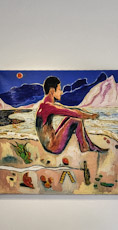
THE PAINTER MAHESH BALIGA was born in the south Indian state of Karnataka in 1982. He studied painting at The Chamarajendra Academy of Visual Arts (CAVA) in Mysore, and then received a postgraduate qualification at the prestigious Faculty of Fine Arts, MSU, in Baroda (Vadodara in Gujarat). He has taught at various art schools in India and exhibited in several countries including India. Currently, he lives and works in Baroda. Between the 12th of April 2022 and the 28th of May 2022, some of his works are being exhibited in a solo exhibition, “Drawn to Remember”, at the David Zwirner Gallery in Grafton Street (in London’s West End).
The paintings on display were created using casein tempera. This kind of paint has a glue-like consistency, but it can be thinned with water. According to Wikipedia, artists like this kind of paint because:
“… unlike gouache, it dries to an even consistency, making it ideal for murals. Also, it can visually resemble oil painting more than most other water-based paints …”
At first glance, it is difficult to discern whether the Baliga’s paintings on display at Zwirner’s resemble water colours or oil paintings; some of them seem to look halfway between the two mediums. All of them, except one, are quite small canvases and without exception they are all attractive. The subject matter depicted in the works is varied, from studies of plants and animals to everyday scenes (often with depictions of Indian life) to the slightly unusual. An example of the latter is in the only large canvas of the show in which there is an image of a man with sticky plasters over his left eye. Another odd subject shows a man with flowers growing out of his shirt. This is appropriately named “Flowering Self”.
The small size of most of the paintings, which the artist described as ‘lap-sized’, has a reason. Many of them were executed on the journeys the artist made when commuting to and from Surat (in the south of Gujarat), where he held a teaching position for a while. Though they are not large paintings, each one of them provides a window on the artist’s experiences and and his take on them. Although the paintings are far from mundane, they are not over-dramatic or excessively visually challenging. The exhibition is well worth seeing. I would be happy to hang any one of the works I saw at his exhibition on my walls at home.
THE TATE BRITAIN pleases me far more that its younger relative, The Tate Modern, and its cousins in Liverpool and St Ives. I do not know why, but I feel far more comfortable in the old institution on London’s Millbank. Today (31st of March 2022), I took a leisurely wander through some of the Tate Britain’s galleries. I was on the lookout for works by artists, who have been associated with Hampstead in north London. My only disappointment was that there were no works by John Constable (1776-1837) on display. Buried next to Hampstead’s parish church, he worked and lived (for several years) in Hampstead. I had better luck with one of his contemporaries, George Romney (1734-1802). His “A Lady in a brown Dress: The Parson’s Daughter” hangs in the Tate. “Roadside Inn” was painted in about 1790 by George Morland (1763-1804), who used to visit Hampstead to teach. The gallery also contains a picture, “Punch or May Day”, by the painter Benjamin Haydon (1786-1846), who is known to have visited Hampstead, where he met the essayist and critic Leigh Hunt and walked with the poet Wordsworth.
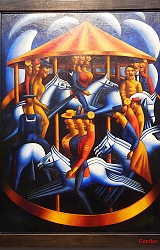
By Mark Gertler
It was the painter William Rothenstein (1872-1945), who found accommodation for, and looked after the great Indian literary genius Rabindranath Tagore, when he stayed in Hampstead briefly in 1912. The artist, who also lived in Hampstead for a while, is represented by at least two of his paintings in the Tate Britain: one was painted in 1891 and the other in 1899-1900.
It was during the first five decades of the 20th century that Hampstead became a mecca for artists, who are remembered today and whose works are displayed in Tate Britain. “The Merry-Go-Round”, a colourful painting created by Mark Gertler (1891-1939), who had a studio in Hampstead, depicts a fairground attraction on Hampstead Heath. It was painted in 1916. Gertler studied at the Slade School of Art at the same time as the painter Stanley Spencer (1891-1959), who had a studio in Hampstead’s Vale of Health for a while. It is therefore apt that Gertler’s painting hangs next to one by Spencer: “The Resurrection, Cookham”.
Another juxtaposition is a wooden sculpture by John Skeaping (1901-1980) and a painting by Ben Nicholson (1894-1982). Both worked in Hampstead in the 1930s and both were married to the sculptor Barbara Hepworth (1903-1975). She divorced Skeaping to marry Nicholson. One of her sculptures is on display close to another artwork by her second husband. I spotted one more work by Hepworth. That was a painting, a sketch for a sculpture she was planning in 1957. The three artists all worked at various times in the Mall Studios near Parkhill Road.
David Bomberg (1890-1957), who, like Gertler and Spencer, studied at the Slade, lived in West Hampstead between 1928 and 1934. There are several of his dazzling, colourful paintings hanging in the Tate Britain.
Henry Moore (1898-1986), who lived for a while in Hampstead, is the best represented of all the artists who lived or visited that locality. Tate Britain has many of his sculptures on display and some of the sketches he made during WW2. These images depict people sheltering in deep Underground stations to be safe from the bombs being dropped by the Luftwaffe. Moore lived for a while in the modernist and relatively bomb-resistant Lawn Road Flats (‘The Isokon’) near South End Green (and, incidentally, near the Mall Studios). I have read that it is likely that Moore made some of his dramatic wartime sketches in the nearby Belsize Park and Hampstead Underground stations.
It was fun visiting the Tate and seeing pictures by some of the artists, whom I have written about in my new book about Hampstead: “Beneath a Wide Sky: Hampstead and its Environs”. This work contains two chapters detailing Hampstead’s myriad artistic connections. If you wish to learn more about this and about other aspects of Hampstead and its surroundings, my book (and Kindle edition) can be obtained from Amazon (https://www.amazon.co.uk/dp/B09R2WRK92).
IT IS TEMPTING to concentrate on the wonderful collection of exhibits in Cambridge’s Fitzwilliam Museum, but you should spare some of your attention for the magnificent decoration of some of its galleries. Look up from the paintings and display cases to see superb ceiling decorations above you, and also around you when using the grand staircase. You are sure to be amazed.
The museum is housed in a neo-classical edifice initially designed by George Basevi (1794-1845), architect of London’s Grosvenor Square. After Basevi’s death, the planning of the structure was completed by Charles Robert Cockerell (1788–1863). Built to house the collection bequeathed to the University of Cambridge by Richard FitzWilliam, 7th Viscount FitzWilliam (1745-1816), the present museum was opened to the public in 1848. Over the years since then, the museum has been enlarged by adding newer buildings and now it is home to about 500,000 artefacts.
Years ago, I remember reading (I cannot remember where) a comparison of a museum in the USA designed by Ludwig Mies van der Rohe (1886-1969) with another one, the Guggenheim in Manhattan, designed by Frank Lloyd Wright (1867-1959). Both buildings are elegant but that by Mies Van der Rohe modestly allows the exhibits to grab the viewer’s attention more than the architecture, whereas the unusual design of Wright’s building competes with the artworks for the viewer’s attention. The internal decoration of the older galleries of the Fitzwilliam are sufficiently eye-catching to be able to compete with the exhibits housed in them, but somehow, they hardly do this. That is why I am asking you to take your eyes off the exhibits if only to glance briefly at the décor of the galleries,
MANY MARKET PLACES in English and Scottish towns have what is called a ‘market cross’. These are often elaborate and ornate structures. One definition of such a building is (according to Wikipedia): “… a structure used to mark a market square in market towns”. Some of them include crosses (of the Christian variety), others do not. A market cross can range in design from a simple cross or obelisk to a significant structure, sometimes serving as a covered shelter.
The market cross in Swaffham, Norfolk, is in the form of a circular shelter topped with a lead covered dome supported by eight plain columns with Doric capitals. The dome is surmounted by a statue of the Roman goddess of corn and agriculture, Ceres. She is depicted holding in her left hand a cornucopia filled with vegetables, and in her right a bundle of heads of corn. This market cross with its statue that harks back to pre-Christian religion does not contain or otherwise display the cross associated with Christianity.
The market cross is a distinctive and attractive feature in the centre of Swaffham’s large, triangular marketplace. Also known as the Butter Cross, it was designed by a Mr Wyatt, who might possibly have been the architect James Wyatt (1746-1813), who specialised in both neo-classical and gothic revival styles. It was completed in 1783 for the politician George Walpole, 3rd Earl of Orford (1730-1791), grandson of Sir Robert Walpole, 1st Earl of Orford (1676-1745), who became Britain’s first prime minister. George Walpole, founder of The Swaffham Coursing Club (i.e., hare coursing) in 1776, the first such club in England, was extremely extravagant. To raise money, this decadent and bankrupt fellow sold his grandfather’s collection of 204 old master paintings, which used to hang in Houghton Hall (Norfolk), to Catherine the Great of Russia in 1778. The sale was arranged by James Christie, founder of Christie’s auction house and raised £40,555. Seventy of these paintings were returned briefly to Houghton Hall for a temporary exhibition held there in 2013 (www.tretyakovgallerymagazine.com/articles/%E2%84%964-2013-41/walpole-paintings-houghton-hall-brief-homecoming).
According to a brief history of Swaffham by David C Butler, the market cross in Swaffham was known as the Butter Cross because trading in butter was carried out beneath its dome. In the 18th century, large amounts of locally produced butter were sent to London, where it and other butter from the district was known as ‘Cambridge Butter’.
Restored in 1984, the eye-catching domed structure is, according to David Butler, now a designated scheduled ancient monument. However, it appears to have been ‘de-scheduled’ and re-designated as a ‘listed building’ (https://historicengland.org.uk/listing/the-list/list-entry/1269570). I am unsure what to make of this, but that need not bother you should you happen to pass through Swaffham, the childhood home of Howard Carter, the discoverer of the grave of Tutankhamun, and the birthplace of Admiral Sir Arthur Knyvet Wilson (1842-1921), a hero of the Anglo-Egyptian War of 1882. Should you wish to sit and contemplate the decadent earl’s contribution to Swaffham, I suggest you have a refreshment at an outside table next to a café named after the Ancient Egyptian king discovered by Carter.