SIR WILLIAM ROTHENSTEIN (1872-1945) was born of German-Jewish parents in the Yorkshire city of Bradford. His father was involved in Bradford’s textile business. Trained at the Slade School of Art (part of London’s UCL), William became a well-known painter and cultural figure. Between 1920 and 1935, he was director of the Royal College of Art. Rabindranath Tagore dedicated his work “Gitanjali” to William. One of William’s sons, Michael Rothenstein (1908-1993), who was born in Hampstead, became a noted printmaker. He married Betty Mona Desmond Ayers (née FitzGerald; 1915-2017), who was known as ‘Duffy Ayres’. She was an English portrait painter.
Michael and Duffy had two children, one of whom is Anne Rothenstein (born 1949). She is a self-taught artist, who lives and works in London. Until 12 April 2025, there is an exhibition of her paintings at the Stephen Friedman Gallery in London’s Cork Street. Her attractive paintings, which seem deceptively simple when compared with those made by her grandfather William, depict portraits, interiors, and landscapes. However, they are far from simple. They are subtle and sometimes dreamlike. And as the gallery’s handout noted, her portrayal of perspective is unusual: the landscapes seem flattened. The paintings on display are oddly compelling and this along with their somewhat muted colouring, enhanced my enjoyment of Anne’s art.
As soon as we entered the gallery and I saw the artist’s name, I wondered whether she is related to the famous Sir William Rothenstein. When the gallery assistant informed us that she is from the same family, I was excited. Already, I knew of William’s connections with Hampstead and that he hosted Tagore, when the great Bengali visited London, but I had no idea that both his son and his granddaughter were artists (although far less well-known than him).
AN EXHIBITION AT LONDON’S Victoria and Albert Museum, which is showing until 5 May 2025, displays works of art created in the Moghul Empire between about 1560 and 1660, a period in which the Emperors Akbar, Jahangir and Shah Jahan reigned. Apart from wonderful jewels, jewellery, jewel-encrusted swords, and various other luxurious items, the exhibition contains a superb array of painted miniatures. Each one of these meticulously painted images is filled with a wealth of detail, and depict people as well as scenes of (often) courtly life.
The miniature paintings differ from those created in Western Europe (notably in Italy, France, Germany, and the Low Countries) during that period in many ways. One of these differences is the portrayal of perspective. To the eyes of people used to looking at Western European paintings of the late sixteenth and early seventeenth centuries, the Mughal miniatures seem to lack any obvious portrayal of perspective when compared to what was being painted at the same time in Western Europe.
Many of us living in the twenty-first century are accustomed to seeing perspective portrayed in the way it has been done since the fifteenth century, when it was pioneered by the architect and engineer Filippo Brunelleschi, who rediscovered what the Ancient Greeks and Romans knew already. While I was looking at the Mughal miniatures, I wondered whether people who were living in the Mughal Empire at the time when they were painted saw the images in a different way to us, who are used to having perspective ‘spelled out’ or depicted in the Western European way. Did they look at the paintings and understand the perspective, without it having to be emphasised as it is in European art? Did their experience of life, as it was, allow them to understand the spatial relationships of the subject matter depicted in the paintings, or would it have seemed to lack depth as it does when we look at it today? Or was the subject matter more important to them than how it looked in ‘real life’?
ONE CAN PAINT ON paper, canvas, glass, textiles, ceramics, and walls. Until yesterday (9 February 2025) when we visited an exhibition at Bangalore’s Museum of Art and Photography (‘MAP’), I did not know that paintings have been made on sheets of the translucent mineral mica. Mica has been, and still is, mined in great quantities in India.
Because of its translucency, lanterns made with mica, on which images have been painted, have been used in both Hindu and Muslim ceremonies. Since the eighteenth century artists have been creating paintings on mica, usually using watercolours or gouache mixed with an adhesive to ensure that the colours stick to the mica. Because the colours are on a translucent material that does not absorb any of the pigments, rather than opaque paper that inevitably absorbs some pigment, they appear much more vibrant on mica than on paper.
Murshidabad, now in West Bengal, was an important centre of mica painting. Initially, artists concentrated on paintings and portraits commissioned by local nawabs and other members of the Indian aristocracy. With the arrival of Europeans in Murshidabad and other parts of Bengal in the late eighteenth century, the artists began depicting subjects designed to appeal to European customers. Europeans were particularly attracted to the paintings on mica. The subjects included illustrations of daily life and customs. They are therefore an interesting record of life in Bengal (and other parts of India) during the late eighteenth century.
The exhibition at MAP consists of a collection of paintings both on mica and on paper. These images were designed to appeal to European visitors (both short- and long-term) to India and are examples of Company Paintings (East India Company).
Many of the paintings on mica depict people who appear to have no faces. Originally, these paintings had faces painted in gouache. However, the faces were painted on a layer of mica placed above that on which the rest of the subject was painted. This was done to give the images a three dimensional quality. Sadly, many of these upper layers have been lost, resulting in literally a loss of face.
The exhibition at MAP was well displayed. An extremely informative booklet about the exhibits and mica painting was available free of charge. I am pleased we visited the show not only because it was both beautiful and fascinating, but also because we had visited Murshidabad a few weeks earlier.
PS mica painting was done in parts of India where mica was plentiful, such as Andhra Pradesh, Madhya Pradesh, Tamil Nadu, Rajasthan, Bihar, and Jharkhand.
AJIT KUMAR DAS was born in 1957, son of a laundry man (washer man). From an early age, he became fascinated with the wonderful colours of the textiles that his father washed. He became involved with traditional fabric printing and design. Today, Das is recognised as one of India’s foremost natural dye painters.
Das paints on cloth using natural dyes, rather than artificially created colours. He uses dyes derived ed from sources such as, for example, pomegranate rind, turmeric, fermented iron solution, indigo, and madder. He applies them using bamboo brushes and handmade quills. The colours are fixed using alum as mordant. With decades of experience and experimentation, he is able to use the natural dyes to produce interesting colourful effects.
At his exhibition held in a magnificent gallery in the Kolkata Centre for Creativity, we were able to view more than 20 of his paintings. All of them feature closely observed natural objects, such as foliage, birds, and fish, all arranged in patterns on the textiles. Some of these compositions are naturalistic. In others, Das has arranged the details from nature to produce lovely patterns.
We were fortunate to have been at the inauguration of the exhibition, during which the soft-spoken Das discussed his works with a panel of invited guests. From what I could gather, the panellists were more interested in the current state of natural dye crafts than the artist’s works on display. I am pleased that we made the journey from central Kolkata to the outlying district of Anandapur to see the exhibition and to learn a little about the use of natural dyes in traditional methods of textile making.
AT THE EXPRESSIONIST exhibition, currently showing in London’s Tate Modern until the 20th of October 2024, I was suddenly reminded of something that I did in the last three months of 1963. During those months, my father was a visiting academic in the economics department of the University of Chicago. I spent that period as a pupil in the University of Chicago’s Laboratory School. It was in that time that President John F Kennedy was assassinated.
Once a week, we had a lesson during which the teacher played us a recording of classical music – some Beethoven, for example. Each of us students were given a large sheet of white paper and some coloured crayons. While the music was playing, we could draw whatever the music inspired us to do. I cannot recall what I drew, but I do remember these lessons.
Kandinsky and his siblings
Today, the 15th of July 2024, we visited the Expressionist exhibition at the Tate Modern. In one small room, there was music by Arnold Schoenberg playing in the background. There was also a photograph (taken about 1888) of the artist Wassily Kandinsky (1866-1944) playing chamber music with his two siblings. Opposite the photograph, I saw a framed painting created by Wassily Kandinsky in 1911. It is called “Impression III (Concert)”. He painted it after hearing a concert of music by Arnold Schoenberg. This painting was his response to the music.
It was seeing this painting by Kandinsky that reminded me of our music-inspired art sessions in Chicago back in 1963.
THERE IS A LONG corridor in Dyrham Park house near Bath. It seems to be extremely long when seen from one end of it, but this is an illusion. The extreme length has been created by putting a troupe l’oeil painting at one end of the corridor. This painting is a work of the Dutch artist Samuel van Hoogstraten (1637-1678), who was one of Rembrandt’s most successful students.
In addition to this trompe l’oeil by Hoogstraten, there is another one placed above a grand staircase at Dyrham House. These two paintings are not the only ones at Dyrham. One of the former owners of the house, William Blathwayt (1649-1717), was a collector of paintings by Dutch masters. Not only did he purchase Dyrham Park, but also, amongst many other achievements, he established the War Office as part of the British Government.
This painting on display at Sotheby’s in New Bond Street was created by Sir John Kyffin Williams (1918-2006). He was born in Wales on the island of Anglesey.
When I was a pupil at London’s Highgate School (between 1965 and 1970), Kyffin Williams taught art at the school. He was the senior art master between 1944 and 1973. I was fortunate to have attended a few of the painting sessions He supervised.
In 1968, Kyffin visited the Welsh settlement in Patagonia. After his return to England, he gave a fascinating talk about his trip to us at the school. I attended this, and still remember some if what he related.
A few years ago, we drive to Anglesey to see his work at the Oriel Mon gallery near his birthplace, Llangefni.
Seeing this painting at Sotheby’s brought back happy memories.
THE BRITISH MUSEUM is chock-full of exciting exhibits. To view them all would take many months, if not years. During a recent visit in March 2014, we were heading through the museum on our way to view a special exhibition of drawings and prints by four post-WW2 German and Austrian artists when we passed a painting that caught my eye. The exhibition was fascinating but not as much as the painting we passed as we were heading towards it.
The colourful painting (oil on cloth) was created in Ethiopia sometime between 1940 and 1949. So, by the British Museum’s standards it is relatively modern. The picture depicts two large armies facing each other. On the left side of the image, we can see the Ethiopian forces, and they are facing the Italians on the right side. Between the two armies, there are several dead or injured combatants. And amongst this carnage, there are two armed men on horses – they are riding towards the Italians. The faces of the Ethiopians are not all the same in appearance, whereas there is almost no variation of the faces of their Italian opponents.
Although it was painted in the 1940s, the picture illustrates the Battle of Adwa, which raged on the 1st of March 1896. The Ethiopians defeated the Italians. By the end of the 19th century, most of Africa had been invaded and occupied by various European nations. The exceptions were Liberia and Ethiopia. In 1889, Italy, having occupied to coastal territory of Eritrea, signed a treaty with King Menelik of Shewa. It was signed in Italian and translated into Amharic. The Italian version made Ethiopia a protectorate of Italy – virtually, an Italian colony. However, the Amharic version read differently – it agreed that the Ethiopians could use the ‘good offices’ of the Italians in their relations with foreign powers, if they wished.
The Italians decided to go to war with the Ethiopians to enforce the Italian version of the treaty. The Battle of Adwa put an end to the treaty with the Italians, who then recognised Ethiopia as an independent state. This situation lasted until the 1930s when Mussolini decided to invade the country.
In the painting at the British Museum, Emperor Menelik II of Ethiopia is depicted in the top left corner in his royal crown. In the bottom left of the painting, seated on a horse, and surrounded by Ethiopian soldiers, sits Empress Taitu of Ethiopia. Look carefully, and you can see that this veiled lady is holding a large revolver.
The painting is in a short corridor, which also has exhibits relating to the Copts of Egypt. As the painting fascinated me so much, I took little notice of the exhibits near to it. So, as if one needs one, yet another reason to revisit the British Museum.
EVERY TIME I VISIT Hampstead, I feel pleasant twinges of nostalgia not only because I was brought up in the area but also because of my associations with the place after childhood. One place, which still exists, and has done so since it first opened in 1963, is Louis Patisserie on Heath Street. Originally, its shop sign bore the words “Louis Hungarian Patisserie” because it had been established by a Hungarian called Louis Permayer.
Sometime in 1970 or maybe the following year, I took a young lady, who is now my wife, to Hampstead on our ‘first date’. We had a genteel afternoon rendezvous at Louis. My wife remembers that she had coffee, and that it had been served with a separate bowl containing freshly whipped cream. Back in those days and for many years afterwards, Louis, with its wood-panelled walls, seemed to me to have a ‘touch of class’ as well as being evocative of Central Europe. The cakes and other baked items they used to sell were all good quality versions of what you might expect to find in a ‘Konditorei’ in Vienna or a ‘Cukrászda’ in Budapest.
Today (the 26th of February 2024), it was windy and extremely cold when we got off the bus in Hampstead. For old time’s sake, we entered Louis to warm up with hot beverages. Louis has long since changed hands, but the wood-panelling and several other original features still remain. However neither the hot beverages nor the patisserie items were of the same high quality as they used to be long ago. There are now other places in Hampstead where both the coffee and the food are superior to what is available at Louis, but none of these places bring back happy memories.
High on the end wall of the sitting area within Louis, there is a large, framed painting of a pond with buildings along one side of it. These are reflected in the water. In the foreground, three figures are depicted fishing with rods. The picture is painted with muted colours, or, possibly, the colours have faded since it was completed. Despite having visited Louis on numerous occasions, I had never looked at the painting properly until today. At the lower left corner of the painting, there is the artist’s name and a date:
“… Towner was born at Eastbourne and studied at Eastbourne and Brighton schools of art and at the Royal College of Art under William Rothenstein 1923-1927. He moved to Hampstead in 1927 where he lived until his death and produced many paintings of the area and residents. D.C. Towner showed at the RA, Burgh House, NEAC etc.”
William Rothenstein (1872-1945), mentioned above, lived in Hampstead between 1902 and 1912, but by the time he taught Towner he was living elsewhere. It is unlikely that Towner lived in Hampstead because of Rothenstein. It was more likely that he chose the area because it was already favoured by many other artists.
Although DC Towner is not one of the greatest of the artists who lived and worked in Hampstead, his family name has related to the arts in another way – possibly better known than for his paintings. When his father, Alderman John Chisholm Towner of Eastbourne, died in 1920, he left 22 paintings and £6000 for the establishment of a public art gallery. Rehoused in a new gallery opened in 2009, the Towner Gallery still exists in Eastbourne. We visited it in its beautifully designed new home in 2019.
As the picture in Louis was painted in 1972, we would not have seen it on our ‘first date’. I do not know when it was purchased or acquired by the owner of the café. Who knows, but maybe the artist used to enjoy ‘Kaffee und Kuchen’ in the place where I took my future wife out one afternoon long ago.
PS: If you wish to see another of Towner’s paintings in Hampstead, you should visit the Lady Chapel of St John’s Parish Church in Church Row. In it, you can see Towner’s depiction of Church Row, where he lived, and his self-portrait – he used a mirror image of his own face for the Christ in this painting. The picture in the church was created to commemorate the artist’s mother, Grace Towner (1862-1949), who lived in Church Row and was buried nearby in St John’s cemetery.
THE MUSEUM OF ART and Photography (‘MAP’) on Kasturba Road is a relatively new addition to Bangalore’s cultural scene. When it opened in February 2023, we were amongst its first visitors. Privately financed by the Poddar family, it is housed in a recently constructed edifice. I prefer the appearance of its interior to that of its exterior.
MAP describes itself as a museum of art and photography. The institution is home to a large collection of photographs created over the many years since the technique was invented. Much photography is in my opinion also art. However, the present exhibition at MAP, which is on until the 24th of March 2024, combines a traditional art form – painting – with photography. The show is called “What the camera didn’t see”.
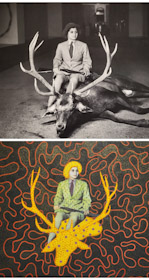
The British born artist Alexander Gorlizki (born 1967) , who holds a higher degree from the Slade School of Art (at University College London) and now works in NYC, has teamed up with Pink City Studio – a group of miniaturist painters in Jaipur – to present historic photographs in a new light.
The exhibition at MAP consists of several old photographs from the museum’s collection and new reproductions or prints of these vintage images. Gorlizki and his colleagues have taken the reproductions and painted over them in the traditional Mughal miniature style, but leaving faces in the photographs uncovered by paint.
The resulting ‘doctored’ photographs are mostly quite whimsical and witty. The highly imaginative ideas of the artists are skilfully and beautifully superimposed on the reproductions of the old photographs. Thus, the art of the original photographers has been metamorphosed by contemporary painters in Jaipur in collaboration with their curator, Alexander Gorlizki. The results, which are on display at MAP, are both amusing and most pleasing aesthetically . This is an exhibition well worth seeing.





 yamey
yamey 