
Exodus from Yugoslavia … for the lucky ones.

The Lutheran church in central Trieste was built in an austere late gothic style between 1871 and 1874. Outside its west end, in Largo Odorico Panfili, there is a tall cylinder surrounded by transparent glass or plastic. Within the cylinder there are models of people. This artwork is a monument to a tragic era.
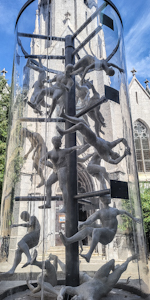
The monument called “Momentum”, designed by Jasmine Iannì and Giuseppe Sabatino, is dedicated to the memory of those Italians who fled from areas that had been Italian but had been incorporated into Tito’s Yugoslavia at the e d of WW2. These territories included Istria, Fiume, Dalmatia, and Zadar .

Well, I knew about these refugees, but not about something else commemorated by the monument. What I had not known about were the ‘foibe’ killings – massacres of Italians living in the formerly Italian territories that became part of Yugoslavia. These were, it is said, carrued out by Tito’s communist partisans. According to Wikipedia (https://en.wikipedia.org/wiki/Foibe_massacres):

“The estimated number of foibe victims is disputed, varying from hundreds to thousands,according to some sources 11,000or 20,000…”

I was horrified to learn about this. I had read that many anti-communist Yugoslavs and other opponents of Tito had been killed or imprisoned at the end of WW2. In the 1980s, I knew the wife of a man who had been imprisoned by Tito in 1945 because he was “the wrong kind of communist”, and was still behind bars in the mid-1980s.

However, until I saw the monument in Trieste today in September 2026, I did not know about the Italians who had been massacred simply because overnight in 1945, they were suddenly living in the wrong place.

THE EMPRESS BRANDISHES HER REVOLVER DURING A BATTLE IN ETHIOPIA

THE BRITISH MUSEUM is chock-full of exciting exhibits. To view them all would take many months, if not years. During a recent visit in March 2014, we were heading through the museum on our way to view a special exhibition of drawings and prints by four post-WW2 German and Austrian artists when we passed a painting that caught my eye. The exhibition was fascinating but not as much as the painting we passed as we were heading towards it.

The colourful painting (oil on cloth) was created in Ethiopia sometime between 1940 and 1949. So, by the British Museum’s standards it is relatively modern. The picture depicts two large armies facing each other. On the left side of the image, we can see the Ethiopian forces, and they are facing the Italians on the right side. Between the two armies, there are several dead or injured combatants. And amongst this carnage, there are two armed men on horses – they are riding towards the Italians. The faces of the Ethiopians are not all the same in appearance, whereas there is almost no variation of the faces of their Italian opponents.

Although it was painted in the 1940s, the picture illustrates the Battle of Adwa, which raged on the 1st of March 1896. The Ethiopians defeated the Italians. By the end of the 19th century, most of Africa had been invaded and occupied by various European nations. The exceptions were Liberia and Ethiopia. In 1889, Italy, having occupied to coastal territory of Eritrea, signed a treaty with King Menelik of Shewa. It was signed in Italian and translated into Amharic. The Italian version made Ethiopia a protectorate of Italy – virtually, an Italian colony. However, the Amharic version read differently – it agreed that the Ethiopians could use the ‘good offices’ of the Italians in their relations with foreign powers, if they wished.

The Italians decided to go to war with the Ethiopians to enforce the Italian version of the treaty. The Battle of Adwa put an end to the treaty with the Italians, who then recognised Ethiopia as an independent state. This situation lasted until the 1930s when Mussolini decided to invade the country.

In the painting at the British Museum, Emperor Menelik II of Ethiopia is depicted in the top left corner in his royal crown. In the bottom left of the painting, seated on a horse, and surrounded by Ethiopian soldiers, sits Empress Taitu of Ethiopia. Look carefully, and you can see that this veiled lady is holding a large revolver.

The painting is in a short corridor, which also has exhibits relating to the Copts of Egypt. As the painting fascinated me so much, I took little notice of the exhibits near to it. So, as if one needs one, yet another reason to revisit the British Museum.