Bats in a baobab tree in Bombay

I HAVE SEEN PHOTOGRAPHS of baobab trees, but until we visited the café of the formerly named Prince of Wales Museum in Bombay, I had never seen one ‘in the flesh’. A member of the mallow family of plants, baobabs are native to Madagascar.

Baobab tree in Bombay

These trees with curious looking conical trunks were imported to India by Arab traders. Although this is the case, this baobab in Bombay is the first such tree I have seen during my 30 years of frequent visits to India.

As we sat with our cold drinks, I looked up at the high branches of the baobab, and saw something flapping about. At first, I thought it was a black plastic bag caught in the branches. Then I noticed that it was a large bat stretching its wings. I saw it was not alone, but one of a large number of bats hanging on the high branches. These large creatures had black wings and dark brown bodies.

Despite the fact we had just seen a wonderful exhibition of ancient sculptures (from India, Ancient Rome and Greece, and Assyria), finding the baobab and seeing the bats in it, made my day.

A home and museum near Holborn

THE ARCHITECT SIR John Soane (1753-1837) created what is my favourite museum in London – Sir John Soane’s Museum. Son of a builder, Soane became a successful architect in the reigns of Kings George III and George IV. In 1806, he was elected Professor of Architecture at the Royal Academy. Although he was able to undertake the Grand Tour in Italy and Malta during the period 1778 to 1779, many of his students were unable to do so because of the Napoleonic Wars raging in Europe between 1803 and 1815.  This meant that they were deprived of the opportunity of viewing the great works of art and architecture, which was considered an important part of an architect’s training during the Regency Period. However, Soane got around this problem as I will explain.

Between 1792 and about 1812, Soane purchased and then demolished three neighbouring houses on the north side of Lincoln’s Inn Fields. He rebuilt them to his own designs. He continued remodelling their interiors to test out the efficacy of his novel architectural designs. One feature that stands out are his clever ways of getting natural light to reach parts of the buildings that were far from natural light sources. Often skylights are located above tall internal lightwells, which allows light to reach, for example the basement rooms. In addition, carefully placed mirrors assist the distribution of natural light. These clever methods of illumination were important innovations in the era before electricity or gas-lighting.

Soane lived in his houses, had his architectural workshops there, kept a picture gallery, and created a museum. The picture gallery is ingenious. A small square room, lit from above, has some of the pictures arranged in two layers, one covering the other. The wall carrying the outer layers of pictures is in fact a huge, hinged door, which can be opened to reveal the pictures on the layer it covers (see the photo above). By this method, Soane created much more hanging area within the room. The pictures and drawings include many by Hogarth and Piranesi, and at least one by Canaletto. There is also a pair depicting Soane and his wife. Other pictures depict buildings designed by Soane as well as projects that he planned but were never fulfilled. To squeeze so many large artworks into such a small room, where they can be viewed comfortably, is a work of genius.

Soane, who was a successful architect and married the daughter of a wealthy builder, was not short of cash. He spent some of it on purchasing a huge variety and a great number of antiques including the Sarcophagus of Seti (Egypt, c 900BC). The sarcophagus had lain in front of the British Museum for two years before he was able to purchase it from the man who owned it. It had been offered to the British Museum, which declined to purchase it for £2000. So, Soane bought it, and it is the most important exhibit in his museum. The other antiques include Ancient Greek and Roman as well as mediaeval and renaissance artefacts. Soane put much effort into arranging his collection and established it as a museum. In 1833, he managed to get a Private Act of Parliament passed. This enshrined in law that after his death, number 13 Lincoln’s Inn Fields (the museum) should be preserved in perpetuity in the state he left it. And this has been done faithfully, but with careful restoration when necessary.

One of the purposes of Soane’s Museum was to allow his architectural students to view and study the sort of things that would have been able to see had the Napoleonic Wars not prevented them from undertaking their own Grand Tour. A visit to the curiously cluttered museum is fascinating and wondrous. The staff and volunteers that keep an eye on the various rooms and chambers in the museum are well-informed and provide interesting information.

19th century photographers in Madeira and elsewhere

ALMOST WITHOUT REALISING IT, it seems that I have developed an interest in 19th century photographers. A visit to the Isle of Wight in 2022 led to me becoming interested in the life and work of the pioneer of artistic photography – Julia Margaret Cameron (1815-1879). She lived at Dimbola Lodge in Freshwater on the Isle of Wight between 1860 and 1875. It was here that she produced most of her highly creative photographs. I have written a book about her: “Between Two Islands: Julia Margaret Cameron and Her Circle”.

Five years after Julia left the Isle of Wight, my great-grandfather Franz Ginsberg travelled from the German Empire to King Williams Town (‘KWT’) in the eastern part of what was then the southern African Cape Colony. Aged 18, he arrived there with his future brother-in-law Jakob Rindl. The two men set up what became a successful commercial photographic studio in the town, which they might have chosen because many of its European inhabitants were German speakers. Although Jakob continued the studio after 1885, Franz diversified his activities by founding soap, match, and candle factories in the town.

I believe that despite becoming a successful industrialist and politician, Franz continued taking photographs as a hobby. Because of his success in KWT, other members of his family came out from Germany to work in the town. Amongst these were Franz’s nieces, Anna and Else Ginsberg. These two intrepid ladies founded a photographic studio in KWT. They were the first ladies to have opened a commercial photography studio in what was to become South Africa. Of interest, amongst each of the generations of Franz and Jakob’s descendants, there have been keen photographers including myself,

In May 2023, when we visited the city of Funchal on the Portuguese island of Madeira, we came across a museum that helped to bring 19th century photography back to life for me. It is the Museu de Fotografia da Madeira in Rua de Carriera. The museum is housed in what had been the premises of the commercial studio founded by Vicente Gomes da Silva (1827-1906) in 1863. The studio remained in business until 1978. In 1982, the Regional Government of Madeira purchased the building – Atelier Vicente – and used it for a museum of photography.  

Vicente Gomes da Silva became interested in photography in 1856, and by 1859 he was recorded as an amateur photographer in a local newspaper published in the June of that year. By 1863, he had made photography his business venture, and moved into the Atelier on Rua Carriera in 1865. A year later, he was appointed photographer to the Empress of Austria. His son, also called Vicente, continued the business, and was appointed photographer to the Portuguese royal family in 1903.

The museum is interesting not only because it exhibits the sorts of cameras that must have been used by my ancestors in South Africa and by Julia Margaret Cameron, but also because features that were characteristic of early photographic studios have been maintained and explained. The Atelier was opened before there was electricity on Madeira. The main studio area was arranged so that it was lit by northern light that filtered through skylights and curtains designed to make it a homogenous light source. Part of the studio’s laboratories had skylights that allowed ingress of sunlight that was required at various stages of preparing the photographic plates. At the back of the studio, there are a set of sliding panels, each painted with a different scene that could be used as a background to the people being photographed. The desired scene could be slid out behind the area where the subjects posed for their pictures. In other rooms, there are exhibits illustrating the history of cameras and photographic processes, as well as a fine collection of reproductions of images captured by some of the many photographers – both Portuguese and others – who worked in Madeira.  Some of the foreigners who took photographs on the island included British photographers such as Russell Manners Gordon (1829-1906) and Alexander Lamont Henderson (1837-1907).

Although I have no information about the appearances of the photographic studios used by my relatives in 19th century KWT, seeing the museum helped to give me an inkling of how their workplaces must have been. In the case of Julia Margaret Cameron, the places where she created images in her home, Dimbola, were far more makeshift from what I can gather.

Except for Julia Margaret Cameron, all the photographers I have mentioned, and many others working in the nineteenth century, aimed to create visually accurate images of their subjects. Often crystal clear, these pictures are fascinating but usually lifeless. What made Julia Cameron’s photography both unusual and full of life was her experimentation with focussing and processing. She used the camera not as equipment for capturing real life accurately on film but as a tool for creating works of art, in the same way as a painter uses the brush and the sculptor uses chisels. By doing this, she was far in advance of her time; experimentation with photography as a creative art form really only took off in the 20th century. The portraits and other composition that she created on film successfully captured not only their external appearance but also her astute interpretations of her subjects’ personalities.

My book about Julia Margaret Cameron can be obtained from Amazon: https://www.amazon.co.uk/dp/B0BZFCVLX9/ ,

and at the museum shop at Dimbola at Freshwater Bay on the Isle of Wight

Imported from India

IN THE FIFTEENTH century, the Portuguese made an important set of discoveries, which were kept a closely guarded secret. These discoveries brought great wealth to Portugal. The Portuguese navigators found routes from Portugal to India via the Atlantic Ocean and the Cape of Good Hope. By using these, they were able to transport spices and other valuable commodities from Asia to Portugal directly. Prior to the discovery of this sea route, goods from India and further east arrived in Europe via Egypt and the former Ottoman Empire. This overland route undoubtedly added various middle-man costs to the goods.

Once the Portuguese began sailing in the Indian Ocean, they successfully created a monopoly over trading in this area. However, after a period of uninterrupted use of the Indian Ocean, competition arrived in the form of mainly Dutch and British trading vessels.

Mother of pearl bowls from India

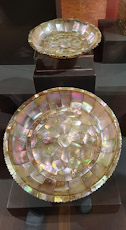
Madeira was one of the places that the early Portuguese ships called in at during their voyages. This was brought home to me during a visit to Funchal’s superb Museum of Sacred Art. In two of its rooms we saw religious artefacts – sculptures and two mother of pearl bowls – which were labelled as having come from India. There were others that came from ‘Portuguese Asia’. One item, a beautiful inlaid tortoise shell box, came from Japan.

Unlike the religious sculptures we have seen in old Portuguese churches in Goa, which often feature Indian looking faces, those in the museum had European facial appearances. An exception is a 16th century carved panel depicting St Francis Xavier asleep on the Island of Shangchuang. He is accompanied by two saints – one Indian and the other Chinese.

Seeing these beautiful old sculptures and other objects, which were made in Asia and then brought to Madeira, helped make the history of Portugal’s former pioneering navigational achievements a little more vivid for me.

Franco and Franco in Funchal

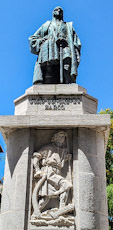
MOST VISITORS TO central Funchal in Madeira will pass, and probably notice, a bronze statue high up on a square based plinth outside the Bank of Portugal and the Golden Gate Grand Café. It depicts Joao Goncalves Zarco, who began the Portuguese settlement of Madeira in the 15th century. Very few people who pass this statue will know that it was created by a Madeiran sculptor, Francisco Franco (1885-1955). His older brother Henrique Franco (1883-1961) is one of Madeira’s most famous painters.

Both brothers studied at the Lisbon School of Fine Arts. They also spent time in Paris. Henrique returned to Madeira where he painted many of his pictures. Many of them are of Madeirans and scenes of the island. His paintings are beautifully executed and visually pleasing. Although the influence of Cezanne can be detected, Henrique did not seem to have affected by the innovative trends that were occurring in Western art during the 20th century.

Francisco visited Mussolini’s Italy in the 1920s and was impressed by the way that the state produced sculptures, which promoted the ethos and aims of the regime. He returned to Portugal, and began creating sculptural works that boosted the image of his country. Many of his important works were created for the Salazar government, which began in 1932.

Until our second visit to Funchal, I had never heard of the Franco brothers. Today, the 8th of May 2023, we visited a small museum in Funchal. It contains a fine collection of the works of both brothers. The museum contains many fine paintings by Henrique and sculptures by his brother, including a bust of Portugal’s former dictator Salazar. A video showing in the museum seems to suggest that far from being hostile to the Salazar dictatorship, Francisco was happy to create sculptures for it and its institutions.

Francisco attended an industrial school in Funchal. Its building is next to the museum. Over its main entrance is a carved stone sculptural frieze created by Francisco. The edifice now houses the Escola Secundaria de Francisco Franco, which opened in about 1976. Within its entrance lobby, we saw a bas-relief depicting the sculptor.

Although it is not one of Funchal’s main tourist attractions, the Museu Henrique e Francisco Franco deserves to be better-known.

A penguin in the museum

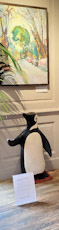
HAMPSTEAD’S BURGH HOUSE was constructed in 1704 and retains many of its original architectural features. Several of its rooms house a fascinating museum with exhibits relating to the history of Hampstead. I have visited the museum many times, but it was only today (the 9th of March 2023) that I noticed a model penguin on display. This used to stand inside High Hill Bookshop, which was located on Hampstead High Street. Founded by Ian Norrie in 1956, it remained in business until 1988.

During my childhood, in the 1950s and 1960s, I used to visit Hampstead almost every Saturday morning with my parents and my sister. We used to park the family car near to Jack Straws Castle, which is close to Whitestone Pond – one of the highest spots in London. Then, we would walk down Heath Street and along the High Street until we reached High Hill Bookshop. My parents were keen to encourage my sister and I to read. Therefore, every time we visited the bookshop, we had to choose one book each, which they purchased for us. I cannot recall all of the books I chose, many of them Puffin paperbacks, but I do remember that during these visits I gradually built up my collection of the adventures of Tintin by Hergé.

According to an article (https://jessicanorrie.wordpress.com/2017/08/04/the-best-independent-bookshop-in-london/) by Norrie’s daughter, Jessica Norrie, there was a party for Penguin Books held in the shop in 1960. The model penguin, which I saw in Burgh House today, was in attendance at that party back in 1960. I was eight in 1960, but I am afraid that I cannot remember seeing the penguin. It must have been in the shop during some of my visits, but then my interest in choosing a book was greater than looking for model penguins.

The penguin in the museum is black and white. On the white section of the bird’s belly, there are words, including “October 12th, 1960. High Hill Bookshop Silver Jubilee Party” and, also, some signatures. One of the signatures is that of Allen Lane, founder of Penguin Books. He died 10 years after the party. Another signature is that of the novelist Olivia Manning, There are several other signatures, but I found them too difficult to decipher.

Seeing the penguin at Burgh House brought back happy memories of my childhood and, at the same time, made me sad because High Hill Bookshop was irreplaceable. Waterstone’s, which followed in its wake, although well-stocked, lacks the charm of Ian Norrie’s wonderful creation.

You can read more about Hampstead past and present in my recently published book “Beneath a Wide Sky: Hampstead and its Environs”, which is available from Amazon: https://www.amazon.co.uk/BENEATH-WIDE-SKY-HAMPSTEAD-ENVIRONS/dp/B09R2WRK92/

A pavilion for Ramadan

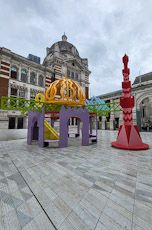
IN 2023 RAMADAN WILL occur between about the 22nd of March and the 21st of April. To celebrate this holy Islamic month, a colourful pavilion has been erected in the courtyard of the Exhibition Road entrance to the Victoria and Albert (‘V&A’) museum. It has been designed by Shahed Saleem and set up by The Ramadan Tent Project and the V&A. According to the museum’s webpage (www.vam.ac.uk/event/ok1kLZm29xJ/ramadan-pavilion-march-may-2023), the pavilion:
“…draws inspiration from the V&A’s Prints and Drawings collection to represent the history of the mosque and Muslims in Britain.”

Another webpage (https://www.vam.ac.uk/blog/museum-life/the-ramadan-pavilion-by-shahed-saleem) contains some interesting information about the history of Islamic edifices in the UK. The first mosque in Britain was built in 1889 in Liverpool by 20 British converts to Islam. It was housed in a Georgian terraced house. Since the arrival of many Muslim migrants in the UK im the 1950s and ‘60s, there is now a sizeable Muslim population in the country, and they worship in Britain’s approximately 1800 mosques. The earliest of these were in converted buildings, but now there are plenty of purpose-built mosques. Of these, one of the most beautiful and original is the mosque in Mill Road, Cambridge.

Shahed Saleem is an architect who specialises in designing mosques. Apparently, his pavilion at the V&A is the result of years spent studying mosques in Britain. With his Ramadan Pavilion, Saleem hopes that it will encourage people, who have never entered mosques, to explore mosque architecture and encourage them to enter these holy places to discover more about them. Well, that is an admirable aim, but from what I have seen of the pavilion, it is unlikely to fulfil that aim.

Undoubtedly, Saleem’s pavilion incorporates elements of mosque architecture and design. Sadly, it looks to me more like a children’s play area than a homage to Islamic architecture. I love Islamic architecture, but feel that the multi-coloured pavilion, which resembles something made with over-sized Lego bricks, does not respect the great beauty, delicacy, and intricateness that can be found in mosques both old and modern.

A new museum on the map

THE MUSEUM OF ART and Photography (‘MAP’) in central Bangalore has just opened (on the 18th of February 2023. Facing the Visvesvaraya Industrial & Technical Museum, MAP is housed in a brand new building with some attractive architectural features.

The edifice has five floors and a basement, which is home to an exorbitantly priced café, run by a company called Smoor. The ground floor has a reception area, a book/gift shop, and some gallery space. This is currently housing an exhibition of fascinating, attractive sculptures by LN Tallur. Some of the works of this contemporary artist allude to Hindu deities in a novel way.

The first floor is home to an auditorium, named after one of MAP’s major donors, Mazumdar-Shaw. Kiran Mazumdar-Shaw, a childhood friend of my wife, is a keen collector of art and has helped finance many other cultural establishments. On the same floor, there is a digital exhibition, whose subject matter can be chosen by the visitor.

The second floor is dedicated to offices and a library. Above this on the third floor, there is currently an exhibition of photographs by Jyoti Bhatt (born 1934), who began his artistic career in the famous art school in Baroda (Vadodara) in Gujarat. His works range from excellent straightforward documentary photography to highly creative artistic photography and collage work.

On the fourth floor, we enjoyed a beautiful exhibition called “Visible/Invisible”. Curated by Kamini Sawhney, Arnika Ahldag, Vaishnavi Kambadur, Riya Kumar and Arshad Hakim, this show explores the visual representation of women in artworks through the ages. Words alone can not do justice to the impactful nature of the display, but I will give you a rough idea of its range. In addition to paintings, modern and old, there are sculptures; photographs; tapestries,; traditional textiles; prints; and a video installation. Most of the artworks in this show were created by Indians or members if the Indian diaspora. The show successfully demonstrates how women have been portrayed over the centuries and how this has changed, especially more recently.

The fifth floor has a terrace from which there are some great views. There were some tables and chairs up there, but the café, if it exists, was not open.

Some years ago, we were in Bangalore when its branch of the National Gallery of Modern Art (NGMA) was opened in a restored palatial mansion near the Bangalore Golf Club. A beautifully designed annex was built next to the old building. When it was opened, I decided that it was a ‘must-see’ attraction in Bangalore. It remains so, but MAP in its newly constructed home will join NGMA amongst my suggestions of what should not be missed by visitors (and inhabitants) in Bangalore.

An empty cupola in Chennai

ONE OF THE FIRST things that a visitor sees when entering Chennai’s Fort St George is a cupola supported by eight fluted pillars topped with Ionic capitals. It looks as if it ought to contain something, but it is empty.

In 1792, after losing a military campaign against the army of the British East India Company, the ruler of Mysore, Tipu Sultan, surrendered two of his sons as hostages to be held by the British. They were handed over to the British commander Lord Cornwallis. Tipu’s sons were taken to be held by the British until he had paid them an enormous sum of money, deemed to be reparations for damages that were supposed to have been inflicted on his British opponents. He managed to pay this ‘ransom’ after a couple of years, and his sons were returned.

Cornwallis was regarded as a great hero by the British. In about 1800, Thomas Banks sculpted an enormous stone statue of Cornwallis standing on a tall stone cylindrical base. The base has figures sculpted in bas-relief. The bas-relief depicts the moment when Tipu’s sons were handed over to Cornwallis.

At first, the statue was housed in the above-mentioned cupola. Later, it was moved indoors, first to the Long Room of the Connemara Library, and then later to the museum in Fort St George. It was moved indoors from its original position beneath the cupola, because, to quote an informative panel near it:
“… of ill feeling caused by certain reliefs on its base.”
Well, at least it was never toppled to the ground as was the case with, for example, statues of Stalin, Enver Hoxha, and the Bristol slaver Edward Colston.

A postman and his spear

Happy New Year!

NEXT TO THE POST OFFICE on the corner of Bangalore’s Museum and State Bank of India Roads, there is a recently opened Museum of Communication. Housed in an old-fashioned Bangalorean bungalow, it is effectively a museum of the Indian postal services. This well laid out museum contains a variety of exhibits ranging from postage stamps to large pieces of mechanised equipment. I will describe a few of the many exhibits that interested me.

There is a photograph of the world’s highest post office (somewhere in the Himalayas). There is an enormous piece of equipment, which occupies the whole of a room. It was used for transmission of money orders. Several panels described the history of the Indian freedom struggle and that of the Indian Post.

Outside on the museum’s shady verandah, there is a collection of old letter boxes. They include boxes of various shapes, sizes, and colours. One of them bears the Portuguese words “CAIXA POSTAL”. Once upon a time, it must have been used in one of Portugal’s Indian colonies, but there was no information about its original location.

Outside the museum, and still in use, there is a hexagonal pillar box, very similar to one placed at the Bowring Institute in the late 1880s. Unlike the one at Bowring, which bears the British Indian postal insignia, the box near the museum has been modified to make it look like a post-Independence Indian Post pillar box.

Next to the entrance to the museum, also on the verandah, there is aalifesize model of an Indian postman of yesteryear. Wearing a green and white uniform (including a turban) with some red trim, he has a sack slung over his left shoulder. His right hand is stretche out in front of him. In it he holds a wooden shaft tipped with a sharp metal spear tip. Four small bells are attached to the base of this tip. A lantern hangs from his right wrist.

In the past, the postman mafe his way from village to village along paths through the jungle. The spear tip and its staff were used to ward off wild animals. The lantern was used to light his way, and the bells were rung to alert villagers to his arrival.

Visiting the museum was an interesting experience. Seeing the hardships that postmen used to face should make us pleased that we can now communicate using fax, email, and other modern inventions.