
THE COUNTRYSIDE AROUND Murshidabad is dotted with brick factories. Their tall, often smoking, chimneys are surrounded by vast expanses of new bricks, usually stacked neatly. The clay that can be found in the area is particularly good for brick making. So, it is unsurprising that many local buildings make substantial use of brickwork.
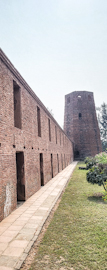
Near Murshidabad, there are two famous mosques constructed not with stone or concrete, but with bricks. One of these, the Katra mosque, was constructed entirely with bricks between 1723 and 1724. This huge edifice was built not only as a mosque but also as a caravanserai. It is one of the largest caravanserais in the Indian Subcontinent. The rooms of the caravanserai are arranged in a square that surrounds the mosque rather like cloisters in a monastery. These small rooms also served as workplaces and bedrooms for students studying the Koran and other Islamic texts. Thus, the Katra was a complex consisting of a mosque, a caravanserai, and a madrasa. At each of its four corners, there were tall brick towers. Only two of these remain. The tomb of Nawab Murshid Quli Khan(1660-1727) is located under the staircase leading to the main entrance of the building. Protected by the Archaeological Survey of India, the remains of the Katra complex are well conserved. This is not the case for another brick mosque nearby: the Fauti Masjid.
The Fauti was constructed in 1740 by Nawab Safaraz Khan (c1700 – 1740). However, it was never completed. It is a large mosque, 137 feet long and 38 feet wide. If you manage to chamber within it, which I did with great difficulty despite helping hands, the remains of its five huge incomplete domes can be seen.
The Fauti is a protected building, but in a bad condition. It is possibly perilously unstable. However, because of the vegetation around it and within it, it is a picturesque ruin of the sort that eighteenth and nineteenth century European Romantic artists enjoyed portraying.
In addition to these mosques, which were built using baked clay (I.e., bricks), we have also seen some Hindu temples near Murshidabad that include terracotta in their construction. But more about these at a later date.


 yamey
yamey 