Quilts in a wonderfully designed library

OUR FRIEND MIKAEL is an accomplished creative quilter (maker of quilts). Some of her artistic quilting is on display alongside works by other quilters in London’s Swiss Cottage Library until the 26th of July 2023. I must admit that when I learned that we were going to see an exhibition of quilts, my heart sank a bit. However, I am glad we went. I had no idea how creative and imaginative quilt makers can be. Well displayed in Swiss Cottage Library, there is a collection of extremely artistic contemporary quilts, which are well worth seeing. Far from simply being scraps of material stitched together, the quilters have used their imaginations and skills to create artworks which are not only beautiful but superbly innovative.

Until I entered Swiss Cottage Library today, I cannot recall having been inside it since about 1965 when I left the nearby Hall School, aged 13. I have passed its distinctive exterior often but never bothered to go inside. I was at the school between 1960 and 1965, and I remember visiting the then new library after it opened in November 1964. It was designed in the Modernist style by Basil Spence (1907-1976), who was born in Bombay. He based his library on the design of several that he had visited in Scandinavia. All that I can recall of the new library was that its shelves contained a far better range of books than our local library in Golders Green. Being a pupil in the area, I was able to borrow books from the Swiss Cottage Library, which I used to visit often because I found it to be so wonderful.

Although I can remember the superb collection of books that existed in 1964-1965, I could not recall the appearance of the library’s interior. It was only today when we visited the quilting show that I appreciated what a superb job had been done by Basil Spence and his team. Even though it was designed in the early 1960s, the style of the well-lit spacious interior has not dated at all. The interior of the library is far more intelligently conceived than most new British buildings created in the last few years. It is uplifting to wander around the various peaceful spaces within the library. If it were nearer home, it would be a place where I would want to go regularly to read and write.

I am grateful that Mikael invited us to see the quilting exhibition not only because it contained aesthetically pleasing works of art but also because I got to go back inside the library. Although I was not particularly interested in architecture when I was 11, my fascination with it began to grow a few years later. There was even a brief period in my life when I toyed with the idea of becoming an architect. Even though I did not pursue that profession, my love of good architecture – both modern and historical – has persisted. I believe that now, in my retirement, my appreciation of great buildings (such as Swiss Cottage Library) is greater than it has ever been. Even if you miss the quilting exhibition, it is worth making a detour to see Spence’s wonderful creation – both inside and outside.

An interesting intersection

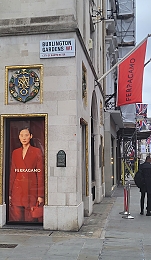
WHERE BURLINGTON GARDENS meets the south end of New Bond Street and the north end of Old Bond Street, there are two things that reminded me of my late mother.

One of them is a shop in a colourfully decorated building. This edifice used to be the home of Atkinson’s – a firm that sold perfumes and beauty products. Founded in 1799, it moved to the building on the corner of Burlington and Old Bond Streets in 1832. The decorative building is surmounted by a carillon of 23 bells, which is played by hand occasionally – to celebrate both public and private special occasions. Currently, the ground-floor is occupied by a branch of Ferragamo’s. And this firm has a connection with memories of my mother.

Salvatore Ferragamo (1898-1960), born in Italy, was a designer of luxury shoes. His clients included the Maharani of Cooch-Behar, Eva Peron, and Marilyn Monroe. He died in Florence (Firenze), where he had a shop on the Via dei Tornabuoni. This shop was close to Via del Giglio, where we as a family used to spend a fortnight in the city every year until I was about 15.

One of my clearest memories of our sojourns in Florence was not the Uffizi or the famous Duomo or the Medici Chapels, or even Michelangelo’s statue of David, but Ferragamo in Via dei Tornabuoni. You might wonder why. It was not that I have a shoe fetish or any great interest in footwear. It was because of my mother. Hardly a day passed without us having to enter Ferragamo’s to watch my mother trying on several pairs of shoes. For a youngster like me this was not an interesting way to spend my precious school holidays. And what is more, I cannot recall my mother ever buying a pair of shoes in that shop.

Facing Ferragamo’s on the corner of New Bond Street and Burlington Gardens, there is a small paved open space. In the middle of it, there is a bronze sculpture of a horse and rider. This was sculpted by Elisabeth Frink (1930-1993). My mother was also a sculptor and met Frink (or ‘Liz Frink’, as we knew her) at St Martins School of Art (in Tottenham Court Road), where they both worked in the Sculpture Department. They became close friends. I used to meet Liz Frink when she was invited to our house for dinner occasionally.

The Frink sculpture has been on Bond Street since 2018. Before that, it was located at the corner of Dover Street and Piccadilly, where it was placed in about 1975. As for the branch of Ferragamo’s that faces it across Burlington Gardens, I am not sure how long it has occupied its present site. However, it was only today that it occurred to me that the intersection of the two Bond Streets with Burlington Gardens has a connection with recollections of my mother.

Photographs taken in a garden

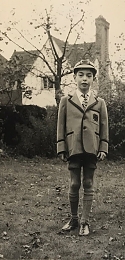
IN 1960, when I was 8 years old, I was accepted as a pupil at the Hall School in London’s Swiss Cottage area. Recently, I received some photographs of me in my newly acquired Hall School uniform. They were taken in the garden of our house in Hampstead Way in the Hampstead Garden Suburb, Maybe, it is fortunate that the photographs are in black and white because the Hall’s uniform was pink trimmed with black. The Hall’s ‘logo’ was a black Maltese cross – also a symbol used by the German army. I remember occasionally, children from other schools used to shout “Nazis” at me and my friends when we were wearing our uniforms in the street. The photographs were taken by my uncle Felix, who was born in South Africa.

When Felix came to London from South Africa in the second half of the 1950s, one of his first jobs was working in a photography shop in London’s Holborn. Like other members of my mother’s family, he was a keen photographer. His grandfather, my great grandfather, opened a photography studio in King William’s Town in the Eastern Cape in 1880.  It was while Felix was working in the shop that the photographs of me in my new uniform were taken.

I remember the occasion vividly. Felix arrived at our house in the Suburb, carrying with him a great deal of equipment borrowed from the shop. Most of it was professional lighting on collapsible stands. Felix spent some time setting up a photographic studio in our living room. There were wires all over the place, and every electric socket in the room was used to power the lighting. I was positioned in a suitable pose. When he was ready, my uncle began switching on the lights. Then, it happened. The house’s electrical fuses blew, and all the lights went out. I remember that my parents were not too pleased with what had happened.

Because of the electrical problem, the much-wanted photographs, which were to be sent to relatives in South Africa, had to be taken outside in the garden. Seeing these pictures six decades later brought that occasion to the forefront of my memory.

Felix was a delightful, kindly man. He was everyone’s friend, and never harboured a grudge against anyone. Although he never had any children, I believe that he regarded the whole world as his family.

Cattle in Cornwall and Denmark

THE EARLY MORNING sun was shining over the hills surrounding our holiday cottage near Wadebridge in Cornwall, and we decided to take a stroll along the narrow country lanes nearby. The air was crystal clear, and we could see far-off grassy fields dotted with grazing sheep. Wind turbines with slowly turning blades punctuated the northern horizon. After crossing a small, fast-flowing stream, we ascended a steep hill. Every now and then, gaps in the walls bordering the roadway afforded us with splendid views. We reached the entrance to a field, I was reminded of a holiday I enjoyed in 1962 when I was ten years old.

Cows in Cornwall

Early in 1962, I underwent surgery to have my inflamed appendix removed. A few weeks after this, we set off for Denmark in our family Fiat 1100. It was just before Easter and the weather was cold. After traversing West Germany, we crossed into Denmark and headed for our destination, a farm near Toftlund in Jutland. The farm was owned by Lis, one of our former au-pair girls, and her husband. One thing I remember about Toftlund was something pointed out to me by Lis’s father. He showed me that each house had two different numbers: one was on a red background, and the other on blue. I cannot remember which was which, but one numbering system was that of the Danish authorities, and the other was that of the Germans, who had formerly occupied this part of Denmark.

The most memorable and enjoyable aspect of our weeklong stay on the farm was being able to mingle with the farm animals. The cattle and pigs were housed in sheds because it was too cold for them to graze outside. All day my sister and I enjoyed watching and stroking the animals. I think that the time we spent on the farm was so much fun because it was far more ‘child friendly’ than most of our other family holidays, which were centred around my parents’ fascination with artworks in Italian churches and museums.

Some of the cattle had horns. There is nothing unusual about that. However, my mother, who worried about most things and saw potential danger everywhere, was extremely concerned about these horns. What made her anxious was the possibility that one of the creatures might gore me and thereby cause my appendicectomy scar to burst open. Luckily, I survived to tell this story.

Returning to our walk in Cornwall, you will recall that we had reached an entrance to a field that sparked off my memories of Denmark more than 60 years ago. The gate to the field was the entrance to a small pen, The pen contained several cows waiting to be moved somewhere, or maybe to be milked. Seeing them staring at me staring at them reminded me of my wonderful holiday near Toftlund.

Eating there again at least 50 years later in Venice

EARLY IN SEPTEMBER (2022), I was eating spaghetti alle vongole (spaghetti with clams) in a restaurant in Venice (Italy). The place where I was eating this delicious dish has many memories for me.

Lantern hanging outside the entrance to the Antica Locanda Montin

During the late 1950s and throughout the 1960s, my parents took my sister and me for annual holidays in Venice. My parents were discerning eaters. Unfortunately, back in those now far-off times, there were very few restaurants in Venice which served food that met my parents’ approval.  Eventually, they homed in on one place that they liked enough to return there for every evening meal (our accommodation provided lunch as part of our demi-pension deal). That restaurant is called the Antica Locanda Montin (‘the Montin’). According to its website, it has hosted celebrities including Modigliani, Ezra Pound, Robert de Niro, Luigi Nono, and David Bowie. Well, I did not know that when I used to dine there with my family.

During our recent trip to Venice, we found out that the Montin is still in business, and we booked a table for lunch. To my delight and amazement, the restaurant looks exactly as it did when I last visited it over 50 years ago. It does not seem to have changed one little bit. The front of the Montin faces a small canal. The dining room is long and rectangular. At the far end opposite the front door, a rear door gives access to a pleasant garden, where people can eat in good weather. The walls of the dining room are covered with framed paintings, many of them of great artistic quality. Apparently, they have been donated over the years by artists, who have dined in the restaurant.

I cannot remember what I used to eat at the Montin over 50 years ago. However, my spaghetti alle vongole was tasty and enjoyable. My wife and our daughter were also happy with what they ate. Our lunch was one of the better meals we ate during our four days in Venice. What I enjoyed even more than the food was discovering that the Montin looks as it did when I was much younger. I am glad that the place has survived the trying times we have been through recently and Italy’s various economic crises.

Out to sea without stepping off land

THE FIRST TIME I visited Southend in Essex was in about 1960. I was invited to go there on a day trip with my best friend, his younger brother, and their father, who was a senior official in London Transport. We went by car, stopping on the way at several London Transport bus garages, where we saw a few vintage busses. I remember two things about Southend on that first visit. First, we ate fish and chips. It was the first time I had sampled this cuisine because my parents were too snobbish about food to have been seen dead in a fish and chip shop. I have enjoyed fish and chips ever since that time in Southend. The other thing that sticks in my mind was travelling along Southend Pier in a special train that carried passengers almost to its furthest point from the seafront. It was not until the 11th of February 2022 that I made my second visit to Southend.

Southend Pier

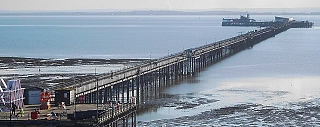
Southend Pier is the longest pleasure pier in the world. It is 1.34 miles (2.16 kilometres) in length. The present pier, which replaced an earlier wooden one built in the early 1830s, was completed in the late 1880s. it was opened to the public in 1889. At about this time, the single-track railway running along it was also ready for use. It was extended by 1898. The trains were then electrically operated. In 1978, the electric railway was closed. By 1986, it had been re-opened using trains that were driven by diesel engines. It was on one of these that we took a return trip this February.

I enjoy piers. They provide a way of going out to sea without leaving land and without risking seasickness. In addition, like the one at Southend, most of the piers in England are visually satisfying when viewed from the shore. At the sea end of Southend Pier, there are various structures ranging from painted wooden shacks to the beautiful contemporary-style Royal Pavilion, opened in 2012. Despite being a complete contrast to the other constructions on the end of the pier, it enhances to visual attractiveness of the area.

Although the pier was not the primary reason for our excursion to Southend, it certainly enhanced our enhancement of the place as did our lunch at a local fish and chips shop.

Stay away from the windows

HAPPY NEW YEAR!

Many years ago sometime during the 1980s, I spent New Year’s Eve in Belgrade, which was then the capital of a country that no longer exists: Yugoslavia.

I was staying with my good friend Raša. He enjoyed a good party. We set out to attend one in New Belgrade, which was built after WW2 on the left bank of the River Sava, a tributary of the Danube.

The air was chilled when we left Dorčol, the old part of the city where Raša lived. There was an odour in the wintry air that I always remember: the smell of the smoke from the lignite that was burned in central heating units in the city.

As we travelled in the tram towards New Belgrade, my friend explained that many retired military personnel lived in New Belgrade. Many of these people kept guns and rifles in their flats.

Raša advised me to keep off the balcony and well away from windows as the last midnight of the year approached. The reason for this was that as the new year began, drunken people would begin firing their weapons to celebrate. There was a good chance both of being struck by poorly aimed bullets and by others that ricocheted when they struck walls and so on.

Midnight came and went, but I cannot remember hearing any gunshots. Maybe I had imbibed too much vodka and other highly alcoholic drinks such as sljivovitz and loza!

Now, Yugoslavia is only a fond memory as is my friend Raša. I last saw him in May 1990. He passed away several years later after having done much work to help refugees caught up in the civil wars that tore Yugoslavia apart.

Shish kebab and sausages

Not long ago, I wrote about Warren Street, which played a significant role during part of my life. Now, let’s move a little further south to a street, which is overshadowed by the Post Office Tower and contains many memories for me.

CHAR 0

London’s Charlotte Street runs between Rathbone Place in the south and Maple Street in the north. It is just over half a kilometre in length. Laid out in 1763, it was named after Queen Charlotte, who married King George III. I began to get to know the street just under 200 years later.

My earliest recollections of Charlotte Street were regular visits in the early 1960s to the Hellenic Stores on the west side of the street south of Goodge Street. My mother bought olives and other Mediterranean products at this store and another Greek shop in nearby Goodge Street. The latter was smaller than the Hellenic Stores, and a little less honest. When something needed weighing in the Goodge Street shop, the shopkeeper would throw it on the scales. The weighing machine’s needle would flash across the dial, and before one had time to think, a price was given. Neither of these purveyors of Greek produce exist anymore.
CHARL 4 site of Schmidts

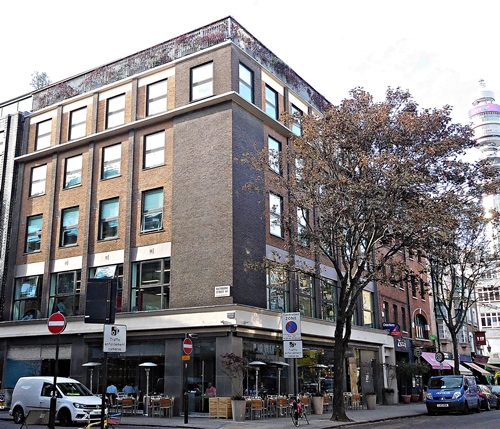
Site of Schmidt’s, now rebuilt

During the twelve years (1970-82) that I studied at University College London (‘UCL’), I used to visit Charlotte Street often. As a student, I was always keen to find somewhere to eat cheaply. Schmidt’s on Charlotte Street was one such place. This was a German restaurant. Its dining area was on the first floor. Most of the waiters were pasty-faced gentlemen, who added to the gloomy atmosphere of the place. The ground floor served as a delicatessen. It contained a counter where boiled Frankfurter sausages were served with mustard and slices of delicious greyish German bread. They were very cheap and extremely delicious.  A female cashier sat in a booth in the middle of the room. Whenever I saw her, she had a blackish facial hair where men grow moustaches. My father, who was in London during the 2nd World War, told me that during the conflict, the owners of Schmidt’s posted labels on their windows, which read: We are British, NOT German.”

There have always been plenty of eateries on Charlotte Street. L’Etoile, which I never entered because it was beyond my budget, was a long-established restaurant on Charlotte Street. It had a Parisian look about it, but like Schmidt’s, it has disappeared. Near to the posh L’Etoile, there was a Greek ‘taverna’ called Anemos. I never visited it, but plenty of my fellow students did. One did not visit Anemos for its food, but for its riotous atmosphere, which included music, dancing and the trational Greek practice of plate breaking. Venus was another Greek place that has long since disappeared. I was taken there several times by an uncle, who worked nearby and regarded it as his favourite Greek restaurant.

CHARL 3

Just north of Goodge Street, there is another long-standing, and still existing, restaurant. This is the Pescatori, an Italian place specialising in fish dishes. It was one of my parents’ favourite restaurants in London. Back in the 1960s, there used to be a life-size boat suspended from the ceilings above the tables. I believe that my father was being serious when he said that he preferred not to sit beneath the boat, in case it fell.

CHARL 5

There was another fish restaurant in Tottenham Street that leads east of Charlotte Street. Pescatori was at the high end of the scale of elegance, and Gigs was at the lower end. Gigs was very popular with students from UCL and workers in the neighbourhood. It was divided into two sections: take-away and sit-down. At lunchtimes, there was always a long queue at the take-away counter. Two gentlemen, oozing with sweat, took the orders for fish and chips and also for the delicious lamb shish kebabs they prepared while you waited. In between taking the cash and wrapping the fish and chips, they threaded lumps of lamb onto skewers, and grilled them. The kebabs were served with salad in a warm pita bread. As the saying goes, they were ‘to die for’. Despite the rather haphazard-looking hygiene, I know no one, who died from these mouth-watering bundles of meat and salad.

Gigs closed many years ago. Then a few years ago, the premises were modernised, and Gigs was brought back to life by some relatives of the original owners. What used to be the take-away section is now an attractive restaurant, and what used to be the sit-down area is now the take-away area. The updated Gigs is both hygienic in appearance and looks as if it is designed to attract a more sophisticated clientele than its ancestor.

My father was a professor at the London School of Economics (‘LSE’) for most of his working life. The LSE has a hall of residence for students, Carr-Saunders Hall, a non-descript 1960s building on Charlotte Street. When it opened in 1964, my father’s colleague Kurt Klappholz was its first warden. Kurt, whom I knew well as a family friend, was a Polish Jewish Holocaust survivor. Later, another of my father’s colleagues was a warden there many years ago. Once, he invited me to his flat. This academic possessed the most wonderful sounding HiFi equipment that I had ever heard. The warden, who owned it, was rather over-built. He told me that he preferred listening to music sitting in a comfortable armchair in front of his HiFi, than trying to squeeze into uncomfortably narrow chairs in concert halls.

CHARL 1

The building that used to house Cottrells

When I became a dental student, I became aware of Cottrells in Charlotte Street. This was near the Rathbone Place end of the street. It was the showroom for a major supplier of dental equipment. Housed in an elegant Victorian building, which still exists (it now contains a restaurant), the firm supplied everything from dental examination mirrors to entire dental operating units (chair plus attachments fordrills etc.) The technician responsible for teaching me how to cast gold crowns (caps) told me to visit Cottrells, not to look at the equipment, but, instead, the pictures hanging on the walls of the showroom. The walls were hung with a large collection of paintings by William Russell Flint (1880-1969). He specialised in depicting women.  Well-painted, and quite artistic, the paintings on the walls of the dental showroom and of its main staircase fell very definitely into the category of extremely light porn.
CHARL 6 Rathb Pl

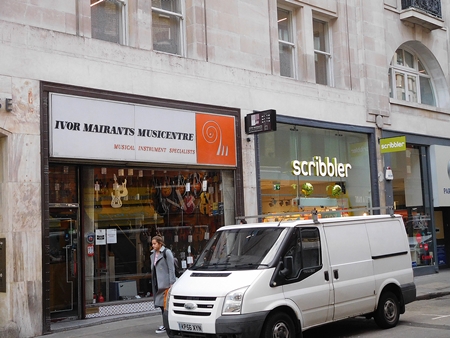
One of the longer established shops in Rathbone Place: Mairants

Rathbone Place, a short street which connects the southern end of Charlotte Street contained a large postal sorting office. Quite late on in life, one of my uncles, a bachelor now sadly no longer living, got a job there as a postman. He often used to tell me about his experiences as a medical orderly in the South African Army in the North African desert during the 2nd World War. He spoke of them fondly, regarding the great camaraderie he experienced amongst his fellow serving men. I often felt that this was one the more enjoyable times in his long and varied life. When he joined the postal team at Rathbone Place in his fifties, he spoke of this in the same appreciative terms. He liked being part of a working team. Now, not only has my uncle gone, but also the sorting office no longer exists.

Charlotte street and its surroundings lie in the shadow of the Post Office Tower, which was ready for use in 1964. Until 1980, it was the tallest building in London. When it opened it had a revolving restaurant high above the ground. I never ate there, but did manage to visit the viewing platform just beneath it. When I looked up from this platform, I could watch the concrete base of the restaurant rotating slowly. A terrorist attack in 1971 put an end to the public being allowed to visit the viewing platform or any other part of the tower.

I still wander along Charlotte Street occasionally. Although it is still extremely vibrant, it evokes many memories of times long past.