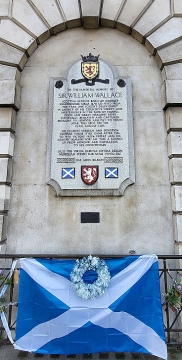
FACING SMITHFIELD MEAT market, there are three wall plaques commemorating four men who were martyred at Smithfield, which several centuries ago was an important site for executions. The four men, whose memorials I saw today (17 March 2026), were: Wat Tyler (c1320-1381), John Ball (c1338-1381) who was executed in St Albans, William Wallace (c1280-1305), and John Bradford (1510-1555).
Sir William Wallace memorial
Tyler and Ball were significantly involved in the Peasants Revolt. William Wallace, a Scot, was one of the main military leaders in the First Scottish War of Independence (1296-1328), and was captured by the English, taken to London for trial, and executed at Smithfield. And Bradford, a Protestant, was executed for alleged crimes against the Catholic Queen Mary I.
Today, Smithfield is becoming a trendy area with plenty of bars, pubs, and restaurants. It is difficult to imagine that it was once a place where these dreadful executions were carried out.
WHEN RABINDRANATH TAGORE (1861-1941) visited China in 1924, he gave a series of lectures in English, which were translated for the Chinese audiences by the talented young poet Xu Zhimo (1897-1931). During a visit to Cambridge (UK) in August 2024, in several shop windows I noticed a book called “Xu Zhimo Cambridge & China” by Zilan Wang. Even though Cambridge has many students and tourists from China, I wondered about it.
Xu Zhimo was born in Haining (China). He studied law in Beijing, then in 1918 travelled to the USA, where he studied for, and was awarded a degree at Clark University in Worcester, Massachusetts. After starting a degree at Columbia University in New York City, he left the USA because he could no longer stand the place. He then travelled to the UK, where he first studied at the London School of Economics, and then at Kings College, Cambridge. It was in Cambridge that he became deeply attracted to poetry, and began writing it. In 1922, he returned to China, where he became an important figure in China’s modern poetry movement. He was a believer in ‘art for art’s sake’ rather than the (Chinese) Communists’ belief that art should serve politics.
When Tagore came to China, the country was in turmoil: there was fighting between rival warlords and the risk of an invasion by the Japanese was great. Xu Zhimo served as one of his oral interpreters, translating Rabindranath’s romantic (English) language into vernacular Chinese. Tagore did not rate his visit to China a great success. He was met with some hostility as Huan Zhao explained in the introduction to an article entitled “Interpreting for Tagore in 1920s China: a study from the perspective of Said’s traveling theory” (Perspectives, Volume 29, 2021 – Issue 4):
“During Tagore’s visit, his initial perceptions of welcome were transformed dramatically into a feeling of rejection, resulting in an unpleasant sojourn. After forty-odd days, Tagore left China, disconsolate, with his mission unaccomplished. Exactly what happened remains unclear. The introductory flyleaf of Talks in China claims his poor reception had much to do with ‘organized hostility from the members of the Communist Party and was labeled as a reactionary and ideologically dangerous.’ Others maintain that Xu, as Tagore’s interpreter, should shoulder much of the responsibility for the visit’s outcome – that Xu’s efforts to enhance his own fame while welcoming Tagore effaced Tagore’s purposes and ideas”
And in the author’s conclusion, the following was written:
“In 1920s China, Tagore’s lectures and Xu’s interpretations faced strong resistance from Chinese intellectuals who sought radical social reform. This resistance interrupted Tagore’s visit and inflicted lasting anguish on his interpreter Xu Zhimo. Although challenged by critics, Tagore’s lectures continued to influence Chinese philosophers, thanks in large part to Xu’s unyielding efforts to expand and explain Tagore’s lectures.”
Xu Zhimo was killed in an air crash in November 1931.
On our recent visit to Kings College in Cambridge, we stopped to look at a large stone on which Chinese writing characters are inscribed. We had passed it on previous visits to the city, but had not investigated it. This time, we noticed a short path leading from the stone into a circular enclosure surrounded bushes and trees. The path is lined with rectangular paving stones on which some lines of a poem by Xu Zhimo is carved. Alternate stones are in Chinese, the others are in English. The words are from Xu’s poem “再别康桥” (Zài Bié Kāngqiáo, which means ‘Taking Leave of Cambridge once more”), which he wrote in 1928. The enclosed area has a small bench upon which we sat, watching a continuous stream of Chinese people visiting the memorial, stopping to look at it respectfully.
MACBETH STREET IS a short thoroughfare in Hammersmith. It runs from Kings Street to the A4 dual carriageway. We often walk along it to reach the pedestrian subway beneath the busy A4. There is an architecturally unexciting building on Macbeth Street, which I would not have stopped to look at had I not noticed two memorial plaques affixed to it.
One of the plaques bears the words:
“This stone was laid To the Glory of God on June 28th 1930 on behalf of the South Street Mission by Mrs Alfred Goodman. Mission superintendent Sister Lizzie”
The other plaque reads:
“To the Glory of God on June 28th 1930 on behalf of the Shaftesbury Society by Sir Charles JO Sanders KBE. Treasurer L(?) Goodman Esq”
“South Street Mission Hall. This was run by Sister Lizzie as a women’s refuge. South Street Mission Brass Band was active from around 1910s through to the 1950s. The building now appears to be operated as a church centre probably through St.Paul’s church. It also appears to have links with the Shaftesbury Society and the St.Barnabas movement operating as a centre for the homeless and a night shelter for street sleepers.”
As for the Shaftesbury Society, according to Wikipedia:
“In 1872 the social reformer Lord Shaftesbury established the Emily Loan Fund to enable young women flower sellers to support themselves. Later, in 1914, the Ragged School Union merged into the Shaftesbury Society, becoming fully subsumed under the title of the Shaftesbury Society in 1944.”
“Whos Who 1938” has an entry for Sir Charles JO Sanders. He was an important civil servant involved in shipbuilding matters. The reference to him includes his philanthropic work:
“… a well known worker amongst the poor in all kinds of religious, social, and philanthropic work, Chairman of Council of Shaftesbury Society and Ragged School Union, 1918, 1919,1929, 1930, 1936 and 1937, Treasurer since 1933.”
As for Sister Lizzie, I have not been able to discover more about her.
Today, the building is used by various religious groups including the ‘House of Worship’ and the ‘Sword of the Spirit – Int. Prophetic Ministries’.
I guess that the memorial plaques, which caught my eye, were placed when the present building was built to replace an earlier version.
IT IS NOT UNCOMMON to see gravestones with inlaid engraved brass images in English churches. Known as ‘monumental brasses’, they began to be used in the 13th century instead of three-dimensional effigies and images throughout Europe to commemorate the dead. These often-elaborate brasses are set in depressions carved in the tombstones where they are placed.
During a recent visit to the Suffolk village of Long Melford, we wandered around inside its enormous 15th century Holy Trinity Church. The long side aisles of this edifice are paved with tombstones, many of which have empty depressions where once there had been monumental brasses. A person looking after the church explained to us that long ago, the brasses had been prised out of the gravestones. This had been done both during the Reformation in the reign of Henry VIII and later by the puritans. Later, when the church had run low on funds, it sold some to a local blacksmith for what was then a huge amount – about £8 and 10 shillings.
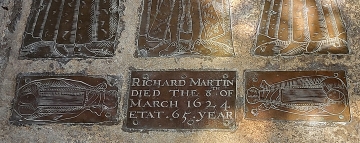
So much for the lost brasses. Fortunately, at the eastern end of the church, several monumental brasses have remained in place – some of them intact, and others damaged. To the south of the high altar, there is a set of intact 17th century brasses commemorating members of the large Martyn family. Included amongst these brasses are two of particular interest – they are Chrism brasses (see photograph above), which commemorate children who died before their mother was “churched” (that is before the mother has gone to church to give thanks to God for the birth of a child). The Chrism brasses depict babies in swaddling clothes. In addition to these brasses, there is another one depicts a brother and sister. The girl is holding a skull, which means that she died before her parents.
Churches in England, and especially that at Long Melford, offer many fascinating insights into how people lived in the distant past. The brasses – those which have gone and those which remain – are fine examples of history on display.
THE HIGH STREET runs through Sandwich (Kent) from south to north. At its northern end, it runs beneath an archway next to a former toll bridge across the River Stour. After 1977, the toll was abolished. Under the archway, which is part of the mediaeval barbican (built c 1470) that used to be a gateway through the town wall, there are several notices of interest.
One of the notices records the fact that tolls were collected from users of the bridge from 1759 to 1977, and the last toll was collected from the Mayor Councillor on the 30th of September 1977. Near this memorial, there is a table of tolls dated June 1905. Interesting as these two signs are, it is the third one that was a complete surprise to me. It read:
“This plaque is to commemorate Richborough Transit Camp 1939-1940 where 5000 men found refuge from Nazi persecution on the Continent. During the Second World War most of them volunteered to fight for the Allied cause.
Erected in gratitude to the citizens of Sandwich and East Kent who, as in the past, welcomed the refugees.”
I noted that this brief notice made no mention of the identities of the refugees. However, another plaque, attached to the nearby Bell Hotel, clarified the situation. The hostelry was:
“… A meeting place for Jewish refugees from the Kitchener Camp, Richborough, Sandwich 1939-40”
The Kitchener Camp was a former army barracks located north of the Stour, not far from the toll bridge, on the west side of Ramsgate Road. There is now no trace of it because it was demolished after the end of WW2. During 1939, 4000 mainly German and Austrian Jewish men were accepted for accommodation in the camp on condition that they would not be granted UK citizenship or work, and must emigrate to the USA. The camp received no government funding. It was paid for by Jewish organisations including The Central British Fund for German Jewry (founded 1933). At the start of WW2, 887 of these men volunteered to join the Pioneer Corps, which carried out light engineering projects at the battle fronts. After the Dunkirk episode in May 1940, the British public became suspicious of German speaking refugees because they were worried about the possibility that some of them might be involved in spying and sabotage. So, those, who were not enrolled in the war effort, were shipped out to internment camps in Australia and Canada, and then Kitchener was closed.
During its brief existence, the Kitchener Camp, which began accepting refugees on the 20th of January 1939, became a hive of cultural activity as can be discovered by looking at the highly informative website – https://kitchenercamp.co.uk/ There were concerts and a cinema provided by the Odeon Cinemas, run by it’s the Jewish founder Oscar Deutsch. I had never heard of the Kitchener Camp (aka ‘Richborough Tansit Camp’) until I spent a few days in Sandwich recently. Regarding the plaque commemorating it beneath the arch of the barbican, it mentions 5000 men, but reliable sources always refer to 4000 Jewish men. This puzzles me, as it was placed by the Jewish Community of Great Britain ( according to https://www.warmemorialsonline.org.uk/memorial/263444/).
MAHATMA GANDHI IS commemorated by a statue in Tavistock Square in London’s Bloomsbury. He is probably the most famous of three Indians with statues in Bloomsbury. Crafted by the sculptor Fredda Brilliant and presented by the Indian High Commission, it was unveiled by Prime Minister Harold Wilson in 1967.
The next most famous Indian represented by a sculpture in Bloomsbury is a Nobel Prize winner, the celebrated writer and polymath from Kolkata (Calcutta), Rabimdranath Tagore (1861-1941). The memorial depicts Tagore’s head. It was created by the sculptor Shenda Armery, and unveiled by the Prince of Wales, now King Charles III, on Tagore’s 150th birth anniversary year in July 2011. The bust stands in Gordon Square, close to University College London, where Tagore studied law briefly. His face looks away from the college towards the southeast. – towards India, his homeland. On one side of the plinth, there are some words written in Bengali script. On another side, there is a translation of this brief text (by Tagore) in English: “Thou hast made me endless, such is thy pleasure. This frail vessel thou emptiest again and again, and fillest it ever with fresher life. This little flute of a reed thou hast carried over hills and dales and hast breathed through it melodies eternally new. At the immortal touch of thy hands my little heart loses its limits in a great joy and gives birth to utterance ineffable. Thy infinite gifts come to me only on these very small hands of mine. Ages pass and still thou pourest and still there is room to fill.” This is from Tagore’s collection of poems – “Gitanjali”, translated into English from Bengali by the author in 1913. It was this collection that led to Tagore being awarded the Nobel Prize for Literature in 1913. In 1915, King George V awarded him a knighthood, but following the Jallianwala Bagh massacre of 1919, he renounced his knighthood to express his horror at the murders that had been perpetrated on innocent Indians by British troops in the Punjab.
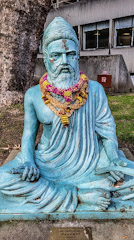
Thiruvalluvar
Call me ignorant but I had never heard of Thiruvalluvar, whose bust stands in a garden next to the School of Oriental and African Studies in Bloomsbury. According to a plaque next to the bust, this man was author of “Thirukkural”, which was a classic of Tamil philosophy and ethics. The bust was donated by the Governent of Tamil Nadu in 1996, and unveiled by the then Indian High Commissioner Dr ML Singhvi. Celebrated as he is in Tamil Nadu, little is known about his life. It is possible that he was born or lived in Mylapore (now a district of Chennai) in the south of India. According to Wikipedia: “His work Tirukkuṟaḷ has been dated variously from 300 BCE to about the sixth century CE.” As for his great work “Thirukkural”, the online version of Encyclopaedia Britannica remarked: “…Tirukkural (“Sacred Couplets”), considered a masterpiece of human thought, compared in India and abroad to the Bible, John Milton’s Paradise Lost, and the works of Plato.”
I have described monuments to three notable men from India, but omitted one woman, whose memorial is close to those already described. The WW2 heroine Noor Inayat Khan (1914-1944) is commemorated by a bust, which, surprisingly, I have never noticed, in Gordon Square. Sculpted by Karen Newman, it was placed in the square in 2012. This artist also sculpted a bust of Violette Szabo (1921-1945), which is on the embankment of the Thames near Lambeth Palace. Both Noor and Violette worked for the British SOE, and perished in Nazi concentration camps. Once the epicentre of the British Empire, it is not at all surprising that one comes across memorials to notable Indians whilst wandering about in London and other places in the UK.
NAGPADA JUNCTION IS one kilometre east of Mumbai Central Station. There are several interesting memorials located around this place where six busy roads meet. Each of them commemorates someone of the Islamic faith.
One memorial, a large rectangular bas-relief, is dedicated to the great poet Mirza Ghalib (1797-1869).
Dominating the junction is a tall flagpole from which India’s flag flutters. The base of this includes a large curved bas-relief in grey stone. The base has carvings of several important Indian freedom fighters including Mahatma Gandhi. There are also scenes of these leaders behind bars and other Indians being attacked by Britishers. The words “Quit India” can also be seen in several languages. The Quit India movement was one of many attempts to get the British to leave the huge country they ruled until 1947.
This monument and its flagpole are mainly dedicated to the memory of Maulana Abul Kalam Azad (1888-1958). In brief, he was all of the following and much more: an Indian independence activist, Islamic theologian, writer and a senior member of the Indian National Congress. Between 1947 and 1958, he was independent India’s first Minister of Education.
Lesser known than Ghalib and the Maulana, but also commemorated at Nagpada Junction is the freedom fighter Maulana Fazlul Hasan Hazrat Mohani (1875-1951). This celebrated writer of poetry in the Urdu language is best known for a slogan he created in 1921: “Inquilab zindabad”, which means “Long live the revolution”. He is also credited as being one of the first Indians to demand complete independence for India, rather than increases in the degree of the country’s autonomy whilst remaining part of the British Empire.
At first a member of The Indian National Congress, Hasan Hazrat later joined the Communist Party. He was against the Partition of India and would have preferred that India had become a confederation of states such as was the case in the USSR.
Nagpada Junction is both rich in traffic and memorials to notable Muslim men. One more memorial and a street name commemorate another Muslim, Sofia Zuber (Zubair), at this meeting place of busy. thoroughfares. She was an education superintendent for Urdu affiliated to a civic body and later a corporator from Nagpada. The short road named after her used to be a meeting place for Urdu authors and journalists.
I would not have written about this interesting traffic junction had I not noticed the Maulana Abul Kalam monument as we sped past it in a yellow and black taxi. Curious about it, we returned later and had a look around, and then ate good kebabs in the Sagar restaurant beside the junction.
ALTHOUGH THERE WERE ALREADY villages on the banks of the River Hooghly where the city of Kolkata (Calcutta) now stands, the Britisher Job Charnock (1630-1693), a man of commerce, is often regarded as the founder of Calcutta. He died there and his remains are interred in a charming mausoleum (1695) of oriental design in the churchyard of Kolkata’s former cathedral, the church of St John.
Job Charnock’s mausoleum
Job does not rest alone in that structure. His companions include the surgeon William Hamilton, who died in 1717. He had cured Ferukseer, the “ King of Indostan”, and beneath his memorial, written in English, there is another written in Persian script. Job’s wife Mary lies next to him. She died in 1700. There is no mention of his other wife, an Indian named Maria. There is also a memorial to Martha Eyles, who died in 1748, having first been married to John Gumley (who died in Dhaka in what is now Bangladesh), and then married Edward Eyles, who was on the council of Calcutta’s Fort William.
Whereas Martha Eyles had had two husbands, Mrs Frances Johnson, whose remains lie in a mausoleum a few feet away from Charnock’s, had a more exciting marital record. Born in 1725, she died in 1812 at the age of 87. Frances had four husbands. First, she married Parry Purple Templer, then after his demise , James Altham. Mr Altham died of smallpox a few days after marrying Frances. Next, she married William Watts, and they produced 4 children. In 1774, after the death of Mr Watts, she married the Reverend William Johnson. He survived until Frances died.
Apart from the above-mentioned graves in the churchyard of St John’s, there are many others that commemorate the deaths of early European inhabitants of Charnock’s Calcutta, and there is also a memorial to those who died in the Black Hole of Calcutta, but more about this at a later date.
MOUNT STREET GARDENS in London’s Mayfair was formerly the burial ground of St George’s Church in Hanover Square. Its name derives from Mount Field, where there had been some fortifications during the English Civil War. The burial ground was closed in 1854 for reasons of protecting public health. St George’s Church moved its burials to a location on Bayswater Road, St Georges Fields, which is described in my book “Beyond Marylebone and Mayfair: Exploring West London”. In 1889-90, part of the land in which the former burial garden was located became developed as the slender park known as Mount Street Gardens (‘MSG’- not to be confused with a certain food additive). Small as it is and almost entirely enclosed by nearby buildings, it is a lovely, peaceful open space with plenty of trees and other plants.
The garden is literally filled with wooden benches. Unlike in other London parks where there is often plenty of space between neighbouring benches, there are no gaps more than a few inches between the neighbouring benches in MSG. The ends of neighbouring benches almost touch each other. The result is that MSG contains an enormous number of benches given its small area. And they are much appreciated by the people who come into the park and rest upon them.
Each bench bears a memorial plaque. Many of these memorials commemorate people from the USA, who have enjoyed experiencing the MSG. And most of these having touching messages written on them. Here are just a few examples: “For my children Philippa and Richard, young Americans who may one day come to know this place. Richard L Feigen. 8th August 1987”; “Seymour Augenbraun – a New Yorker and artist for whom this spot in London is his oasis of beauty. From his wife Arlene and family on July 15th 1986”; “To honour a dear brother and sister Ira and Nancy Koger of Jacksonville Florida”; “This seat was given by Leonora Hornblow, an American, who loves this quiet garden”; “In memory of Frances Reiley Bochroch, a Philadelphia lady who found these gardens a pleasant pace”; and “In loving memory of Joe Bleich (1910-1990). An American who could not find a park like this in New York City,”
There are plenty of other similar memorials to Americans on the benches. All of them interested me, but one of them particularly stood out: “To commemorate Alfred Clark, pioneer of the development of the gramophone. A friend of Britain, who lived in Mount Street”. Clark (1873-1950) was a pioneer in both cinematography and sound recording. Eventually, he became Chairman of EMI. A keen collector of antique ceramics, he donated some of his pieces to London’s British Museum.
Not all of the benches are memorials to Americans. There are others to Brits and people from other countries, but the Americans outnumber the rest. Had it not been for the extraordinarily large number of benches in this tiny gem of a park, I doubt that my eye would have been drawn to the commemorative plaques, but having seen the one in memory of Joe Bleich, who was unable to find a park like it in NYC, I was drawn to examine many of the others.
THE WALLS OF Bath Abbey are lined with memorials to the dead, many of whom are buried within the church. A remarkably large percentage of the funerary memorials commemorate the lives of people who worked in Britain’s colonies. There are monuments to people who lived and worked in the Caribbean, North America, and Asia, especially for the East India Company, which ‘ran’ and exploited India until 1858.
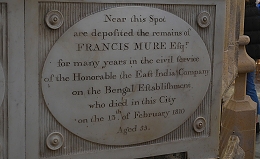
For example, Francis Mure Esq worked for many years in the civil service of “the Honourable the East India Company on the Bengal Establishment”. He died in Bath in 1810 aged 53. Henry Lynch Esq MD “of the island of Barbadoes” died in Bath in 1823, aged 49. Also from this place in the Caribbean was Benjamin Alleyne Cox Esq who died in Bath in 1802 aged 74. In 1812, 78-year-old Rawson Hart Boddam also died in Bath, after having served as the Governor of Bombay in 1784. Robert Brooke Esq, who had served in the Bengal Civil Service died in 1843 aged 72 is also interred in Bath Abbey. Peter Read Cazalet, “of the Honourable East India Madras Civil Service”, who died in 1859, aged 37, is yet another old ‘India hand’, who is buried in Bath. Also in the abbey are the remains of Major General Sir Henry White KCB, part of whose inscription reads chillingly like some of the news bulletins in the current Ukraine crisis: “The judicious Position taken by his Division in the Attack on Agra Which accelerated its fall And the Reduction of The Strong Hill Fort at Gwalior By Siege Are Proofs of Zeal and Military Skill…” He died in 1822.
What puzzled me was why did so many of these men from the colonies ended their lives in Bath. Was it because they were sick and had come to the place to take the curative spa waters, which failed to cure them? Or had they retired to Bath? Or, as someone suggested, Bath is close to Bristol, which was in many ways involved with colonial affairs.
The answers to these questions must remain uncertain at present. However, I wondered why the wealthy American Senator William Bingham died in Bath in 1804, aged 49. He was involved with the Barings Brothers bank in London, which might have been a reason for him being in England at the time of his death. He left for England in 1801, when his wife was taken ill. What he was doing in Bath remains unclear.
Amongst the many fascinating memorials in the Abbey are several commemorating people who died abroad. Some of these people had been in India when their lives ended. An interesting example of this, which illustrates the hazards of warfare and the difficulties in subduing people, who have no wish to be colonized, is the monument to 1st Lieutenant George Dobson Willoughby, of the Bengal Artillery and the Commisary of Ordnance at Delhi, who died in 1857. His inscription includes the following details: “As a brave and zealous soldier he stood firm in the defence of the post intrusted to him, and when resistance failed blew up the Delhi Magazine on 11: May 1857 to prevent it falling into the hands of the mutineers and rebels. Burnt and wounded he subsequently fell a prey to the insurgents …”
Maybe, this is a lesson from which the dutiful Russian soldiers in Ukraine should take heed.






 yamey
yamey 