An advantage of wearing a hijab in an airport in a Gulf State

THINGS DID NOT BEGIN well for me when I arrived at Bangalore Airport’s recently opened Terminal 2 prior to boarding an Emirates airline flight to Dubai, where we were to catch another flight to London. We arrived at the airport in good time – before the check-in desks were open. After finding somewhere to sit, I walked to the Chaayos refreshment stall and asked for two cups of south Indian filter coffee. The server must have misheard me and only charged me for one. When this arrived instead of the two, I was expecting, I paid for another cup. While it was being made, I carried the first to my wife. I returned to the stall and picked up the second cup. It was filled to the brim, very hot, and the cup was poorly insulated. Just before I reached where we were sitting, my hand moved slightly, and the boiling hot coffee fell on my palm. This was extremely painful. I dropped the cup and the rest of its contents. I rushed to the washrooms, and after finding a tap that worked, I rinsed my palm in cold water. Meanwhile, my wife managed to get me some ice to put on the scalded part of my hand.
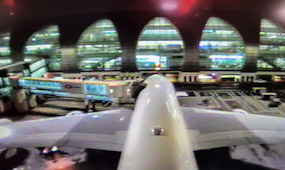
Dubai Airport

After dropping off our baggage and collecting boarding passes (printed on extremely thin paper), we headed for the security check. This involves divesting oneself of anything that contains metal before walking through a metal-detecting arch and then being frisked by a security official. Because the trousers I was wearing were too big, I had to keep one hand on them to stop them falling down. Meanwhile, I was somewhat shocked, and my hand was still smarting after the scalding.

After the frisking, I went over to the conveyor belt that carried our hand baggage and other items slowly through an x-ray machine. After rescuing both my wife’s and my own cabin baggage, telephones, wallets, coats, neck cushion, and my trouser belt, I secured my trousers with the latter. It was then that I realised that my boarding pass was nowhere to be seen. I was horrified – in so many decades of flying, I had never lost a boarding pass.

We reported the loss to the security supervisor – a female officer. She rang for an official from Emirates airline. While waiting for him to arrive, she said to my wife in Hindustani:
“He should not worry. They won’t leave him behind.”
After an agonising wait – actually, it was no longer than about 15 minutes – the official arrived. By then, I was feeling both anxious and extremely upset. The Emirates man explained that I would be issued a new boarding pass at the boarding gate. Not entirely happy with that, we left the security area, and headed for the departure lounges. On the way, we came across an empty baggage trolley, and began loading it with our carry-on bags and coats. As we were doing that, something fell to the ground – it was my missing boarding pass. In an instant my mood of melancholy and apprehension switched to one of immense happiness and relief. I rushed back to the security supervisor to tell her the good news. As the Emirates man was still around, I told him and shook his hand.

The flight to Dubai was pleasant. There was nothing to complain about. At Dubai, we had to pass through another security check. This time, I decided not to remove my belt before passing through the metal detector. Instead, I untucked my shirt and covered my belt with it. Despite there being a large metal buckle on the belt, the detector did not detect it. Nobody stopped me. Meanwhile, passengers’ hand baggage was passing through an x-ray machine so quickly that I doubt there was time to examine the series of x-ray images in any detail – if at all.
After enjoying exorbitantly expensive hot drinks, which I did not manage to spill, we entered a departure lounge dedicated to our flight to London. Before entering the lounge’s seating area, an official examined each passenger’s passport and boarding pass. Most passengers, including my wife and I, had to head for a line of trestle tables. By each of them there was a male or female security official. A few passengers were sent straight into the seating area, bypassing the tables.

The officials standing at the tables first searched the contents of bags – rather cursorily. Then, using an electronic wand, they frisked the passenger. After that, each passenger was asked to present their hands, palms facing upwards. An explosives detector sponge was rubbed on each palm, on the clothing, within the footwear (which had to be removed), on the mobile ‘phones, and other carry-on items. After placing the (re-usable) sponges in a machine, we were allowed to sit down and await the flight. My wife told me that the security lady who examined her was both rude and rough.

This process took quite a while. I sat watching it and gradually, I and my wife became aware of something curious. About a third of the passengers on our flight were women wearing hijabs (Muslim head coverings). This was not surprising in an airport in a Gulf State. What was astonishing was that not one of them had to be searched at the tables. They were allowed to board the flight without having been checked as thoroughly as the other passengers had been. Given that very recently, soldiers wearing hijab were able to enter a hospital in Gaza and attack it with firearms, was it wise to assume that because they were wearing hijab, the passengers on our flight to London were beyond suspicion, whereas all the other passengers – both male and female – needed to be regarded as potential terrorists?

The flight to London could not be faulted. And in case you are wondering, by the time we landed at Heathrow, my scalded palm was neither painful nor inflamed.
The loss of an earring made by a jeweller in Bosnia

ONE MORNING IN Kutch (part of Gujarat), we set off to see a historical monument not far from the town of Mandvi. On the way, we stopped at a cash machine (ATM) to withdraw some cash.

We inserted the debit card and the appropriate PIN code. After keying in the amount we wanted, the machine made the normal noises, and then asked us to remove the cash and our card. To our great dismay it delivered no cash. Yet, we received an SMS stating we had just withdrawn the amount of cash we had keyed in. This worried us greatly.

Fortunately, there was a branch of our bank near the ATM. We spoke with the manager, and explained what had happened. After taking a few details, he resolved the situation and instructed the cashier to give us the cash we had wanted. From his desk, he also managed to ascertain that the ATM had suffered a technical problem.

We drove on towards our intended destination. Despite information on the Internet and on noticeboards, all of which suggested that the place would be open, it was closed. The watchman at the gate explained that the attraction was closed for repair. However, he let us go in for a couple of minutes, after telling us that if anyone saw us enter, he would be in big trouble.

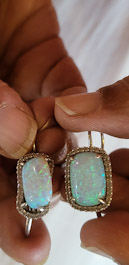
After this second mishap of the day, our driver took us to see a lovely Hindu temple a few miles away. As we began walking around the place, my wife noticed that one of her earrings had become detached. It was one of a pair that a jeweller in Sarajevo (Bosnia) had made. The pair had been made by the uncle of one my Bosnian dental patients, who, having been pleased with my dentistry, had given them to me to present to my wife. These earrings were of great sentimental value, and Lopa was most unhappy to have lost one.

After retracing our steps in the temple compound and failing to find the piece of jewellery, we decided to return to the bank and the ATM, where during the panic of the debit card problem, it might have fallen. On the way, we returned to the closed visitor attraction. We asked the watchman of he had spotted the earring. He had not.

So, we decided to search the part of the driveway, where we had stopped earlier. Lopa and I looked around in vain. Then, our driver joined the search. Within a couple of minutes, he found the earring in the gravel of the roadway. Sadly, either something had driven over it or stepped on it. The earring was intact but the silver stone setting had been distorted. We will have it repaired by Kalim, our skilful jewellery repairer in Bangalore.

They say things happen in threes. That was the case that morning in Kutch. Fortunately, two of the three problems were resolved in a good way.

A bridge across the River Thames and a personal loss

JUST UNDER A YEAR AGO, we visited Cookham in Berkshire, a small town on the River Thames, with our friend ‘H’. I first met H and her widowed mother in about 1975 at the home of some dear friends, my PhD supervisor and his wife. My wife and I used to see H about once a year until about 1999 at the home of our mutual friends. Then, we lost touch. A few years ago, H and I reconnected via social media and we kept promising that we should meet up again. It was only in about July 2020 during a relaxation of the covid19 regulations that we finally met face to face. Our meeting was in Cookham, where we enjoyed an exhibition at the small Stanley Spencer Art Gallery. After having coffee together – it was the first time that H had been to drink coffee outside her home since mid-March, we walked through the rain to Cookham Bridge and crossed it, admiring the lovely views of the Thames.

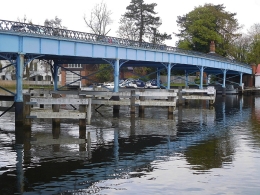
Cookham Bridge

The roadway on Cookham Bridge is so narrow that traffic must be regulated by signals at both ends of the crossing. These signals allow traffic to flow in single file in one direction for a few minutes, and then in the other. While we walked across the bridge, I noted its lovely decorative iron railings, which can be seen in a painting, “Swan Upping at Cookham” (www.tate.org.uk/art/artworks/spencer-swan-upping-at-cookham-t00525), painted in 1915-19 by Cookham’s famous artist Stanley Spencer (1891-1959).

It was not until April 2021 that we revisited Cookham with some friends and walked along the Thames Path, which passes under Cookham Bridge. It was then that I noticed what we had not seen with H: the interesting Victorian ironwork structure supporting the crossing. A sign screwed onto one of the pontic’s metal panels reads: “Pease, Hutchinson, & Co. 1867. Engineers & iron Manufacturers. Skerne Iron Works. Darlington”. The Skerne Iron Works were:

“…run by a Quaker partnership trading as Pease, Hutchinson and Ledward. The Skerne company built its reputation upon plates for ships, boilers, and particularly bridge building, and at its peak employed 1,000 workers.” (www.gracesguide.co.uk/Pease,_Hutchinson_and_Co)

The iron bridge, supported by pairs of slender iron beams (filled with concrete) with cross-bracing rods, was opened in 1867 to replace an earlier wooden bridge that was opened in 1840. The existing bridge was when it was constructed the cheapest bridge across the Thames for its size (https://en.wikipedia.org/wiki/Cookham_Bridge). Until 1947, it was a privately owned bridge for which users needed to pay a toll. It was owned by the Cookham Bridge Company. In 1947, Berkshire County Council bought the bridge, and the toll was abolished. An octagonal house still stands next to the bridge across the river from Cookham. It is the early 19th century toll house built in 1839 by a Mr Freebody (https://heritageportal.buckinghamshire.gov.uk/Monument/MBC19500).

At the Cookham side of the bridge stands The Ferry pub, close to where there used to be a ferry across the river. This old, half-timbered inn, now a mid-priced eatery, has a lovely terrace by the river, from which the bridge can be viewed as well as the waterways leading downstream to Cookham weir and the lock that bypasses it.

Recently, a close relative of H contacted me. He had found my details in the address book in H’s computer. It came as a shock to learn from him that H had passed away suddenly a few weeks ago. When we had last seen her late last year, she was looking hale and hearty. Apparently, one Saturday, she began feeling extremely unwell and on the following day she expired. We were terribly upset because we got on so well with her and were planning outings with her once the covid19 socialising restrictions were eased. They were relaxed but not in time for us to be able to see H again. As we drove through Cookham on our most recent visit, we kept seeing places that reminded us of our meeting with her last summer.

Our friend with whom we crossed Cookham Bridge last year has crossed from this world into another, where I hope that she will be reunited with her parents, our mutual friends, who introduced her to me and then later to my wife, as well as Sir Geoffrey Howe and Elspeth, his wife, with whom she worked happily for many years. H will be sorely missed.

Directions

directions


I travel a great deal and sometimes get lost. It is then that I might ask a passer-by for directions. Generalising a bit, the kind of answer you get tends to vary from country to country.

During trips to the USA, I have either been told that the person I asked has absolutely no idea at all or I have been given very precise, accurate directions. 

In the UK, if you ask directions from the average person you meet by chance, several things might happen. First of all, you might be given accurate directions. More likely, you will recieve a vaguer reply like:

“I think it’s somewhere in that direction. Follow that road, and then ask again.”

Because most British people want to be helpful, you might be told:

“I think I’ve heard of it. You could try going that way, but I’m not sure.”

But, it is very rare that you will be told:

“I’ve absolutely no idea.”

In India, asking directions can result in a small conference taking place. People within earshot of the person you first asked will join in the discussion. Often each person will point in a different diection in an attempt to be helpful and also to have the chance to meet a stranger. Like the Americans, who will happily admit ignorance of places that do not have any importance in their lives , many Indians also only know how to reach places where they need to be but not others. But, unlike the Americans, Indians do not want to disappoint visitors to their country by not supplying some kind of answer.

Of course, all of the above is highly generalised. But, here is one specific example, which occurred in Istanbul, Turkey. We were looking for some place of interest, but could not find it. We entered a shop. Without having any knowledge of Turkish, we managed to make it clear what we were looking for. Without hesitation, the shop keeper abandoned what he was doing, becckoned us to follow him, and then walked with us through the area until we reached our desired destination.


My cat

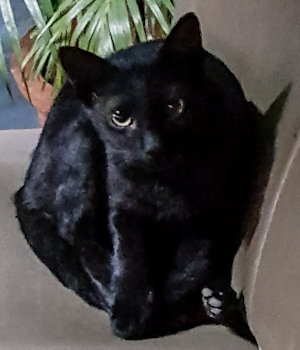
I love cats. I have only ever ‘owned’ one. I named it Crumpet.

I was less than ten years old when Crumpet entered my life. I was lying in bed at home, recovering from a bout of tonsillitis, when my late mother brought Crumpet into my bedroom. She had only just bought the cat at a pet shop to cheer me up.

My mother, who was always nervous about me risking injury, would not allow me to open the tins of cat food that Crumpet enjoyed. She was concerned that I might cut myself on the sharp edges of the open tin lids. So, as my mother did not want to disturb my father, who did much of his academic work at home, she became responsible for feeding Crumpet.

Cats tend to be quite self oriented. They favour the people who feed them. In Crumpet’s case, it was my mother who received much of the cat’s attention. Our cat used to rub herself against my mother’s legs affectionately, especially when my mother was opening the cat food.

Now, here’s the rub. My self sacrifying mother could not bear cats. She put up with Crumpet for my sake.

Crumpet must have realised that my mother was not keen on her because after a few weeks our pussy abandoned our home for another about one hundred yards away from ours.

Since Crumpet deserted us, I have never kept another pet, but my fondness for cats has remained.