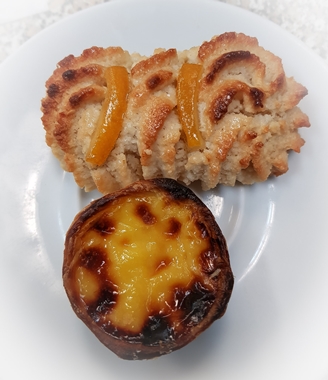
Ev’ry now and then
comes the urge to indulge
in treats sweetly tasting
(Image: Portuguese sweets at Café Lisboa in London, W10)

Ev’ry now and then
comes the urge to indulge
in treats sweetly tasting
(Image: Portuguese sweets at Café Lisboa in London, W10)
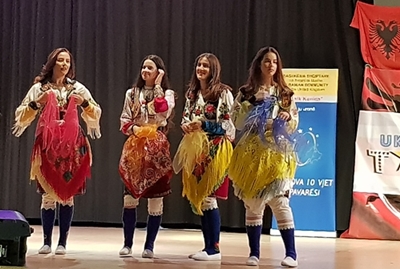
The Albanian community in the UK has been in the country long enough for some of their children to have been born in the country. It would be easy for the first generation born in the UK, who have to attend British schools and mix with non-Albanians, to begin to forget their cultural heritage. However, thanks to various organizations that some of the children of Albanian heritage attend, Albanian language and cultural traditions are being kept alive in the UK. On the 27th of October 2018, I was invited to attend the finals of the, which was held in a school hall in London’s Chalk Farm.
The Albanian Ambassador to the UK, Mr Qirjako Qirko, was one of several well-known personalities who introduced the show in Albanian. He ended his speech with a few words in English. The gist of what he said was as follows. He thanked the Queen and her Government for allowing Albanians to maintain their traditions and language, which is not the case in every other country. The show which followed the speeches certainly demonstrated that despite being far from their traditional homes and many years away from them, the Albanian community is encouraging their children to keep alive the traditions of their forefathers.

The show consisted of a series of performances by young people whose parents came from Albania or Kosovo. There were songs (traditional and contemporary Albanian as well as renderings of current and not so current popular songs in English). Small troupes of youngsters in traditional Albanian garb performed traditional Albanian dances. Others danced routines that they had choreographed themselves. Several youngsters declaimed poetry in Albanian. Naturally, the quality of performance was not uniform. Some of the young people were dazzlingly competent, the rest were not bad. None of the performers was shy or overtly lacking in confidence. Each of them performed with an enthusiasm that was refreshing to observe. The large audience around me encouraged each of the contestants as they performed on stage, cheering and clapping to the rhythm of the music. The five judges praised and gave friendly encouragement (in Albanian) to each of the performers when their act was over. Three of the judges were for singing, one for poetry recital, and one for dancing. The atmosphere in the hall was joyful and friendly. Everyone who passed my wife and me, greeted us warmly even if they had no idea who we are. It was great to discover that the famed hospitality of the Albanian people has been preserved in its British diaspora.

Many, if not all, of the performers, who sung or recited in Albanian or who dressed up in traditional costumes and performed the dances of their ancestors, use English in their day to day life. They have given up parts of their precious spare time to learn Albanian and to help Albanian cultural traditions remain vital and vibrant. They set an example that many children of British ancestry might profitably follow.

Sun shining on tall spire
At end of day
Autumn evening: inspired

Foliage goldening
In the setting sun:
Autumn arrives slowly
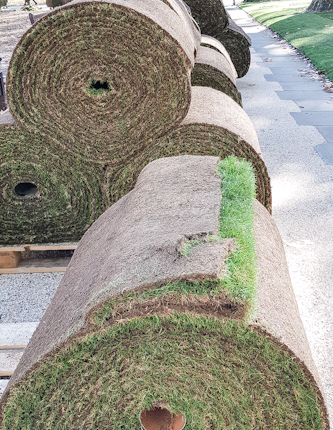
Rolls of turf await
slow unwinding before
a fine green lawn appears
My parents were not particularly musical. My late mother, a person who never gave up on anything she started, was forced to learn to play the piano when she was a child in South Africa. Through persistence rather than out of love of music, she passed many piano exams. When she became a mother, she decided that it was up to my sister and I to decide if we wanted to learn to play any musical instruments. My sister learnt to play several instruments, but, apart from one miserable six week attempt at the piano, I did not.

[Source: http://www.discogs.com]
At the school I attended between 1960 and ‘65 in London’s Swiss Cottage, we had music lessons once a week. They were conducted in the so-called ‘Billiards Room’ by Miss McDonald. We spent the lesson singing songs such as “The British Grenadier” while she accompanied us on the piano. Miss McDonald quickly worked out which of us in the class could sing well, and which could not. I was one of the vocally challenged group. Those who she considered to be poor singers had to sit on the floor. She referred to us as the ‘mice’. Potential choristers and others with tolerable singing voices sat high above us on upholstered chairs. Several times during each lesson, our teacher made the mice sing one verse of a song alone and unaccompanied. No doubt, we sounded feeble and unmelodious. The rest of the class, the future ‘Pavarottis and Bryn Terfels’, laughed at us.
When I arrived at my secondary school, Highate School (founded 1565), a boy’s school in 1965, all the new entrants had to take a voice test. The purpose of this was to determine which of us had a good enough voice for the school choir. Mr Chapman (nickname ‘Cherry’), the senior music teacher sat at a piano. The new boys lined up. One by one, each of us approached the piano. Cherry hit one key, and the boy had to sing the note. When I reached Cherry and his piano, I made a sound that must have resembled the ‘Aaaah’ that one makes when a doctor is examining your throat. With that short demonstration of my vocal skills, I was rejected from joining the choir. Once a week, there was a forty-five-minute period when the school choir met for rehearsals. The boys, who were not required for this, spent the period reading quietly.
In addition to music, Cherry also taught mathematics. Occasionally someone in the class, who had not heard what Cherry had just said, would shout: “pardon.” Cherry always replied; “granted” because he wanted to make the point that when someone could not hear him, he expected them to say something like: “Pardon me, sir, but what did you say?” To their faces, all teachers were addressed as ‘sir’.
The deputy music teacher was a Mr Wallace. During a year nearer the end of my five years at Highgate, we were given classes that were outside our chosen pre-university specialities. The idea was to broaden our general knowledge. One of these weekly classes was conducted by Mr Wallace. He used to set up a gramophone, and then play us classical music on LPs for forty-five minutes. He simply told us what we were about to hear and no more. Less of a disciplinarian than Cherry, he must have hoped and prayed that the class would not end up in mayhem, which it did often. Most of my fellow classmates were far more interested in The Rolling Stones than Rachmaninov.
One day, Mr Wallace played us one of the first two of the symphonies by the Finnish composer Sibelius. I was entranced by it. That weekend, I made my way to the branch of WH Smiths in Temple Fortune, our nearest shopping centre, and bought a recording of the symphony. It was issued by EMI on a low-cost series of recordings called ‘Music for Pleasure’. I played it often and bought other recordings of Sibelius’s music. I was hooked on classical music. Thanks to Mr Wallace, I began amassing a huge collection of classical music LPs, and then later CDs. Thanks to him, I enjoy attending classical concerts and meeting musicians.
I imagine that Mr Wallace must have passed away, and now enjoys music played by angels on their celestial harps. Sadly, I do not think that I ever told him how much I valued his musical appreciation classes.

A celestial trail crossing
the west London sky
very faintly

To many readers the early 1960s must seem as remote today as the 1860s seemed to me when I was a young boy at school in the 1960s. Between 1960, when I was eight years old, and 1965 I attended a prestigious private preparatory (‘prep’) school near Hampstead in north-west London. For those who are unfamiliar with private schooling in Britain a prep school prepares children for examinations that allow them to gain admission to Public Schools (i.e. private secondary schools).
In British schools today, teachers get into big trouble if they so much as touch one of their pupils. Even an affectionate pat, let alone a punitive slap, can get a teacher into ‘hot water’ both with the parents and with the school authorities. This was not the case at my prep school in the first half of the 1960s. Let me tell you about three of my school teachers.
Mr Rotherham taught us Latin. He was a short, slightly plump man. His face was always bright red. It looked as if he was about to burst yet another blood vessel. He was not a man to mess with. If he thought that a pupil had done something wrong, even a small grammatical mistake, he would race up to the miscreant’s desk, and seize a bunch of the poor boy’s hair. Then tugging at the hair, Mr Rotherham would pull the boy off his chair and drag him around the class room, shouting abuse. This procedure was known as a ‘Rozzie haircut’.
Mr Bathurst, who I quite liked, taught us history. Every year, we would begin with the date that Julius Caesar first landed in England and would end at 1914. The aim of the history, which we were taught at prep school, was to drum into us a series of important dates. What actually happened on those dates and the significance of those occurrences was of no importance. It was important that we could arrange in chronological order a set of items such as for example: Archbishop Laud, Agincourt, The Corn Laws, Waterloo, Magna Carta, and The Armada. Their importance was unimportant. It is no wonder that it took me many years before I realised how exciting it is to study history. On the whole, Bathurst, or ‘Batty, as we referred to him out of his earshot, was a kindly fellow. However, if you annoyed him, there were two possible outcomes. He would have called you up to the front of the class and then gripped one of your ears before twisting it painfully. Alternatively, the victim of his wrath had to lay his palm on the desk in order that Batty could hit the ‘criminal’s’ fingers with the edge of a wooden ruler.
Mr P also taught Latin. His first name was Denzil. This was also our nickname for him. Denzil’s fingers were crooked, distorted perhaps by a joint disorder. His voice was very nasal. In the early 1960s, teachers were not forbidden from smoking in class. Denzil used to hold his chalk in a crooked finger of his right hand, and a lighted cigarette in a curved finger of his other hand. His handwriting on the blackboard was illegible. Occasionally, he would show off, claiming that he was ambidextrous. He used to let go of the cigarette and replace it with a second piece of chalk, and then write on the blackboard with both hands at the same time. The result was terrible, even more illegible than when he wrote with only one hand. If someone annoyed Denzil, he would come up to the person, and sharp clip an ear with the knuckle of one of his twisted fingers. We called this short, sharp, painful blow the ‘Denzil blip’.
Well, none of this would be tolerated in today’s Britain, and quite rightly so. In the words of the former Prime Minister Harold Macmillan, let me tell today’s school kids that they: “… have never had it so good…”

Vienna and Wiesbaden can
No more be reach’d
From this here station

Like ants they crawl
Across a sea of glass
High above the River Thames
 yamey
yamey 