A French artist in London

Cocteau


The entrance to the Roman Catholic church of Notre Dame de France (‘NDF’) is on Leicester Place, a very shiort walk from London’s Leicester Square. Consecrated in 1868, the church occupied a circular building. After WW”, it iwas rebuilt retaining its ciricular plan. Today, when there are not services, amny of the pews in this lovely building are occupied by sleeping homeless people and a few other folk seeking a peaceful refuge in this busy part of central London.

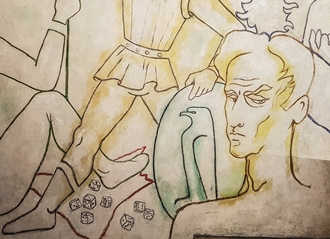
The Lady Chapel on the north ‘side’ of NDF is closed off by transparent thick glass panels. This is no doubt to protect the frescos lining its walls and the mosaic by the Russian-born Boris Anrep (1883-1969) on the altar. The frescos were created by the French writer/artist Jean Cocteau (1889-1963) in 1960. These beautiful pictures represent the Annunciation, Crucifixion, and Assumption. At the feet of one of the Roman centurions depicted in the central fresco, which illustrates the Crucifixion, there is a self-portrait of the artist. Cocteau drew this three years before his death.

Many people visit Leicester Square every day, but few of them visit NDF. For anyone interested in twentieth century art, seeing this church, which is open daily from 9 am to 9pm,  is a worthwhile thing to do.


Address: 5 Leicester Pl, London WC2H 7BX

Shrinking cabbages


Golborne Road intersects London’s famous Portobello Road. I practised dentistry in a clinic on Golborne Road between 1995 and 2001. In those days, Golborne was far less chic than it is today. Every day I used to pass E Price and Sons, a vegetable shop on Golborne.

The shop had a disorderly display of vegetables outside it and was run by a very old couple. I never entered their shop because it seemed to be impenetrable.

On the rare occasions that I purchased anything there, either the old lady or the old man would hurl the produce onto the scales and hardly waited to see the true weight. Then, they would mention a price, always adding the word ‘alright’, pronouncing it as if they were asking the question “is that alright?” They said the word ‘alright’ in such a way that suggested that something was not alright.

My lasting memory of this vegetable shop is of watching either of the man or woman sitting outside the shop removing withered outer leaves from the cabbages. Every day, I noticed that the cabbages on display got smaller and smaller; they seemed to be shrinking.

The shop closed a few years ago, and was later reopened by younger members of the Price family. Sadly, their lovely shop went out of business and the premises are awaiting their new reincarnation.

Climate, cycles, and trees

cycle


Undoubtedly, there is much concern about the future of planet Earth’s climate. So much so that children are missing school to go on protest marches because they are worried that they might never complete their lives because of catastrophic flooding or abnormally high ambient temperatures. Whether or not the dire predictions will turn out to be fulfilled remains to be seen, but there is no harm in trying to do something to address and then ameliorate or extinguish the perceived causes of the predicted ultimate disaster(s).

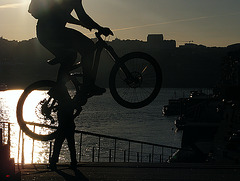
One of many measures being taken in London to reduce the output of gases toxic to the environment is to encourage the use of bicycles instead of motor vehicles. At present, cycling in London is fraught with dangers. There have been many collisions between cyclists and motor vehicles with quite a few fatalities amongst the cyclists. Many attempts are being made to segregate cyclists from other road traffic by constructing dedicated cycle lanes. Countries like the Netherlands have demonstrated very successfully that cycling can be made both safe and enjoyable by means of a comprehensive network of cycle lanes. 

Recently, there was a plan to construct a cycle lane along the tree-lined Holland Park Avenue in west London. From my frequent observations of this thoroughfare, there is only heavy cycle traffic in the morning and evening rush hours. Outside these busy times, there are few cyclists using this stretch of road. I felt that because of this a cycle lane was of questionable value.

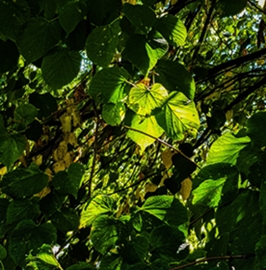
To build the proposed cycle lane, planners faced a problem, which they might not have anticipated. In order to construct the cycle lane, twenty mature leafy trees would have had to be removed from Holland Park Avenue. This prospect aroused the anger of protestors in the area, who felt it was wrong to chop down trees to make way for a cycle lane. In a way they were correct.

Trees, as most people now know, help to protect the climate, which motorists (in cars powered by fuels other than electricity) are destroying. One need only look at the recent international protests against cutting down the rainforests in Brazil to understand the perceived importance of trees. Granted, Holland Park Avenue is hardly a rain forest, but chopping down trees does not seem like a good thing. In Bangalore (India), many trees have been removed to accomodate the needs of a rapidly growing metropolis, and the city’s climate and water supply are being adversely affected by factors such as this.

So, we have a conundrum: cyclists or trees? Rather than sit on the fence, let me give you my answer. The object of encouraging cycling and preserving trees is to save the future of human existence. If that is accepted, then saving cyclists’ lives and protecting them from harm has to take preference over saving twenty undoubtedly attractive trees.

All I ask of the cyclists is to protect themselves and pedestrians by obeying traffic signals.

For more about the Holland Park cycle lane, see:

https://www.bbc.co.uk/news/uk-england-london-48635369

What is art?

art centre


A few days ago, I visited the Camden Arts Centre on the corner of Arkwright and Finchley Roads in north west London. This converted Victorian building has been enlarged with later additions and has a lovely café as well as a fine garden. Several galleries on the first floor are used to display artworks in temporary exhibitions.

We entered one gallery in which a video by the Hong Kong artist Wong Ping was being projected onto a large screen. At its base, there was a big pile of toy dentures with gold painted teeth.

Just after we sat down to watch the video, a group of young teenage school children were led into the gallery by an aducation officer employed by the art centre. After she had explained that the screen was the same kind as those used to display advertisements at Piccadilly Circus, she told the students:

This is art.”

Then, she added:

Anything in a gallery is art

My wife and I were sitting in the gallery. Does that mean that we were to be considered as art?

Riding the bus without paying


There are some advantages to growing older. When our daughter turned 18 and was no longer eligible for reduced price tickets, we reached an age above which our cinema tickets were subject to discount. Our daughter was not amused.


freedom


If you are a London resident, you are eligible to receive a Freedom Pass after you pass a certain age over 60 years. This pass allows the holder to travel free of charge on London’s buses, trams, Underground trains, and national railway lines within certain limits. A London Freedom Pass holder can also use most local bus services anywhere within England (but not in Scotland). So, if you have the time and patience, it is possible to travel long distances in England free of charge by using a Freedom pass on local bus services.

‘K’, an old friend of mine, enjoyed exploring England with her Freedom Pass. On one of her earliest explorations, she set off from London to somewhere deep in the heart of Kent. She reached her destination eventually, having used a series of local buses without having to pay. The return journey was less successful.

K began her homeward trip and arrived at Tunbridge Wells at about five pm. When she made enquiries about local buses heading towards London, she received a diappointing answer. The last bus of the day that would taken her in her desired direction had already departed. The next would run on the following day. So, K was forced to return to London by train. Instead of paying nothing, she had to spend money on a costly one-way railway ticket. Her anticipated day of free travel ended up quite expensive. Since then, she has been more careful with her trip planning and not had a repeat of her unexpected travel expenses.

We make great use of the Freedom Pass when we are out of London. One of the best ‘bargains’ we have so far encountered was at Exeter in Devon. We parked our hired car at an Exeter ‘Park and Ride’ and boarded the bus which was to take us into the city. We were fully expecting to have to pay for a day’s parking and also the bus ride. When we showed our passes to the bus driver, he told us that there was nothing to pay.

Mahatma Gandhi ate in Notting Hill

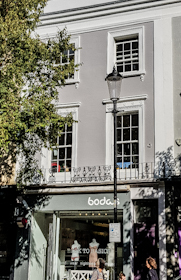
Today, 36 Ledbury Road (illustrated) in London’s trendy Notting Hill district (made famous by the 1999 film Notting Hill starring Hugh Grant and Julia Roberts) gives nothing away about its colourful past. It was once the home of the Indian Catering Company, a restaurant run by Nizam-ud-Din, who also owned the Eastern Café near Chancery Lane.

The Indian Catering Company, which was serving customers during the reign of Edward VII (1901-10) was not the first Indian restaurant to have been opened in London. The first curry house in London was opened by Sake Dean Mahomet (born in India in the 18th century). An employee of the East India Company, which he joined in 1769, he arrived in London in 1807. Two years later, he opened his Hindostanee Coffee House at 34 George Street near Portman Square. Although it was called a ‘coffee house’, it was actually a restaurant serving curries and other examples of Indian cuisine. The restaurant thrived until 1833, when it was closed. There is much more information about this establishment in Star of India, a book by Jo Monroe.

By the time that the restaurant at 36 Ledbury Road was serving customers, the Indian Catering Company was one of many Indian restaurants in early twentieth century London. The reason for my interest in this former eatery is that it was a meeting place for extremist Indian independence fighters in Edwardian London. I discovered this while researching my recently published book IDEAS, BOMBS, and BULLETS.

Although he cannot be considered an ‘extremist’, the famous Mahatma Gandhi partook of a meal at the Indian Catering Company in Ledbury Road in October 1909. Here is an excerpt from my book:

In October, the festival of Dussehra was celebrated at Nizam-ud-Din’s restaurant, The Indian Catering Company, at 36 Ledbury Road in Bayswater. Gandhi had been invited to chair the proceedings. He had accepted the invitation on condition that the food would be pure vegetarian and that discussion of controversial politics was avoided. The food was served by Savarkar’s followers: VVS Aiyar, Tirimul Acharya, and TSS Rajan, all sometime members of India House.”

Whereas Gandhi both preached and practised non-violence, the same cannot be said of VVS Aiyar, Tirimul Acharya, and Vinayak Damodar Savarkar ( a ‘father’ of Hindu Nationalism and Hindutva), who also attended the meal.

Although there is no plaque recording the interesting history of 36 Ledbury Road so near to Portobello Road, whenever I pass this house I feel a tingle when I remember the famous Indian freedom fighters who once entered it and ate there.

A SMALL house cover

“IDEAS, BOMBS, and BULLETS” is by Adam YAMEY

ISBN: 9780244203870

The book is available from on-line stores including:

Amazon, Bookdepository.com, and lulu.com

It may also be ordered from bookshops

There is an e-book edition on Kindle

 

From Norway to Bengal

Doll hse


We were attracted to the latest theatrical production at the Lyric Theatre in Hammersmith (West London) because it was a play set in Calcuttta (Kolkata) in the late 1870s. It was not any old play set in Victorian Bengal, but a new adaptation of Henrik Ibsen’s the Dolls House (first performed 1879), which was originally set in a Norwegian town in the 19th century.

What we saw at the Lyric was a new version of Ibsen’s play created by the playwright Tanika Gupta. In Ibsen’s play the main protagonists are Nora Helmer, her husband Torwald Helmer, Dr Rank, Nora’s school friend Kristine Linde, and one of  the employees in Torwald’s bank, a desperate widowed father, Nils Krogstad. In Gupta’s play Torwald becomes Tom Helmer, an Englishman, who has married Niru,  a Bengali beauty, and has become a senior official in the British administration of India. Dr Rank remains Dr Rank, but is also an Englishman. Kristine becomes Krishna Lahiri, an impoverished widow and schoolfriend of Niru. Nils Krogstad is transformed into Mr Kaushik Das, a widowed Bengali father of four children and a lowly employee in Tom’s office.

In its new guise, Gupta’s Dolls House sticks to the spirit and main ideas in Ibsen’s plot but causes it to be played out in the steamy tropical climate of Calcutta. Gupta explores the relationship between the representative of British imperialism and his very sweet Indian wife. The arrival of Krishna and then Mr Das on the scene soon unsettles the happy home life that the Helmers had been enjoying. Without giving the story away, Mr Das, whom Tom does not like, holds a secret that could bring about Tom’s downfall if revealed. Tom is blisfully ignorant of the threat that Das poses, but the opposite is the case for Niru, whose great anxiety Das stimulates.

Although I had some reservations about the new version of the play, I enjoyed it and the often excellent performances of the actors. What fascinated me was how successfully Ibsen’s play had been ‘relocated’ from the gloom of Norway to the colourfulness of Bengal without losing the feeling that it was a play inspired by Ibsen. By translating the play from one cultural milieu to another, Gupta has preserved and enhanced Ibsen’s messages about the role of women and social class. She has added another fascinating ingredient: the portrayal of British racism towards Indians in pre-independence India. I feel that many of the Anglo-Saxon members of the audience might have been blissfully unaware of their ancestors’ unpalatable attitude to Indians they ruled. They would have left the theatre better informed about this blot on Britain’s history.


The play is on at the Lyric until 5th October 2019.

See: https://lyric.co.uk/shows/a-dolls-house/


Image adapted from lovetheatre.com

If you think you have seen the light, think again…

Hoop


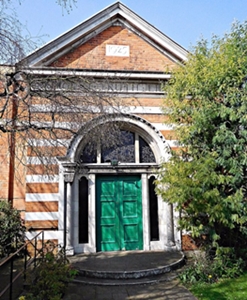
My earliest memories of Hoop Lane (in Golders Green, northwest London) date back to when I was three or four years old, and therefore are rather vague. At that age, I attended a kindergarten in Hoop Lane. This was in the hall attached to Golders Green’s Unitarian Church (see photograph above), which was designed in the ‘Byzantine revival’ style by the architect Reginald Farrow (opened in 1925). It contains interesting artworks including a mural by Ivon Hitchens (1893-1979), which I have not yet seen.

The kindergarten was under the direction of Miss Schreuer, who lived a few doors away in Hoop Lane. My only lasting memory from my time there was when my father appeared at the school with a white beard and a red outfit, dressed as Father Christmas. A few years later, my sister and my cousins attended Miss Schreuer’s. One day while my sister was attending, I was allowed to return to the school to act as an older helper. One of my fellow pupils was the late Micaela Comberti (1952-2003), who was later to become an accomplished violinist. Her German mother and Italian father were friends of my parents.

I am not sure what became of Miss Schreuer, but I heard rumours that the end of her life was unhappy. Today, the hall, where her school flourished, is now a Montessori kindergarten. When I lived in the area (I left finally when I was aged thirty), I often walked past the school and the Unitarian Church. The latter had a panel facing the road, upon which posters with pious messages were posted. One that I will always remember said:

If you think you have seen the light, think again”.


This is an excerpt from a piece I wrote a couple of years ago. If you wish to read the whole article, please visit:

https://londonadam.travellerspoint.com/48/

Foolish on foot

Taxi!_240


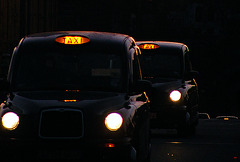
Years ago, I had friends who lived south of Hampstead Heath in South End Green, near where the writer George Orwell lived during the 1930s. I often visited my friends there and usually stayed with them until long after public transport ceased working late at night – those were the days long before 24 hour bus services. In those days, I was a student with limited means. Taxi and minicab rides to my home in Hampstead Garden Suburb to the north of Hampstead Heath were costly and if used too often would eat too deeply into my meagre funds.

So, often I used to walk through the darkness to my home, a distance of well over 2 miles. Most of this walk was across the wooded stretches of Hampstead Heath. Even back in the 1970s, this vast expanse of urban woodland was far from safe. Murders and attacks were not unknown. My parents and others would have been horrified to learn that I was risking my life to save paying a cab fare. Was I scared? The answer was both yes and no. I was concerned because of the news stories I had read. Yet, on the other hand I was not so afraid.

I felt that anyone encountering me on my nocturnal wandering deep in the secluded heart of Hampstead Heath might have had one of two reactions. Either he or she might have imagined that I was up to no good and possibly on the prowl for victims and would therefore steer clear of me, or that the person  whom I encountered was up to no good. If he or she was ill-intentioned, the person would have still had to be a little bit cautious because I might have turned out to be more than a match for him or her. This reasoning would have done me no good had the person I met been severely evil. 

Fortunately, luck was on my side. I never encountered anyone, innocent or evil, on my nocturnal strolls. However, I would never even dream of making this kind of journey across Hampstead Heath again, and would not advise anyone else to attempt it because London has become more dangerous than it was in the 1970s and before.