The Duke and Dunhill in London’s Mayfair

OUR YEARNING FOR visiting the art galleries in London’s West End is growing daily because the current covid19 lockdown has meant that they are all closed. So, when we read that the Gagosian Gallery on Davies Street, just north of Berkeley Square, had put on an exhibition that could be viewed from the street through its huge plate glass windows, we had to ‘take a gander’. The gallery is displaying some ceramic bowls created by Edmund de Waal until the 30th of January 2021 (https://gagosian.com/exhibitions/2020/edmund-de-waal-some-winter-pots/). Frankly, although they embody great craftsmanship, we were disappointed.  However, across the road, facing the Gagosian, there is a detached house that attracted more of my attention than the bowls. It was not only its antiquity that appealed to me but also some huge, inflated spheres with reflecting surfaces in its courtyard that produced fascinating reflections of the building and those nearby.

Bourdon House, a Georgian mansion completed in 1724, possibly designed by Isaac Ware (1704-1766), is now Dunhill’s exclusive shop for discerning “modern gentlemen”. The current building consists of two sections (www.british-history.ac.uk/survey-london/vol40/pt2/pp69-76#h3-0002):

“On the west, with a return front to Davies Street, is a much-extended and enlarged early Georgian house built in the 1720’s, and to the east and south-east is a substantial Edwardian wing built in a matching style, with fronts to both Bourdon Street and Grosvenor Hill.”

Bourdon after whom the house was named in 1860, lived in the 18th century and was the first occupant of the house. He was a justice of the Peace for Middlesex and held other important positions.

Over the years, numerous people resided in Bourdon House, which underwent modifications as time moved on. In September 1916, Hugh Grosvenor, the 2nd Duke of Westminster (1879-1953) took ownership of the house and lived there from 1917 until he died. When he moved in, his former home Grosvenor House, was being used by the Government in connection with WW1. The Duke liked Bourdon House so much that he decided not to return to Grosvenor House when the Government returned it to him in 1920 (it was demolished in the 1920s). During his occupancy of Bourdon House, the Duke divorced thrice.

On his death, the Duke’s fourth wife, Anne (née Sullivan; 1915-2003), whom he married in 1947, remained in Bourdon House until 1957. After she left, the house began to be used as commercial premises, first becoming an antique shop. In 2008, the house became a luxury emporium for the company of Alfred Dunhill. The company’s founder was Alfred Dunhill (1872-1959), who was a tobacconist, inventor, and entrepreneur. By the early 20th century, he was a pioneer in the creation of the modern luxury goods market. He was a collector of smokers’ pipes and, also, an author, publishing his “The Pipe Book” in 1924, and later “The Gentle Art of Smoking”.

Many years ago, in the late 1960s, one of my cousins visited London from his home overseas. He was on a trip to see the major cities of Europe. While he was in London, I spent a day showing him some of the sights, an activity I enjoyed in my teens. My relative, also in his teens, was very keen to visit one of Dunhill’s London shops, probably the one that was in Duke Street. His desire was to purchase a Dunhill pipe to add to the collection he was making whilst travelling around Europe. It is a shame that when he visited and wanted to buy a pipe, the shop in Bourdon House had not yet been established. I would have enjoyed seeing inside this historic building, but now I will have to wait until the lockdown is over before I can enter it on the pretence that I am considering buying some Dunhill t-shirts, most of which cost well over £200. At least, they are cheaper than the De Waal ceramics that can be purchased from the gallery opposite Bourdon House.

Rambling in Hampstead: Romney to Robeson

AN OLD FIRE STATION with a tall clock tower was built in 1871 and used until 1923. It stands on a corner at the southern end of narrow Holly Hill, opposite Hampstead Underground Station. Let us begin the steep climb up Holly Hill, noting on our right the house (number 16) where the painter Derek Hill (1916-2000) lived between 1947 and his death.  A painter of portraits and landscapes, he was greatly regarded in Ireland.  Close to his home, number 18 Holly Hill is named ‘Sundial House’ and has a heavily painted black sundial attached to its façade.  It was once part of the house owned by Hill.

former Mount Vernon Hospital

A little further up the hill on the same side as Sundial House, there is a large house with white painted weatherboarding, which was the residence of a painter far better-known than Hill, George Romney (1734-1802). Romney bought the property in 1796 and had it redesigned by Samuel Bunce (1765-1802) for use as a studio and gallery in 1797/8. Although Romney had spent a great deal of money to create his Hampstead abode, to which he moved from having lived in Cavendish Square for at least 20 years, he was not entirely happy being so far away from the buzz of central London life.  He sold the house in 1799. In 1807, the house was enlarged and became ‘The Hampstead Assembly Rooms’. Later, in1929/30, the house was remodelled and enlarged by the architect Sir Bertram Clough Williams-Ellis (1883-1978), who created the picturesque village of Portmeirion in western Wales. So, much has happened on this plot of land, which used to be the site of the stables of Cloth Hill, a house that existed in the 17th century.

To the north of Romney’s house is Fenton House, built about 1693, once owned by the Riga merchant PI Fenton, who bought it in 1793, and now owned by the National Trust. It houses a fine collection of old keyboard instruments. In the late 1960s when I first visited it, visitors were free to touch the instruments and make sounds or music with their keyboards. Now, this is forbidden unless you are a musician who has been given special permission to play them. Fenton House is next door to Bolton House and Volta House. These two and another, Windmill House, comprise a terrace constructed 1720-1730 (https://britishlistedbuildings.co.uk/101379202-volta-house-bolton-house-windmill-hill-house-and-enfield-house-hampstead-town-ward#.YAG3W-j7RPY). The poet Joanna Baillie (1762-1851) lived in Bolton House between 1791 and 1851. Her guests at the house included John Constable, Walter Scott, William Wordsworth, Lord Byron, and John Keats. The street on which these buildings and Fenton House stand, Windmill Hill, was named in 1709, probably because there had been a windmill nearby in the 17th century (https://www.british-history.ac.uk/vch/middx/vol9/pp15-33).

Across Holly Hill and high above Romney’s house, a steep footpath reaches Mount Vernon. Just where the small lane makes a right-angle turn, there is a plaque on a high brick wall commemorating the physiologist Sir Henry Dale (1875-1968), who lived nearby. Dale first identified acetylcholine in 1914 and proposed that it might be a neurotransmitter, a substance that allowed nerve cells to communicate with one another. In 1936, he and his collaborator Otto Loewi (1873-1961), whom he met at University College (London), were awarded a Nobel Prize for their work on the role of acetylcholine in neurotransmission.

The wall to which Dale’s plaque is attached is part of that which surrounds the  Mount Vernon House, which is barely visible behind the wall. The house, originally named ‘Windmill House’, was built in about 1728. It has been home to Dale; the surgeon William Pierce (c1706 -1771); General Charles Vernon (died 1810), Lieutenant of the Tower of London from 1763 until 1810, who leased it between 1781 and 1800; and the British landscape painter Edmund John Niemann (1813-1876). Dale and his wife occupied the house from 1919 to 1942.

Immediately north of Dale’s former home, there is a massive Victorian building replete with turrets topped with conical roofs. Now a block of flats, this used to be Mount Vernon Hospital for Tuberculosis and Diseases of the Lungs (https://ezitis.myzen.co.uk/mountvernonhampstead.html). It was built on land owned by General Vernon.  I often wonder what people living in former hospitals like this one and the old Royal Free, also in Hampstead, the former Royal Dental Hospital (now a hotel in Leicester Square), and the former St George’s Hospital (now the luxurious Lanesborough Hotel), think when they consider that parts of their residences might once have been filled with consumptive patients, or the sickly poor, terrified dental patients, and the dying.

Built in 1880 and opened a year later, this hospital was built in faux 17th century French renaissance style. In 1914, the building and its later extensions was sold to the Medical Research Committee and Advisory Council  to house a National Institute for Medical Research. By 1915, it was a hospital again. After WW1, the building reverted to being used for medical research until 1950. According to a watchman at one of the entrances to the former hospital, the place was converted into flats about 25 years ago.

Moving northwards, Holly Hill becomes Frognal Rise, which drops downwards to the east end of Frognal before rising again. Two gate posts marking the beginning of a lane, Oakhill Way, that leads west from the ascending part of Frognal Rise are the entrance to Combe Edge. Along the lane, there is a house with that name, whose gateway bears the date 1878. One of its walls has a plaque commemorating Elisabeth Rundle Charles (1828-1896), who lived there from 1874 to 1896. A writer, Charles is best known for her novel about Martin Luther, “The Chronicles of the Schönberg-Cotta Family”, published in 1862, which can be read online (www.gutenberg.org/ebooks/36433), if you have nothing better to do. But we must move on to our next port of call: Branch Hill House.

The house, formerly called ‘Spedan Tower’, is an ugly brick pile, which looks institutional.  However, its gothic revival gatehouse, built 1868 and designed by SS Teulon (1812-1873) and overlooking a large area of allotments, is attractive. The former care home (built in 1901) was once the home of John Spedan Lewis (1885-1963), founder of the retailing group John Lewis Partnership.  Beneath it in what was once its gardens, there is a modern council estate called Spedan Close. Completed in 1978, it:

“…was, at the time it was built, the most expensive council housing in the country; every property with its own individual roof garden.” (www.theundergroundmap.com/article.html?id=29094).

Returning to Frognal Lane, it becomes Branch Hill a few yards before it joins West Heath Road. Number 1 Branch Hill, a house named ‘The Chestnuts’, was home to the great singer Paul Robeson (1898-1976) from 1929 to 1930. This was after his appearance in “Show Boat” in London in 1928. It was in this show that his famous performance of the song “Ol’ Man River” was first heard. Paul and his wife bought the house in Hampstead, but soon after they divorced, he returned to the USA.

By now, you will have walked not much more than 600 yards, but passed plenty of places of historical interest, which I have mentioned, and others that wait for you to explore.

Little Nell and the British Empire

Here’s poor lil’ Nell

  With a fresh fish under each arm

Crazed, scarred, and cracking

CAN YOU BELIEVE that although we have walked through London’s Hyde Park so many times (in order to take exercise as is recommended by our great leader, a biographer of Winston Churchill, and his government) that there are still many things in it for us to discover? Walking in the southwest corner of the park recently, we saw four man-made items that caught our interest.

An octagonal Victorian bandstand, which was built in 1869 and stood in Kensington Gardens, was moved to its current location in Hyde Park not far from Hyde Park Corner in 1886 (www.royalparks.org.uk/parks/hyde-park/). It is said that this bandstand has good acoustics; I have yet to hear music played here. In the 1890s, concerts were held at the bandstand three times a week. Currently, in normal times, that is when there is no pandemic, the bandstand is used occasionally for concerts and other events as well as becoming part of the annual Winter Wonderland fairground held in Hyde Park.

The bandstand, which was/is often used by military bands, is about 100 feet northwest of a black coloured bronze equestrian statue depicting St George slaying a mammoth dragon. Its coiled, scale covered body, my wife considered accurately, resembles a haphazard pile of discarded lorry tyres. The stone base is surrounded by a frieze depicting cavalrymen in action. The equestrian sculpture stands in front of a low wall which bears the names of cavalry regiments involved in WW1. The monument, though erected before WW2, also those involved those:

“… in the war / 1939-1945 / and on active service thereafter.”

The monument, The Cavalry Memorial, which used to stand nearer Park Lane was unveiled in 1924 by Field Marshal, The Earl of Ypres (formerly Sir John French; 1852-1925) and the Prince of Wales (the future Edward VIII, who reigned for 11 month). The knight on the horse was modelled on:

“…a 1454 effigy of the Earl of Warwick, mounted on horseback holding an uplifted sword, and the horse on a C15 century engraving by Albrecht Dürer.” (https://historicengland.org.uk/listing/the-list/list-entry/1278118).

The sculptor was Captain Adrian Jones (1845-1938). Jones was an army veterinary surgeon between 1867 and 1890. He took up painting and sculpting after he retired, specialising in depicting animals. His best-known work, created in 1912, is not far from the cavalry monument: it is the Quadriga that adorns the top of the Wellington Arch at Hyde Park Corner.

The cavalry monument is a mere 200 yards north by north-east of a modest memorial to a fairly recent tragedy that stands beside the South Carriage Drive. It remembers the eleven soldiers who were killed by a bomb planted by IRA terrorists near this spot on the 20th of July 1982.

Returning to a path that leads north from a spot between the Cavalry Memorial and the bandstand, you will quickly reach a small art-nouveau structure. Formerly a fountain, this is a depiction of an almost naked girl wearing a hat and holding a fish under each of her arms. We asked a gardener working nearby if he knew anything about this curious garden sculpture. He informed us that it was a sculpture of Little Nell, a character in “The Old Curiosity Shop” by Charles Dickens and that it used to stand in Hyde Park’s Rose Garden.

The sculpture, created by William Robert Colton (1867-1921) has been variously known as the ‘Memorial Fountain’, ‘The Mermaid Fountain’, ‘The Colton Memorial’, and, much later, as ‘Little Nell’ (www.victorianweb.org/sculpture/colton/7.html). It is not clear why Colton’s sculpture should be associated with Dicken’s character, Nell.  What we see today is a concrete cast of the original that was made in 1897. It looks as if it could do with a lot of tender love and care as it seems to be crazed, cracked and scarred.

Colton created various public sculptures in London, but his work is found further afield. I read (www.speel.me.uk/sculpt/coltonwr.htm) that:

“Important in his career was a series of Indian portraits in the mid-1900s, including statues and busts of the Maharajah of Mysore and the Dewan of Mysore, and a monument to J. Tata, including allegorical figures, for Bombay.”

I have probably seen some of his Indian works both in Mysore and Bangalore but took little notice of them. A website (http://mysore.ind.in/chamaraja-circle) extolling the virtues of Mysore reveals:

“The French born celebrated sculptor of the time, William Robert Colton was commissioned to execute a statue in memorial of the maharaja. He is the same sculptor who executed many famous sculpture in India including the statue of Sir K Seshadri Iyer, at Cubbon Park in Bangalore, who was the Dewan of Mysore State from 1883 to 1901. Also the 8 bronze tigers of Mysore Palace too are the works of Colton.

He spend[sic] some three months in Mysore during 1912 for the preliminary study for making the statue of Chamaraja Wodeyar. The statue was executed in white Italian marble in England … In the statue the maharaja is portrayed in standing posture in military uniform.

Though Colton was famous for executing lifelike sculptures, one glitch was the in the appearance of the face of the maharaja. There was not much resemblance between face of the maharaja and the face of the statue. When the statue finally arrived in Mysore in 1918, the queen the late maharaja Chamaraja Wodeyar was not happy with this aspect.”

Colton, whose father was an architect, was born in Paris, but was taken to England when he was three years old. He studied art first at the Lambeth School of Art and then at the Royal Academy.

Three of the items, which I have described, have connections with Britain’s former empire. Some of the cavalrymen remembered on the Cavalry Memorial, fought in not only in WW1 but also in Egypt, South Africa, and British India. Several major cavalry units were based in India and included soldiers of Indian origin. The other item with an association with part of the former British Empire is the small lady with two fishes, created by an artist who has sculpted some notable Indians. The bandstand near these two park features is typically Victorian and octagonal, and not markedly different in appearance from one that stands in Cubbon Park in Bangalore (India). And all of these are but a few minutes leisurely stroll from Apsley house, the former home of Arthur Wellesley (1769-1852), who fought in India in the late 18th century.

Hunting for Hunt: poets in Hampstead

I MUST CONFESS THAT I knew nothing about Leigh Hunt (1784-1859) until I became interested in the history of Hampstead in North London. What triggered my interest in Hunt was seeing a house named Vale Lodge in a part of Hampstead called The Vale of Health. Vale Lodge, a late Georgian (early 19th century, pre-1831) house modernised in the 20th century, is difficult to see from the lane by which it stands because it is surrounded by a high wall.

Vale Lodge

People, who have lived in Vale Lodge include the writer Edgar Wallace (1875-1932); the Russian-born industrialist Sir Leon Bagrit (1902-1979); and the banker Sir Paul Chambers (1904-1981). One source (https://historicengland.org.uk/listing/the-list/list-entry/1379083) mentions that Vale Lodge was:

“… home of Edgar Wallace, writer, and probably also the residence of Leigh Hunt, poet.”

Well, that got me interested because I had read that Leigh Hunt lived in the Vale of Health from 1816 onwards for a few years.

Hunt, a radical, was a critic, essayist, and poet. He was a co-founder and/or collaborator of several periodicals including “The Examiner”, “The Reflector”, “The Indicator”, and “The Companion”. In about 1812/13, Hunt and his two brothers, also involved with “The Examiner”, were imprisoned for libelling the Prince Regent (the future King George IV). Whilst incarcerated in the Surrey County Jail, Hunt was visited by his eminent friends including:

“…Lord Byron, Thomas Moore, Lord Henry Brougham, and Charles Lamb … When Jeremy Bentham called on him, he found Hunt playing battledore.” (https://en.wikipedia.org/wiki/Leigh_Hunt).

On his release from prison in 1815, Leigh:

“… went to live in the Vale where he stayed until 1819, returning again for a brief period in 1820-1.” (www.british-history.ac.uk/vch/middx/vol9/pp71-73)

Hunt’s home in the Vale of Health not only inspired him to write some poetry extolling the virtues of Hampstead, but also attracted several of his contemporaries who were notable literary figures. These included the poets Percy Bysshe Shelley (1792-1822), Bryan Waller Procter (1787-1874) and John Keats (1795-1821) as well as the painter Benjamin Robert Haydon (1786-1846) and the essayist William Hazlitt (1778-1830). When I was studying at University College, I read some of Hazlitt’s essays. Some words he wrote about the fear of death made a great impression on me:

“Perhaps the best cure for the fear of death is to reflect that life has a beginning as well as an end. There was a time when we were not: this gives us no concern – why then should it trouble us that a time will come when we shall cease to be? I have no wish to have been alive a hundred years ago, or in the reign of Queen Anne: why should I regret and lay it so much to heart that I shall not be alive a hundred years hence, in the reign of I cannot tell whom?” (from “Table Talk”, published in 1821).

The poet Keats, who had slept in Leigh Hunt’s home in the Vale of Health, took a great liking to Hampstead and settled there in 1817. He lived in Wentworth House, which was later renamed ‘Keats House’. The house was built in about 1815 (https://keatsfoundation.com/keats-house-hampstead/) and divided in two as is common with modern semi-detached houses. One half was occupied by Charles Armitage Brown (1787-1842), a poet and friend of Leigh Hunt and the other half by Charles Wentworth Dilke (1789–1864), a literary associate of Hunt and a visitor to his home in the Vale of Health. Keats became Brown’s lodger. Keats had first visited the house when the poet and playwright John Hamilton Reynolds (1784-1852), who was part of Leigh Hunt’s circle of friends, introduced him to Dilke, Brown’s friend and neighbour.

While living in Hampstead, Keats wrote much poetry including “Ode to a Nightingale” (and other “Odes”), “Isabella”, Hyperion”, “St Agnes”, “La Belle dame sans Merci”, and began working on “Endymion”.  It has been suggested that Keat’s poem “I Stood Tiptoe Upon a Little Hill” was inspired by his experience of Hampstead (www.hamhigh.co.uk/lifestyle/heritage/rare-keats-handwritten-poem-inspired-by-hampstead-heath-goes-up-3438636). Another of his works, “Dedication. To Leigh Hunt esq” relates directly to his friend Hunt (words: www.bartleby.com/126/1.html). His poem “Sleep and Poetry”, according to Leigh Hunt (http://spenserians.cath.vt.edu/TextRecord.php?textsid=36069):

“… originated in sleeping in a room adorned with busts and pictures … ‘On Sleep and Poetry,’ was occasioned by his sleeping in one of the cottages in the Vale of Health, the first one that fronts the valley, beginning from the same quarter.”

The house was that of Leigh Hunt (https://www.bartleby.com/126/1000.html#31).

There is no doubt that many now famous literary and artistic people congregated around Leigh Hunt while he has living in the Vale of Health, but there appears to be some uncertainty as where exactly he resided. One suggestion, already mentioned, is Vale Lodge. However, a 19th century writer, William Howitt, wrote of Hunt’s residence in his “The Northern Heights of London” (published in 1869):

“The house, which he occupied … was pulled down to make way for the great hotel just mentioned.”

The site of the hotel, which has also been pulled down, is now occupied by a block of flats called Spencer House. If that is the case, then Vale Lodge can be remembered for at least one literary figure, Edgar Wallace, if not also Leigh Hunt.

Morocco and Meanwhile

FOR SEVEN YEARS, between 1994 and 2001, I treated dental problems at a dental practice in Golborne Road in North Kensington. The place was like a United Nations of bad teeth. My patients hailed from places including Brazil, the Caribbean, Spain, Zimbabwe, Ireland, England, Uganda, Portugal, St Helena, Italy, the USA, and North Africa. Most of the North Africans were from Morocco because many people from that country live in the housing estates that are close to Golborne Road. Although I used to make good use of the lovely shops and eateries on that road and nearby Portobello Road, I never bothered to walk northwest along Golborne beyond Trellick Tower (designed by Ernő Goldfinger and built in 1972), in whose shadow the road lies. Trellick Tower stands next to the Paddington Arm (branch) of the Grand Union Canal. At its base and running along about 450 yards of the west side of the canal, is the Meanwhile Gardens, which we visited for the first time last year, almost 20 years since I stopped working at Golborne Road.

Since the worsening of the covid19 pandemic in December 2020/January 2021, we have been on the lookout for shops where there are few other customers and there is plenty of space to avoid them. We have discovered that the Ladbroke Grove branch of Sainsburys, which is next to the canal towpath a few feet west of the bridge carrying Ladbroke Grove over the canal, is such a place. I have never been in a supermarket with such wide aisles; they are about 15 feet in width. It is also well-stocked, and the staff are helpful. The check-out area looks as if it has been designed with efficient ‘socialdistancing’ in mind. In addition, the large car park allows drivers to leave their vehicles free-of-charge for up to three hours. Do not worry, I do not have shares in Sainsburys.

After a spell of shopping, we tend to walk along the towpath that runs past the supermarket. Apart from joggers, who often feel (sometimes aggressively) that they have right of way over other pedestrians, and (usually considerate) cyclists, this path affords a pleasant and visually varied place to stretch one’s legs. Walking east from Sainsburys, soon the towpath runs alongside Meanwhile Gardens. There are several apertures through which one can enter the gardens from the towpath, and you can also gain access to the place from the streets that surround it.

The Meanwhile Gardens were conceived as a green space for the local, then generally low-income, mixed race community, in 1976 by Jamie McCollough, an artist and engineer (https://meanwhile-gardens.org.uk/history/16). They were laid out on a strip of derelict land, which once had terraced housing and other buildings before WW1, with financial assistance from the Gulbenkian Foundation and other organisations. They were, according to circular plaques embedded in the ground, “improved 2000”.

The gardens and the Sainsbury supermarket are in a part of London that used to be known as ‘Kensal Town’. Where the supermarket is now was part of an extensive gasworks, the remains of which can be seen nearby in the form of a disused gasometer. Residential buildings began appearing in the 1850s and many local people were employed in laundry work and at the gasworks of the Western Gas Company that was opened in 1845 (www.british-history.ac.uk/survey-london/vol37/pp333-339). In the 1860s and ‘70s, there was much housebuilding in and around the area now occupied by Meanwhile Gardens. Golborne Road was extended to reach this area in the 1880s. Many of its inhabitants were railway workers and migrants whose homes in central London had been demolished. The area was severely overcrowded and extremely poor. Few houses had gardens and the population density was high. After WW2, many of these dwellings were demolished and replaced by blocks of flats, including Trellick Tower, and smaller but salubrious shared dwellings. These residential streets contain the homes of many of my former dental patients.

A winding path links the various lovely parts of the garden including a sloping open space; a concrete skate park; a children’s play area; several sculptures; small, wooded areas; some interlinked ponds with a wooden viewing platform; plenty of bushes and shrubs; bridges; and a walled garden that acts as a suntrap. Near the latter, there is a tall brick chimney, the remains of a factory. The chimney was built in 1927 near to the former Severn Valley Pure Milk Company and the Meadowland Dairy. It was the last chimney of its kind to be built along the Paddington Arm canal and is completely dwarfed by the nearby Trellick Tower.

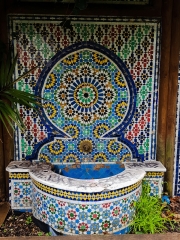
The Morroccan Garden, an exquisite part of the Meanwhile Gardens, was opened by Councillor Victoria Borwick on behalf of the local Moroccan community in 2007.  It celebrates the achievements of that community and is open for all to enjoy. A straight path of patterned black and white tiling leads from the main path across a small lawn to a wall. A colourful mosaic with geometric patterning and a small fountain is attached to the wall, creating the illusion that a tiny part of Morocco has been transported into the Meanwhile Gardens. Nearby, there are a few seats for visitors to enjoy this tiny enclave in the gardens.

Words are insufficient to fully convey the charm of the Meanwhile Gardens, one of London’s many little gems. If you can, you should come to experience this leafy oasis so near the busy Harrow Road. In addition, a stroll along the canal tow path, where you can see an amazing variety of houseboats and plenty of waterfowl, is bound to be rewarding.

A hill of memories

PRIMROSE HILL IN NORTH LONDON is a delightful place to take exercise. From its summit at 210 feet above sea-level, it is possible to enjoy a superb panorama of London if the weather permits. At its summit, a low concrete construction is inscribed with the words the poet William Blake (1757-1827) told the lawyer, diarist, and a founder of University College London, Henry Crabb Robinson (1775-1867):

“I have conversed with the spiritual Sun. I saw him on Primrose Hill”

In one of his poems, Blake wrote:

“The fields from Islington to Marybone,

To Primrose Hill and Saint John’s Wood,

Were builded over with pillars of gold,

And there Jerusalem’s pillars stood.”

On a recent visit to Primrose Hill in January 2021, when the temperature was at the freezing point of water and London was covered by low cloud, we had no sight of the sun, spiritual or otherwise. Nevertheless, we had an enjoyable stroll that evoked many memories. One of these was when I studied at University College London. If I felt energetic, I used to walk the five or so miles to college from my home in Hampstead Garden Suburb. Part of my route was up and over Primrose Hill.

The gardens on the south side of Elsworthy Road back on to the northern base of the hill. It was on this road that my parents, newly married in 1948, lived briefly in a flat that they rented from the economist Ronald Coase (1910-2013). My mother told me that amongst the furniture in the flat there was a record player with a gigantic horn as its speaker. 46 years later, my father and my stepmother bought a house on the road. He lived there until he died last year.

Elsworthy Terrace, a cul-de-sac, leads from Elsworthy Road to Primrose Hill. The botanist and first female botanist to be elected a Fellow of the Royal Society, Agnes (née Robertson) Arber (1879-1960), lived at number 9 between 1890 and 1909, when she married the paleobotanist Edward Alexander Newell Arber (1870–1918). The Terrace leads to one of the many footpaths that form a crisscrossing network all over the grassy hill that has well-spaced trees of varying shapes and sizes. Plenty of these were covered with frost. Many of the paths meet at the treeless summit of the hill where, if you are lucky with the weather, you can enjoy a good view.

Primrose Hill, first opened to the public in 1842, was part of land appropriated for hunting by King Henry VIII. The earliest mention of its name was in the 15th century. In October 1678, the body of the anti-Catholic magistrate Sir Edmund Berry Godfrey (1621-1678) was found on Primrose Hill, marked with signs of strangulation and other bruises. The identity of his killer(s) remains a mystery. The hill was also the site of duels including one in about 1813 when the Italian patriot Ugo Foscolo (1778-1827) faced Mr Graham, the editor of the “Literary Museum”. The dispute that led to this was about his ‘Three Graces’:

“The Three Graces were his maidservants; two of them turned out to be prostitutes, and one of them ran off with his former translator. This led to a duel, whether in Regent’s Park or Primrose Hill is not clear; fortunately no blood was shed.” (www.regentsparklit.org.uk/authors_e_i.htm#Foscolo)

The southern edge of the hill is bounded by the Regents Canal, designed by John Nash (1752-1835), first used in about1816. We walked eastwards along the towpath from the elegant bridge number 10 to the point where the canal makes a right angle and heads under the Water Meeting road bridge and towards Camden Lock. This stretch of the canal has the London Zoo on both of its banks. On the north side of the canal, we passed the aviary designed by Lord Snowdon in 1964. One of Snowdon’s collaborators was Frank Newby, who was a colleague of my uncle Sven Rindl, a structural engineer at the Felix Samuely company.  On the opposite bank we passed the Giraffe House and the wild hunting dog’s enclosure, where we spotted several of these beasts prowling about. Moored at the corner where the canal changes direction, you cannot miss seeing an old-fashioned boat that looks as if it has sailed from China. This houses the ‘Feng Shang Princess’ floating Chinese restaurant, which was already built by the 1980s.

The Victorian gothic St Marks Church is flanked on two sides by the canal and on another by a short street, St Marks Square. The church, which is not particularly attractive, was consecrated in 1853, damaged during WW2, and rebuilt by 1957.  The northern edge of the church’s ground is on the southern side of Regents Park Road.

Heading west away from the church, we reach number 52 Regents Park Road. It was here that four of my good friends including the author and art historian Michael Jacobs (1952-2014) lived as ‘house-sitters’ for its then owner Rudi ‘G’ during the 1970s. The road flanks the north-eastern edge of Primrose Hill before curving eastwards and becoming an upmarket shopping street.

Since 1979, a Greek restaurant called Lemonia has been flourishing in Regents Park Road. Originally, this was housed in premises on the east side of Regents Park Road. Then, it moved to larger premises across the road in 1992. For a while, its original premises, remained part of the restaurant but renamed ‘Limonaki’. This has disappeared. The lady, who has become my wife, lived for a few months during the spring of 1983 in an avant-garde dwelling in Eglon Mews, close to the shops in Regents Park Road. It was then that she ‘discovered’ Lemonia, which became one of our favourite restaurants for several years. We held a few birthday parties there. Much later, when my father came to Elsworthy Road, he and my Greek stepmother became keen users of this friendly eatery. Nearby, is the independent Primrose Hill Books shop, a handy source of reading matter for the many local inhabitants with intellectual leanings, real or imagined.

These long-established businesses are in the midst of a good range of shops, offering a wide variety of goods. as well as cafés and restaurants and a pub. I can heartily recommend taking some physical exercise on Primrose Hill before acquiring something to stretch your mind at the bookshop (sadly not open at the moment), and taking refreshment in a pleasant, faintly Bohemian but distinctly bourgeois environment.

WHERE A JUDGE ONCE WALKED IN CHELSEA

WALKING HAS ALWAYS been my favourite and almost only form of exercise. I do not enjoy games, gyms, or swimming, or any other sport, but I love to stroll through towns, villages, and rustic landscapes, exercising my body and especially my eyes. I always carry a camera to record anything I consider of interest or picturesque or curious. With the current (January 2021) restrictions on moving far afield from home to take exercise, I must confine myself to wandering around within a short distance of home. Luckily, the borough, within which I live, and its neighbours are full of fascinating places to see, photograph, and investigate. One of these is Justice Walk, a short (77 yards) passageway leading from Chelsea’s Old Church Street to Lawrence Street.

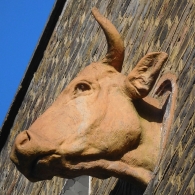
But first, let me tell you about number 46 Old Church Street close to the beginning of Justice Walk. This building has a sculpture of a cow’s head attached to its façade as well as two pictures made with coloured tiling. One of them, with the words ‘An early mower’, depicts a man holding a scythe and taking a drink from a small barrel. The other shows a milkmaid carrying a wooden pail on her head. An alleyway on the north side of the building leads to a modern gateway. On the north wall of the house there is a name plate that reads ‘The Old Dairy Chelsea’ and near this there is another tiled painting showing a milkmaid watching cattle standing in a stream with ducks and ducklings. Behind the gates, there is a larger brick building with a pediment bearing a cow’s head as well as the date ‘1908’ and ‘estd. 1796’.

The house and the building behind it were part of Wrights Dairies, which is well described in a blog article by ‘Metrogirl’ (https://memoirsofametrogirl.com/2018/11/14/wrights-dairy-cow-heads-chelsea-history-kings-road-old-church-street/) :

“The dairy was one of the first in Chelsea and was erected on Cook’s Grounds (the site of Glebe’s Place today) in 1796. Around 50 cows and two goats grazed nearby, providing milk for the dairy … A frequent visitor to the dairy was Scottish philosopher and writer Thomas Carlyle (1795-1881), who lived a few minutes walk away on Cheyne Row … The Old Dairy was forced to move slightly west due to rapid redevelopment in the late 1800s, with Cook’s Ground and the nearby kitchen gardens of the Chelsea Rectory being swallowed up by housing. Wright’s Dairy set up their headquarters and a shop at 38-48 Church Street (now Old Church Street). The fields behind the dairy were used for the grazing cows.”

The cow’s head on the former dairy looks out at pictures of pigs across the road. These adorn a pub with the name ‘The Chelsea Pig’. Originally called ‘The Black Lion’, the establishment is said to date back to the 17th century.

Justice Walk is extremely picturesque. It is dominated by a large brick building, whose appearance is suggestive of authority, topped with a triangular pediment. This was formerly a Wesleyan chapel, which was built in 1841. It was used as a chapel and a Sunday school between 1843 and 1903 (https://chelseasociety.org.uk/wp-content/uploads/2013/11/1997-Annual-Report-1.pdf). Many estate agents have misrepresented this building as a former courthouse, glamourising with words such as these (www.russellsimpson.co.uk/stylist-the-court-house/):

“A historic courthouse and jail that once held highway robbers and thieves before they were transported to the British penal colonies in the 18th Century has been transformed into a luxury £14.5 million home.

The Court House, on the aptly-named Justice Walk in Chelsea, is one of London’s last surviving courthouses and gaols and has been dubbed “Britain’s most expensive prison cell” after undergoing a designer restoration and makeover. Built in the early 18th Century, the majestic house of justice tried hundreds of criminals with highway robbery, drunken behaviour and petty theft – of a kind similar to legendary highwayman Dick Turpin (who was executed in 1739 for horse theft).”

So much for Dick Turpin and other exciting misinformation. Opposite the former chapel, there is a house whose front door is surmounted by a scallop shell and other ornate decoration. The door bears the name ‘Judge’s House’. Given what I have learnt about the so-called courtroom, which was really a chapel, I wonder whether a judge ever lived in the house. My doubt is increased when I read (in “The London Encyclopaedia, edited by B Weinreb and C Hibbert) that Justice Walk is most probably named after John Gregory, a Justice of the Peace, who owned property in nearby Gregory Place and in Kensington Church Street.

Several houses at the corner of Justice Walk and Lawrence Street stand where there was a factory and showrooms for the renowned Chelsea china. The china establishment was demolished at the end of the 18th century (www.british-history.ac.uk/old-new-london/vol5/pp84-100). Although the china works are long gone, the Cross Keys pub still exists, though closed during the ‘lockdown’. Established in 1708, it is Chelsea’s oldest pub. Its customers have included JMW Turner, John Singer Sargent, and James McNeill Whistler, painters; Dylan Thomas, poet; Bob Marley, musician; and Agatha Christie, novelist.

Seeing all that I have described took about fifteen minutes, but you could easily miss it all if you walked past in a hurry. Although I did not perform much exercise looking at this tiny part of London, seeing it provided plenty of food for thought. After exploring this area, my wife and I walked out of Lawrence Street and began a vigorous stroll along the Thames embankment which provided lovely vistas in the hazy winter sunshine.

Beer and biryani in Hampstead High Street

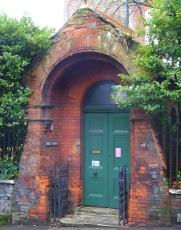
MANY PEOPLE HAVE FAVOURITE restaurants. My parents were no exceptions. Amongst the restaurants they frequented often in London during the early 1960s were Mon Plaisir in Monmouth Street; Otello in Soho; Cellier du Midi in Hampstead; and the Tung Hsing in Golders Green, one of the first restaurants in London to serve ‘Pekinese’ cuisine. For Indian food, they patronised the Shahbhag in Hampstead High Street. 135 feet west of that still extant restaurant there is an archway decorated with sculptures depicting sheaves of barley and an inscription that reads:

“Established 1720. BREWERY. Rebuilt 1869”

The archway is at the street entrance of a covered cobbled lane that leads to a converted Victorian industrial building, now named ‘Clive House’, within a yard of varying width. The yard contains a well-head covering a well that looks quite old, and certainly not of recent construction.

The brewery was that of the ‘Hampstead Brewery Co. Ltd’ founded in 1720 by John Vincent (died 1755).  In about 1713, Vincent, already a landowner, acquired the Jack Straws Castle pub near Hampstead’s Whitestone Pond (www.british-history.ac.uk/vch/middx/vol9/pp66-71). He founded the brewery behind a pub called the “King of Bohemia’s Head” in 1720. In 1733, he was granted a 33-year lease of a spring by the trustees of an estate in Hampstead, which contained it and other wells including those with curative mineral waters. It was:

“…used only to supply the Vincents’ brewery in High Street and a few adjoining houses, was of little value to anyone other than the brewer.” (www.british-history.ac.uk/vch/middx/vol9/pp169-172).

Thomas J Barratt, a historian of Hampstead, wrote (in 1912) that Vincent selfishly believed that:

“… he could utilise the water to his own profit and the benefit of some of his neighbours; therefore, with the leave of the trustees, he laid down pipes and conveyed water from the pond not only to his brewery but also to a number of better-class houses in the town. He charged the householders for the water, and no doubt did well out of the transaction; but when, after many years, the Chancery decree brought about a day of reckoning he was ordered to pay £322 for arrears of rent, and the water was advertised to be let to the highest bidder. When Gayton Road, a thoroughfare now connecting Well Walk with High Street, was being formed, remains of the pipes conveying this water to the brewery were discovered a few feet below the surface.”

In addition to the brewery, Vincent acquired much other property in Hampstead including several pubs. On his death in 1755, Vincent’s brewery and other properties passed to his younger son Robert, who is thought to have continued running the brewery with his elder brother Richard (www.british-history.ac.uk/vch/middx/vol9/pp111-130). Richard entered Wadham College, Oxford, in April 1736 and became a barrister (Inner Temple) in 1743 (https://en.wikisource.org/wiki/Page:Alumni_Oxoniensis_(1715-1886)_volume_4.djvu/270).

In 1787, Robert’s widow Elizabeth became involved in running the business and some of the Vincents’ pubs in Hampstead including the ‘George’, the ‘Black Boy’, and the ‘Coach and Horses’. She retained an interest in the brewery until 1812, which is well after it was taken over by Messrs Shepheard and Buckland in 1797. The brewery was rebuilt in 1869 with two shopfronts on the High Street, and by the 1880s, it was owned by Mure & Co. In 1928, the company had 184 employees, but it closed in about 1931. Reffell’s Bexley Brewery acquired it in 1931 (https://builtforbrewing.wordpress.com/2012/08/06/on-hampstead-high-street/).  

The brewery buildings had become quite dilapidated by 1959 when they were being used for motor repairs. Later, the structure was converted for use as office space and an attractive group of residences were built within its compound.  The main brewery building is now named Clive House. It is currently the offices of the Pears Foundation, which is:

“…an independent, British family foundation, rooted in Jewish values, that takes £15 ‐ 20 million of private money every year and invests it in good causes.” (https://pearsfoundation.org.uk/who-we-are/).

The Brewery’s grounds were adjacent to the grounds of a church, which has been converted into residential dwellings, which retain some of the original windows topped with ogival arches. This building is labelled as ‘Trinity Presbyterian Church’ on a map surveyed in 1866. It was founded in 1844 and had its roots in Calvinist theology. The church’s story is as follows (https://search.lma.gov.uk/scripts/mwimain.dll/144/LMA_OPAC/web_detail/REFD+LMA~2F4352?SESSIONSEARCH):

“Trinity Presbyterian Church began after a report by the Presbyterian district visitor for Hampstead that Scottish inhabitants needed a preaching station … By the end of 1845 the average attendance was 130 in the morning and 80 in the evening … The congregation moved to Well Walk Chapel in 1853, however, the building was dilapidated, so a site at 2 High Street, on the corner of Willoughby Road, was bought in 1861. The new church opened in 1862. It was demolished in 1962 … Shops were built on the site and the hall was converted into Trinity Close.”

So, what can be seen today was the church hall.

All this history is making me hungry. So, let us return to the Shahbhag, which my parents enjoyed back when I was a youngster. I went there once in the early 1970s and had a pleasant meal. Then, I did not return to it until the mid- to late 1990s.  It looked different to what I remembered of it, but its location was the same as of old. I sat down and ordered a meal. While I was waiting for it to arrive, I looked around at what was arriving on the plates being served to other diners and I did not like what I saw. It looked and smelled far less attractive than the food that I was used to having in other Indian restaurants at the time. I was beginning to regret having entered this restaurant, mainly for nostalgic reasons. I waited and waited for an extremely long time, but my food did not arrive. I looked at the time, almost 45 minutes had elapsed since giving my order, and realised that soon I had to meet my wife and some friends. I called the waiter and told him that I could wait no longer and that I would be cancelling my order. He seemed undismayed as I walked out of the restaurant.

Recently (January 2020) when I explored the grounds of the former Hampstead Brewery, I noticed that the Shahbhag was still in existence but closed for the time being because of the current viral pandemic. I am glad it still exists as it is something that reminds me of my parents, but I doubt I will be entering it again when it reopens. When restrictions relating to covid19 ease up, I would rather have a beer than a biryani in Hampstead.

A house, a spa, and Gray’s Anatomy

I ENJOY FINDING links between seemingly diverse subjects. Recently, I discovered a connection between an old house in Hampstead in north London and the famous textbook “Gray’s Anatomy”.

On crossing East Heath Road, having just visited the Vale of Health, I saw a pair of wooden doors framed by a substantial brick archway. These doors are the entrance to the grounds of Foley House, which stands on a plot at the corner of Well Walk and East Heath Road. Even though it is partially hidden by the trees that grow within the railings that surround it, the upper windows of this three-storey brick building can be seen. From its architectural style, I guessed that it was pre-Victorian, maybe 18th century. Just south of the main building, there is an outhouse with a white painted wooden weatherboard façade. The top of the façade has six small apertures each above one of two shelves. Presumably, these are parts of a dovecote.

One source (https://www.british-history.ac.uk/vch/middx/vol9/pp15-33) states that the present Foley House was built between 1771 and 1773 by the Holborn glazier Edward Helling. Helling, whose dates I cannot find, had already died by 1781. This house (or an earlier one on the same site) was built for Mr John Duffield. who was:

“… the first Spa manager …” (https://historicengland.org.uk/listing/the-list/list-entry/1342099)

The spa was across Well Walk opposite Foley House.

In the late 17th century, Hampstead became well-known for its supposedly curative Chalybeate spring water, which is rich in iron salts. The spa was established on land that was leased in 1698 by Susannah Noel on behalf of her son Baptist, 3rd Earl of Gainsborough (1684-1714), who was lord of the manor, but a minor.  The lease:

“…granted 6 a[cres]. of Hampstead Heath, including the well of mineral water, to 14 trustees, who were admitted as copyholders at a rent of 5s. a year to use the income for the poor of Hampstead. The trustees leased all the property except the pond or springhead north-west of the mineral spring to John Duffield in 1701 for 21 years at £50 a year, on condition he spent £300 over 3 years improving it, and agreed for a second term for improvements worth £200.” (https://www.british-history.ac.uk/vch/middx/vol9/pp169-172).”

According to Thomas Barratt, author of the encyclopaedic “The Annals of Hampstead” (published 1912), one of these fourteen men was one Thomas Foley. The house might have been named in his memory.

Duffield was quick to develop the mineral spring into a spa. Christopher Wade, author of “For the poor of Hampstead, forever. 300 years of the Hampstead Wells Trust” published in 1998, quotes an advertisement for a concert that was to be held in the Hampstead Wells on the 18th of August 1701. By then, Duffield had built his Long Room, an edifice containing a ‘Pump Room’ and an ‘Assembly Room’. The latter measured about 72 by 30 feet and was tall and airy with large windows. It could accommodate 500 people The Long Room, which was demolished in 1882, was located where a house called Wellside (built 1892) stands in Well Walk today.

Wade wrote that Duffield:

“… had done well enough for himself to build ‘a goode brick house’ costing £1000. Some historians claim that that this became Foley House on East Heath Road, but the evidence is confused. (The house is not shown on a detailed map of 1762)”

The words “a goode brick house” are quoted from the manorial records of 1706. Barratt notes:

“Mr GW Potter is of the opinion from the description given in the record that this house was, in all or in part, that now called Foley House…”

Well, if the house that we see today was only built in 1771, it is not surprising that it was not shown on the map created in 1762. I looked at that map (https://www.british-history.ac.uk/vch/middx/vol9/pp15-33) and Wade is right. There is no building marked where Foley House should be found. However, in “The Buildings of England. London 4: North”, the architectural historians Nikolaus Pevsner with Bridget Cherry write that Foley House was:

“… built in 1698 for J Duffield, the first spa manager …, but with mid-c18 three-bay front … Early c18 stables, weatherboarded.”

Pevsner and Cherry were describing the house that we saw, but its absence from the map is puzzling. I speculate the following. Duffield did have a house built in 1698 on the plot where the present Foley House stands. Maybe, it had been demolished by 1762, when the map was drawn, and then later replaced by the house built by Edward Helling, mentioned above. Alternatively, the map was incomplete or not 100% accurate.  

Several Victorian buildings neighbouring Foley House on Well Walk (currently numbers 21-27) bear the name ‘Foley Avenue’. Designed by Henry S Legg, these were built in 1881 on land that was once part of the grounds of Foley House.

And now for the link that I mentioned at the beginning of this piece. One of the people who lived in Foley House was the physiologist and surgeon Sir Benjamin Brodie (1783-1862). In an autobiographical note (“The works of Sir Benjamin Collins Brodie … with an autobiography”, published 1865), he wrote:

“In the year 1828 I engaged a house on Hampstead Heath, which at that time was a comparatively rural retreat. My family resided there during the summer and part of the autumnal season, and I generally was able to go thither to dinner, returning to my occupation in London in the morning.”

Brodie helped to acquire the building at the north end of Kinnerton Street in Belgravia, which became the medical school for St Georges Hospital (while it was located at Hyde Park Corner in what is now ‘The Lanesborough Hotel’).  One of the students who was taught by Brodie in Kinnerton Street was Henry Gray (1827-1861), author of one of the most famous medical textbooks, “Gray’s Anatomy”. Gray dedicated his masterpiece to his teacher and colleague Brodie.

Brodie used Foley House between 1828 and 1837, when his lease expired. Then, he bought a property in Surrey. As Gray was under ten years old when Brodie lived in Hampstead, he would not have been a visitor to Foley House.

Had I not written about Kinnerton Street and its association with “Gray’s Anatomy” shortly before spotting Foley House in Hampstead, there would have been hardly any chance of me being able to realise the connections between the house, Brodie, and his student, the famous anatomist.

Accidental death of an architect

ELEGANT BELGRAVE SQUARE is but a stone’s throw from Hyde Park Corner. Many of its neo-classical buildings are home to diplomatic missions and their staff. As with many London squares, the centre of Belgrave Square contains a private garden. That at Belgrave Square is adorned with sculptures, mostly statues of eminent people. At each of its four corners, there is one. The people depicted at these four positions are Prince Henry the Navigator (1394-1460); Christopher Columbus (1451-1506); Simon Bolivar (1783-1830), the liberator of Venezuela, Bolivia, Colombia, Ecuador, Peru, and Panama; and José San Martin (1778-1850), liberator of Argentina, Chile, and Peru. Almost facing San Martin on the north east corner of the square is a statue of Sir Robert Grosvenor, First Marquess of Westminster (1767-1845), upon whose estate Belgrave Square was built.

Elias George Basevi

On the eastern side of the square, close to the statue of Simon Bolivar and within the garden, there is a sculpture by Enzo Plazzotta (1921-1981), which was completed after his death by Mark Holloway. It is called “Homage to Leonardo. The Vitruvian Man”.

Interesting as all the above-mentioned are, the sculpture that intrigued me most is a bust of Elias George Basevi (1794-1845), who is described on his plinth as ‘architect’. I guessed that he was likely to have been involved in the design of Belgrave Square, and I was right. According to a plaque on the base of Grosvenor’s statue, he designed the neo-classical terraces surrounding the square for the Haldimand Syndicate, which was under the control of the brothers George (1781-1851) and William (1784-1862) Haldimand, of Swiss origin, sons of a banker born in Switzerland and an English mother. In 1825, William, a Member of Parliament:

“… negotiated successfully with the 2nd Earl Grosvenor, Seth Smith and William Cubitt for a 99-year lease on Belgrave Square, where he had 49 houses built: 16 to be owned by George Haldimand, 14 by himself, eight by Prevost, four by Smith and three by Cubitt…” (www.historyofparliamentonline.org/volume/1820-1832/member/haldimand-william-1784-1862)

The Haldimands were related to Frederick Haldimand (1718-1791), who became Governor of Quebec in 1777. Thomas Cubitt (1788-1855), who was involved in creating the square, was a major Victorian property developer.

As for Basevi, at first, I thought that his surname sounded Italian. His family might have come from that country as its origins were Sephardic Jewish. The Basevi surname is particularly associated with Sephardic Jews in Verona (https://judaism_enc.enacademic.com/2089/BASEVI). His father, Joshua, usually known as ‘George’, was a London City merchant (www.jewishencyclopedia.com/articles/2616-basevi-george-joshua). Elias George’s aunt, George’s sister Maria (née Basevi), was married to Isaac D’Israeli, whose son was Benjamin Disraeli, Earl of Beaconsfield (1804-1881), who was Prime Minister between 1874 and 1880. In 1810, Elias became a pupil of the great architect John Soane (1753-1837), who specialised in creating in the neo-classical style. According to the Dictionary of National Biography (‘DNB’) (https://doi.org/10.1093/ref:odnb/1615), from which I have gleaned much information about Elias, he:

“… also studied at the Royal Academy Schools, where Soane had recently been appointed professor of architecture. In 1815 he visited Paris with his brother, and on completion of his architectural training in 1816 he embarked on a three-year study tour of Italy and Greece, staying the longest in Rome and Athens, but also travelling extensively elsewhere in Italy and even visiting Constantinople.”

Regarding Belgrave Square, the DNB relates:

“Basevi designed and handled the construction of the terraced houses making up the four sides of the square (1825–40), though not the four detached villas at the corners. He treated the stuccoed terraces of eleven or twelve houses on each side as single palatial façades, giving each a central columnar portico and end pavilions in a similar manner to John Nash’s terraces in Regent’s Park … The financial success of this speculative development during an economically depressed period was due in large part to Basevi’s precise and scholarly attention to detail, not just in the design of the individual houses but also in the paving, street furniture, and composition of the square as a whole.”

Elias Basevi’s other projects included, to give just a few examples, St Thomas, Stockport, Cheshire (1822–5); work at several country houses; a building at Balliol College Oxford; Beechwood House and The Elms in Highgate; and the Fitzwilliam Museum in Cambridge, whose construction was completed after his death. Beechwood House was built for the architect’s brother Nathaniel, a barrister, in 1840, who was married to a niece of Sir Robert Peel (1788-1850).

Noticing Basevi’s buildings in Highgate, I looked at John Lloyd’s “History, Topography, and Antiquities of Highgate”, published in 1888, and discovered more about Basevi. He wrote that the Basevi family had been prominent in the Anglo-Jewish community. One member of the family, Napthali, the grandfather of Benjamin Disraeli’s mother, was an early President of The Jewish Board of Deputies, which was involved in the struggle for the emancipation of the Jews. The Basevis moved away from the Jewish faith as did their kinsmen the Disraelis.

Elias Basevi married Frances Agneta Biscoe. They produced eight children, one of whom was given the name James Palladio Basevi (1832-1871), who became an officer in the Royal Engineers.

On a personal note, I attended Highgate School between 1965 and 1970. Some years later, I acquired a copy of the “Highgate School Register 1833-1988”. Today, I looked up ‘Basevi’ in the index of pupils and discovered that in March 1840, James Palladio Basevi joined the school. This son of the architect joined the school two years after the Reverend John Bradley Dyne (1809-1898) had become headmaster. Dyne was to raise the school’s reputation considerably.  Other Basevi family members attended the school were William Augustus Basevi (joined January 1841), George Henry Basevi (joined January 1842) Frederick Biscoe Basevi (joined April 1844), Charles Edward Basevi (joined June 1844). All of these fellows were sons of the architect of Belgrave Square. Why they went to Highgate School is a bit of a mystery. Part of the reason might have been that their uncle, Nathaniel, had his home at Beechwood, a short walk from the school. however, their father, the architect lived in central London. The historian Alan Palmer, who used to teach at the school, wrote that out of the 43 graduates of Dyne’s first ten years, only 16 came from homes near the school. His reputation as a headmaster was already excellent by the time that the first of the architect’s sons entered the school, which attracted boarders.

Elias, who became a Member of the Royal Institute of British Architects, and a Fellow of both the Society of Antiquaries and the Royal Society, ended his life in a frightening way. The DNB relates his tragic ending:

“He died on 16 October 1845, aged fifty-one, after falling through an opening in the floor of the old bell chamber of the west tower of Ely Cathedral while inspecting repairs. His remains were buried in Bishop Alcock’s chapel at the east end of the cathedral.”

The bust of Elias George Basevi is smaller than the other commemorative sculpture placed in and around Belgrave Square and easy to miss if you are walking around the square. I only noticed it because I was watching two people walking with their dogs within the square’s private garden. Had I not seen the bust, I might have never explored the life of this man whose family had connections with Highgate, where I attended secondary school.