A long way from Wales

Primrose Hill is south of Hampstead village and southeast of Swiss Cottage. It is a delightful place to take exercise and has been home to several notable figures. From its summit at 210 feet above sea-level, it is possible to enjoy a superb panorama of London when weather permits. At its summit, a low concrete construction is inscribed with some words by the poet William Blake (1757-1827).
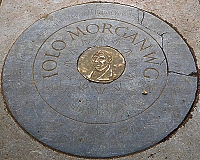
In the centre of the circular concrete platform at the summit of the hill, there is a round commemorative metal plaque surrounded with words in the Welsh language. It was placed to remember Iolo Morganwg (1747-1826), who was born in Wales as ‘Edward Williams’. He was a poet and antiquarian, who both wrote and collected poetry in the Welsh language. He had a great interest in preserving the literary and cultural heritage of his native land. His integrity as a scholar was somewhat undermined by the fact that he had forged several manuscripts that he claimed were of mediaeval origin. Nevertheless, he was involved in the early revival of Druidism. In 1792, he founded the ‘Gorsedd Beirdd Ynys Prydain’ (Gorsedd of Bards of the Island of Britain). The Gorsedd, which still meets today, is a society of poets, writers, musicians, artists, and other individuals, who have made  notable contributions to the Welsh nation, language and culture. Every year, the Gorsedd assembles at a festival of Welsh culture, now known as the Eisteddfod. According to the website of the Royal Parks, Primrose Hill was the site of the first ever Gorsedd, which was held on midsummer’s day, 21 June, 1792, a long way from Wales.

Art deco discovered

BOMBAY IS RICH in fine examples of buildings in the art deco style, which flourished roughly between the end of WW1 and the end of the 1930s. There is a good collection of buildings in this style along Marine Drive in Bombay, the Oval Maidan, and elsewhere in the city. London has some fine examples of structures that exhibit features of this kind of decorative style, but, apart from along a stretch of the A4 road, there are few concentrations of art deco buildings in London, such as can be found in Bombay. In London, the art deco buildings are mostly scattered around the city.

At the end of December 2021, we were walking with friends along the bank of the Thames between the London Apprentice pub at Isleworth and Richmond Bridge when I spotted a row of houses built in the art deco style. I had never seen them before. They line the south side of Park House Gardens in Twickenham. The detached house nearest the river, number 66, is larger and more attractive than the others in the street. The rest of the art deco residences on the street are rather mundane pairs of semi-detached homes, constructed to a pattern that I have seen elsewhere in London’s suburbs. Most of them have curved art deco period Crittall windows, which have panes of glass framed in metal rather than wood.

Park House Gardens was laid out in the early 1930s when:

“…gravel pits were filled in with, according to the local people, rubble and other material from the foundations of the Old Hotel Cecil in the Strand. The first houses were then built in Park House Gardens at prices of up to £1600 for semi-detached with garages, about the price of a garage today.” (www.twickenhampark.co.uk/a-brief-history.html)

The Cecil Hotel was in the Strand. Of its many guests, one was Mahatma Gandhi.

Another source (https://haveyoursay.citizenspace.com/richmondce/easttwickenham-spd/supporting_documents/East%20Twickenham%20SPD_Oct%2015.pdf) dates the houses differently:
“The buildings are semi-detached with Art Deco details though they do not appear to have been built until c. 1950s.”

Apart from the above information, I have found nothing else about these art deco style houses and would love to learn more.

Almost hidden from view

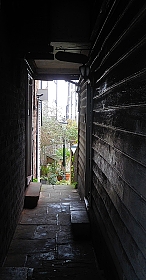
A GAP BETWEEN the houses almost opposite the long-established La Gaffe restaurant (opened in 1962) on Hampstead’s Heath Street leads into an alley lined on one side of a wall covered with overlapping planks of timber, i.e., clapboard. Steps lead down from the alleyway to a small sunken paved square surrounded by houses, some of which are 18th century.  This almost hidden nook is called Stamford Close. The name derives from the now-demolished Stamford Lodge, where John Constable and his family were briefly lodgers in 1823 after they had left their rented accommodation on Hampstead’s Lower Terrace, where they lived between 1821 and 1823.

According to Christopher Wade, in the 1930s, six old cottages were condemned and the close was considered to have been:

“…a miserable dark square – a black spot.”

Today, the square is far from miserable, and many would kill to own a house there. I am not sure how practical this would be as far as shifting heavy shopping and luggage is concerned. Also, parking cars is not possible close to the houses. Despite these disadvantages, this square would be a lovely place to live.

Marching on

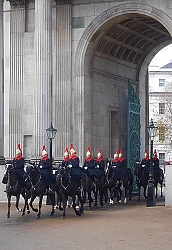
As we approach the end of the year, the pandemic rages on, the weather is appalling, and prospects for post-Brexit UK are not yet looking too bright. But all is not doom and gloom. On Christmas Eve, we went for a walk from Knightsbridge to St James Park. As we reached Hyde Park Corner and the Wellington Arch, an ever present reminder of the days when ‘England ruled the waves’ and a great deal more, we heard the sound of horse’s hooves behind us. We turned to look back at the arch and saw a line of mounted soldiers with shining helmets adorned with red tassels emerging from beneath the arch.as they have been doing several days a week for very many years, if not for several centuries. Seeing this age-old tradition being enacted in front of us reminded me that although much has been disrupted since the covid19 virus began ruling the waves, life goes on.

Winter solstice in the park

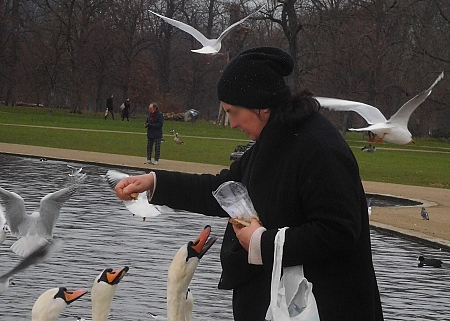
THE TEMPERATURE HAS dropped. Fear of the Omicron variant of the covid19 virus has meant that less people are out and about in London. This was the case in Kensington Gardens today, the winter solstice. The wildfowl that gather around its not so round Round Pond wait eagerly for visitors to distribute tasty morsels. Today, I saw a lady feeding the birds. So many were attracted to her that sometimes her head seemed lost in a cloud of noisy gulls. In front of her, swans extended their necks, attempting to reach her hands. Undaunted, this animal lover continued carrying out her kind gesture.

Guardian dragons

CAST-IRON STATUES of dragons mark the City of London’s boundaries on main roads leading into it., The City includes the oldest part of the metropolis.

Standing on their hind legs, the dragons stick out their red-painted tongues and rest their left forepaws on a shield with the coat-of-arms of the City of London. The creatures were designed by James Bunstone Bunning (1802-1863), who was architect to the City of London from 1843 until his death.

Thirteen of these dragons can be found in London. Some of them were placed at entrances to the City as late as the 1960s. The dragons are part of the City’s coat-of-arms, which was in use by 1381. In this emblem, a pair of them supports a crest.

I consider that these creatures look far from welcoming.

Burgers on the Strand

THE BYRON RESTAURANT chain, which specialises in serving burgers, has a branch next to the Adelphi Theatre on London’s Strand. I have not eaten there but I did peer through its street door. What I saw is quite amazing. The ground floor dining room’s walls have giant mirrors separated by marble pilasters. The ceiling beams look like marble , although it is unlikely that they are made of that material. The grand dining room has a decadent fin-de-siècle appearance, providing your eyes are averted from the banquettes upholstered with red leather, or perhaps plastic, which are quite appropriate for a burger joint.

The large façade of the restaurant has pink granite pillars on both sides. On one of these, there is a commemorative plaque that reads:

“Site of the Adelphi Theatre Restaurant owned by the Swiss-Italian Gatti family, restaurateurs, music hall, theatre and electricity supply entrepreneurs. Sir John Gatti served as Lord Mayor of Westminster, 1911-12.”

The Adelphi Theatre is still in business, but its neighbour, the Adelphi Theatre Restaurant, is now the Byron outlet.  Carlo Agostino Gatti (1841-1897) and his brother Stefano Gatti (1844-1906), father of Sir John, ran the Adelphi Theatre, the Adelphi Theatre Restaurant and the Vaudeville Theatre all in the Strand (www.londonremembers.com/subjects/gatti-family). Carlo and Stefano came from Ticino Canton in Switzerland. Another Gatti, Gaspare Antonio Pietro Gatti, known as ‘Luigi’, came to London from Montalto Pavese in Italy, where he was born in 1875. He is supposed to have managed the restaurant at The Ritz Hotel, as well its concessions on two ships, one of which was the ill-fated Titanic. Whether Luigi was related to the brothers is uncertain.

What is also uncertain in my mind is whether the dining room that now serves as home to Byron and its burgers is the original that existed when the Gatti family owned the restaurant or whether it is from a later era. The upper storeys of the building were recently converted into luxury flats, whose interiors can be viewed on websites such as https://www.businessinsider.com/pictures-london-gatti-house-millionaire-flats-on-the-strand-with-pizza-lift-2015-10?r=US&IR=T .

So, next time you are wandering along the Strand, take a peek into Byron’s and, maybe, if you are feeling peckish …

Art on the roof

TEMPLE STATION IS on the Circle and District lines of London’s Underground. It was opened in 1870 and named after the nearby ancient Temple Church, which stars in Dan Brown’s 2003 novel “The Da Vinci Code”. The station’s ticket office is housed in a single storey building with a flat roof surrounded by a balustrade. The flat roof, with a few benches, occupies about half an acre and until recently served simply as a place to sit in the fresh air. Now, this has changed.

The flat roof has become employed as an open-air exhibition space for young artists. Today (December 2021), we climbed the stairs to reach the roof and were amazed to see that it has been covered with multi-coloured painting and plastic floor tiles, a dramatic sight. There is also a colourful hut, “The Artist’s Hut”, a modern take on the traditional cabman’s shelter. With the title “Back in the Air: A Meditation on Higher Ground”, the art installation was created by London-based artist Lakwena Maciver (born 1986). Also on this coloured space, there are a couple of ceramic works by another artist, Camilla Bliss. It is a wonderful surprise to see this field of bright colours, especially beneath a cloudy, grey sky. It would be fun to see the space from the air. But I do not know whether the pigeons would agree with me.

In the future, it is hoped that other artworks will b e displayed above Temple Station.

Putting Hampstead on paper

I HAVE TOLD SEVERAL friends that I am busy writing a book about Hampstead in North London. Hearing this, each one of them has said something like “Aren’t there already so many books about the place?” Well, those words are hardly encouraging. Had I been writing a love story or a book about WW2, they would not have expressed any sentiments about the untold number of already published love stories and books about WW2.

I wondered how many books there are about Hampstead, non-fiction rather than fiction. I searched for “Hampstead” in the book section on Amazon’s UK website and found that there are not more than about 40 different non-fiction titles relating to Hampstead rather than only Hampstead Heath or Hampstead Garden Suburb. Of these titles, 11 were published since 2000, and most of these before 2015. The rest were published before 2000, and of these at least 16 were published before 1980. Since 2015, only 3 books, which deal mostly with Hampstead, have been published. Therefore, although there are many books about Hampstead, few of them have been published in the last six years. So, maybe it is time that another one should appear in print.

While researching the book I am writing, I have consulted many of the books still available on Amazon and many others which have chapters about Hampstead, as well as a wealth of information that can be found on the Internet. I am making much use of what I have discovered from these sources and from my own observations, and I believe that when it is completed my book will contain a distinctive combination of facts and observations, which differs from presentations in other books about the locality.  

The greater part of the book’s subject matter will be about Hampstead and its ‘satellites’, North End, Swiss Cottage, Belsize Park, and West Hampstead. I am also including shorter, detailed sections on Highgate and Golders Green. I am still at an early stage in the book’s production, but I do not feel deterred by observations that my friends have made that imply that I am simply ‘sending coals to Newcastle’, by writing yet another book about Hampstead. Time will tell.