
Wet tarmac shining
With bright motor headlight beams
While rain keeps falling

Wet tarmac shining
With bright motor headlight beams
While rain keeps falling
THE GRAND UNION canal meets the River Thames at Brentford. From there, it runs towards the Midlands where it meets other waterways in England’s extensive network of canals, which was built for commerce, but is now used mainly for pleasure.
Six miles along the canal from Brentford, there is an important junction. Here at Bulls Bridge, the Paddington Arm branches off the main Grand Union canal. From beneath the bridge, the Arm runs 13 ½ miles to Paddington. Near its destination in central London, the arm flows through a large body of water, known as Little Venice. From there, two canals, the continuation of the Arm and the Regents Canal, link Little Venice to Paddington Basin and Limehouse Basin respectively.
The Paddington Arm was opened for use in 1801. The Bulls Bridge is a single-arch brick bridge spanning the Paddington Arm a few feet east of its junction with the Grand Union Canal. It stands amidst a dull landscape filled with industrial units and large supermarkets.
Following the towpath along the Grand Union Canal away from Bulls Bridge in a north-westerly direction for 177 yards, we reach a bridge that carries the canal over a narrow stream, the River Crane. a tributary of the River Thames. According to a website, touristlink.com, the course of the Crane is as follows:
“The River Crane is 8.5 miles (13.6 km) in length. Its source is taken to be a point south of North Hyde Road in Hayes, Hillingdon, from where its course is generally in a southerly, if near semi-circular, direction, before it joins the River Thames at Isleworth. Its name is a back-formation from Cranford, London. Formerly it was called the Cranford River. The River Crane creates the boundary between the London boroughs of Hillingdon and Hounslow.”
What could be seen from the bridge carrying the canal over the Crane was a deep weed-filled fissure in the depths of which there was a narrow stream. This lies in the shadow of an elevated road, the busy Parkway (A 312) that links both the A40 and the M4 with Heathrow Airport.
Continuing north-west along the Grand Union, the canal passes beneath a series of railway bridges that carry trains to and from Paddington Station. Nearby is Hayes and Harlington station, which stands in a part of Hayes, which was once the village of Botwell. This is now a shopping area with supplied with lavishly stocked fruit and vegetable shops and a branch of Lidl’s supermarket chain. Lidl’s faces a Roman Catholic Church, Immaculate Heart of Mary, built in 1961, which according to Pevsner, contains a painting by Pietro Annigoni (1910-1988). Near the station is a less attractive church, St Anselm, built between 1926 and 1928.
Even at the beginning of the 20th century, Hayes in Middlesex was a village north of Botwell and separated from it and other neighbouring settlements by open countryside. By 1940, Hayes had begun to be engulfed by London’s western spread. The village was, according to James Thorne, writing in 1876:
“… quiet and respectable, and chiefly dependent on the wealthy residents … consists of a few ordinary houses and shops.
Today, it is still quiet, the commercial district being in Hayes Town, the former Botwell, near the railway station.
There is one good reason to visit what was old Hayes. That is to see the parish church of St Mary the Virgin. It stands on the eastern side of Barra Hall Park, which are the grounds of the former manor house, now much modified. The church is mediaeval. Its lychgate is probably early 16th century. Its chancel is late 13th century, the tower and the north aisle are 15th century, and the main aisle is 16th century. The church has beautiful timber ceilings and a 12th century font. On the north wall there is a large wall painting of St Christopher carrying the Christ child. Pevsner did not consider this image was painted before about 1500.
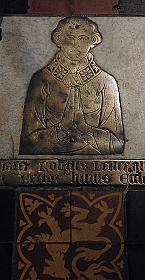
The church is full of fine funerary monuments. These include elaborate memorials for Sir Walter Grene (1456); the judge of the King’s Bench Edward Fenner (died 1612); Roger Jenyns (died 1693) and members of his family; Richard Lugg (1697); and Thomas (died 1576) and Elizabeth Higate. There are plenty more monuments to be seen as well as several fine brasses. Fenner’s monument consists of an effigy of Fenner lying recumbent supporting his head on his right hand. This is framed by marbled pillars supporting an elaborate carved stone semi-circular canopy, which is flanked by a pair of sculpted figures.
Although Hayes is not high on most tourist’s lists of what to see in London, the old church parish church of Hayes is certainly worth a detour. As for Bulls Bridge, visiting it is only for dedicated enthusiasts of desolate landscapes and inland waterway history.

High on a wall
Watching the street far below
Without moving at all
This photograph was taken in Hampstead, a lovely area in north London. Discover Hampstead by reading my new book: https://www.amazon.co.uk/dp/B09R2WRK92
ONE OF MY COUSINS, who was on a trip around Europe during his high school years in the late 1960s, met me while he was in London. A keen collector of pipes, he wanted to visit the Dunhill shop in central London’s Piccadilly. We did this together, but I cannot recall whether he purchased a pipe. Since that day several decades ago, I have barely thought about Dunhill or even smokers’ pipes.

Today (8th of February 2022), I was strolling along Uxbridge Street near Notting Hill Gate when I looked at a building that looks as if it might have once been a factory or warehouse. I have often noticed it and wondered about its former purpose. However, it was only today that I noticed a commemorative plaque affixed to it. I am sure that I have never noticed it before; maybe, it was placed recently. The words on it read:
“This building was the Dunhill pipe & cigarette factory 1916-1946.”
Well, that got me interested.
Tim Rich published an article about Alfred Dunhill and his firm in an issue of “The Pipe” (number 2, 1995). Alfred Dunhill (1872-1959) opened his first tobacco shop on Duke Street in 1907. Three years earlier, he had invented a ‘windshield pipe’, which allowed motorists to smoke in draughty vehicles. In 1910, dissatisfied with the pipes he was selling in his shop, he decided to start his own pipe factory. At first, they were made in Mason’s Yard, where today a branch of the White Cube art gallery is located. As business grew, he moved his factory to Notting Hill Gate and later opened another in Plaistow in the East End. The Notting Hill factory “…turned out several thousand Dunhill pipes per week” (https://rebornpipes.com/tag/history-of-dunhill/).
According to Carolyn Hubbard-Ford, writing in a 2014 issue of “The Notting Hill & Holland Park Magazine”, Alfred Dunhill was a major employer in the area. The factory used to be linked by a bridge, now gone, to another building across the road. The bridge was made of metal and low enough for local children to throw balls over it. Alfred’s daughter Mary began working in the factory in the 1920s immediately after she left school. Dunhill’s also had a shop, no longer in existence, close to the factory at 137-143 Notting Hill Gate.
After Dunhill’s moved out of the factory in 1946, the building on which the plaque is attached was converted into offices. In about 2001, the building was again converted, this time to provide residential units.
It is interesting what one can spot when walking leisurely along a street
CALLCOTT STREET IN Notting Hill Gate is only 76 yards long. It contains two lampposts that provide evidence of Kensington’s administrative history. Once, this street was in the Borough of Kensington, which was incorporated into the larger Royal Borough of Kensington and Chelsea (‘RBKC’) in 1965.
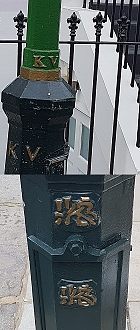
Most streetlamps in RBKC, are marked with the letters R, B, K, and C, intertwined. However, one of the lampposts in Callcott Street is marked with ‘RBK’, without the ‘C’. The other lamppost in this short thoroughfare is marked with the letters ‘KV’. This stands for Kensington Vestry. In the 19th century and probably earlier, local affairs were governed by the local vestry. This was a meeting or council of parish ratepayers, which often met in the local parish church or its vestry. In the case of Kensington, there is a fine Victorian building, now a branch of the Iranian Bank Melli, which used to serve as the Kensington Vestry Hall. Before this was built (in 1852), the local vestry used to meet in a room attached to the nearby St Mary Abbots church.
In 1901, the Metropolitan Borough of Kensington was granted the status of ‘Royal Borough’ and was known as the Royal Borough of Kensington. So, the streetlamp marked with ‘RBK’ must date from between 1901 and 1965, and the one with ‘KV’ is even older.
In the middle years of the 1720s, Daniel Defoe described Hammersmith as a village that was growing into a small town:
“… and some talk also of building a fine stone bridge over the Thames …”
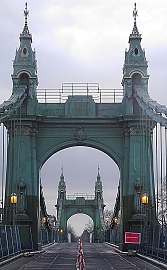
It was almost 100 years after Defoe speculated that a bridge across the Thames would be built at Hammersmith. A suspension bridge was constructed between 1824 and 1827. It was the first of this type of bridge to be constructed anywhere near London and the first to span the Thames. James Thorne, writing in 1876, that in outline and simplicity of style, it:
“… remains the best-looking-bridge of its kind on the Thames …”
The bridge was designed by William Tierney Clark (1783-1852), who had been guided in his development of bridge construction techniques by Thomas Telford and John Rennie, who designed the old London Bridge that now stands in Lake Havasu City in Arizona. Clark also designed the suspension bridge (1832) across the Thames at Marlow and the impressive Széchenyi (Chain) Bridge which crosses the River Danube to link Buda and Pest. The latter resembles Clark’s Hammersmith Bridge as depicted in old engravings.
In 1883-37, Clark’s Hammersmith Bridge was replaced by a newer one designed by Joseph Bazalgette (1819-1891). According to Cherry and Pevsner in The Buildings of England. London 2: South, Bazalgette:
“… re-used the piers and abutments. Iron-framed towers clad in cast iron partly gilt, with Frenchy pavilion tops, and elephantine ornament at the approaches … The deck stiffening girders were replaced in a major overhaul in 1973-6.”
This bridge, which was built for use by horses and carts, pedestrians, and the occasional cyclist, long before the advent of heavy motor vehicles such as busses and lorries. It has been closed for repairs several times, causing much nuisance for those who live on both sides of it. In April 2019, Hammersmith and Fulham Council closed the bridge to all motorised traffic. This was done following the discovery of serious cracks in the pedestals that support the bridge. It remained open for pedestrians and cyclists until August 2020, when a heatwave caused further deterioration. Then, the bridge was closed to all users.
A variety of schemes have been proposed for repairing the bridge and there was some disagreement as to who would pay for the work. In June 2021, Hammersmith and Fulham Council came to a cost-sharing deal to complete the rehabilitation of the Victorian bridge. In July 2021, the bridge was reopened for use by cyclists and pedestrians until 2027. In February 2022, I stepped on the bridge for the first time since it closed. The view from it is marvellous, especially upstream where one gets a good view of the historic buildings lining the waterfront between Hammersmith and Chiswick.
THE SHED IS aptly named. It is a restaurant in a long lean-to shed amongst the more solidly built edifices on Palace Gardens Terrace in Notting Hill Gate. This ramshackle-looking wooden structure has been home to a restaurant for many decades. For most of that time, it was called ‘The Ark’. It served lovely French-influenced food including my favourite on its menu, rack of lamb. The Ark was a popular local eatery, which attracted some celebrities including Prince Charles and Ingrid Bergman in the 1960s.

On one occasion a friend, let us call him ‘X’, who had eaten at our home many times,offered to treat us at The Ark. We accepted willingly. As soon as we sat down, X ordered the restaurant’s most expensive bottle of red wine. When, during our meal, it came to an end, he ordered another of the same. When the bill arrived at the end of our dinner, X fumbled in his pockets, blushed, and then, stammering, said:
“Oh, I have left my wallet at home.”
His home was a long way from Notting Hill Gate. He continued:
“This is all I have got”,
and placed a £10 note on the table. £10 barely covered half the cost of one of the bottles of wine he had ordered. Naturally, we paid the bill, and he said he would refund us the money, which he must have forgotten to do.
The Ark closed and then re-opened as a branch of the restaurants run by the chef Jean-Christophe Novelli. It served what I considered to be rather over-priced pretentious food. On one occasion, the Novelli restaurant took part in a scheme run by the Evening Standard newspaper. For £15, restaurants in the scheme offered a full meal without drinks – a bargain. My wife rang Novelli at the old Ark and asked whether we could book a table that day and use the voucher in the newspaper for the discounted meal. She was told that the restaurant was fully booked. So, I rang about two minutes later and asked to book a table, but without mentioning the newspaper offer. The lady, who answered the ‘phone at the restaurant, told me:
“Certainly, we have plenty of tables. Come when you like.”
Novelli’s closed, and the old Ark building remained empty for a while.
In 2012, the Gladwin brothers opened The Shed restaurant in the shed that once was home to The Ark. Time Out magazine (www.timeout.com/london/restaurants/the-shed) described it well:
“Tucked away behind a curtain of tousled ivy, The Shed serves up small, resourceful dishes built with foraged and locally-grown ingredients from the countryside. Led by the Gladwin Brother trio, who have their own farm and vineyard in Nutbourne, West Sussex, as well as two additional London restaurants, their flagship Shed was quick to become a local neighbourhood favourite when it first opened in 2012.
Though the menu changes seasonally, the original plates are still the best bet. (Note: everything is served tapas-style and 2-3 dishes per person is the recommendation.)”
I have been there a couple of times and found it to be both pleasant and original from the culinary vantage point. The serving staff, which briefly included our daughter, are obliging and well-trained. When ordering, the waiter or waitress discusses the dish and its ingredients knowledgeably. Pleasant as it is, it is not as enjoyable as The Ark was in its time.
AT THE EASTERN END of Notting Hill Gate, there is a road called Linden Gardens. In the 1860s, only the eastern part of this existed and it was named Linden Grove. To the west of Linden Grove was Linden Lodge, set in extensive grounds with a large pond or lake. It was designed by the engraver, architect, and property developer Thomas Allason (1790-1852) and constructed in 1826. He lived there until about 1838. In the late 1860s, the Lodge was demolished, and houses were built around the edge of, and on, its grounds. This occurred because of the construction of the Metropolitan Railway in the mid-1860s. The gateposts of the lodge still stand, partially embedded in the buildings at the south end of Linden Gardens.
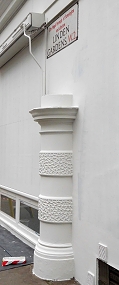
The website british-history.ac.uk noted that it was probably the peacefulness of the Grove:
“… which attracted two other artists, William Mulready, who lived in the southernmost of the eight paired houses (now demolished) from 1828 until his death in 1863, and Thomas Creswick, who lived at the still surviving No. 42 from 1838 until 1866. In the latter year this house was affected by the building of the Metropolitan Railway. Creswick therefore moved to Mulready’s now vacant house, and also, apparently, occupied the adjoining house to the north (with which it formed a pair) until his death in 1869.”
William Mulready (1786-1863) was the designer of the penny postage envelope depicting Britannia. Creswick (1811-1869) was a landscape painter and illustrator. Someone, who lived in Linden Gardens, told me that some of Queen Victoria’s children received art lessons in a studio in Linden Grove, but I have found no evidence to confirm this. However, it is certain that David Hockney painted Mr and Mrs Clark and Percy, a portrait of the dress-designer Ossie Clark (1942-1996) and his wife in their flat in Linden Gardens. The balustrades in the painting are typical of those on most of the first-floor balconies of the houses in the Gardens.
Another artist, Elsa Fraenkel (1892-1975), a German-Jewish born sculptor and Fellow of The Royal Society of Arts, who fled from the Nazis, also lived briefly in Linden Gardens, so I was informed by her daughter, who lives in Bangalore (India), where Elsa died.

A town on high
Home of famous artists and authors
Hampstead by name
ENJOY my new book which takes a fresh look at north London’s Hampstead: its sites, its personalities, its character, and history. “Beneath a Wide Sky: Hampstead and its Environs” is available from Amazon: https://www.amazon.co.uk/dp/B09R2WRK92

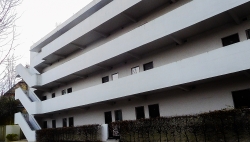
HAMPSTEAD’S LAWN ROAD Flats, better known nowadays as the Isokon Flats, was built in the 1930s as an experiment in communal living. This modernistic building was home to artists, writers, architects, and others. Many of its tenants were intellectuals fleeing from Nazi Germany. Amongst its many inhabitants were Henry Moore, Agatha Christie, and Walter Gropius. Unintentionally, it also became a centre for Soviet Russian espionage activities. You can read about this amazing place and a great deal more about Hampstead in my new book, “Beneath a Wide Sky: Hampstead and its Environs”: https://www.amazon.co.uk/BENEATH-WIDE-SKY-HAMPSTEAD-ENVIRONS/dp/B09R2WRK92/

