Just around the corner … in South Kensington

PEOPLE USUALLY ASSOCIATE South Kensington with its magnificent set of museums. However, there is far more than that in the district, and within a few yards of the museums. Here are a few places of interest near to the Victoria and Albert Museum (the ‘V&A’).

The V&A stands on the northeast corner of Exhibition Road and Cromwell Gardens (a short stretch of the A4) and faces the Ismaili Centre on the southeast corner. This attractive building built for the religious community that is led by the Aga Khan was designed by the Casson Conder Partnership and completed in 1985. According to the website of the Ismailis, https://the.ismaili, the building’s pleasing exterior:

“… has used materials and colours which are compatible with those of the surrounding buildings while at the same time in keeping with the traditional Islamic idiom and its colours of whites, light greys and blues.”

Monument in he Yalta Memorial Garden

An open space, The Yalta Memorial Garden, on the east side of the centre contains a monument to remember “… the countless men, women, and children, from the Soviet Union and other East European states, who were imprisoned and died at the hands of Communist governments after being repatriated at the conclusion of the Second World War…” The memorial consists of a column on the top of which there is a sculpture by Angela Conner (born 1935) depicting 12 faces of men, women, and children. Nearby, a house on the northeast corner of Thurloe Square and facing the V&A, bears a plaque informing that the museum’s first Director Henry Cole (1808-1882) lived there.

The Brompton Oratory, or to give its full name, the Church of the Immaculate Heart of Mary, is a huge Roman Catholic church with a neoclassical façade and a dome. It stands east of the V&A. It was designed by the architect Herbert Gribble (1846-1894), a convert to Roman Catholicism, and constructed between 1880 and 1884. The architectural style is mainly Roman Baroque. This enormous edifice was the largest Roman Catholic church in London until Westminster Cathedral was constructed in the first decade of the 20th century.

Cottage Place runs along the east side of the Oratory towards the Holy Trinity Brompton church north of it. A building that looks like many of the older Underground station entrances on the Place has a façade decorated with blood-red glazed terracotta tiles. Between 1906 and 1934, when it was closed, it was the entrance to Brompton Road station on the Piccadilly Line. It was a stop between the still functioning Knightsbridge and South Kensington stations. It was closed because it was hardly ever used by passengers.  An article in the Guardian newspaper, published in February 2014, related that during WW2, the disused station was used as a command centre for anti-aircraft batteries. It also suggested that the Nazi Rudolf Hess (1894-1987) was interrogated here. Between the station’s closure and about 2014, the building was owned and used by the Ministry of Defence.

The Holy Trinity Brompton Church, a gothic revival structure, was designed by Thomas Leverton Donaldson (1795-1885), and completed in 1829. It was established to accommodate the growing population of this part of Kensington, which until then had to worship in the church of St Mary Abbots in Kensington, almost one mile away. In 1852, a part of the church’s land was sold for building the Oratory upon it. The large grassy space north of Holy Trinity, now a park, was formerly the church’s graveyard.

Although none of the places I have described rival the splendour of the V&A and especially its fantastic collection of artefacts, they are worth exploring if you happen to be in the neighbourhood. A problem in London is that there are so many places of the greatest interests to visitors, which often means they have so little time to explore the lesser-known curiosities that form part of the rich tapestry of London’s past and present.

Return to the Himalayas

SOUTHALL LIES NOT far from Heathrow Airport. Despite its architecture being mostly typical of dull London suburbs that developed between the two World Wars, it is far from being a run-of-the mill west London suburb. Recently, in March 2022, we visited Southall after several years since we last went there.

The centre of what was once the tiny village of Southall is about 1.7 miles north of Osterley Park house. The manor of Southall was owned by the Archbishop of Canterbury in the 14th century. Separated by countryside from its neighbours, it lay on the road from London to Uxbridge and Oxford. It was only in the 1870s that the village began expanding southwards to the Great Western Railway line. Today, the place has been fully incorporated into London and retains little or nothing of its former rustic nature.

Detail of the roof of the Himalaya Palace in Southall

On arriving by train at Southall station, the observant traveller will notice that the station name signs are bilingual; they are in both Latin and Punjabi scripts. Southall is sometimes aptly referred to as ‘Chota Punjab’ (Little Punjab). The three Punjabi brothers, Charan Singh Bilga, Jagar Singh Bilga, and Lave Singh Bilga, began living in Southall in 1938. They were followed by Pritam Singh Sangha, who opened a shop in Southall in 1954, having arrived in the area in 1951. His shop was then the only shop in west London, if not in the whole of the metropolis, purveying Indian provisions.  Pritam Singh Sangha in partnership with his friend and business associate, Jarnail Singh Hura (also known as “Ghura”), established the first known business in Southall and Fakir Singh purchased numerous houses which he rented out to his countrymen.”

Vivek Chaudhary, writing in the Guardian in April 2018, recorded:

“By the time my own father arrived in 1960, local authority records show that there were approximately 1,000 Punjabis living in Southall, nearly all men. He would joke that one of the reasons why they settled here was because of its proximity to Heathrow airport, only three miles away, and “if the gooras [whites] ever kicked us out, it would be easy to get on a plane and return home”. It was a light-hearted reference to the uncertainty that was generated by the chronic racism of the time. It was the R Woolf rubber factory in neighbouring Hayes that attracted Punjabis to Southall – the general manager had served with Sikh soldiers during the second world war and was only too happy to recruit them…”

He added:

“Punjab was partitioned by the British in 1947; part of it fell within Pakistan with the remainder in India. Punjabis can be Sikh, Hindu or Muslim, and while all three demographics settled in this outpost of west London, it was the Sikhs who came in the largest numbers and gave Southall its distinct identity.”

Chaudhary mentioned that at the time he wrote his article, although at one stage Southall’s population was 70% Punjabi, this has decreased to about 50% and the descendants of many of the original settlers:

“…have prospered and moved to wealthier pastures, replaced by new communities from Afghanistan, Sri Lanka and Somalia. At its heart, though, this corner of west London remains an indelibly Punjabi town.”

And so, it is. Southall is like the Punjab and other places in India or Pakistan, but with the often-dull English weather and rather pedestrian suburban architecture. The main streets, South Road and the Broadway (Uxbridge Road), are lined with shops, small bazaars consisting of several tiny shops, and eateries. Judging by the profusion of colourful, often glittering, Indian (and Pakistani) style party clothing on sale, one might be excused for thinking that the people of Southall do nothing apart from attending ‘glitzy’ weddings.   If you wish to sample shopping as it is in India without leaving the country, then Southall is the place to do it in London. It seemed to my wife and me that the quality of the clothing on sale was high, better than much that is available in India. A Sikh salesman explained that what is on sale in Southall is made in India but unlike what is on sale over there, this is export quality.

One building is worthy of special mention in Southall, apart from the area’s gold-coloured domed Sikh gurdwaras. This is the former Himalaya Palace cinema. Built in 1929, it is unique in Britain in that its façade is in the form of a Chinese Temple. It has a pagoda roof which is flanked by dragons. It used to screen films from India’s Bollywood studios until it closed in 2010. It has now become an indoor market called Palace Shopping Centre. Fortunately, the building is protected by a preservation order and the façade is likely to remain a wonderful landmark in the foreseeable future. Not far away in a less distinguished building is another mall, the Himalaya Shopping Centre. Entering these malls, and the others in Southall, is like stepping into a typical indoor shopping bazaar anywhere in India. The air in these Southall shopping centres has the special fragrantly perfumed odour I associate with India.

Near the former cinema, stands the former Southall Town Hall, which was constructed in 1898. On its wall, there are commemorative three plaques placed by an anti-racism group called Southall Resists 40. They are dedicated to Gurdip Singh Chaggar, who was killed in 1976; Blair Peach who was killed in 1979; and ‘Misty in Roots & People Unite Musicians Cooperative’. Each of the three bears the words “Unity against Racism”.

The blind beggar and his dog

AN ELIZABETH AND AN ELISABETH figured in my mother’s life during my childhood years. One was the cookery writer Elizabeth David (1913-1992), whose recipes my mother followed faithfully. The other was the sculptor Elisabeth Frink (1930-1993). Although she never met the cookery writer, she was a good friend of the sculptor. Between 1954 and 1962, Frink taught sculpture at St Martins School of Art, which was then located in Charing Cross Road. During that period, my mother, a sculptor, worked in the sculpture workshops in St Martins. It was probably then that she and Elisabeth became friends. ‘Liz Frink’, as we knew her, visited our home in Hampstead Garden Suburb as a dinner guest regularly and I remember meeting her on these occasions. My memory of these meetings was revived when visiting London’s East End this month (March 2022).

We were walking eastwards along Roman Road from Globe Road towards the Regents Canal when we passed the Cranbrook Estate, a collection of six rather bleak looking blocks of flats. The buildings are arranged around Mace Street, which is in the form of a figure of eight. The estate was built on land which had formerly accommodated a factory, workshops, and terraced houses. The blocks were completed by 1963. They were designed by Douglas Bailey and Berthold Lubetkin (1901-1990). Born in Georgia (Russian Empire), Lubetkin lived in Russia during and after the 1917 Revolution. He studied in Moscow and Leningrad (now St Petersburg), where he became influenced by Constructivist architectural principles. In the 1920s, he practised architecture in Paris, and by 1931, he had emigrated from the USSR to Great Britain, where he mixed with the artistic community then based in Hampstead (see my book: https://www.amazon.co.uk/dp/B09R2WRK92). In London, he founded Tecton, an architectural practice. He is particularly well known for his Penguin Pool at London Zoo and his luxurious block of flats in Highgate: High Point. The flats he designed on the Cranbrook Estate were for social housing.

Various other buildings and features have been added to the estate. One of these is a triangular garden surrounded on two sides by rows of single storey houses (bungalows for the elderly). In the middle of this, the Tate Garden, there is a pond with a fountain. Perched on what looks a bit like a diving board made of concrete discs piled one above another, there is a sculpture of a man and a dog. As soon as I saw this, I was reminded of Elisabeth Frink’s sculptures. Later, when I investigated it, I discovered that it is a sculpture by her. Entitled “Blind Beggar and his Dog” and cast in bronze, Liz Frink created this in 1958, which was when she and my mother must have already become friends. A sculpture depicting the Blind Beggar and His Dog, who figure in a tale that gained popularity in Tudor times, was commissioned in 1957 by Bethnal Green Council. Incidentally, there is a Blind Beggar pub in Whitechapel Road, where in 1966, the gangster Ronnie Kray shot dead a member of a rival gang, George Cornell.

We had visited the area near the Cranbrook Estate to see a small exhibition. As it had not taken long to view it and it was a warm sunny day, we took the opportunity to roam around the area. Had we not done that, I doubt that I would have become aware of this sculpture by an old friend of my mother.

Dwellings in Globe Town

ROMAN ROAD IN east London is a section of a road running northeast from Shoreditch. It is part of a Roman road, once known as ‘Pye Road’, which ran from London to Venta Icenorum that was near Norwich. The modern road passes through an area known as Globe Town, which lies just east of Bethnal Green Underground Station. Known as ‘Eastfields’ until the start of the 19th century, the area was then called Globe Town, probably because there was a pub with that name in the area. The area was developed in the late 18th century to accommodate French Huguenot and Irish silk weavers. The weavers had looms in their homes.

By the late 19th century, Globe Town had become an overcrowded slum. Then, there were not only weavers in this run-down district but also dockworkers and people considered to be disreputable: thieves, prostitutes, and vagrants.

At the start of the 20th century, some of the slum buildings were replaced by improved habitations. Some of these can be seen whilst walking along Globe Road, which runs north from Roman Road. The buildings along Globe Road were mainly constructed by the East End Dwellings Company (‘EEDC’) between 1900 and 1906. This philanthropic company was founded in 1882 to create model dwellings. One of its founding fathers was the vicar of St Judes Church in Whitechapel, Samuel Augustus Barnett (1844-1913). Samuel and his wife Henrietta Barnett (1851-1936) unwittingly played an important role in my childhood and early adulthood. For, it was their idea to create the Hampstead Garden Suburb (in north London), where I lived for almost 30 years. Interestingly, the Anglican church in the Suburb is also dedicated to St Jude.

The aim of the EEDC was to house the poor economically, yet not without making some modest profit. The company’s first project was Katharine Buildings in Aldgate, which were opened in 1885. The buildings in Globe Road were completed between 1900 and 1906 and are still in use. Apart from the EEDC buildings, Globe Road offers the visitor a few other treats. One of these is The Camel pub, whose menu includes a range of pies. Nearby is another pub, The Florist Arms, which offers stone-baked pizzas.  If these food items are not to your taste, The Full Monty Café offers tasty snacks, Opposite the latter, there is a small second-hand bookshop, which raises money for a Buddhist organisation. The London Buddhist Centre is housed on the corner of Globe and Roman Roads. A short distance east of Globe Road, Roman Road crosses the Regents Canal, which is flanked on its east side by pleasant parks.  

A church transformed

THE VICTORIAN GOTHIC Westbourne Grove Church (with a Baptist congregation) is on the corner of the Grove and Ledbury Road. Built on the site of an earlier church, this building was constructed in 1866. On examination, it is obvious that it has been modified considerably. According to the church’s website, westbournegrovechurch.org, in 2001:

“… the church worked with the Manhattan Loft Corporation to redevelop the site. Our vision was to use the church building to serve the local community, as an expression of God’s generosity and love. The church retains space spread over the entire ground and first floors of the building, while the project was funded by development of apartments in the top four floors of the converted building.”

The church now shares its building with retail outlets and residential units, the rents from which help finance the church’s activities and maintenance.

The parts of the ground and first floors used by the congregation have been redesigned imaginatively and beautifully in a simple contemporary idiom. Airy spaces simply but attractively decorated, flow neatly between each other giving the interior of the church a cubist sculptural feel. The rooms at the base of the two towers on the south façade of the church are used for exhibitions and meetings. In short, the spaces used for ecclesiastical and pastoral purposes provide a wonderful example of successful modern interior design. The current vicar is Chris Thackery. His wife Charlotte is an architect, and was involved in overseeing, and advising on, the modernisation of the church.

A visit to see this wonderful new church is well worth making. It is not far from Portobello Road and is a treat for lovers of imaginative architectural design.

From bank to beauty parlour

AL SAQI BOOKSHOP in London’s busy Westbourne Grove occupies a shop with a façade that would not look out of place on a palazzo on the Grand Canal in Venice. I have already described the interesting history of this building elsewhere (https://adam-yamey-writes.com/2020/10/18/the-story-of-a-bookshop/).

62-64 Westbourne Grove, London

Further west along the Grove, well past the Planet Organic ‘wholefood’ store and Alounak, one of the Grove’s several Persian restaurants, we reach number 62-64, whose façade is almost as grand as that of Al Saqi. Unlike the latter, this building’s history is harder to ascertain. Currently, it is the premises of Aveda, a beauty salon also called Gina Conway Salon Spa.  The ground floor façade of this edifice includes neoclassical columns with Doric capitals, and decorative mouldings, which include the letters ‘C’, ‘L’, and ‘M’. These are intertwined to form a logo. The first floor is fronted by three large arches separated by decorative mouldings and the top storey has three sets of windows set back behind lintels supported by short columns with Doric capitals. The salon, although modernised to suit its current purpose, has its original elaborately decorated moulded plaster ceiling and wall mouldings, some of which depict the heads of angels or putti.  Nobody in the salon had any ideas about the history of this attractive building.

A photograph in the London Metropolitan Archives describes number 62 as having an Edwardian façade. When this image was created in 1974, the building was a branch of the Midland Bank, which occupied its western two thirds. The eastern third of the place was the premises of The French Kitchen and Tableware Supply Company. The bank was already in existence at this address in 1940.  What was there before the bank occupied the edifice and when exactly it was built, I have not yet discovered. The building is marked as a bank on a detailed map surveyed in 1914, but not on one surveyed in 1893. However, Allan & Mortons Street Directory of 1867 revealed that number 62 was then the address of Dr Barry, who practised homeopathic medicine.  Both the 1893 and the 1914 maps mark the building west of number 62-64 on the corner of the Grove and the western arm of Newton Road as being a bank at those times. This building currently houses Farmacy, a vegan eatery.

The logo ‘LCM’ on the old bank stands for ‘London, City, and Midland’, a bank founded in 1898, which was renamed the London Joint City and Midland Bank in 1918 and then the Midland Bank in 1923 (www.gracesguide.co.uk/London_City_and_Midland_Bank). In the absence of any more information and in view of the fact that the architectural historian Pevsner regarded it as “Edwardian”, it might be safe to conclude that the present building at 62-64 Westbourne Grove was originally constructed to house a bank sometime during the reign of Edward VII, i.e., between 1901 and 1910, and certainly before 1918.

Brothers in art

RECENTLY, WE DROVE to Southend-on-Sea in Essex to see an exhibition, “Brothers in Art”, at the town’s superb Beecroft Art Gallery. There, we enjoyed visiting a temporary exhibition of the paintings of two artists, about whom we knew nothing: the brothers Walter (1908-1997) and Harold (1911-1971) Steggles. They were members of the East London Group of artists, East End workers who created and exhibited together between 1928 and 1936. Influenced by the artists John Albert Cooper (1894-43) and Walter Sickert (1860-1942), the group produced pictures that often-depicted everyday scenes and mundane sites in a joyful way.

The Steggles were born in Ilford (east London), sons of the manager of a high-class footwear store in London’s Strand. They were not born into a family that had any history of artistic talents. At an early age, the brothers began visiting art exhibitions, including, in 1925, one at the Bethnal Green Men’s Institute Art Club at the Bethnal Green Museum. This led them to join the art classes there. Walter was 17 and Harold was 14. Unhappy with the classes at Bethnal Green, they joined the art classes conducted by John Cooper at the Bromley & Bow Institute. He encouraged the brothers to paint scenes near the institute. Soon they became members of the East London Group.

In 1928, the Group held an exhibition at the Whitechapel Art Gallery. The brothers exhibited several of their paintings at this prestigious public art venue. Many influential members of the art scene attended the show, one of them being the then director of the Tate Gallery. Several of the brothers’ paintings at the exhibition were acquired by the Tate.

The East End Group also held regular exhibitions at the Lefevre Gallery in London’s West End. The gallery, which existed from 1926 until 2002, represented leading artists including, to mention only a few, Seurat, Matisse, Degas, Picasso, Dali and Kandinski. The two brothers:

“… found themselves part of a cosmopolitan artistic milieu that included Ben Nicholson, Charles Ginner, Philip Wilson Steer, George Braque and Raoul Dufy … Before long they found themselves sought after by other galleries and Harold became a protégé of the flamboyant aesthete Eddie Marsh who lived near his office in Gray’s Inn as well as accepting a prestigious commission from Villiers David to paint the gentlemen’s clubs of St James.” (https://spitalfieldslife.com/2017/07/26/harold-walter-steggles-artists/).

Harold recalled that the first picture he sold was bought by the highly influential art dealer Sir Joseph Duveen (1869-1939) and was hung at the Tate Gallery in 1929. In 1936, Walter had one of his paintings exhibited in the Venice Biennale.

Walter and Harold sold their paintings and became prosperous enough to buy a car. This allowed them to make forays into East Anglia where they painted things they saw.  Some of these East Anglian scenes were on display at the exhibition in Southend alongside their paintings of sights in London; many of these places have disappeared since WW2.  Both Walter and Harold were commissioned by the Shell petrol company to create posters. These display places in England, beautifully depicted. Several of these were also on display.

Even though the brothers were successful as artists, they had to continue working in non-artistic jobs to gain a sufficient income. When Walter retired, he was able to concentrate fully on painting.

With the death of John Cooper in 1943, the East End Group declined and the works it had created faded from the artistic world’s limelight. What the group created was not as excitingly innovative as the art produced by the now better-known artists, some of which I mentioned above. However, the work of the Group and, in particular, of the Steggle brothers is of high quality and very pleasing aesthetically. It was well worth trekking out to Southend to see their paintings.

A poet in Hampstead and Rome

THE SHORT-LIVED POET, John Keats (1795-1821) resided briefly in Hampstead in what is now called Keats House. In my new book, “Beneath a Wide Sky: Hampstead and its Environs” *, Keats:

“… took a great liking to Hampstead and settled there in 1817. He lived in Wentworth House, which was later renamed ‘Keats House’. The house in Keats Grove was built in about 1815 and divided in two separate dwellings. One half was occupied by Charles Armitage Brown (1787-1842), a poet and friend of Leigh Hunt and the other half by Charles Wentworth Dilke (1789–1864), a literary associate of Hunt and a visitor to his home in the Vale of Health. Keats became Brown’s lodger. This was after Keats had visited his neighbour Dilke, with whom he became acquainted following an introduction by the poet and playwright John Hamilton Reynolds (1784-1852), who was part of Leigh Hunt’s circle of friends.”

Keats remained in Hampstead until 1820, when, ailing, he left for Italy to try to improve his health. Leigh Hunt (1784-1859), who lived in Hampstead’s Vale of Health, noted in his autobiography that Keats died in Rome and was buried in the English Protestant cemetery near the monument to Gaius Cestius. Amongst his graveside mourners was the poet Percy Bysshe Shelley (1792-1822), who also had spent time in Hampstead.

Had Keats not travelled to Italy, he would have probably died in Hampstead. If that had been the case, it would have been likely that he would have been buried in the graveyard of St John’s, Hampstead’s parish church on Church Row, where the artist John Constable rests in peace.

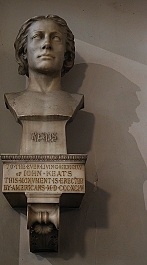
Bust of Keats in St Johns, Hampstead

Within the church there is a memorial to Keats, a bust, dated 1894, within 100 years of the poet’s birth. A gift from admirers of Keats in the USA, it was the first memorial to Keats in England. The story of the bust is related on the church’s website (https://hampsteadparishchurch.org.uk/data/keats_bust.php) as follows:

“Anne Whitney, a Boston sculptor (1821-1915) carved her original bust of Keats in 1873. The marble bust was inscribed Keats and not signed. It was exhibited the same year at Doll and Richards, Boston. It was owned by the artist until 1915 when it was bequeathed to Fred Holland Day. Day exhibited it at Boston Public Library in the loan exhibition of his Keats memorabilia in 1921 to mark the centenary of the poet’s death. The Keats bust was given by Fred Holland Day to Keats House and Museum shortly before he died, and its arrival was acknowledged by Fred Edgcumbe the curator of Keats House and Museum on 2 November 1933, the day of Day’s death. The marble replica of the bust inscribed KEATS AW (monogram) 1883 was carved by Anne Whitney in 1883. It was exhibited by F. Eastman Chase, Boston, and presented by Americans, as the first memorial to Keats on English soil, to Hampstead Parish Church on 16 July 1894. The bust remained in position until March 1992 when it was stolen. It was seen by Judith Bingham, the composer, when it was about to be auctioned at Finchley in May 1992. It failed to reach its reserve, Judith Bingham recognised its identity and it was returned to the Parish Church.”

The Keats bust is near the Lady Chapel, in which I saw a remarkable painting by Donald Chisholm Towner (1903-1985), who lived in Hampstead, in Church Row from 1937 until his death. The church’s guidebook revealed:

“The Altar Piece in the chapel was painted by Donald Towner of Church Row, in memory of his mother. True to the medieval tradition Towner used a local resident as the model for Mary, his nephew for John and his own mirror image for Christ.”

What is remarkable is that the three figures are depicted standing in Church Row. St John’s church can be seen in the background.

Apart from the bust and the painting, the church is well worth visiting to see its lovely architecture and to enjoy its peaceful atmosphere.

*My book is available from Amazon: https://www.amazon.co.uk/dp/B09R2WRK92

A short street in Kensington and social differences

AUBREY WALK IS a short street in Kensington. About 260 yards in length, it leads west from Campden Hill Road. Originally, it was the approach road to Aubrey House. Until 1893, when it was given its present name, the short stretch of road was named ‘Notting Hill Grove’ (https://www.british-history.ac.uk/survey-london/vol37/pp87-100#h3-0006).

St George, Aubrey Walk

Aubrey House, at first known as ‘Notting Hill House’, was completed by the end of the 17th century. It is at the western end of the street and was attached to some springs with medicinal properties: the Kensington Wells. In the mid-18th century, the house was enlarged by its then owner, Sir Edward Lloyd. The house and its extensive grounds passed through the hands of many different owners. Between 1767 and 1788, it was the home of the diarist and political observer Lady Mary Coke (1727-1811), the daughter of the second Duke of Argyll. By the mid-19th century, it acquired its present name, Aubrey House, to commemorate Aubrey de Vere, who owned the manor of Kensington at the time of the Domesday Book.

In 1863, the house became the property of a politician and Member of Parliament Peter Alfred Taylor (1819-1891). He was a radical, a supporter of the northern states in the American Civil War, and an anti-vaccinationist. A website, british-history.ac.uk, noted:

“Peter Alfred Taylor was M.P. for Leicester from 1862 until 1884 and was a noted champion of radical causes. His wife Clementia was also famous as a philanthropist and champion of women’s rights. They were closely involved in the movement for Italian liberation and Mazzini was a frequent visitor to Aubrey House. In 1873. Taylor sold the house to William Cleverley Alexander, an art collector and patron of Whistler.”

The Taylors opened the Aubrey Institute in the grounds of the house. This was to improve the education of poor youngsters.  WC Alexander (1840-1916), who bought the property, employed the artist James Abbott McNeill Whistler (1834-1903) to decorate the walls of the reception rooms of the house. Sadly, today, all that the public can see of the house, which is now a private residential complex, are glimpses over the outer wall of the roof and the upper storey windows.

Aubrey House used to be neighboured by the now demolished Wycombe Lodge and its large garden. In its place, there is a set of recently built houses arranged around a rectangular open space. This is called Wycombe Square.

Walking east from the wall of Aubrey House, we pass several places of interest including Wycombe Square. On the south side of Aubrey Walk is the club house of Campden Hill Lawn Tennis Club. This was founded in 1884, only seven years after the first championship competition at Wimbledon. Its twelve courts, six outdoor and the others indoors, are not visible from Aubrey Walk. Almost opposite the club, numbers 38-40, a 20th century art deco style building, contains the former home of the singer Dusty Springfield (1939-1999), who resided there from 1968 to 1972.

At the eastern end of Aubrey Walk there is the distinctive Victorian gothic church of St George (Campden Hill). In the middle of the 19th century, the area between Kensington Church Street and Campden Hill Road, the area containing Uxbridge Street, Hillgate Street and Place, and other small lanes, was a slum. It was where labourers in the nearby gravel pits and brickfields lived, often with several families in one tall, narrow house. Many of the folk living in this locality were destitute, which is difficult to imagine when you look at the place today. It was decided to build a church nearby to cater for the poor people living in this deprived area. This became St George’s on Aubrey Walk. The first church was an iron building, a large hut, which had been used by soldiers as a chapel on the Crimean War battlefields.  

In 1862, the Vicar of St Mary Abbots, the parish church of Kensington arranged to break up his huge parish into smaller units, one of which became the ecclesiastical district of St George. John Bennett, a local builder, financed the construction of a church to replace the iron structure. The first stone of the present church, which can accommodate 1500 people, was laid in 1864. Its architect was Enoch Keeling (1837-1886). The building he designed is a rare example of ‘continental gothic’, also known as ‘Eclectic Gothic’. This style makes use of brick and stonework of various colours, both externally and internally. Its exterior gives an Italianesque impression. This is especially the case when you look at the prominent bell tower at the southeast corner of the church.

St George’s was actively involved in providing education, and social work (including a soup kitchen on Edge Street) to its congregation who lived in the nearby slums. It also played a major role in the Temperance Society, which served Kensington, Notting Hill, and Shepherds Bush.  Before WW1, services at St George’s were well-attended, and a wide range of music was played. Writing in a booklet about the church, its authors, Tom Stacey and Ivo Morshead, noted:

“Elaborate settings for the choir were juxtaposed with favourites from ‘Hymns Ancient and Modern’ … The repertoire consisted of works by Stanford, Goss, Barnby, and Handel … St George’s was hardly classy at this time but it sang the same music as its more fashionable contemporary churches … Perhaps the music was above the heads of some of the congregation; yet St George’s remained a full church until the outbreak of the 1914 War.”

By the 1890s, the people that attended services at St George’s were becoming more similar to those living in other parts of Kensington because slowly but surely housing conditions were being improved and what had been a ‘down and out’ part of Kensington was ‘coming up in the world’. Many of the former slum dwellings just east of St George’s are still standing, but instead of being the residences of the poor, they are the much sought-after homes of the wealthy.

In nearby Kensington Place, east of the church, stands the parish hall, St George’s Hall.  In 1901, the Victorian building was, according to a plaque affixed above its main entrance:

“… acquired and altered to commemorate the glorious reign of Her Majesty Queen Victoria born at Kensington Palace May 24: 1819”

It is now used for residential purposes.

Aubrey Walk, although short in length, has several interesting sights. In the 19th century, it linked two social extremes. At the western end was the fabulous Aubrey House and at the eastern end, the poor of Kensington flocked to attend services in St George’s Church.

John Constable and a bookseller’s grave

ST JOHN’S IS the parish church for the C of E parish of Hampstead. The present building, designed by Henry Flitcroft and John Sanderson, was dedicated in 1747. It stands on Church Row, which is lined with elegant 18th century houses and links Heath Street with Frognal.

Church Row, Hampstead, London

The church is at the northern edge of a graveyard well populated with funerary monuments, including the grave of the artist John Constable (1776-1837). This grave is in the old part of the church’s cemetery, which was hardly used after 1878, when it was officially closed. A larger, newer graveyard is on a sloping plot across Church Row and north of St John’s. This is the burial place for a host of well-known people as well as the family of Hampstead’s Pearly Kings and Queens.  

When I used to visit Hampstead in the 1960s and early 1970s, I used to ‘haunt’ a most wonderful second-hand bookshop on Perrins Lane, which leads east from Heath Street. It was owned by an old gentleman, whose name, Francis Norman, I only learnt many years after he died. Recently, I met a member of Mr Norman’s family. He told me that Mr Norman died in 1983 and is buried in the cemetery at St Johns, describing the location as: “by a wall near Harrison and the children’s playground”.

I was not sure to whom he was referring when he mentioned “Harrison”. At the church, we asked a lady about Mr Norman’s grave.  Hearing that he had died in 1983, she suggested that we looked in the newer part of the cemetery. This has a wall that borders a children’s playground. When I looked around carefully, I found  neither any monument to Harrison nor Norman’s gravestone.

On returning to the church and explaining our unsuccessful quest, the lady sent me to see another church official, who was working in an office attached to the church. This lady knew exactly where Mr Norman was buried. She took me into the older part of the cemetery and showed me the gravestones of Francis and his wife Sonia, which lie next to each other. They are next to a small wall and close to a large monument to the clockmaker John Harrison (1693-1776). He was the inventor of a marine chronometer, which solved the problem of how to ascertain longitude whilst at sea. His story can be read in “Longitude” by Davina Sobell.  Norman’s grave is not far from that of John Constable.

Francis and Sonia Norman are amongst the few people buried in the old cemetery after it was closed in 1878.  My helpful informant at the church did not know why they had been interred there instead of in the newer part.

Francis Norman was a kindly, wise, and friendly fellow, who did not mind me and several of my friends spending hours in his shop, often spending very little on his extremely reasonably priced books. I have fond memories of the time that we spent in his presence, which are described in my book “Beneath a Wide Sky: Hampstead and its Environs” (https://www.amazon.co.uk/dp/B09R2WRK92).  So, it was with great pleasure that I met one of his family and was able to pay my respects at his grave.