Shops and shrines on a busy road in old Bangalore

I KNOW OF TWO Avenue Roads. One is in London. Lined with the homes of the wealthy, it runs between Swiss Cottage and Regents Park. The other one is in Bangalore. It runs between KR Market (aka City Market) and a large Hindu temple (mandir) where Kempe Gowda Road becomes District Office Road. Both the road in London and its namesake in Bangalore carry much traffic, but there the similarity ends.

Avenue Road in Bangalore (‘AR’) is mainly lined with all kinds of shops, especially those dealing in paper goods (stationery as well as printed books). It runs through one of the oldest parts of the city: Chickpet. The lines of shops are punctuated by small lanes and alleys that lead away from AR.

Old pillars in a mandir on Avenue Road in Bangalore

As you stroll along the thoroughfare, you will pass mandirs and one church. And near the KR Market end of the road, a short lane leads to a Muslim shrine, the Dargah-e-Hazrath Manik Mastan Sha Saherwadi. It is well worth removing your footwear to enter this peaceful place. The grave it contains is in a small room with a mirrored, domed ceiling.

Some of the mandirs on or near AR are also worth looking into. Although some of their facades look fairly recent, the carved stone columns within the buildings look quite old. Near the street entrance of one of the mandirs on AR, I saw two intricate stone carvings of Hindu subjects. Both looked as if they might have been carved several centuries ago.

The Rice Memorial Church stands in its own small grounds, separated more from its neighbours than the mandirs on AR. Named after the British missionary, the Rev Benjamin Holt Rice, this Church of South India place of worship was built between 1913 and 1916 on the site of an earlier chapel first constructed in 1834, and then later rebuilt before being demolished. Although I have passed it often, I have not yet been able to enter it.

Not far from the church and a couple of picturesque mandirs, there is a branch of the Kamat chain of eateries. You can stop there for snacks and a variety of beverages. This place is in the midst of the numerous bookshops on AR. Proclaiming discounted books, these stores mainly stock textbooks and computer programming instruction manuals. Incidentally, AR is a good place to find a wide variety of diaries and calendars.

Bustling Avenue Road in Bangalore is a far more colourful and interesting thoroughfare than its rather elegant but staid namesake more than 5000 miles away in London. The street in Bangalore and the lanes leading off it give one a good idea of the ‘flavour’ of the parts of the city which existed before the arrival of the British imperialists. It makes a fascinating contrast to the newer Cantonment areas that became established after the British began settling in Bangalore.

Protesting about lettering in Bangalore

Happy New Year!

KANNADA IS THE language spoken by the indigenous people of the Indian State of Karnataka. It is a Dravidian language spoken by about 44 million ‘natives’ of Karnataka and a 2nd or 3rd language for about 15 million ‘non-natives’.

The city of Bangalore is home to many people who either know no Kannada or for whom the language is not their ‘mother tongue’. Consequently many shop signs in the city either have no Kannada or have both English and Kannada lettering.

At the end of February 2024, it will be a legal obligation for all shop signs in Karnataka to have at least 60% of their coverage in Kannada script (currently, the requirement is 50%). However, for some fanatic Kannada nationalists this is not soon enough. On the 27th of December 2023, a few lorries loaded with men toured Bangalore. They stopped outside shops and attempted, often successfully, to damage or destroy the English lettering on shop signs. They did this not only to those signs which were entirely in the English script, but also to some bilingual signs (I.e., signs with both English and Kannada script). Not only did they damage or disfigure the English script, but in some cases, they also smashed windows.

Defaced shop sign

The police attempted to restrain these pro-Kannada activists. A few of them have been arrested. However, two days later I read that further unrest in Bangalore is threatened if those who have been arrested are not released.

While I sympathise with locals being upset that many of those who have come to Karnataka from elsewhere have little or no knowledge of Kannada, vandalism is no way to promote usage of the language and its script.

An interesting outdoor bazaar in Bangalore

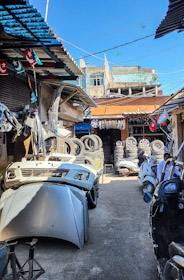
AT FIRST SIGHT, you might well think that you are looking at a crowded carpark which has been blown to pieces by a powerful bomb. There are parts of cars – bodywork, tyres, engine parts, etc., – all over the place.

After a moment or two, you begin to realise that there is a semblance of order in this ocean of car parts, many of which have been salvaged from cars at the end of their useful lives. For this area in the Shivajinagar district of Bangalore is a car parts bazaar. There are many different dealers, each specialising in particular parts of a vehicle. For example, there are merchants selling radiator grilles, others purveying axles (both front and rear), there are sellers of tyres, there are shops selling car doors and body panels … and so on.

Near both Russell Market and St Mary’s basilica, the car parts bazaar is almost hidden from sight by the buildings surrounding it. It is approached by short gullies – narrow lanes. I first stumbled across it in late December 2007. Then, on subsequent trips to Bangalore, I tried to find it again, but in vain. Today, the 26th of December 2023, I managed to locate it, and spent a few minutes wandering around it, stopping to take photographs.

It seemed that most of the dealers were Muslims. Some of them stopped me, greeted me, and asked where I came from and my name. When I replied ‘Adam’, they asked me whether I am Muslim. This reminded me of my first visit to Kosovo in 1975. As soon as I stepped of the bus that had carried me from Skopje (Macedonia) to Prizren (Kosovo), a group of youngsters surrounded me. They wanted to know my name, and when I told them, they were very happy because they thought that, like them, I was a Muslim.

Most of the dealers in the car part bazaar were happy with my taking photographs, but a few in one section of the market asked me not to use my camera.

As far as I could see, no repair work was being undertaken in the bazaar. Nearby, next to Russell Market, there were plenty of cars being repaired. Often those involved in repairing a vehicle were engaged in noisy discussions.

It is seeing places like the seemingly shambolic car parts bazaar that help to endear India and its people to me.

Three elephants

During my first visit to India (in early 1994), my in-laws encouraged my wife and me to take sightseeing trips organised by the Karnataka State Road Transport Company (‘KSRTC’). These coach trips, each of which lasted more than 12 hours, involved seeing many interesting sights. During one of them, we visited the old (12th century and earlier) temples at Belur.

After viewing the temples, we left the area in which they are enclosed, and stood waiting to board our bus. A small boy approached us. In his hand there were three small carved stone elephants, which he offered to sell us. They were quite attractive, but not something that we wanted. He began by saying:

“Two hundred rupees only.”

We declined his offer.

“One hundred and fifty rupees,” he said.

We were not tempted.

“One hundred?”

We said “No, thanks.”

“Fifty?”

Again, we refused. He brought the elephants closer to us.

“Twenty-five?”

“We really don’t want them,” we explained to him. Then, he said:

“Have them for nothing.”

We told him that we did not want them, and he wandered off,

Today, almost thirty years later, I still wonder what would have happened next if we had accepted the three elephants without paying anything to the little chap. Even though we did not buy or accept the three cute little carvings, I can still see them in my mind’s eye.

If it ain’t broke …

THE KAMAT GROUP has been operating hotels and restaurants for about forty years, if not longer. One of the branches is opposite the Jumma Masjid in the busy Commercial Street district of Bangalore (Bengaluru) in South India. I have visited this eatery many times during the 28 years that I have been making visits to Bangalore.

We usually drop in, or rather ascend the steps to, the seating area of Kamat’s to have a cup of coffee after doing errands in the crowded lanes that form the bustling area through which Commercial Street runs.

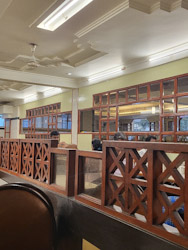
The interior of Kamat never changes. It has probably looked as it does today ever since it opened sometime before my fist visit to Bangalore. Its walls are simply decorated with mirrors and polished woodwork. A wooden barrier runs along the midline of the rectangular seating area, which comprises basic tables and chairs.

Despite not having the latest, trendy internal decor, Kamat in Commercial Street attracts many customers. The owners have done nothing noticeable to modernise the place; to make it compete with the many much more glitzy places in the city. Clearly, they understand the maxim ‘if it ain’t broke don’t fix it’

Welcomed to India with coffee

BECAUSE OF THE COVID19 pandemic, we had not stepped onto Indian soil for two years and nine months. This was unusual for us because after we married in early 1984, we have been visiting India on average twice a year. For family related reasons, we have almost always landed in Bangalore.

When a new international airport was opened near Devanahalli village (at the northern edge of Bangalore) a few years ago, a line of eateries and cafés opened alongside the main landside of the terminal building. Being outside the terminal, which can only be entered by holders of air tickets, these outlets can be used by passengers and those who are not travelling by air.

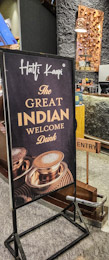
One of these stalls is a grand affair partly decorated with copper sheeting. It is called Hatti Kaapi. The ‘kaapi’ in the name refers to the way local Bangaloreans pronounce ‘coffee’. This particular coffee stand provides excellent quality South Indian filter coffee. It is so wonderful that whenever we visit the airport, either arriving (from the UK or from places elsewhere in India) or departing, we always make time to drink a coffee served by this superb stall.

So, after what was for us an abnormally long absence from India and what has been a disastrous period for everyone, it was wonderful to discover that it was ‘business as usual’ at Hatti Kaapi. And since our last trip 2 ¾ years ago, a new sign has appeared at Hatti Kaapi. It reads:
“HATTI KAAPI The great Indian welcome drink.”


Seeing that sign after 2 ¾ years made us feel much more welcome than its designers could have ever imagined.

Drawn to remember: an exhibition by an Indian painter

THE PAINTER MAHESH BALIGA was born in the south Indian state of Karnataka in 1982. He studied painting at The Chamarajendra Academy of Visual Arts (CAVA) in Mysore, and then received a postgraduate qualification at the prestigious Faculty of Fine Arts, MSU, in Baroda (Vadodara in Gujarat). He has taught at various art schools in India and exhibited in several countries including India. Currently, he lives and works in Baroda. Between the 12th of April 2022 and the 28th of May 2022, some of his works are being exhibited in a solo exhibition, “Drawn to Remember”, at the David Zwirner Gallery in Grafton Street (in London’s West End).

The paintings on display were created using casein tempera. This kind of paint has a glue-like consistency, but it can be thinned with water. According to Wikipedia, artists like this kind of paint because:

“… unlike gouache, it dries to an even consistency, making it ideal for murals. Also, it can visually resemble oil painting more than most other water-based paints …”

At first glance, it is difficult to discern whether the Baliga’s paintings on display at Zwirner’s resemble water colours or oil paintings; some of them seem to look halfway between the two mediums. All of them, except one, are quite small canvases and without exception they are all attractive. The subject matter depicted in the works is varied, from studies of plants and animals to everyday scenes (often with depictions of Indian life) to the slightly unusual. An example of the latter is in the only large canvas of the show in which there is an image of a man with sticky plasters over his left eye. Another odd subject shows a man with flowers growing out of his shirt. This is appropriately named “Flowering Self”.

The small size of most of the paintings, which the artist described as ‘lap-sized’, has a reason. Many of them were executed on the journeys the artist made when commuting to and from Surat (in the south of Gujarat), where he held a teaching position for a while. Though they are not large paintings, each one of them provides a window on the artist’s experiences and and his take on them. Although the paintings are far from mundane, they are not over-dramatic or excessively visually challenging. The exhibition is well worth seeing.  I would be happy to hang any one of the works I saw at his exhibition on my walls at home.

Honouring a Hindu hero in London

MI5 WORKS TO HELP protect our democracy in the UK. Its architecturally unflattering headquarters stand looming above the southern end of Vauxhall Bridge. A few yards downstream from it, and directly facing the main entrance of the Tate Britain across the river, there is a small grassy triangle close to the river. In the middle of the green space, there is a bust on a pedestal. The bust depicts a man with a moustache, who is wearing two chunky necklaces and what looks like a bejewelled turban. This is a monument to Basaveshvara, who lived between 1134 and 1168 (actually, these dates are not certain: he might have lived c1106-1167). A panel on the side of the pedestal notes that he was:

“Pioneer of Democracy and Social Reform”

Various people and organisations supported the creation of this monument to someone of historical importance but until now unknown to me and, I would guess, to many other people wandering past the bust. As one of the organisations involved in its creation was The Government of Karnataka (in southern India), I reached for my tattered copy of “A History of Karnataka” (edited by PB Desai), which I picked up in the wonderful Aladdin’s cave of a bookshop, Bookworm, in Church Street, Bangalore, a city which I visit often. It has 8 index entries for Basaveshwara, who is also known as ‘Basava’, ‘Basavanna’, and ‘Basavaraja’, all of these being transcripts from various Indian language alphabets.

Basaveshwar was born of Shaivite Brahmin parents at Bagevadi, which is now in the Bijapur district in the northern part of Karnataka. His name is derived from the Sanskrit word ‘Vrishabha’, the divine bull, Nandi, who carries the god Shiva. Early histories (the Puranas) described him as an incarnation of the god Shiva rather than a human being, but it is considered that he was certainly a real person. A devotee of Shiva, Basaveshwara was well-versed in both Kannada and Sanskrit learning. He was brought up in a social milieu in which people blindly adhered to the dogmas and rituals of Vedic Hinduism without bothering to understand the true spirit of religion. Desai wrote:

“Basava’s mind revolted against these ills and he decided to defy the existing order of things.”

After receiving the sacred thread, very roughly speaking a Hindu equivalent of the Jewish Bar-mitzvah or the Christian confirmation, Basaveshwara went to the Kudama Sangama, a temple complex at the confluence of the Rivers Krishna and Malaprabha. In 2011, long before I had ever heard of Basaveshwara, we stopped briefly at the Sangama on our way from Hospet to Bijapur (now named ‘Vijayapura’), both in Karnataka. When we were there, the rivers had dried up and we saw signs advising visitors to beware of crocodiles.  

Basaveshwara remained at the Sangama for about 12 years. In his time, as it is now, the Sangama was much visited by people from all walks of life. There, he met many scholars and learned men from all schools of Hindu belief. Eventually, Basaveshwara travelled to Mangalavada, the headquarters of Bijala II (c1130-c1167), the feudatory governor of the Kalachuri family (of the Chalukya dynasty). Soon, Basaveshwara became the Chief Treasurer of Bijala’s court. It was then that Basaveshwara:

“… started his new movement of religious and social reforms, treating all devotees of Siva [i.e. Shiva] as equal in all respects without the traditional distinctions of castes, communities and sects.” (Desai)

After about 20 years, BASAVESHWARA moved to Kalyana, the capital of Bijala, where his reformist ideas gained a great following. Bijala II, who had become suspicious of Basaveshwara, began crushing the movement inspired by Basaveshwara’s radical ideas that seriously threatened the traditional hierarchy that favoured the Brahmins, as well as advocating some hitherto unknown equality of men and women in spiritual aspects of life. For example, Basaveshwara sanctioned a marriage between the son of an ‘untouchable’ and the daughter of a Brahmin. Upset by this, Bijala sentenced the couple to death. Basaveshwara’s followers then plotted to assassinate Bijala, an act of which Basaveshwara disapproved. Realising that he could not restrain his angry followers, Basaveshwara retreated to Kudama Sangama, where he died. Bijala was murdered soon afterwards. Later, Basaveshwara became venerated as a (Hindu) saint.

Basaveshwara believed:

“…that every human being was equal, irrespective of caste and that all forms of manual labor was equally important.” (https://en.wikipedia.org/wiki/Basava).

These ideas sound familiar to those versed in the history of Mahatma Gandhi, who lived many centuries after Basaveshwara.  Yet, Basaveshwara is relatively unknown compared with Gandhi. Basaveshwara was certainly a reformer as is stated on the base of his bust near Vauxhall Bridge and his radical ideas were undoubtedly democratic when considered in relation to the time when he lived. So, it is quite appropriate that from his bust, there is a clear view of the Houses of Parliament, a home of democracy.

The bust on the embankment was erected by Dr Neeraj Patil, born in Karnataka, a member of the Labour Party and Mayor of the London Borough of Lambeth 2010-2011 and Dr Anagha Patil. It was unveiled in November 2015 by the current Prime Minister of India, Shri Narendra Modi. It is appropriate that Modi inaugurated this memorial as his parents were members of what was officially recognised a socially disadvantaged community, whose emancipation would surely have been approved by the reformer Basaveshwara.  And what is more, Modi is one of the first, if not the very first, of the Indian Prime Ministers, all democratically elected, who was not from a ‘high’ caste or social class such as Brahmin, Kayastha, and Rajput, and has completed at least one term of office. So, I feel that Basaveshwara does deserve a place within sight of the ‘Mother of Parliaments’.

A picnic to remember


I AM NOT A LOVER OF picnics. My perfect idea of eating outside my home is not squatting on a rug in a picturesque open-air location, but in a restaurant. In contrast, my wife and her parents loved picnics.

Many years ago, when both of my dear in-laws were still alive and healthy, that is well before 2006, we decided to have a picnic at the Big Banyan Tree just outside the city of Bangalore (India). Known in Kannada, the official state language of Karnataka, as ‘Dodda Aalada Mara’ that means ‘Big Banyan Tree’, this huge tree, an example of Ficus benghalensis which is about 400 years old, covers about three acres. It is located about 17 and a half miles west by southwest of the Bangalore Club in central Bangalore.

It is a popular local attraction for picnickers. This being the case and also the fact that I had never been there helped my in-laws decide that we should enjoy a picnic at the Big Banyan Tree. After thermos flasks had been filled, masala omelette sandwiches prepared, blankets packed, puri aloo packaged, bhakri boxed up in cylindrical steel containers with tight fitting lids, we set off: my parents in law, my brother in law and his family, my wife and our very young daughter, and me.

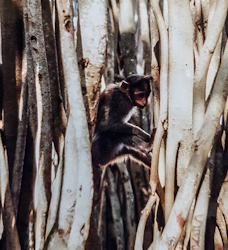
We arrived at the tree, which looked more like a dense, tangled forest than a single tree, but that is what banyan trees become when left to their own devices. After threading our way through the aerial roots hanging down from the tree, we found a small open space that looked nice for a picnic. At least everybody except me, not a lover of picnics, thought so.

We laid out the blanket, and put out the containers of food, and that is about as far our picnic was to resemble a normal meal ‘al fresco’. Moments after setting out the food, swarms of our closely related primates appeared. These monkeys had not come to keep us company or simply to watch their two-legged relatives eating. No, they had arrived to be fed. Their only intentions were far from friendly. They had come to steal our picnic. One by one they dropped out of the trees and approached our food. With great difficulty we were able to ‘shoo’ away these almost fearless raiders. At one stage, I resorted to throwing wet used teabags at them. They were very persistent, in fact so persistent that we decided not to persist with our picnic. We packed everything and made a hasty departure having eaten nothing.

This experience did nothing to remove my long-held prejudice against picnicking. It did the opposite. Wasps and other intruders are bad enough, but monkeys ‘took the biscuit’. Well, metaphorically if not in fact.

If you are there, you must try…

TAHARI blogg

I had always wanted to visit Gulbarga (now ‘Kalaburgi’) in northern Karnataka (India), not far from Hyderabad, because of the richness of its medieval Islamic architectural heritage.

When my friend in Bangalore, Mansour, a great gastronome and connoisseur of fine foods, knew we were in Gulbarga, he said:

If you’re there, you must try tahari

Well, we had no idea what this dish comprised, but if Mansour reccomended it, it must be worth trying. A search on Google revealed that the Limra Tahari was highly rated. We rang to make a reservation and were told that was unnecessary. Also, we learnt that the place only took cash payments.

One evening, we hired an autorickshaw to take us to Limra. However, the driver had no idea how to find it, and eventually dropped us near a different restaurant, saying;

This is a restaurant. You can eat here.

It was a totally unsatisfactory eatery.

Next evening, we were fortunate. A rickshaw driver knew where to find the Limra. When we arrived, he told us that he would wait for us as we would not be long and, also, it was difficult to find autorickshaws in the area in the evening. We wondered why, but soon found out.

The front of the restaurant was unprepossessing, to put it mildly. The place was separated from the street by a pair of ageing red curtains, rather like that found at a theatre stage. The steps leading up to it from the street were littered with old newspaper and other rubbish. I looked at my wife questioningly. She seemed happy to enter, so we parted the curtains and stepped inside. The interior was spotlessly clean.

To the left of the entrance, an old man sat behind a small cash desk. To the right, there were a couple of men preparing food in huge metal post heated by smouldering charcoals. Limra’s dining area was simple. There were several long narrow rectangular metal tables, which were probably screwed to the floor. All of the diners were men, except my wife.

Before we had time to ask for a menu or what was on offer, a boy slid two metal plates across our table towards us. Each plate was laden with tahari. He added a third plate that contained an unappetising looking greasy sauce. We ordered a couple of bottles of mineral water and began our exploration of tahari.

The tahari consisted of spicy yellow rice which contained a few lumps of well-cooked tender meat. The sauce turned out to be delicious and not at all greasy. The tahari was very tasty and delicately spiced – a real treat. Tahari is, I later discovered, an Awadhi dish from the region of India where Lucknow is located. It is typical of a certain style of Mughal cooking. It is, as we saw when we entered Limra, slow-cooked.

When we finished our tahari, we noticed the menu on the wall behind us. It consisted of two items: tahari: full plate, and tahari: half plate. No wonder, we were served our food immediately. There was nothing to choose from here! Our bill for two full plates and two bottles of water came to only 80 Indian Rupees (about £0.90 sterling). It took us no more than 10 minutes to finish our scrumptious meal. We understood why our driver decided to wait for us, and we understood why the restaurant did not accept anything but cash as payment. So, if you are ever in Gulbarga, you must try tahari!