
THE CITY OF Ahmedabad was founded in 1411 AD when Ahmad Shah I of the Gujarat Sultanate moved his capital to the already existing settlement of Ashaval. He renamed the place as Ahmedabad. During the fifteenth and sixteenth centuries, many fine mosques were built in the city. During previous visits to Ahmedabad, we have looked at many of these edifice.

Today, 29 November 2025, we came across a mosque we had not seen before. It, the Rani Rupamati (aka Rupavati) Masjid, is beside the main road (Mirzapur Rd) that leads from the Sidi Saiyed mosque in the city centre to the Delhi Gate.
The Rani Rupamati Masjid was constructed in the fifteenth century, possibly Sultan Mahmud Begada for Rani Rupamati, whom he married. The mosque and the dargah next door to it are connected with Sunni Sufism.
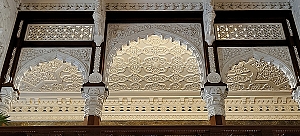
Architecturally, the mosque shares many features in common with other mosques built in Ahmedabad and the rest of Gujarat in the fifteenth and sixteenth centuries. Built in the so-called Indo-Saracenic style, this mosque and others built in the same era contain architectural and decorative features often found in Hindu and Jain temples. Although rich in decorative ornamentation, the mosques, unlike the temples, are devoid of representations of people and animals. Floral and leafy motifs can be found at the Rupamati Masjid, as well as at other mosques built in the same era. The highly decorated bases of two minarets can be seen but the tall upper parts of the minarets were listed during an earthquake in the early nineteenth century.
Beside the mosque and within its grounds, there is another structure, topped by two domes. This pillared hall contains the tombs of Rupamati and other worthies.
The mosque is a protected historical monument, but is still used by worshippers. Although it is an attractive building, it does not seem to be on the main ‘tourist trail’.


 yamey
yamey 