
Stems of sharp thorns,
Fair flowers above:
Is not Nature so wonderful?

Stems of sharp thorns,
Fair flowers above:
Is not Nature so wonderful?
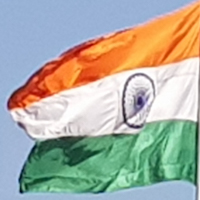
A Non Resident Indian or NRI is someone, most usually of Indian origin, residing outside India.
There are Indians living in India who try to make their lifestyle as un-Indian as they can possibly manage. These people are usually fabulously wealthy. They try to isolate themselves from the material reality of India as much as they can. A friend of ours refers to these people as “Resident Non Indians”, which is a great way of summarising the way they try to live.

I know it is not a good idea to make generalisations, but it is quite fun to do so occasionally. So, here goes! This time, I am going to generalise about taxi drivers’ knowledge in London, Bombay, Bangalore, and Ahmedabad.
The drivers of London’s characteristic black (usually) cabs are only allowed to work when they have “The Knowledge”. That is, they have passed an examination that requires the candidate to have a very detailed knowledge of the streets of London. A London cabbie only very rarely does not know the way.
London’s minicab and Uber drivers do not have to be tested on The Knowledge, but they are usually very adept at using GPS systems.
In Bombay, there is a huge number of yellow and black cabs. In my experience, the drivers usually know their way around the city. Some of them raise all kinds of objection s before they give in to your wish to hire them, but once aboard they will take you where you want without requiring navigational assistance.
I find the best way to get around Bangalore is to travel in an autorickshaw. Their drivers often know the way, and if they do not, they will ask fellow autorickshaw drivers, who can point them in the right direction. Uber and it’s competitor Ola exist in Bangalore, but their drivers, often from out of town, are often clueless about the city’s geography and find GPS hard to understand.
It is our experience with autorickshaw drivers in Ahmedabad that prompted me to write this blog. We have made many trips in their vehicles. An enormous proportion of the drivers will tell you that they know how to reach a place, but in reality they have no clue. They will not admit their ignorance and are often reluctant to stop and ask for directions from bystanders.
One driver in Ahmedabad, who was completely lost, got annoyed with us, his customers, and said: “Why are you going somewhere if you don’t know how to get there? I should leave you here, and you can find your own way.”
I did say that I would be generalizing. In all fairness, I must record that some of the autorickshaw drivers in Ahmedabad have been very knowledgeable about their city, but these have been in the minority.
So, when you visit the truly wonderful city of Ahmedabad, you will find it helpful to be able to access Google maps on your mobile phone while travelling around.
I always enjoy finding bookshops that are out of the ordinary. Although bookselling chains such as Waterstones in the UK and Crossword in India are well stocked with popular titles that are likely to sell well, it is the quirky or niche bookshops that I particularly seek out. The one-off bookshops usually keep a far more interesting range of books than the chains.
Here is a short description of a lovely specialist bookshop hidden away in a residential district of Ahmedabad, not far from the River Sabarmati, on whose bank Mahatma Gandhi set up one of his famous ashrams.
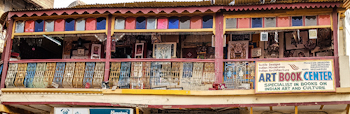
This small gem of bookshop, the Art Book Centre, in Ahmedabad is a wonderful discovery. It was recommended to us by Mr Shukla who is the General Secretary of the Ahmedabad Textile Mill Owners Association, which is housed in a masterpiece by the architectural genius Le Corbusier.
The bookshop, a true life Aladdin’s cave, is on the first floor of a residential building. It is reached by a steep ladder like staircase typical of those found in houses all over Gujarat. The steps lead to a balcony which is festooned with colourful folkloric items. A doorway leads from there into the shop itself.
The walls of the small, cosy shop are lined with neatly stacked book cases. Piles of books rise from the floor. On the walls and in between the book cases, there are numerous folkloric artworks and practical items including beautifully embroidered and printed textiles. We were welcomed by Manarbhai and Ketan, one of his two sons. They invited us to sit down.
Manarbhai worked for many years as a typist in the Mathematics Department of the University of Gujarat. He was no ordinary typist. He was able to type mathematical equations, which was no easy feat in the era before computerised word processors became available.
Manarbhai began his book business as a part time enterprise. In 1970, he converted part of his home into what is now his shop. At first, he only opened his shop on weekends. Now, it is open every day between 10 am and 6 pm.
The shop specialises mainly in books on art and architecture. It contains many books about textiles. Many of the volumes available are rare editions. If what you wish is not stocked, Manarbhai and his sons will do their best to source it, and then send it to you anywhere in the world.
It soon became apparent to us that Manarbhai and Ketan are extremely knowledgeable about books in the fields on which they specialise. They are also sensitively intelligent salesmen. Very quickly, they assessed our particular interests and began showing us books that were in harmony with them. We came away with a valuable selection of books that will help satisfy our curiosity about the fascinating history of the city of Ahmedabad.
This is a bookshop for true book lovers and collectors. It should be on every bibliophile’s itinerary. What Manarbhai cannot find for your bookshelf is probably not worth having.
Address: near Jain Temple, Madalpur, Ellis Bridge, Ahmedabad 380006
This article is adapted from http://www.gujarat-travels.com

While travelling through Gujarat in western India, I have seen many camels (? dromedaries) working as beasts of burden. They are well suited to the arid semi desert climate of Gujarat. The camels remind me of airline jokes I learnt in my childhood. Each joke gives another meaning to an airline’s name or acronym.
BEA was British European Airways. The joke version was Big Empty Aeroplanes;
TAP, Portuguese Airlines became Take Another Plane;
The Greek company Olympic became Only Like Your Money Pay In Cash;
EL AL, the airline of Israel, became Every Landing Always Late.
And this brings me to humped beasts of burden.
BOAC, which was British Overseas Airways Corporation, became Better On A Camel.
Postscript
When the petroleum company ESSO first became established in India, workers in Indian companies worked half day on Saturdays. Esso workers got a whole day off on Saturdays. So, ESSO became known as Ever Saturday Sunday Off.

The camel pulls
A quite enormous load,
Perhaps uncomplainingly
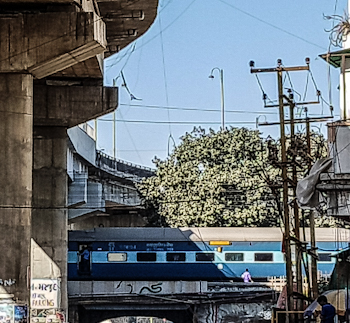
This is a true story told to me by the man who took the upper berth on a train in India’s Uttar Pradesh state.
Our friend, who related this story, was boarding a sleeper car. He had reserved the lower berth in a compartment, but when he reached it, he found it occupied by a man who had not made a reservation. The man aggressively refused to budge from our friend’s berth. Our friend called the conductor. After a considerable and unpleasant argument, the miscreant relinquished the berth, which our friend then occupied.
Shortly after this, an old man, who had been given a reservation in the upper berth, entered the compartment. He was unable to climb into the upper berth. Out of kindness, our friend took the old man’s upper berth and gave him the lower one.
Next morning, our friend woke up. He climbed down from his upper bunk and was horrified to discover that the old man had been stabbed to death during the night. No doubt, the man who had been evicted by the conductor had exacted his revenge.

I love receiving gifts. I love giving gifts especially if the recipient expresses joy, rather than gratitude.
This photograph taken in the Khanderao Market in Vadodara (India) expresses the joy of giving, which, as in the case of this flower merchant, can be greater than the joy of receiving.

Some restaurants in India serve both veg (vegetarian) and non-veg (meat, fish, eggs) food. Recently, my wife and I were sitting near to a young lady in a very good Italian restaurant in Vadodara in Gujarat.
Our young neighbour is a vegetarian. She ordered a veg pasta and asked the waiter if she could have a portion of mashed potatoes. I know that pasta and mashed potatoes are an unusual combination, but that is what she wanted.
The waiter told her that she could not order mashed potatoes with a veg pasta. Puréed potatoes, which are pure veg, could only be served with a non-veg dish.
We overheard the waiter telling this to our neighbour. My wife, who always tries to be helpful, interrupted the waiter and told him to bring a small dish of mashed potatoes with the pasta. Eventually, and somewhat reluctantly, the waiter did as asked. Our neighbour was so happy to receive the mash with her pasta that she got up and gave my wife an affectionate hug.
I am not a vegetarian.
Although I have met numerous pure vegetarians during the 25 years I have been visiting India, I still find it hard to believe that there are so many people, who have never tasted meat, eggs, or fish.
Once, long before ‘political correctness’ became fashionable, when my wife was an undergraduate student, she asked two Nigerian students whether they preferred their tea “black or white “. They looked at her indignantly before answering aggresively: “with milk“.
When I was a child, I drank tea without milk. That was the way my parents preferred it. That is what I became accustomed to. If I sipped even a little tea with milk, I felt nauseous. Tea with milk, as served in England, is made by adding brewed tea to milk or vice versa depending on your preference.
My prejudice against tea with milk persisted until I began visiting India in 1994. At first, I was suspicious of the “white” tea on offer, but soon began to enjoy it. I think that this is because it is made differently from that which is served in the UK.
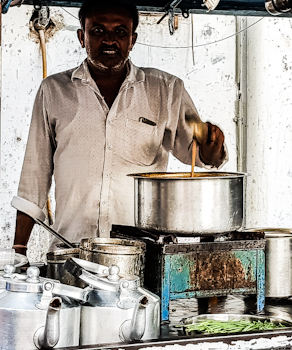
In India, tea leaves are boiled vigorously with milk. Often additives such as sugar, crushed ginger, cardamom, mint, and lemon grass are added to the hot bubbling mixture. After a while, the boiled milky tea is passed through a strainer, often cloth, and served in cups. The resulting drink is a harmonious blend of the flavour of tea and the additives. In my opinion, it tastes quite different from, and much better than what is served in England.
I have visited India many, many times since 1994. Apart from developing a great fondness for the country and its people, my tastes in food have changed for the better as a result of my exposure to life in India.
 yamey
yamey 