Gracie Fields and modernism in Hampstead

ACTRESS AND ENTERTAINER GRACIE Fields (1898-1979) commissioned a house to be built in Hampstead in 1934. This was five years before she moved to the Italian island of Capri. I cannot establish how long she retained ownership of this home. The house, with its roof covered by interlocking curved green tiles (pantiles) and centrally located gable that resembles those found in houses built by the early Dutch settlers in the Cape of Good Hope, is by no means a masterpiece of architectural design. It stands on the curved section of a private road, Frognal Way, which links Frognal to Church Row. The short Frognal Way, apart from being the location of the house that Gracie built, contains two masterpieces of twentieth century British architecture.

Number 4 Frognal Way, London NW3

Standing on raised ground above the north side of Frognal Way is number 9, Sun House. This was designed by the modernist architect Maxwell Fry (1899-1987) and built 1934-35.  Fry and his wife, the architect Jane Drew (1911-1996), worked with Le Corbusier on his 1950’s project to build Chandigarh, the new capital of the Indian state of the Punjab.  Maxwell was originally trained in the classical style, but soon began working with noted exponents of modernism including Walter Gropius, Le Corbusier, and Pierre Jeanneret. His early compositions, which were in the neo-classical style, include Margate Station (1924-26), which is a far cry stylistically from the Sun House in Hampstead. It would be difficult to believe that the same person had designed both.

The architectural historian Nikolaus Pevsner (1902-1983), himself a resident of Hampstead (at North End) and much admired by Maxwell Fry, wrote of the Sun House:

“… an object lesson in façade composition. White rendered walls, three-storeyed window bands of different heights, large first-floor balcony on thin steel supports and then a broad projection at the r. end on the first floor, and a narrow one on the l. on second floor level. The effect is surprising and shows what a design of quality can make of relatively elementary material …” (from “The Buildings of England. London 4: North”)

Regarding the other buildings in Frognal Way, Pevsner and his co-author Bridget Cherry summarise them beautifully:

“Otherwise Frognal Way has an assortment of interwar villas from Neo-Georgian to Hollywood Spanish-Colonial and South African Dutch (with pantiles) …”

The latter mentioned is the house that Gracie Fields had built. Opposite the Sun House, there is a house with two wings and a centrally located entrance, number 4, which defies stylistic categorisation. It has three windows above the front door and above these there is a curious roundel with a bas-relief depicting a man wearing a skull cap and a winged cloak. On either side of him there is a single flower. The roundel is dated 1934, the same year as the Sun House and Gracie Field’s home were built. The house with the roundel is mentioned in a blog (https://trainwalkslondon.wordpress.com/2014/02/06/walk-1-st-pancras-walk-to-west-hampstead-thameslink/), whose author, like me, cannot shed any light on the history of this building.

There is another treat for lovers of modernism in Frognal Way. It stands where this short unpaved road meets the main road, Frognal. The façade of number 66 Frognal reminds me of paintings by the Dutch artist Piet Mondrian (1872-1944). The building was constructed in 1937, the year before the artist arrived in London. It was designed by Amyas Connell (1901-1980), Basil Ward (1902-1976), and Colin Lucas (1906-1984). Their architectural practice was short-lived (1933-1939), but highly creative and productive. They

“… were among the foremost exponents of the International Style in Britain. Their architecture largely comprised cubic sculptural forms made from reinforced concrete and an emphasised horizontality.” (www.themodernhouse.com/directory-of-architects-and-designers/connell-ward-lucas/)

To quote Pevsner again, the house they designed on the corner of Frognal Way was:

“… the extreme idiom of the day, now something of a classic. The design was perhaps a little too concerned to ‘épater les bourgeois’ [i.e., ‘to shock the bourgeois’]. The design has been diluted by alterations …”

Some of these alterations were approved by the original architects, others not. Despite the alterations, the building remains a stunning and pleasing architectural statement, and is a house in which I would be happy to reside. Despite this, the architectural critic Ian Nairn (1930-1983), who both admired and criticised Pevsner’s approach to architectural writing, wrote that in his opinion it was the best house built in Britain before WW2 (www.wowhaus.co.uk/2019/02/12/1930s-connell-ward-lucas-designed-66-frognal-modernist-house-in-london-nw3/).

During the last few months, we have been making regular visits to Hampstead, each time wandering slowly along its often steep streets and alleyways.  Amongst the many historic buildings there is a good number of adventurous new buildings, many of them superb examples of late 20th and early 21st century architectural talent. It is pleasing that the pioneering work of the pre-War architects, such as can be seen in Frognal Way and other parts of Hampstead (e.g. Willow Road and Lawn Road), is continuing even today. That these visually adventurous new buildings are being constructed is a credit to the open-mindedness of local planning authorities.

French connections

GENERAL CHARLES DE GAULLE (1890-1970), an eminent refugee from France, was dead against Britain joining what was the Common Market and is now the European Union, despite the country having generously hosted him during WW2, when his country was invaded by Germany. This is quite well known, but far less known is the fact that he lived in Hampstead, north London. His home was at 99 Frognal in what is currently St Dorothy’s Convent.

The convent building, Frognal House, was built in about 1740 and later modified in various ways (https://historicengland.org.uk/listing/the-list/list-entry/1113077). The convent building stands on the site of a 15th century tenement known as ‘house called Frognal’ (www.british-history.ac.uk/vch/middx/vol9/pp33-42). At the beginning of the 18th century, the land on which this stood was owned by the bricklayer Thomas Smith, who probably built the present building, which became known as ‘Frognal House’. During the Crimean War (1853-1856), the house became The Sailors’ Orphans Home (from 1862-1869), which later shifted to the northern end of Fitzjohns Avenue in 1869 and which was constructed on land once owned by Sir Harry Vane (1613-1662).

De Gaulle and his family lived in Frognal House between 1940 and 1942. Monique Riccardi-Cubitt, a writer and art-historian, stayed in Frognal House in about 2000 and has written about it (https://blogs.mediapart.fr/monique-riccardi-cubitt/blog/210418/memories-general-de-gaulle-london). She wrote:

“The reception rooms on the ground floor have remained, but the General’s Cabinet de travail is now the chapel … The first floor panelled library is where I would feel his spirit most strongly hovering as I would work alone early in the morning … In the garden roses grew, I drew and painted them in the late afternoon … His spirit was there too, and I used to wonder how often he would have come back from his headquarters in Carlton Gardens worn and weary with cares, to wander off to the peace of the leafy bowers and refresh his tired mind and soul … From the roof terrace overlooking the whole of London below, he would stand at night and watch the German bombings on the City of London during the Blitz …”

While living in Hampstead, De Gaulle used to attend masses at St Mary’s Catholic Church in Holly Walk. It was the first Catholic church built in Hampstead after the Reformation (16th century). It opened its doors to worshippers in 1816. Its first pastor was a refugee, one of 500 clergy fleeing from the French Revolution, the Abbé Jean-Jacques Morel (1766-1852; https://parish.rcdow.org.uk/hampstead/about-the-parish/). Thomas Barrett, a historian of Hampstead, writing in 1912 in his “Annals of Hampstead”, noted:

“Towards the end of the eighteenth century another interesting religious association came into the life of Hampstead, in a very modest and unassertive way, as one of the minor overflows from the French Revolution. Among the priestly refugees from France was a certain Abbe Morel, who had been connected with the Grand Seminary at Bourg. He was attracted to Hampstead by the fact of there being several French families living there—Talleyrand among the rest, some say—exiles like himself, to whom the question of religious worship according to their own faith was becoming a matter of difficulty…”

Barrett believed that Talleyrand, Charles Maurice de Talleyrand-Périgord (1754-1838):

“… lived for a time at Tensleys, on Hampstead Green, during his service as French Ambassador from 1830 until 1834 … It was pulled down, and the site is now partly covered by the Hampstead General Hospital.”

This is now the location of the Royal Free Hospital. Barrett quotes the following anecdote that reveals that the refugees included members of the French aristocracy:

“… A story is told of two handsomely dressed ladies visiting Hampstead in 1819. They drove in a carriage to the bottom of Holly Hill, and then got out and walked to the top; and sometime later the Abbe was seen walking down the road bareheaded, respectfully escorting them. As the elder of the two ladies got into the carriage she kissed the Abbe’s hand and shed tears. This lady, it was said, was the Duchesse d’Angouleme.”

After some years in Hampstead, Morel:

“… was put to a severe ordeal when, the Revolution having come to an end, it became possible for the refugees to go back to their native country. Most of the little congregation for which he had been officiating returned. He would fain have gone with them ; but in Hampstead he had found a real haven of rest after the turbulence which had preceded his exile, and had formed many ties with the people of the village. He decided to remain, and for many years after that Abbe Morel was a worthy and loved figure in Hampstead.”

In 1941, Fr Joseph Geraerts became the parish priest. During this period:

“… one of the more notable parishioners was General Charles de Gaulle who lived for about a year at 99 Frognal, now St. Dorothy’s Convent. We are told that his tall and impressive figure was always to be seen in the front bench at the 11 o’clock Mass whenever he was home.” (https://parish.rcdow.org.uk/hampstead/wp-content/uploads/sites/193/2015/09/St-Marys-June-15.pdf).

De Gaulle returned to France in June 1944. After initially declining to join the Common Market, Britain applied to join in 1963. De Gaulle was dead against this (https://en.wikipedia.org/wiki/Charles_de_Gaulle#European_Economic_Community_(EEC)). It was only after De Gaulle resigned as President in 1969 that Britain was able to join the European community, which it has left recently.  

Frognal House was converted into its present role, the home of St Dorothy’s Convent, part of a religious community based in Malta, in 1968. The organisation:

“… caters for young ladies coming to study in London or for a short holiday from all over the world. It aims at providing not only a boarding house, but a homely environment where guidance and advice assure the well being and comfort of all the students. Besides catering for the students, the sisters are very much involved in their Parish St Mary’s.” (www.stdorothysmalta.org.mt/convents.html).

Apart from a couple of restaurants in Hampstead, the former Cellier du Midi and the still extant Cage Imaginaire, I had never considered that Hampstead had any other French connections. However, seeing the convent today and looking into its history, has shown me that France had a significant role in Hampstead’s history.

PS: I almost forgot to mention the onion sellers, who used to come to Hampstead from France with their bicycles ands strings of onions. And, also, there is a French creperie in Hampstead next to the King William IV pub on Hampstead High Street.

Hampstead, Highgate, and the Indian freedom struggle

A MOTHER OF FAMILY-planning and women’s rights, Marie Stopes (1880-1958) lived at number 14 in Hampstead’s Well Walk between 1909 and 1916. I remember seeing a plaque recording her residence in Hampstead. However, I do not recall seeing the plaque to one of her neighbours, the socialist Henry Hyndman (1842-1921) on number 14. It was only when I acquired a copy of an excellent guide to Hampstead, “Hampstead: London Hill Town” by Ian Norrie, the owner of the former Hampstead book shop, ‘High Hill Books’ and Doris Bohm that I discovered that Hyndman had lived and died in Well Walk. Hyndman, a politician, lawyer, and skilled cricketer, was initially of conservative persuasion but moved over to socialism after reading “The Communist Manifesto”, written by Karl Marx in 1848. Although anti-Semitic, he was amongst the first to promote the writings of the (Jewish) Marx in England.

Replica of Highgate’s former India House in Mandvi, India

It is an extremely pleasant walk from Well Walk, across Hampstead Heath, Kenwood, and through Highgate village to Highgate Wood, opposite which the Indian born barrister Shyamji Krishnavarma (1857-1930) lived in self-imposed exile with his wife Banumati. Born during the year when The Indian Rebellion of 1857 (First Indian War of Independence or ‘Indian Mutiny’) commenced, it seems that it was appropriate that he was a keen promoter of India being liberated from the British Empire. Krishnavarma, in common with Hyndman, believed that it was wrong that the British should control and exploit the inhabitants of India. They corresponded and most probably met each other.

In 1905, responding to events in India such as the unpopular partition of Bengal, Krishnavarma, a wealthy man, decided it was time to do something about bringing down the British in India. He did three main things. He began publishing a virulently anti-colonial newspaper, “The Indian Sociologist”; he gave money to create scholarships for Indian graduates to study in England; he bought a large house in Cromwell Avenue, Highgate. He was also one of the founders of the Indian Home Rule Society, whose views were in stark contrast to those of the Indian National Congress, which at that time, put great faith in the supposed benevolence of the British Empire towards its Indian subjects.

The scholarships had several conditions attached. The most important of these was that the recipients had to promise that they would never ever work for, or accept posts from, the British Empire. The candidates for these scholarships were usually recommended by people in India, such as Bal Gangadhar Tilak, who were working actively to end British Rule.

Krishnavarma, recognising that many Indian students faced considerable hostility in Britain at the start of the 20th century, used the house he bought in Cromwell Avenue to create both student accommodation and a community centre, a home away from home for Indian students in England. He called the building ‘India House’, which should not be confused with the better-known India House in Aldwych, the Indian High Commission.

The grand opening of India House in Highgate was on the 1st of July 1905. The inauguration speech was given by Henry Hyndman. I do not know whether he was already living at Well Walk when he opened the student centre in Cromwell Avenue.

Soon after it opened, India House became an important centre of anti-British activity. Under Krishnavarma’s leadership, and given his anti-colonialist views, India House became of increasing interest to the British police and intelligence agencies. In 1906. Vinayak Damodar Savarkar (1883-1966), a law student and leader of a secret revolutionary society, became a recipient of one of Krishnavarma’s scholarships. He lived in India House, where he wrote a couple of anti-British books, which were banned in British India. In brief, believing in armed revolution, Savarkar became one of the most dangerously anti-British activists in Europe. When Krishnavarma and his wife shifted to Paris in 1907, Savarkar became the ‘head’ of India House. Under his watch, smuggling of arms and proscribed literature to India was carried out. He encouraged experimentation in bomb-making, and was not dismayed when one of his fellow house-mates, Madan Lal Dhingra, assassinated a top colonial official in South Kensington in 1909. The assassination led to increased police surveillance and India House, which had been opened by Hyndman, closed by 1910.

I have introduced you to this lesser-known aspect of the history of the Indian Freedom Movement for two reasons. One is to explain my delight in discovering that I must have walked many times past the house in Well Walk where Hyndman lived (and died). For me, Hyndman has assumed greater interest than his deservedly far better-known neighbour Marie Stopes. The reason for this is that about five years ago I was in the town of Mandvi in Kutch (part of India’s Gujarat State). Krishnvarma was born in Mandvi and is now commemorated there. Apart from the modest house in which he was born, there is an unexpected surprise on the edge of the town. It is a modern replica of the Victorian house in Cromwell Avenue (Highgate), which was briefly home to Krishnavarma’s India House. Seeing this extraordinary replica of the house inaugurated by Hyndman in a flat desert setting got me into researching its story. In the end, I published a book about the Indian freedom fighters in Edwardian London, “Indian Freedom Fighters in London (1905-1910)”, which explores the story I have outlined in far more detail.

[“Indian Freedom Fighters in London (1905-1910)” by Adam Yamey is available from amazon, bookdepository.com, lulu.com, and on kindle. Or specially ordered from a bookshop: ISBN 9780244270711]

A grand old house in north London

THE OLD WELLS AND CAMPDEN Wash Houses stand on an elevated section of Hampstead’s Flask Walk and overlook a distinguished-looking detached house standing in its grounds surrounded by walls at the eastern end of Flask Walk. Entered through an unusual double set of wrought iron gates, this is Gardnor House, which was built in 1736. The doubling of the gates has happened since the 1960s, during which time it was a single gate (see image at: https://images.historicenglandservices.org.uk/historic-images/1960-present-day/gardnor-house-hampstead-aa071908-1339539.html)

The house was built for the successful upholsterer Thomas Gardnor (c1685-1775) opposite the stocks that were used for punishment until 1831 (Barratt, T: “The Annals of Hampstead). He and his family were responsible for the development of several streets and buildings in Hampstead (www.british-history.ac.uk/vch/middx/vol9/pp15-33). Thomas was responsible for building terraces of houses in Flask Walk and homes in what is now Gardnor’s Place. His family also:

“…enlarged their property holdings in the area to include Flask Walk, Streatley Place and parts of Heath Street, High Street and New End. The family also owned houses in Church Row on the site of Gardnor Mansions.” (https://en.wikipedia.org/wiki/Thomas_Gardnor).

In addition to his property interests, Thomas was made a trustee of the Hampstead Wells Charity, which aided the local poor, in 1761 (Barratt, T). Gardnor is believed to have died of smallpox (https://historicengland.org.uk/listing/the-list/list-entry/1067366) and was buried in the graveyard of Hampstead Parish Church, where his tomb may still be seen.

During the mid-19th century, Gardnor House was owned by a dealer in chinaware. Later that century, by which time most of the area around Flask Walk was inhabited by poor people, the grand Gardnor House was the home of an architect. Moving forward 100 years, we find that Gardnor House was the home of the authors Kingsley Amis (1922-1995) and Elizabeth Jane Howard (1923-2014). By the time they moved in, their marriage was crumbling as Joseph Conolly, owner of the former Flask Bookshop in Flask Walk, recalled (https://thecritic.co.uk/issues/november-2020/very-amis-very-hampstead/):

“…by the time they were settled in Gardnor House in Flask Walk — also Georgian, though rather smaller and with a modest garden — the gilt was beginning to chip away from the golden couple, and that deterioration was about to accelerate rather rapidly.”

 When they separated, the house was sold in 1981. On the 14th of October 2020, the house, which contains five bedrooms, five reception rooms, and four bathrooms, was sold for £11,000,000 (www.rightmove.co.uk/house-prices/detailMatching.html?prop=66871156&sale=11118685&country=england). GW Potter, a local historian,  also once lived in Gardnor House, but I do not know when that was.

The house that Thomas Gardnor built for himself is one of the larger residences within the bounds of old Hampstead. It is either evidence of his success as an upholsterer and/or as a property developer. Luckily, the house seems to be well-maintained. Many of us, who spent our childhood in or near Hampstead, bemoan it having become a more upmarket area than it used to be, but with its property values rising, the condition of many historic buildings is being well-maintained.

Coffee al fresco

THE COVID19 PANDEMIC has, for the time being, made drinking inside cafés a thing of the past. If you wish to enjoy a beverage, be it a cappuccino, cortado, americano, a hot chocolate, or even a humble cup of tea, you can buy it at a counter and then enjoy it outdoors, come rain, snow, or shine. In the absence of restaurants and pubs, with the exception of take-away foods, this has become one of the few little treats, apart from the joys of nature, available to those who wish to enjoy a bit of life out in the open air.

Not long ago, whilst exercising in London’s Hampstead district, we came across a particularly lovely place to obtain hot drinks and a selection of snacks, both sweet and savoury. They are being served under a canopy illuminated by strings of ‘fairy lights’ on a terrace overlooking the sloping garden of Burgh House.

Built in 1704 during the reign of Queen Anne, Burgh House was, according to the historian of Hampstead, Thomas Barratt, first owned by a Quaker couple, Henry and Hannah Sewell. Barratt remarked:

“…the house gives the idea of Quaker severity of style combined with a good quality of work.”

The house acquired its present name in 1822, when it was the residence of the Reverend Allatson Burgh (1769-1856), who was for a time vicar of St Lawrence Jewry (http://www.burghhouse.org.uk/about-us/history-of-the-residents-of-burgh-house#revburgh). He was also the author of a book about church music. Prior to the cleric, the house was occupied, between 1776 and 1820, by the upholsterer Israel Lewis (1748-1820) and his wife Sarah, both known for their good deeds. Lewis was a supporter of the non-Conformist Rosslyn Hill Chapel in Hampstead. The family also provided assistance to the poet John Keats (1795-1821) and his brothers. On the 16th of October 1818, the poet wrote to his brother, who was living in the USA, George Keats (1797-1841):

“Mr Lewis has been very kind to Tom all the summer. There has scarce a day passed but he has visited him, and not one day without bringing him or sending some fruit of the nicest kind.”  (“The Letters of John Keats: Volume 1, 1814-1818”)

Burgh House is close to the former chalybeate wells of Hampstead, which were famed for their alleged curative properties. Before the Lewis’s lived there, it was the home of the chief physician of the Wells and a promoter of the benefits of its water, Dr William Gibbons (1649-1728) and his wife Elizabeth. They lived in the house between 1720 and 1743, Elizabeth continuing to live there as a widow.

After Burgh’s death in 1856, the house named after him became the officers’ mess and headquarters of the Royal East Middlesex Militia between 1858 and 1881. The house was then privately owned by several other people, the last of whom were Captain George Louis St Clair Bambridge (1892-1943) and his wife Elsie (1896-1976). Mrs Bambridge’s father was the writer Rudyard Kipling, who was born in Bombay (India). The Bambridges lived at Burgh House between 1933 and 1937. During that time, the ageing Rudyard was a regular visitor.

After the Bambridges left Burgh House for Wimpole Hall in Cambridgeshire, the venerable building faced dilapidation until it was taken over by Hampstead Borough Council in 1946. It was then used for social functions such as wedding receptions.

After a long campaign and much fund-raising, the house was opened to the public as a museum in 2006. In addition to displaying items of historical interest, concerts, talks, and other cultural events are also held there. The concerts are held in a music room that the Reverend Burgh added on to the building when he occupied it.  All these life-enhancing activities have come to a halt during the covid19 pandemic. The pleasant and attractive outdoor café is helping to keep the community spirit alive until rates of infection decrease sufficiently to allow at least some return of the cultural activities that we used to enjoy.

The Burgh House café is open from Wednesday to Sunday. Should you visit Hampstead when the café at this place is closed, there are another three Hampstead places, from which we enjoy collecting hot beverages:

Ginger and White in Perrins Court

The Coffee Cup in Hampstead High Street

Matchbox Café in South End Green

There are also a couple of telephone kiosks that have been converted to tiny cafés both in Hampstead High Street and Pond Square, but we have never sampled their wares.  

Now you see it, now you don’t and Samuel Johnson

THE GROUNDS OF KENWOOD House in north London are delightful at any time of the year. Here you can enjoy the marvels of a fine country house in magnificently landscaped grounds, rivalling rural spots like, for example, Stourhead, Blenhheim, and Compton Verney, without leaving the metropolis. Amongst Kenwood’s many horticultural attractions are the superb flowering bushes such as camellias, azaleas, and rhododendrons.

Kenwood House

Kenwood was within about half an hour’s brisk walk from my family home in Hampstead Garden Suburb and even nearer Highgate School, which I attended between 1965 and 1970. In amongst the flowering bushes, I remember that there used to be an open-fronted, small round hut with a conical roof.  Inside it, there were benches that served as seats. This edifice was labelled ‘Dr Johnson’s Summerhouse’. The Dr Johnson to which this referred was one of Britain’s greatest literary figures, the writer and lexicographer Samuel Johnson (1709-1784). When I used to see this hut during visits to Kenwood in the late 1960s and the 1970s, I used to try to imagine the great Johnson sitting, resting and enjoying the view of the lawns and trees, some of which we can still see today. But, in those days, I was unaware that he never did enjoy these views from this spot.

It turns out that Dr Johnson used his summerhouse not in Kenwood but far away at Streatham Place in what used to be countryside south of London during Johnson’s lifetime. Shaun Traynor wrote:

“Streatham Place, the grand country house of the brewer Henry Thrale and his wife Hester, became for a time in the mid to late 18th century a setting for some very distinguished literary and artistic company. To this house, then sitting amid extensive grounds in the countryside south of London, came leading figures of the day: Edmund Burke, David Garrick, Sir Joshua Reynolds (who was to paint the Thrales), Oliver Goldsmith and – most significantly – Dr Johnson.” (https://www.johnsonsocietyoflondon.org/resources/Documents/Dr%20J’s%20Summerhouse%20-%20Shaun%20Traynor/Sam%20J%20summerhouse%20Shaun%20Traynor.pdf).

He added that the grounds of Thrale’s home contained a secluded summerhouse in which Johnson used to read and write. When Henry Thrale (born between 1724 and 1730) died in 1781, his widow Hester remarried, and the Streatham Place with its summerhouse were sold. Thrale’s daughter Susannah, who had been fond of Johnson, moved the hut to her home in Knockholt, Kent in 1826.  According to Traynor:

“She erected it on rising ground in the very centre of the grove making all paths lead to it, and making the grove a kind of shrine to Dr Johnson’s memory.”

The years passed, and the summerhouse fell into disrepair. In 1962, a local man, who had great feelings for its historical significance, bought it and then presented it to London County Council (‘LCC’) so that it could be displayed to the public. After restoring it, it was placed in Kenwood at the spot where I recall seeing it, in 1968 (http://www.thrale.com/samuel_johnsons_summer_house). Although it is not inconceivable that Johnson might have visited Kenwood, it is not at all likely that he passed much if any of his spare time in a summerhouse in that garden.

In about 2017, after not having visited Kenwood for two or more decades, I paid it a visit. One of the first things I looked for was Dr Johnson’s summerhouse. I knew exactly where to look, but it was no longer there. After peering in amongst the large clumps of bushes in the spot where I remember that it used to stand, I found an octagonal concrete base. I wondered whether the summerhouse had once stood there. On enquiring at the information desk within Kenwood House, I learnt that the base was all that remained of what I had remembered seeing. I was told that the summerhouse had been destroyed by fire. This fire occurred sometime after 1984, probably 1991 (www.moruslondinium.org/research/dr-johnsons-streatham-park-mulberries). I was saddened to learn of this.

However, all is not lost. Alan Byrne, an artist who used to love sitting in the original Johnsonian summerhouse in Kenwood, has created an accurate replica of the refuge that the great writer used to enjoy. Using detailed plans of the original and other records, he produced an accurate reconstruction during the years 1997 to 1999 (https://www.johnsonsocietyoflondon.org/Dr-Johnson-summerhouse-photos-and-narrative). It stands in his garden in Islington.

Even without Dr Johnson’s summerhouse, Kenwood is well-worth visiting. The gardens alone are splendid, but when it is open, Kenwood House is a ‘must-see’. It contains some fine rooms decorated by Dr Johnson’s contemporary, the architect Robert Adam (1728-1792) as well as a collection of fine-art paintings that is, after the National Gallery, one of the best in London. When you feel that you have seen enough of Kenwood, then treat yourself to a stroll through its grounds and the contiguous Hampstead Heath to historic Hampstead, a place which offers a great range of eateries and pubs. And, incidentally, Samuel Johnson was no stranger to the place as the historian Thomas Barratt revealed:

“‘Mrs. Johnson for the sake of the country air,’ writes Boswell, ‘had lodgings at Hampstead, to which Johnson occasionally resorted. ‘For his own part, Johnson would doubtless have preferred Fleet Street; but he was fond of his wife, and felt in duty bound to minister to her pleasures as far as his limited means admitted.”

I can sympathise with Mrs Samuel Johnson. I much prefer Hampstead to Fleet Street, even if the former has less countrified air than it did in the 18th century.

Where judges might have walked

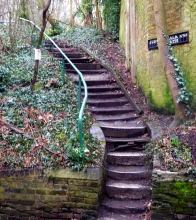
A SHORT STEEP STAIRCASE leads upwards from Hampstead’s Branch Hill to a tree-lined avenue called Judges Walk. This overlooks a steep northwest facing declivity or valley that falls away sharply from Whitestone Pond. This was once the head of a tributary of the River Brent, whose mouth is at the River Thames at Brentford. Today, apart from much mud, there is little obvious evidence of the tributary. Judges Walk has not always had that name. It has also been known as Prospect Walk on account of the views that may be obtained from it, which must have been better in the past than now because the vegetation lining the path might have been less dense.

In days gone by, Judges Walk was a popular place for promenading. The historian of Hampstead, Thomas Barratt (1841-1914), writing in 1912 noted:

“Judges’ Walk is naturally much resorted to for the beauty of its view and its splendid grove of limes and elms.”

Until 1745, when Church Row became a street lined with better-class houses and the parish church was being rebuilt, it became a more fashionable place to promenade than Judges Walk.

How did Judges Walk get its name? William Howitt, author of “The Northern Heights of London” (published in 1869) wrote:

“This avenue derives its name from the tradition that during the great plague of London the judges removed from Westminster, and held their courts in this very airy spot.”

This derivation has been questioned both by GE Mitton in “Hampstead and Marylebone” (published in 1902), who commented that:

“… derivations of this sort are very easy to make up and entirely unreliable”,

 and by Barratt, who wrote:

“If, as tradition asserts, the judges held their courts here in the time of the Plague, that is good enough ground for the title; but as no actual proof of this has hitherto been brought forward it is at least open to doubt.”

However, he did not totally discount a connection of the path’s name with the judiciary. He suggested that:

“…since so many judges have lived in this charming locality and been accustomed to take their walks up and down its famous avenue, it is only natural and in the fitness of things that it should be called Judges’ Walk.”

A more recent historian of Hampstead, Christopher Wade (1920-2015), noted in his book “The Streets of Hampstead” (published 1984) that Judges Walk acquired its present name in the early 20th century, having previously had a variety of names including ‘Prospect walk’, ‘King’s Bench Avenue’, and ‘Upper Terrace Avenue’.  Like others before him, he was doubtful about the Great Plague theory. He seemed to favour an idea that the pathway was named after the nearby Branch Hill Lodge (at the bottom of the staircase mentioned above), which was once known as ‘Judges’ Bench House’. A house, long-since demolished, on the site of the present Branch Hill Lodge, the former home of the founder of the store chain John Lewis, was redesigned in 1745 by the architect Henry Flitcroft (1697-1769) for the Master of the Rolls Sir Thomas Clarke (1703-1764). It was later occupied by at least other two senior members of the English justice system, Sir Thomas Parker (1695-1784) and then Alexander Wedderburn the Earl of Rosslyn (1733-1805) before he moved into his estate next to the present Rosslyn Hill.

Apart from the view from Judges Walk, which has been painted by the famous John Constable (1776-1837), who lived in Hampstead’s Well Walk, there is a building covered with wood cladding that can be seen be looking away from the declivity.  Entered from Windmill Hill, this house, whose foundations were laid in the late 18th century (https://historicengland.org.uk/listing/the-list/list-entry/1379199), is currently named ‘Capo di Monte’, having previously been known as ‘Upper Terrace Cottage’ and ‘Siddons Cottage’. The actress Sarah Siddons (1755-1831) stayed there between 1804 and 1805. Barratt noted that the house:

“…was occupied by Woodburn the printseller ; also, in succession, by Copley Fielding the artist, and Edward Magrath, the first secretary of the Athenaeum Club.”

Years later it was home to the art historian Kenneth Clark (1903-1983) and even later of the broadcaster Marghanita Laski (1915-1988).  No doubt some of these residents of Capo di Monte strolled along Judges Walk to take the air and enjoy the view.

This vista, which we found to be somewhat obscured by the trees and bushes lining Judges Walk, even during winter when foliage is sparse, was described in a novel, “Interplay” (published 1908), written by the suffragette Beatrice Harraden (1864-1936), who was born in Hampstead:

“She sat in Judges’ Walk, and surveyed from there the stretches of wood and copse with their varying shades of green, relieved by delicate tones of red and enhanced in beauty by the sombreness of many trees which, even as ball-room belles, preferred to make a later and more consequential entrance into the scenes of splendour.”

The eastern end of Judges Walk is close to the reservoir on the top of which perches the small Hampstead observatory. Just east of this, and running along the west side of Heath Street, there is a small garden called Whitestone Garden.  I am do not know when this leafy spot, which contains a few benches and did not exist when I was a child in the 1960s, was created, but it is a welcome addition to Hampstead Heath.

In my retirement, I visit Hampstead frequently, and there is never a visit during which I fail to find something new (to me) of interest.  Judges Walk, along which I had never ventured until this year, is one of those many ‘discoveries’ that increase my fascination with this former village that has become surrounded by the relentless spreading of London.  

So much history in such a small space

VISITING HAMPSTEAD IN north London is always a pleasure. Although many of its residents might disagree, this small hill town surrounded by heathland and the rest of the metropolis has retained much of its history and charm. We have taken to walking from West Heath Road to South End Green by way of Holly Hill, Hampstead High Street, and Rosslyn Hill. Each time we ramble along this route, I spot things that arouse my interest. Here are a few of them near where Pilgrims Lane meets Rosslyn Hill.

According to GE Mitton in “Hampstead and Marylebone” (publ. 1902), Rosslyn Hill was originally named ‘Red Lion Hill’ after a pub that used to stand on this thoroughfare just across the road from the western end of Willoughby Road, but was no longer in existence when Mitton was writing. Rosslyn Hill is most likely named after Rosslyn House, a mansion with extensive grounds that lay between Rosslyn Hill and the present Fitzjohns Avenue. Lyndhurst Avenue marks the northern boundary of the now non-existent Rosslyn estate. It was once the home of Alexander Wedderburn, 1st Earl of Rosslyn (1733-1805), who was a lawyer and politician. He served as Lord High Chancellor of Great Britain from 1793 to 1801.

The Red Lion no longer exists. Neither does the police station that once stood on its site. Today, a pink granite drinking fountain stands by the side of the pavement where the pub used to be. It was probably constructed in the third quarter of the 19th century. Inscribed with quotations of a Christian nature, it provides a tap and basin for humans and below it at floor level another for animals. The lower basin is surrounded by the words:

“The merciful man is merciful to his beast”.

The fountain appears to be out of action currently.  It bears no evidence of which organisation placed it there.

Further down Rosslyn Hill, we reach the corner of Pilgrims Lane, a street that leads east to Willow Road. On a map surveyed in 1895, most of what is now Pilgrims Lane, was once named ‘Worsley Road’. Only a short, curved stretch near Rosslyn Hill had its present name. The lane is not named after pilgrims in general but in memory of Charles Pilgrim or his father James (died 1813), who had once owned part of the local Slyes Manor (www.british-history.ac.uk/vch/middx/vol9/pp91-111).

A former branch of Lloyds Bank stands on the north corner of Rosslyn Hill and Pilgrims Lane. The entrance of this handsome building is on its corner. It is surmounted by a hemicircular pediment in which there is a bas-relief crest bearing the letters “LBL”. Above this there is a sculpture of a beehive, the symbol of industriousness and:

“… for Lloyds Bank from 1822 until 1884, when the bank took over Barnetts Bank in 1884 and adopted its symbol – a black horse.” (http://manchesterbe.es/index.php/2016/03/07/king-street-bees-and-beehives/)

‘LBL’ stands for Lloyds Bank limited.

The bank building, now converted to a block of flats, was designed in 1894/95 by Horace Field (1861-1948), who designed several banks for Lloyds. The architectural historian Nikolaus Pevsner, a resident of Hampstead (at North End), described the Queen Anne-revival type of building as:

“… accomplished Wrennaissance style …”

Part of the building facing Pilgrims Lane must have always been residential as the painter and printmaker Sir William Nicholson (1872-1949) lived here between 1904 and 1906. His son was the well-known artist Ben Nicholson (1894-1982), who was married to the sculptor Barbara Hepworth. Part of Ben’s education was in Hampstead at Heddon Court School, which is now in Mill Hill (www.hamhigh.co.uk/lifestyle/heritage/heritage-ben-nicholson-was-one-of-a-nest-of-gentle-3444214).

A short distance away from the former bank there is a non-descript house on Pilgrims Lane, where the ‘cellist Jacqueline du Pré (1945-1987) lived between 1970 and 1975. Opposite the bank building is number 2a Pilgrims Lane, which is a big house largely hidden by a high wall. Its door bears the name “Rosslyn Hill House”. From what I could see of it, it looks quite old, probably early 19th century (https://historicengland.org.uk/listing/the-list/list-entry/1139059). It was the home of Edward Henry Nevinson (died about 1850 in Hampstead), Paymaster to the Exchequer. At one time, this was the home of another Nevinson, the journalist and essayist Henry Woodd Nevinson (1856-1941; http://www.british-history.ac.uk/vch/middx/vol9/pp15-33 ). He married the British suffrage campaigner Margaret Wynne Nevinson (née Jones; 1852-1932). Their son, the artist Christopher RW Nevinson (1889-1946), was born in their family home in nearby Keats Grove.

Proceeding a few yards down Rosslyn Hill, we arrive at a large redbrick building with white stone trimmings on the south corner of Downshire Hill. This was built as the ‘Hampstead Police Station and Magistrates’ Court’ in 1913 to the design of architect John Dixon Butler (1861-1920), who:

“…was appointed Architect and Surveyor to the Metropolitan Police in 1895, following the retirement of his father, who had held the post since 1881. Dixon Butler was articled to his father, John Butler, and hence had an excellent education in the design and planning of police-related buildings…” (https://historicengland.org.uk/listing/the-list/list-entry/1130397).

It has been re-purposed. A doorbell next to a side door on the Downshire Hill side of the edifice is still labelled “Magistrates”.

I have described several buildings and an old drinking fountain, all with historical interest. They are all located within 100 yards of each other. I have not included the remnants of Vane House, which I have described elsewhere, nor the 18th century Cossey Cottage on Pilgrims Lane near to the ‘cellist’s former home, which are within this short distance. This concentration of places of historical interest is yet more proof of my feeling that Hampstead is richly endowed with physical evidence of its fascinating past.

Friedrich Engels and his unfortunate neighbours

FRIEDRICH ENGELS LIVED almost opposite London’s Primrose Hill at number 122 Regents Park Road. A colleague and friend of Karl Marx, he lived between 1870 and just before his death in 1895 in this large house located 360 yards west of the railway lines that run from Euston to places outside London.  His residence had been chosen for him by Jenny (1814-1881), wife of Karl Marx. Every Sunday, Engels used to hold an ‘open house’; all visitors were welcome. Liberal amounts of food and drink would be available and there was music and singing. According to Tristram Hunt, a biographer of Engels, the visitors included, for example, leaders of European socialism such as Karl Kautsky, William Morris, Wilhelm Liebknecht, Keir Hardie, Eduard Bernstein, and Henry Hindman. Hindman, who was a mentor and supporter of the Indian freedom fighter Shyamji Krishnavarma, who was active in Highgate between 1905 and 1910, nicknamed Engels ‘The Grand Lama of Regents Park Road’. Amongst visitors from Russia:

“The founders of Russian Marxism, George Plekhanov and Paul Axelrod, considered the visit to his house in Regents Park Road a necessary pilgrimage whenever they were in London. Vera Zasulitch, who lived in London was another regular visitor as indeed was Stepniak, the terrorist author of “Underground Russia”” (note 1)

The congregation of so many socialists at his home attracted the attention of the police, who frequently kept number 122 under surveillance. Lenin, who first visited London in 1902, clearly would have not been able to visit Engels at Primrose Hill.

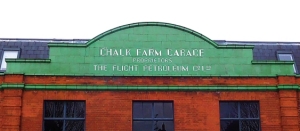
We visit Regents Park Road on some Saturdays and Sundays when parking is easy and free of charge, but, alas, we were born far too late to have been able to enjoy the stimulating atmosphere that must have reigned in the home of Engels on Sundays. Despite the absence of the great Engels, there is much to enjoy along the road where he lived, even during these restricting times of the covid19 ‘lockdown’. Apart from fresh air in plenty on Primrose Hill, there are interesting food shops and a few places that serve hot drinks to passers-by. One of these, which we favour, is Greenberry Café, which is located near to the railway lines. Almost next to this establishment, there is a building set back from the road. Its red brick façade is topped with a green tiled pediment with white lettering that reads:


Chalk Farm Garage

Proprietors

The Flight Petroleum Co Ltd

The ground floor of this building, which might once have included the workshops of the garage are closed in with modern glazing. Now used as the art gallery of the Freelands Foundation (https://freelandsfoundation.co.uk/about), this used to be a regular local petrol filling station. Flight Petroleum is a company that still exists. It is based in Mississippi (USA).  Before becoming a gallery, the former filling station was a branch of the Bibendum company that supplied alcohol not as motor fuel but in the form of wines and spirits.

Almost next to the former garage, a few feet left (i.e, west) of it, there is a curious looking white building, that was not built as a dwelling or a shop. On 19th and early 20th century maps, this is marked as being a ‘chapel’. An extremely detailed (5 feet to the mile) map of 1895 reveals that this chapel was in the grounds of the ‘Boys’ Home Industrial School’. The school’s grounds occupied much of the corner of Regents Park Road and King Henrys Road that meets the former at an acute angle. Where the former garage stands now used to be the entrance to the courtyard around which the school’s buildings were arranged.

I looked at two useful websites, www.childrenshomes.org.uk/EustonBoysIS/ and http://whispersandvoices.blogspot.com/2009/07/boys-home-regents-park-road-london.html, to learn about the school and its history. The school was originally founded by the physician and social reformer George William Bell (1813-1889) as the ‘Home for Unconvicted Destitute Boys’ in 1858 in some houses on Euston Road, where the British library stands currently. Later that year it became a certified ‘Industrial School’, which admitted boys sent by the courts for their protection as well as those who came voluntarily. In 1865, the school had to move because its premises were to be demolished in order to build a railway goods shed.

The school moved to new premises on Regents Park Road, initially a row of three houses. The chapel, one of whose pediments bears the letter ‘T’, was added after the school received a donation from a generous donor and was later superseded by the establishment of the St Marys Church on the northeast corner of Primrose Hill.  In 1868, a new school room was built on the northern side of the school’s yard. This was raised on arches, the spaces beneath them being used to store materials such as wood that was used in some of the practical classes taught in the establishment. By the 1890s, the school occupied the buildings that now form the corner of Regents Park and King Henrys Roads.

The boys learnt a variety of skills including carpentry, brushmaking, tailoring, shoemaking, and so on. They were also hired out to local residents, as Edward Walford described (writing in 1882):

“A large quantity of firewood is cut on the premises, and delivered to customers, and several boys are employed by private families in the neighbourhood in cleaning knives and shoes. The amount of industrial work done in the Home is highly satisfactory. The products of the labour of the boys and their teachers —clothes, shoes and boots, brushes of every kind, carpentry and firewood—are sold, and contribute to the general funds of the institution …”

I wonder whether any of these highly productive young boys did jobs for the household of Friedrich Engels, who lived close by. At the same time as they were beavering away, so was Engels. During his residence close to the school, he:

“ … wrote many of his famous works at № 122—The Housing Question (1872), Anti-Duhring (1877-78), the revised form of three chapters of this book published as Socialism, Utopian and Scientific (1880), Origin of the Family, Private Property and the State (1884), Ludwig Feuerbach (1888).” (www.marxists.org/history/international/comintern/sections/britain/pamphlets/1963/london_landmarks/index.htm).

Engels died in 1895. The school closed in 1920. On a map surveyed in 1938, the school’s courtyard still existed, the garage was not yet built, and the chapel was still marked as such. Today, there is no memorial to the school where it used to stand, but Engels’ house is distinguished from its neighbours by a circular plaque. Both the school and Engels were involved in social reform and the welfare of the oppressed, but few today would associate this pleasant road near Primrose Hill with those historical activities.

Note 1:

www.cambridge.org/core/services/aop-cambridge-core/content/view/F19FEAB88CAD3C1ACBB7B917B1EC1E00/S0020859000002364a.pdf/russian_emigration_and_british_marxist_socialism.pdf

Watching stars where horses drink

FOUR MILES FROM ST GILES Pound and four and a half miles from ‘Holborn Bars’, there stands a white stone milepost close to a pond at one of the highest places in north London. This pond in Hampstead got its name Whitestone because of its proximity to this white milepost.  Originally known as ‘Horse Pond’, it was a place where horses could drink and wash their hooves. The pond was supplied with ramps to allow easier access for the horses. These were preserved when the pond’s surrounding banks were extensively renovated in 2010.

The pond used to be supplied by dew and rainfall but was later kept filled by water from the mains water supply, which is fortunate given how little rain falls during some periods of the year. Being a shallow pool in an exposed location so high above sea level (443 feet), it is often covered with ice in cold weather.

A tall flagstaff stands a few feet west of the pond. This marks the spot where there was once a beacon that formed part of a network of beacons that could be lit to communicate with each other during the 16th century when the threat of invasion by the Spanish armed fleet was feared. The beacon by the Pond was the most northerly of a series of beacons which originated on the cliffs at St Margarets near Dover. This network can be seen on old maps such as that drawn by William Lambarde (1536-1601) in 1570, several years before the arrival of the famous Spanish Armada. Currently, the only purpose of the tall white pole is to fly the red and white flag of the City of London high above the pond.

High as the pond is, it is not the highest point in Hampstead. That honour goes to the small observatory on the top of the reservoir just south of the pond. This point is 449 feet above sea level. The reservoir is a:

“… wonderful example of mid Victorian architecture … The reservoir and railings were constructed in 1856 for the New River Company to serve Hampstead with the water being delivered by pipes from Highgate. The company was absorbed into the Metropolitan Water Board in 1902.” (http://www.ianclarkrestoration.com/122/Hampstead_Reservoir,_London_-_Thames_Water/).

This structure is inaccessible to the public, but the observatory perched on top of it is, in normal times, opened to the public occasionally.

The small observatory topped with a dome was established in 1910 by the Hampstead Scientific Society (www.hampsteadscience.ac.uk/astro/history.html). It can be seen best from Lower Terrace. The first secretaries of the Society were two keen astronomers, Patrick Hepburn and PE Vizard. The first telescope, a ten-and-a-half-inch reflecting telescope, was donated by Colonel Henry Heberden on condition that it be used by members of the public. In normal times, the observatory is still open to the public on clear nights. At the beginning of the 20th century, nights were much clearer than they became later and valuable observations could be made. As time passed, both dust and light pollution have rendered it far more difficult to make any observations at all. In addition to astronomical uses, the observatory is home to a collection of devices used in meteorology. The weather station at the observatory has the longest continuous record of climate measurements for any still extant meteorological site in Greater London, having begun in 1909 (www.weather-uk.com/page2.html).

Returning to the Pond, I remember that during my childhood, the traffic around it was terrible, especially during rush-hours. It became even worse when police officers arrived to try to control it. While I was studying at Highgate School, there was an extremely bright boy in my year group, ‘B-W’ was his surname. During physics classes, he appeared not to pay attention to the teacher because he was too busy designing complicated electronic circuits. When we took our physics mock-O’Level examination, he was the only person in the class to pass it, exceeding the pass mark by a large margin. My result in this test was a miserable 15%, which was five times higher than the boy with the lowest mark. In case you are wondering, I did well during the actual examination a few months later.

One morning, B-W arrived at school and showed us a complicated diagram. It was his proposal for a scheme that should allow traffic to flow smoothly around Whitestone Pond (where five major roads meet). It is a long time since I saw the scheme that he designed, but I would not be surprised if it is much the same as the much-improved traffic flow system that exists today and was only instituted a few years ago.

The Pond has been part of my life intermittently since my earliest days. In the late 1950s, and early 1960s, my parents and I used to walk past it every Saturday morning on our way to the shops in the centre of Hampstead. During the ‘80s, and ‘90s, I used to drive past it on my way to see my father and other members of my family, who lived in the Hampstead Garden Suburb, which is north of the Pond. More recently, my wife and I have been finding that visiting Hampstead, which has a rich history and many attractive old buildings, is a lovely way to pass time and enjoy fresh air. Whitestone Pond and the carpark nearby make for a good starting point for a stroll through a part of London that has to a large extent resisted the ravages of time and so-called ‘progress’.