Sir Harry loses his head

LOSING AN ELECTION is probably one of the worst things that happens to politicians today. Several centuries ago, a politician risked facing a far worse fate: decapitation. Such was the ending that was suffered by a 17th century politician who chose to live Hampstead in north London, close to Westminster yet surrounded by countryside.

Sir Henry Vane (c1612-1662) is often referred to as ‘Henry Vane, the Younger’ or ‘Harry Vane’. Born into a wealthy family, he completed his education in Geneva, where he absorbed ideas of religious tolerance and republicanism. His religious principles led him to travel to New England. Between May 1636 and May 1637, he served as the 6th Governor of the Massachusetts Bay Colony. While in America, he raised a large amount of money to be used for the establishment of what is now Harvard University. Soon, he came into conflict with other colonists. Barratt, an historian of Hampstead, wrote:

“…he soon found that his own ideas of religious independence and those of his friends were not in harmony. Their “tolerance” was shown in a cruel and rigid intolerance of everything that did not fit in with their own narrow Calvinistic views; Harry Vane stood for a larger humanity.”

Harry returned to England and became a Member of Parliament as well as a Treasurer to the Royal Navy (in 1639). He was knighted by King Charles I in 1640.

When the conflict between the Royalists and the Parliamentarians broke out in about 1642, it was hoped that Harry would stick with the Royalists, but he did not. He became a solid supporter of the Parliamentarians. During the Commonwealth that followed Cromwell’s victory in the Civil War (1642-1651), he regained his position of a treasurer to the navy. Harry’s views on various things differed from those of Oliver Cromwell. By this time, Harry had moved to a house in Hampstead, Vane House, where, it is believed, he used to meet with Cromwell, Fairfax, and other prominent Parliamentarians. The poet Milton was also a visitor at Vane House. Barratt relates that when the question of executing King Charles I was being decided:

“…Vane refused to be a party to the sentence, and retired to his Raby Castle property in Durham, one of the estates his father settled on him on his marriage in 1640.”

Vane had married Frances Wray, daughter of Sir Christopher Wray, who was a Parliamentarian.

Harry became concerned when Cromwell barred him from the dissolution of the so-called ‘Long Parliament’ in 1653. Let Barratt expand on this:

“When Cromwell violently broke up the Long Parliament, his most active opponent was Sir Harry Vane, who protested against what he called the new tyranny. It was then that Cromwell uttered the historic exclamation, “O Sir Harry Vane! Sir Harry Vane! the Lord preserve me from Sir Harry Vane!” Vane was kept out of the next Parliament, and, still remaining at Raby, made another attack on Cromwell’s Government, in a pamphlet entitled ‘The Healing Question’. This was a direct impeachment of Cromwell as a usurper of the supreme power of government, and led to Vane being summoned before the Council to answer for his words.”

Harry’s actions led him to be imprisoned on the Isle of Wight.

Following Oliver Cromwell’s death in 1658, Harry returned to public life and his home in Hampstead. He was striving for Britain to become a republic rather than a continuation of the dictatorial Protectorship established by Cromwell and continued by his son Richard.

When King Charles II was restored to the throne, ending the Protectorship, Harry, who had not been party to, or in favour of, the execution of Charles I, was granted amnesty and hoped to live in retirement, contemplating religious matters that interested him, in his Hampstead residence. But this was not to be. Although the King was happy to forgive Harry, some of his advisors were concerned that, to quote Barratt:

“Vane’s ultra -republicanism was probably more objectionable to Charles II. than it had been to the Protector, and Charles had not been established on the throne more than a few months when the arrest of Sir Harry Vane was ordered.”

Harry was taken from his garden in Hampstead by soldiers on an evening in July 1660. After a short spell in the Tower of London, Harry spent two years as a prisoner on the Isles of Scilly. In March 1662, he was brought back to the Tower and faced trial at the King’s Bench. The charge against him was:

“…compassing and imagining the death of the king, and conspiring to subvert the ancient frame of the kingly government of the realm…”

The judges in this unfair trial had no option but to find him guilty. He was executed at the Tower.

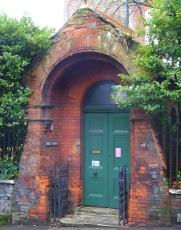
I would not have been aware of this remarkable man had I not spotted a brown and white commemorative plaque in his memory on an old brick gate post on Hampstead’s Rosslyn Hill. The gatepost and a short stretch of wall are all that remains of Harry’s Vane House, which was has been demolished. It was still standing in 1878, by which time it had been heavily modified and:

“…occupied as the Soldiers’ Daughters’ Home. Vane House was originally a large square building, standing in its own ample grounds.” (www.british-history.ac.uk/old-new-london/vol5/pp483-494).

This was connected by a covered arcade to a school for soldier’s daughters. The building which housed the school still stands on Fitzjohns Avenue and has been renamed Monro House. The heavily modified Vane House, in which Sir Harry resided, was demolished in 1972. Its only remains are as already mentioned.

Once again, seeing a small thing whilst strolling around in London has opened a window that has given me a first view of an aspect of history that was almost, if not completely, unknown to me.

From Hungary to England, Budapest to Hampstead

I ENJOY THE OBSCURE, or, at least, what is new and unknown to me. I am also interested in Hungary and the Hungarians. So, recently, when we were walking along Branch Hill, a road beneath and west of Hampstead’s Whitestone Pond, I spotted a circular blue commemorative plaque that I had not noticed before. Close to a house where the singer Paul Robeson lived for one year, it commemorates a celebrated Hungarian,  whom I had never come across before. The plaque reads:
“Alfred Reynolds, Hungarian poet and philosopher lived here 1980-1993”

Sadly, the two most knowledgeable Hungarians I knew, who could have told me something about him, the philosopher Imre Lakatos (1922-1974) and one of my father’s co-authors, the economist Peter Bauer (1915-2002), are no longer in the land of the living. So, I have had to resort to that font of all knowledge, Wikipedia, for information about Reynolds, a name that hardly sounds Hungarian to me. Searches of the internet reveal little other biographical information in English apart from what is noted on Wikipedia.

Alfred Reynolds (1907-1993) was born Reinhold Alfréd in Budapest, Hungary (the Hungarians put their surnames before their first names). His mother was Jewish and his father Roman Catholic. After graduating from the University of Leipzig in 1931, he founded a magazine called ‘Haladás’ (‘Progress’), which published the works of various Hungarian poets and was closed by the police soon after it began. Next, he founded another journal, a monthly with leftish tendencies called ‘Névtelen Jegyző’ (‘Anonymous Chronicler’), which was also soon closed by the police. After a brief spell as a member of the Communist Party of Hungary and a spell of imprisonment in Hungary, Alfred moved to the UK, to London, in 1936.

During WW2, Alfred served in the British Army, joining the Intelligence Corps in 1944. When the war was over, he became a leading light in the Bridge Circle, a group of libertarians. The group produced a journal called “London Letter”, some of whose articles were published in a book called “Pilate’s question: Articles from ‘The London Letter’,1948-1963”, which was released in 1964 and contains articles by Reynolds. In 1988, he published another book in English, “Jesus Versus Christianity”. The aim of this book was:

“…to redefine the prevailing image of Jesus of Nazareth. The author considers that Jesus remains a living figure reminding us of our humanity – the kingdom of Heaven within us. He argues that we should free the image of doctrinal encumbrance.” (https://www.goodreads.com/book/show/4932942-jesus-versus-christianity).

Prior to his arrival in England, Reynolds published his writings in Hungarian and those of other Hungarian poets, mostly in the journals he founded.  Many of his papers, publications, and other memorabilia are currently on display at the Petőfi Literary Museum in Budapest.

And that is about all I can tell you about Reynolds who spent the last years of his life in a fine house that affords good views over Hampstead Heath. I wonder whether he ever frequented Louis on Hampstead’s Heath Street. Louis was opened as a Hungarian patisserie and café in 1963 by the Hungarian Louis Permayer (died 2017), who fled from Communist Hungary during the Uprising in 1956 (http://budapesttimes-archiv.bzt.hu/2014/10/04/louis-patisserie-a-hungarian-tea-temple-in-the-heart-of-north-london/). Louis still exists and has maintained its original wood-panelled interior décor that owes a lot to traditional Central European taste. It was where my wife and I had our first ‘date’. Today, the café is under different management from what it was when Reynolds moved to Hampstead.

Yet again, whilst walking for pleasure and exercise, I have spotted something that intrigued me because it seemed so unfamiliar and made me want to investigate it.  Having discovered that there is not much information easily available about Alfred Reynolds, I am not surprised that I had never heard of him. The plaque commemorating his residence is unusual in that it does not state the name of the organisation or whoever it was that placed it. That adds to the mystery that partially shrouds this Hungarian refugee’s life and his relative obscurity that appeals to me.

Finding Boy George and Bliss in north London

DURING THE COVID19 PANDEMIC, when travelling far afield has been discouraged for public health reasons, I have been exploring one of my old haunts, Hampstead, and have been becoming increasingly more interested in its attractions and historical associations. I invite you to join me on one of my rambles through a part of this intriguing area of north London.

Detail of house where Sir Arthur Bliss lived

East Heath Road runs eastwards, then southwards, relentlessly downhill from Hampstead’s Whitestone Pond towards South End Green, close to the Royal Free Hospital. The road marks the eastern edge of the spread of Hampstead into Hampstead Heath. Except for three well separated blocks of flats, there are no buildings on the eastern side of the Road. A winding lane leads off the road to the small settlement of the Vale of Health, an enclave which is surrounded by the Heath.

The block of flats facing Whitestone Pond at the top end of East Heath Road (‘EHR’) is called Bell Moor. Built in 1929, this edifice stands on the site of the home where the historian Thomas J Barratt (1841-1914) lived from 1877 to 1914. He was Chairman of the Pears soap manufacturing company and a pioneer in brand marketing as well as a historian of Hampstead. His “Annals of Hampstead”, published in 1912, is a detailed, monumental, beautifully illustrated, three volume account of Hampstead’s history. In addition to a plaque commemorating Barratt on Bell Moor there are two others. One of them records that the great conductor Sir Thomas Beecham (1879-1961) lived there from 1937-1941 and the other is placed to record that the surface of the soil at Bell Moor is 435 feet above sea level or 16.5 feet higher than the top of the cross on the dome of St Paul’s Cathedral.

Moving downhill, all the older houses are on the west side of East Heath Road. The writer Katherine Mansfield (1888-1923) and her husband, the critic John Middleton Murry (1889-1957), lived at the end of a short Victorian terrace, at number 17 EHR (formerly ‘Portland Villas’). Next door to this, there is a picturesque ivy-clad building, Heath Cottages, with one wall covered in wood cladding and a small balcony above one of its centrally placed pair of front doors. Barratt included a drawing of this building in his book but makes no comment about it.

A large house, The Logs, with an extravagant brick tower, eye-catching but not attractive, is reached further down EHR. This was built in 1868, designed by JS Nightingale for the drainage and water supply engineer and Justice of the Peace for Middlesex Edward Gotto (1822-1897; http://www.icevirtuallibrary.com/doi/pdf/10.1680/imotp.1897.19422). It has also been home to the comedian Marty Feldman and later the popular musician Boy George. The Logs neighbour is Foley House, which I have described elsewhere (https://adam-yamey-writes.com/2021/01/15/a-house-a-spa-and-grays-anatomy/).

Proceeding down EHR, we pass several large brick-built terraced houses until we arrive at the corner of a lane called Heathside. A large house on the corner of this and EHR bears a plaque that notes that the composer Sir Arthur Bliss (1891-1975) lived here in East Heath Lodge from 1929 to 1939. It was in this house that the painter Mark Gertler (1891-1939) painted the composer’s portrait in 1932 (https://www.npg.org.uk/collections/search/portrait/mw07115/Sir-Arthur-Bliss). During his residence on EHR, his musical compositions began to be come less avant-garde and he became a musical successor to the composer Edward Elgar. I wonder whether living in a house with views over Hampstead Heath might have influenced his change in composing style.

East Heath Lodge appears to have been divided into two residences. Bliss occupied the half of the building next to the Heath. It was built in about 1785 by the local builder Henry White and modified in about 1820 (https://historicengland.org.uk/listing/the-list/list-entry/1342097). A large bell hangs under a metal canopy outside the western half of the building, which bears the name ‘South Lodge’. West of East Heath Lodge along Heathside, there are some large cottages built in about 1814. South of Bliss’s former home, EHR is flanked to the east by a large public car park and to the west by a triangular green space whose apex is at the point where Willow Road meets the southern extension of EHR, South End Road. Just before it does that, EHR meets the eastern end of Downshire Hill soon before it crosses Willow Road.  

Number 2 Willow Road, a modern looking two-storey building can be seen across the grass from EHR. Modern it looks although it was designed and built by the architect of Trellick Tower Ernö Goldfinger (1902-1987) in 1939. In 1942, Goldfinger, who had Marxist sympathies, hosted an exhibition of leading artists in his new home in order to raise funds for “Aid to Russia” (www.nationaltrust.org.uk/features/who-was-ern-goldfinger).  Now owned and maintained by the National Trust, it is well worth visiting this superbly designed living space. Incidentally, Goldfinger’s house was constructed on the site of some 18th century cottages that were demolished to make place for it.

South of Willow Road, EHR becomes South End Road. The houses lining this road’s western side, but set well back from it, are in complete contrast to Goldfinger’s residence just north of them. Each of the houses is separated from the pavement by long strips of beautifully cared for gardens. Most of the dwellings have names: Hartley House (no. 103), where the architect Oswald Milne (1881-1968) once lived; Heath Cottage (no. 101); Guernsey Cottage (no. 93), home of the 19th century translator of “Heinrich Heine’s Book of Songs”, JE Wallis; Bronte Cottage (no. 89), home of the artist Mary Hill (1870-1949); St Johns Cottage (no. 87); Rose Cottage; Leighton House (no. 73), and Russell House (no. 71), an early 19th century house with a late 19th century enclosed veranda by Charles Francis Annesley Voysey (1857-1941), one of his earliest projects. Beyond these, there is Keats Grove, across which a line of shops commences. The architectural historian, Nikolaus Pevsner, who lived in Hampstead, described this row of buildings as:
“… a pleasant irregular sequence of early c19 houses.”

And that is a good description of them.

South End Road, the continuation of EHR, becomes Fleet Road and heads south east towards Chalk Farm. We end our ramble at Pond Square, where once there was a cinema, its site now occupied by Marks and Spencer’s superb food store. Just north of it is Hampstead Heath Overground Station, which is close to a pub with fake half-timbering called the Garden Gate. In 1855, a pub on this site was called ‘The Perseverance’. It was renamed ‘The Railway Tavern’ by 1871 and got its present name more recently. Closed at present because of the covid19 pandemic, the best place to refresh yourself, after walking down from Whitestone Pond and enjoying the varied architecture along the way, is the Matchbox Café next to the small, cobbled bus yard in Pond Square. Its friendly owner Mirko prepares good hot drinks and sells a variety of tempting snacks. And before you leave the area, pick up some great fruit and vegetables from the  well[stocked stall next to the station ticket office.

Guard dogs and Cruella de Vil

LARGE FIERCE LOOKING DOGS roam freely in the grounds of a huge mock Tudor house overlooking north London’s Hampstead Heath on the corner of West Heath Road and Platts Lane. Approach one of the metal gates designed to prevent an outsider from viewing the house properly and within seconds one of those dogs will meet you on the other side of the gates and bark menacingly. I did manage to peer through the railings and the shrubbery within them to catch a glimpse of a huge sculpture of a seated lion sitting close to the steps leading to the house’s front door. Several notices on the outer wall of the property read:
“DO NOT ENTER. LARGE DOGS MAY BE RUNNING FREE”.

I have often passed this house and wondered about it.

A plaque posted by the Hampstead Plaque Fund reads as follows:
“Francis Owen Salisbury (1874-1962) ‘Frank’. Artist. Mural and Portrait painter, recorder of scenes of magnificent pageantry and historic event. Stained glass artist. Lived here.”

Frank, born in Harpenden (Hertfordshire), was the son of a craftsman, who worked in plumbing, decorating, and was also an ironmonger. He was apprenticed to a stained-glass company when he was 15, and then entered Heatherley’s School of Art as a part-time student (www.19thcenturypaintings.com/artists/79-francis-%28%22frank%22%29-o.-salisbury/biography/). A skilled artist, Frank won a scholarship to the Royal Academy Schools, where he won two silver medals. Soon, he:

“…acquired a considerable reputation. He exhibited at the Royal Academy from 1899 to 1943 and his career as a portrait painter also flourished in the United States. His sitters include five presidents of the United States, five British prime ministers and many members of the British royal family, including the official coronation portraits of King George VI.” (https://www.npg.org.uk/collections/search/person/mp07514/francis-owen-frank-salisbury).

Frank painted more portraits of Winston Churchill than any other artist. His portrait of Franklin D Roosevelt is still the official portrait of this president hanging in the White House. He was the first person to paint a portrait of the young lady, who is now Queen Elizabeth II. He made portraits of many of the most famous and infamous personalities of the first half of the twentieth century. Frank’s skills were not confined to portraiture as the commemorative plaque reveals,

Frank was highly successful in the USA and by 1932, he was able to move into his impressive mock-Tudor mansion, Sarum Chase, overlooking Hampstead Heath. The house was designed by Frank’s nephew Vyvyan Salisbury (died c1982). Following Frank’s death, the property was bequeathed to the British Council of Churches, who soon sold the house and its contents. The house has since been used as a background for photo and film shoots. In Disney’s 1996 film of “The 101 Dalmations”, Sarum Chase was used as the exterior of Cruella de Vil’s home.

By 1974, the house was home to St Vedast’s School for Boys, part of the School of Economic Science, which has links with a branch of Hindu philosophy. In 2005, the building was sold and is now, or has been, the home of property developer and donor to Jewish charities.

So, there you have it. If I have aroused your curiosity, that is good but do not try to enter this heavily guarded premises as did a little dog called Chewy, who found its way through a hole in the fence and met his sudden end in the garden of Sarum Chase in September 2016 (https://www.hamhigh.co.uk/news/our-pomeranian-dog-died-after-being-bitten-by-wealthy-property-3531920).

Rambling in Hampstead: Romney to Robeson

AN OLD FIRE STATION with a tall clock tower was built in 1871 and used until 1923. It stands on a corner at the southern end of narrow Holly Hill, opposite Hampstead Underground Station. Let us begin the steep climb up Holly Hill, noting on our right the house (number 16) where the painter Derek Hill (1916-2000) lived between 1947 and his death.  A painter of portraits and landscapes, he was greatly regarded in Ireland.  Close to his home, number 18 Holly Hill is named ‘Sundial House’ and has a heavily painted black sundial attached to its façade.  It was once part of the house owned by Hill.

former Mount Vernon Hospital

A little further up the hill on the same side as Sundial House, there is a large house with white painted weatherboarding, which was the residence of a painter far better-known than Hill, George Romney (1734-1802). Romney bought the property in 1796 and had it redesigned by Samuel Bunce (1765-1802) for use as a studio and gallery in 1797/8. Although Romney had spent a great deal of money to create his Hampstead abode, to which he moved from having lived in Cavendish Square for at least 20 years, he was not entirely happy being so far away from the buzz of central London life.  He sold the house in 1799. In 1807, the house was enlarged and became ‘The Hampstead Assembly Rooms’. Later, in1929/30, the house was remodelled and enlarged by the architect Sir Bertram Clough Williams-Ellis (1883-1978), who created the picturesque village of Portmeirion in western Wales. So, much has happened on this plot of land, which used to be the site of the stables of Cloth Hill, a house that existed in the 17th century.

To the north of Romney’s house is Fenton House, built about 1693, once owned by the Riga merchant PI Fenton, who bought it in 1793, and now owned by the National Trust. It houses a fine collection of old keyboard instruments. In the late 1960s when I first visited it, visitors were free to touch the instruments and make sounds or music with their keyboards. Now, this is forbidden unless you are a musician who has been given special permission to play them. Fenton House is next door to Bolton House and Volta House. These two and another, Windmill House, comprise a terrace constructed 1720-1730 (https://britishlistedbuildings.co.uk/101379202-volta-house-bolton-house-windmill-hill-house-and-enfield-house-hampstead-town-ward#.YAG3W-j7RPY). The poet Joanna Baillie (1762-1851) lived in Bolton House between 1791 and 1851. Her guests at the house included John Constable, Walter Scott, William Wordsworth, Lord Byron, and John Keats. The street on which these buildings and Fenton House stand, Windmill Hill, was named in 1709, probably because there had been a windmill nearby in the 17th century (https://www.british-history.ac.uk/vch/middx/vol9/pp15-33).

Across Holly Hill and high above Romney’s house, a steep footpath reaches Mount Vernon. Just where the small lane makes a right-angle turn, there is a plaque on a high brick wall commemorating the physiologist Sir Henry Dale (1875-1968), who lived nearby. Dale first identified acetylcholine in 1914 and proposed that it might be a neurotransmitter, a substance that allowed nerve cells to communicate with one another. In 1936, he and his collaborator Otto Loewi (1873-1961), whom he met at University College (London), were awarded a Nobel Prize for their work on the role of acetylcholine in neurotransmission.

The wall to which Dale’s plaque is attached is part of that which surrounds the  Mount Vernon House, which is barely visible behind the wall. The house, originally named ‘Windmill House’, was built in about 1728. It has been home to Dale; the surgeon William Pierce (c1706 -1771); General Charles Vernon (died 1810), Lieutenant of the Tower of London from 1763 until 1810, who leased it between 1781 and 1800; and the British landscape painter Edmund John Niemann (1813-1876). Dale and his wife occupied the house from 1919 to 1942.

Immediately north of Dale’s former home, there is a massive Victorian building replete with turrets topped with conical roofs. Now a block of flats, this used to be Mount Vernon Hospital for Tuberculosis and Diseases of the Lungs (https://ezitis.myzen.co.uk/mountvernonhampstead.html). It was built on land owned by General Vernon.  I often wonder what people living in former hospitals like this one and the old Royal Free, also in Hampstead, the former Royal Dental Hospital (now a hotel in Leicester Square), and the former St George’s Hospital (now the luxurious Lanesborough Hotel), think when they consider that parts of their residences might once have been filled with consumptive patients, or the sickly poor, terrified dental patients, and the dying.

Built in 1880 and opened a year later, this hospital was built in faux 17th century French renaissance style. In 1914, the building and its later extensions was sold to the Medical Research Committee and Advisory Council  to house a National Institute for Medical Research. By 1915, it was a hospital again. After WW1, the building reverted to being used for medical research until 1950. According to a watchman at one of the entrances to the former hospital, the place was converted into flats about 25 years ago.

Moving northwards, Holly Hill becomes Frognal Rise, which drops downwards to the east end of Frognal before rising again. Two gate posts marking the beginning of a lane, Oakhill Way, that leads west from the ascending part of Frognal Rise are the entrance to Combe Edge. Along the lane, there is a house with that name, whose gateway bears the date 1878. One of its walls has a plaque commemorating Elisabeth Rundle Charles (1828-1896), who lived there from 1874 to 1896. A writer, Charles is best known for her novel about Martin Luther, “The Chronicles of the Schönberg-Cotta Family”, published in 1862, which can be read online (www.gutenberg.org/ebooks/36433), if you have nothing better to do. But we must move on to our next port of call: Branch Hill House.

The house, formerly called ‘Spedan Tower’, is an ugly brick pile, which looks institutional.  However, its gothic revival gatehouse, built 1868 and designed by SS Teulon (1812-1873) and overlooking a large area of allotments, is attractive. The former care home (built in 1901) was once the home of John Spedan Lewis (1885-1963), founder of the retailing group John Lewis Partnership.  Beneath it in what was once its gardens, there is a modern council estate called Spedan Close. Completed in 1978, it:

“…was, at the time it was built, the most expensive council housing in the country; every property with its own individual roof garden.” (www.theundergroundmap.com/article.html?id=29094).

Returning to Frognal Lane, it becomes Branch Hill a few yards before it joins West Heath Road. Number 1 Branch Hill, a house named ‘The Chestnuts’, was home to the great singer Paul Robeson (1898-1976) from 1929 to 1930. This was after his appearance in “Show Boat” in London in 1928. It was in this show that his famous performance of the song “Ol’ Man River” was first heard. Paul and his wife bought the house in Hampstead, but soon after they divorced, he returned to the USA.

By now, you will have walked not much more than 600 yards, but passed plenty of places of historical interest, which I have mentioned, and others that wait for you to explore.

Hunting for Hunt: poets in Hampstead

I MUST CONFESS THAT I knew nothing about Leigh Hunt (1784-1859) until I became interested in the history of Hampstead in North London. What triggered my interest in Hunt was seeing a house named Vale Lodge in a part of Hampstead called The Vale of Health. Vale Lodge, a late Georgian (early 19th century, pre-1831) house modernised in the 20th century, is difficult to see from the lane by which it stands because it is surrounded by a high wall.

Vale Lodge

People, who have lived in Vale Lodge include the writer Edgar Wallace (1875-1932); the Russian-born industrialist Sir Leon Bagrit (1902-1979); and the banker Sir Paul Chambers (1904-1981). One source (https://historicengland.org.uk/listing/the-list/list-entry/1379083) mentions that Vale Lodge was:

“… home of Edgar Wallace, writer, and probably also the residence of Leigh Hunt, poet.”

Well, that got me interested because I had read that Leigh Hunt lived in the Vale of Health from 1816 onwards for a few years.

Hunt, a radical, was a critic, essayist, and poet. He was a co-founder and/or collaborator of several periodicals including “The Examiner”, “The Reflector”, “The Indicator”, and “The Companion”. In about 1812/13, Hunt and his two brothers, also involved with “The Examiner”, were imprisoned for libelling the Prince Regent (the future King George IV). Whilst incarcerated in the Surrey County Jail, Hunt was visited by his eminent friends including:

“…Lord Byron, Thomas Moore, Lord Henry Brougham, and Charles Lamb … When Jeremy Bentham called on him, he found Hunt playing battledore.” (https://en.wikipedia.org/wiki/Leigh_Hunt).

On his release from prison in 1815, Leigh:

“… went to live in the Vale where he stayed until 1819, returning again for a brief period in 1820-1.” (www.british-history.ac.uk/vch/middx/vol9/pp71-73)

Hunt’s home in the Vale of Health not only inspired him to write some poetry extolling the virtues of Hampstead, but also attracted several of his contemporaries who were notable literary figures. These included the poets Percy Bysshe Shelley (1792-1822), Bryan Waller Procter (1787-1874) and John Keats (1795-1821) as well as the painter Benjamin Robert Haydon (1786-1846) and the essayist William Hazlitt (1778-1830). When I was studying at University College, I read some of Hazlitt’s essays. Some words he wrote about the fear of death made a great impression on me:

“Perhaps the best cure for the fear of death is to reflect that life has a beginning as well as an end. There was a time when we were not: this gives us no concern – why then should it trouble us that a time will come when we shall cease to be? I have no wish to have been alive a hundred years ago, or in the reign of Queen Anne: why should I regret and lay it so much to heart that I shall not be alive a hundred years hence, in the reign of I cannot tell whom?” (from “Table Talk”, published in 1821).

The poet Keats, who had slept in Leigh Hunt’s home in the Vale of Health, took a great liking to Hampstead and settled there in 1817. He lived in Wentworth House, which was later renamed ‘Keats House’. The house was built in about 1815 (https://keatsfoundation.com/keats-house-hampstead/) and divided in two as is common with modern semi-detached houses. One half was occupied by Charles Armitage Brown (1787-1842), a poet and friend of Leigh Hunt and the other half by Charles Wentworth Dilke (1789–1864), a literary associate of Hunt and a visitor to his home in the Vale of Health. Keats became Brown’s lodger. Keats had first visited the house when the poet and playwright John Hamilton Reynolds (1784-1852), who was part of Leigh Hunt’s circle of friends, introduced him to Dilke, Brown’s friend and neighbour.

While living in Hampstead, Keats wrote much poetry including “Ode to a Nightingale” (and other “Odes”), “Isabella”, Hyperion”, “St Agnes”, “La Belle dame sans Merci”, and began working on “Endymion”.  It has been suggested that Keat’s poem “I Stood Tiptoe Upon a Little Hill” was inspired by his experience of Hampstead (www.hamhigh.co.uk/lifestyle/heritage/rare-keats-handwritten-poem-inspired-by-hampstead-heath-goes-up-3438636). Another of his works, “Dedication. To Leigh Hunt esq” relates directly to his friend Hunt (words: www.bartleby.com/126/1.html). His poem “Sleep and Poetry”, according to Leigh Hunt (http://spenserians.cath.vt.edu/TextRecord.php?textsid=36069):

“… originated in sleeping in a room adorned with busts and pictures … ‘On Sleep and Poetry,’ was occasioned by his sleeping in one of the cottages in the Vale of Health, the first one that fronts the valley, beginning from the same quarter.”

The house was that of Leigh Hunt (https://www.bartleby.com/126/1000.html#31).

There is no doubt that many now famous literary and artistic people congregated around Leigh Hunt while he has living in the Vale of Health, but there appears to be some uncertainty as where exactly he resided. One suggestion, already mentioned, is Vale Lodge. However, a 19th century writer, William Howitt, wrote of Hunt’s residence in his “The Northern Heights of London” (published in 1869):

“The house, which he occupied … was pulled down to make way for the great hotel just mentioned.”

The site of the hotel, which has also been pulled down, is now occupied by a block of flats called Spencer House. If that is the case, then Vale Lodge can be remembered for at least one literary figure, Edgar Wallace, if not also Leigh Hunt.

Beer and biryani in Hampstead High Street

MANY PEOPLE HAVE FAVOURITE restaurants. My parents were no exceptions. Amongst the restaurants they frequented often in London during the early 1960s were Mon Plaisir in Monmouth Street; Otello in Soho; Cellier du Midi in Hampstead; and the Tung Hsing in Golders Green, one of the first restaurants in London to serve ‘Pekinese’ cuisine. For Indian food, they patronised the Shahbhag in Hampstead High Street. 135 feet west of that still extant restaurant there is an archway decorated with sculptures depicting sheaves of barley and an inscription that reads:

“Established 1720. BREWERY. Rebuilt 1869”

The archway is at the street entrance of a covered cobbled lane that leads to a converted Victorian industrial building, now named ‘Clive House’, within a yard of varying width. The yard contains a well-head covering a well that looks quite old, and certainly not of recent construction.

The brewery was that of the ‘Hampstead Brewery Co. Ltd’ founded in 1720 by John Vincent (died 1755).  In about 1713, Vincent, already a landowner, acquired the Jack Straws Castle pub near Hampstead’s Whitestone Pond (www.british-history.ac.uk/vch/middx/vol9/pp66-71). He founded the brewery behind a pub called the “King of Bohemia’s Head” in 1720. In 1733, he was granted a 33-year lease of a spring by the trustees of an estate in Hampstead, which contained it and other wells including those with curative mineral waters. It was:

“…used only to supply the Vincents’ brewery in High Street and a few adjoining houses, was of little value to anyone other than the brewer.” (www.british-history.ac.uk/vch/middx/vol9/pp169-172).

Thomas J Barratt, a historian of Hampstead, wrote (in 1912) that Vincent selfishly believed that:

“… he could utilise the water to his own profit and the benefit of some of his neighbours; therefore, with the leave of the trustees, he laid down pipes and conveyed water from the pond not only to his brewery but also to a number of better-class houses in the town. He charged the householders for the water, and no doubt did well out of the transaction; but when, after many years, the Chancery decree brought about a day of reckoning he was ordered to pay £322 for arrears of rent, and the water was advertised to be let to the highest bidder. When Gayton Road, a thoroughfare now connecting Well Walk with High Street, was being formed, remains of the pipes conveying this water to the brewery were discovered a few feet below the surface.”

In addition to the brewery, Vincent acquired much other property in Hampstead including several pubs. On his death in 1755, Vincent’s brewery and other properties passed to his younger son Robert, who is thought to have continued running the brewery with his elder brother Richard (www.british-history.ac.uk/vch/middx/vol9/pp111-130). Richard entered Wadham College, Oxford, in April 1736 and became a barrister (Inner Temple) in 1743 (https://en.wikisource.org/wiki/Page:Alumni_Oxoniensis_(1715-1886)_volume_4.djvu/270).

In 1787, Robert’s widow Elizabeth became involved in running the business and some of the Vincents’ pubs in Hampstead including the ‘George’, the ‘Black Boy’, and the ‘Coach and Horses’. She retained an interest in the brewery until 1812, which is well after it was taken over by Messrs Shepheard and Buckland in 1797. The brewery was rebuilt in 1869 with two shopfronts on the High Street, and by the 1880s, it was owned by Mure & Co. In 1928, the company had 184 employees, but it closed in about 1931. Reffell’s Bexley Brewery acquired it in 1931 (https://builtforbrewing.wordpress.com/2012/08/06/on-hampstead-high-street/).  

The brewery buildings had become quite dilapidated by 1959 when they were being used for motor repairs. Later, the structure was converted for use as office space and an attractive group of residences were built within its compound.  The main brewery building is now named Clive House. It is currently the offices of the Pears Foundation, which is:

“…an independent, British family foundation, rooted in Jewish values, that takes £15 ‐ 20 million of private money every year and invests it in good causes.” (https://pearsfoundation.org.uk/who-we-are/).

The Brewery’s grounds were adjacent to the grounds of a church, which has been converted into residential dwellings, which retain some of the original windows topped with ogival arches. This building is labelled as ‘Trinity Presbyterian Church’ on a map surveyed in 1866. It was founded in 1844 and had its roots in Calvinist theology. The church’s story is as follows (https://search.lma.gov.uk/scripts/mwimain.dll/144/LMA_OPAC/web_detail/REFD+LMA~2F4352?SESSIONSEARCH):

“Trinity Presbyterian Church began after a report by the Presbyterian district visitor for Hampstead that Scottish inhabitants needed a preaching station … By the end of 1845 the average attendance was 130 in the morning and 80 in the evening … The congregation moved to Well Walk Chapel in 1853, however, the building was dilapidated, so a site at 2 High Street, on the corner of Willoughby Road, was bought in 1861. The new church opened in 1862. It was demolished in 1962 … Shops were built on the site and the hall was converted into Trinity Close.”

So, what can be seen today was the church hall.

All this history is making me hungry. So, let us return to the Shahbhag, which my parents enjoyed back when I was a youngster. I went there once in the early 1970s and had a pleasant meal. Then, I did not return to it until the mid- to late 1990s.  It looked different to what I remembered of it, but its location was the same as of old. I sat down and ordered a meal. While I was waiting for it to arrive, I looked around at what was arriving on the plates being served to other diners and I did not like what I saw. It looked and smelled far less attractive than the food that I was used to having in other Indian restaurants at the time. I was beginning to regret having entered this restaurant, mainly for nostalgic reasons. I waited and waited for an extremely long time, but my food did not arrive. I looked at the time, almost 45 minutes had elapsed since giving my order, and realised that soon I had to meet my wife and some friends. I called the waiter and told him that I could wait no longer and that I would be cancelling my order. He seemed undismayed as I walked out of the restaurant.

Recently (January 2020) when I explored the grounds of the former Hampstead Brewery, I noticed that the Shahbhag was still in existence but closed for the time being because of the current viral pandemic. I am glad it still exists as it is something that reminds me of my parents, but I doubt I will be entering it again when it reopens. When restrictions relating to covid19 ease up, I would rather have a beer than a biryani in Hampstead.

A house, a spa, and Gray’s Anatomy

I ENJOY FINDING links between seemingly diverse subjects. Recently, I discovered a connection between an old house in Hampstead in north London and the famous textbook “Gray’s Anatomy”.

On crossing East Heath Road, having just visited the Vale of Health, I saw a pair of wooden doors framed by a substantial brick archway. These doors are the entrance to the grounds of Foley House, which stands on a plot at the corner of Well Walk and East Heath Road. Even though it is partially hidden by the trees that grow within the railings that surround it, the upper windows of this three-storey brick building can be seen. From its architectural style, I guessed that it was pre-Victorian, maybe 18th century. Just south of the main building, there is an outhouse with a white painted wooden weatherboard façade. The top of the façade has six small apertures each above one of two shelves. Presumably, these are parts of a dovecote.

One source (https://www.british-history.ac.uk/vch/middx/vol9/pp15-33) states that the present Foley House was built between 1771 and 1773 by the Holborn glazier Edward Helling. Helling, whose dates I cannot find, had already died by 1781. This house (or an earlier one on the same site) was built for Mr John Duffield. who was:

“… the first Spa manager …” (https://historicengland.org.uk/listing/the-list/list-entry/1342099)

The spa was across Well Walk opposite Foley House.

In the late 17th century, Hampstead became well-known for its supposedly curative Chalybeate spring water, which is rich in iron salts. The spa was established on land that was leased in 1698 by Susannah Noel on behalf of her son Baptist, 3rd Earl of Gainsborough (1684-1714), who was lord of the manor, but a minor.  The lease:

“…granted 6 a[cres]. of Hampstead Heath, including the well of mineral water, to 14 trustees, who were admitted as copyholders at a rent of 5s. a year to use the income for the poor of Hampstead. The trustees leased all the property except the pond or springhead north-west of the mineral spring to John Duffield in 1701 for 21 years at £50 a year, on condition he spent £300 over 3 years improving it, and agreed for a second term for improvements worth £200.” (https://www.british-history.ac.uk/vch/middx/vol9/pp169-172).”

According to Thomas Barratt, author of the encyclopaedic “The Annals of Hampstead” (published 1912), one of these fourteen men was one Thomas Foley. The house might have been named in his memory.

Duffield was quick to develop the mineral spring into a spa. Christopher Wade, author of “For the poor of Hampstead, forever. 300 years of the Hampstead Wells Trust” published in 1998, quotes an advertisement for a concert that was to be held in the Hampstead Wells on the 18th of August 1701. By then, Duffield had built his Long Room, an edifice containing a ‘Pump Room’ and an ‘Assembly Room’. The latter measured about 72 by 30 feet and was tall and airy with large windows. It could accommodate 500 people The Long Room, which was demolished in 1882, was located where a house called Wellside (built 1892) stands in Well Walk today.

Wade wrote that Duffield:

“… had done well enough for himself to build ‘a goode brick house’ costing £1000. Some historians claim that that this became Foley House on East Heath Road, but the evidence is confused. (The house is not shown on a detailed map of 1762)”

The words “a goode brick house” are quoted from the manorial records of 1706. Barratt notes:

“Mr GW Potter is of the opinion from the description given in the record that this house was, in all or in part, that now called Foley House…”

Well, if the house that we see today was only built in 1771, it is not surprising that it was not shown on the map created in 1762. I looked at that map (https://www.british-history.ac.uk/vch/middx/vol9/pp15-33) and Wade is right. There is no building marked where Foley House should be found. However, in “The Buildings of England. London 4: North”, the architectural historians Nikolaus Pevsner with Bridget Cherry write that Foley House was:

“… built in 1698 for J Duffield, the first spa manager …, but with mid-c18 three-bay front … Early c18 stables, weatherboarded.”

Pevsner and Cherry were describing the house that we saw, but its absence from the map is puzzling. I speculate the following. Duffield did have a house built in 1698 on the plot where the present Foley House stands. Maybe, it had been demolished by 1762, when the map was drawn, and then later replaced by the house built by Edward Helling, mentioned above. Alternatively, the map was incomplete or not 100% accurate.  

Several Victorian buildings neighbouring Foley House on Well Walk (currently numbers 21-27) bear the name ‘Foley Avenue’. Designed by Henry S Legg, these were built in 1881 on land that was once part of the grounds of Foley House.

And now for the link that I mentioned at the beginning of this piece. One of the people who lived in Foley House was the physiologist and surgeon Sir Benjamin Brodie (1783-1862). In an autobiographical note (“The works of Sir Benjamin Collins Brodie … with an autobiography”, published 1865), he wrote:

“In the year 1828 I engaged a house on Hampstead Heath, which at that time was a comparatively rural retreat. My family resided there during the summer and part of the autumnal season, and I generally was able to go thither to dinner, returning to my occupation in London in the morning.”

Brodie helped to acquire the building at the north end of Kinnerton Street in Belgravia, which became the medical school for St Georges Hospital (while it was located at Hyde Park Corner in what is now ‘The Lanesborough Hotel’).  One of the students who was taught by Brodie in Kinnerton Street was Henry Gray (1827-1861), author of one of the most famous medical textbooks, “Gray’s Anatomy”. Gray dedicated his masterpiece to his teacher and colleague Brodie.

Brodie used Foley House between 1828 and 1837, when his lease expired. Then, he bought a property in Surrey. As Gray was under ten years old when Brodie lived in Hampstead, he would not have been a visitor to Foley House.

Had I not written about Kinnerton Street and its association with “Gray’s Anatomy” shortly before spotting Foley House in Hampstead, there would have been hardly any chance of me being able to realise the connections between the house, Brodie, and his student, the famous anatomist.

A hotbed of demoralisation and crime in north London

A WINDING LANE leads from Hampstead’s East Heath Road into the picturesque Vale of Health. I wrote about this isolated, small settlement surrounded by Hampstead Heath in the summer of 2017 (https://hampsteadadam.travellerspoint.com/2/) and have not revisited the place until today, the 2nd of January 2021. Little appears to have changed since then, but I have learnt a little more about the place.

As for its name, the place was not always as healthy as its name suggests. I wrote:

The land on which the Vale is situated is mentioned in the Domesday Book (1086 AD). It was then owned by the Abbots and monks of Westminster. By the 18th century this swampland in the middle of the part of the Heath, then known as part of ‘Gangmoor’, was inhabited by impoverished people and was malarial. In the 1770s, the area was known as ‘Hatches’ or ‘Hatchett’s’ Bottom, because Samuel Hatch, a harness-maker, had owned a cottage there before 1770. This unsavoury hollow was described in about 1817 as a “stagnate bottom, a pit in the heath” by the sculptor Joseph Nolleken’s wife (see: http://www.british-history.ac.uk/vch/middx/vol9/pp71-73). It was a vale, but not a healthy one.”

However, by 1801 when the land had been drained and property developers began building houses in the area, it gained the salubrious-sounding name by which it is known today.

Apart from the famous Indian artistic genius Rabindranath Tagore (1861-1941), who stayed in the Vale in 1912, the settlement was home to many other well-known people including the author Compton Mackenzie; the barrister Alfred Harmsworth; DH Lawrence; the philosopher Cyril Joad; and Stella Gibbons. Earlier notable residents included the law reformer Sir Samuel Romilly (1757-1818); the poet and essayist James Leigh Hunt (1784-1859), who entertained leading literary figures such as Hazlitt, Keats, Lord Byron and Shelley in his house in the Vale; the publisher Charles Knight (1791-1873); and, also, a Prince Eszterhazy.

During the 19th century, not only were the literati and wealthy attracted to the Vale but also it was a popular place for hoards of trippers, whose names never made it into the annals of history. The author of “The Northern Heights of London” published in 1869, William Howitt (1792-1879), describes these pleasure-seekers and what they did in some detail. He wrote that:

“This Vale of Health used, till of late years, to present a sight at once picturesque and pleasant. In front of a row of cottages, and under the shade of willows, were set out long tables for tea, where many hundreds, at a trifling cost, partook of a homely and exhilarating refreshment. There families could take their own tea and bread and butter, and have water boiled for them, and table accommodation found for them, for a few pence…”

And then, everything changed for the worse according to the puritanical-sounding Howitt:

“Recent times have seen Sunday dissipation reasserting itself, by the erection of a monster public house with a lofty tower and flag, to attract the attention of Sunday strollers on the Heath. Of all places, this raised its Tower of Babel in that formerly quiet and favourite spot, the Vale of Health … that taps and gin palaces on a Titan scale should be licensed, where people resort ostensibly for fresh air, relaxation, and exercise, is the certain mode of turning all such advantages into popular curses and converting the very bosom of nature into a hotbed of demoralisation and crime…”

This demoniacal-sounding establishment is marked as ‘Suburban & Hampstead Heath Hotel’ on a map surveyed a year before Howitt’s book was published. On a map surveyed in 1912, it is marked simply as ‘Hotel’. Just a few houses away southwest of it, another building is marked ‘Hall’, to which I will refer shortly. According to both maps, the hotel stood where today there is a twentieth century block of flats called Spencer House. Opposite this edifice, there is a caravan park, which has been in the possession of the Abbotts family for over 160 years. Since the late 19th century, this patch of land has been fairground land. About ten members of the family live on the site in caravans, and other travelling fair workers can camp there free of charge. In exchange, members of the Abbott family, who operate travelling fairs, are allowed camp for nothing on other fairground owners’ sites when they travel around the country.

Returning to the building that upset Howitt, “A History of the County of Middlesex: Volume 9” (https://www.british-history.ac.uk/vch/middx/vol9/pp71-73) notes:

“… the Suburban hotel (also called the Vale of Health tavern) with towers and battlements and accommodation for 2,000 was built in 1863 …”

This source also notes another establishment, which was being built whilst Howitt was writing or just about to publish. This was the ‘Hampstead Heath Hotel’, which was built in 1868. This stood between two groups of ‘villas’, that is between 1-6 Heath Villas and 7-12 Heath Villas. It was the building marked as ‘Hall’ on the 1912 map. It is now occupied by a mid-twentieth century block of flats, smaller than Spencer House, named ‘Athenaeum’.

The Hampstead Heath Hotel closed in 1877, when it passed into the ownership of Henry Braun. His great grandson, Frances Francis wrote (www.francisfrith.com/uk/hampstead/vale-of-health-hotel_memory-7431):

“My great grandfather Henry Braun owned the Vale of Health Hotel … overlooking the lake, from 1877 until the early 1900’s. The hotel was used as an Anglo German club called the Athenaeum and by 1908 had 1200 members – 500 English, 700 German, including many political radicals. The hotel became a factory during World War I and then remained derelict for some years. The hotel was eventually pulled down in 1958, when I was 15 and I remember with sadness watching ‘luxury’ flats being erected in its place.”

The club closed in 1914 and then became used as a factory until it was demolished and replaced by the present building in 1958.

According to the County History to which I have already referred, The Athenaeum club’s larger neighbour, the hostelry that Howitt detested was:

“The large Vale of Health tavern, originally intended as a hotel and sanatorium, was sold in 1876, became associated with the fair, was let as flats, and c. 1900 became a hotel again on a smaller scale, with the upper rooms let as studios … Spencer House (flats) replaced the Vale of Health hotel in 1964.”

Howitt would have been even more dismayed to have learnt that there was a third hotel built in the Vale of Health in the 1880s. It stood next to the Athenaeum on the site now occupied by Byron Villas. It was at number 1 Byron Villas that the writer DH Lawrence lived in 1915.

Today, Howitt would most probably be happier with the Vale of Health than he was in 1869. The hotels have gone, and there is not even the tiniest of stalls where refreshments may be obtained. He might disapprove of the parked cars and the caravan site opposite Spencer House, but there would be hardly anything that he could find to decry.  By the edge of its large pond, one of the sources of the River Fleet, the Vale of Health remains a quiet oasis in the heart of north London.

Pond life

WE MADE THE MOST of the shortest day of the year, 21st December 2020, by leaving our house before sunrise, which was supposed to happen at 8.05 am but did not do so visibly because of the grey skies and incessant rain. We drove to South End Green (Hampstead) and parked just above the largest of the Hampstead Ponds (Pond number 1).

Despite the sheets of rain and the sombre sky, the houses across the pond were reflected in the water  where swans and other waterfowl were taking a swim. We splashed along a waterlogged path to the next pond, Pond number 2, which is also overlooked by a few houses, whose inhabitants have an enviable view over the water and the slopes of Hampstead Heath beyond. We stood on a wooden viewing platform and heard a ‘splosh’ near us. It was a cormorant taking a dive. It emerged a few moments later further out in the pond. Several other cormorants could just about be seen through the rain, resting on a tiny island in the pond.

The Hampstead Ponds, three in number, are fed by streams that rise near the Vale of Health, which is about 440 yards northwest of the uppermost pond (number 3), which flows into the second pond and then into the first. These streams, along with those that flow into the Highgate Ponds, are sources of the water that flows in the now subterranean River Fleet, which empties into the Thames under Blackfriars Bridge.  

The idea of damming the streams to make the ponds might have been conceived as early as 1589 (https://guildhallhistoricalassociation.wordpress.com/2016/01/11/the-history-of-the-hampstead-heath-ponds/) but it was only in 1692 that the  Hampstead Water Company  leased the springs that now feed the ponds. The latter, which were used as freshwater reservoirs, were created by damming the streams in the early 18th century. The pond at the Vale of Health was created later, in 1777. Water from these ponds/reservoirs was supplied to users in north London via wooden pipes created by boring holes in elm tree trunks. The Highgate Ponds, which also supply water to the Fleet, were also created by the Hampstead Water Company.

In 1856, the New River Company acquired Hampstead Pond number 1 and the Vale of Health pond, which were by that time becoming less savoury as far as water quality was concerned. Four years later, the Hampstead Junction Railway Company opened what is now Hampstead Heath Overground Station. This was just south of a fourth pond, which was filled in in 1892. In addition, there was another pond in South End Green where a disused 19th century drinking fountain now stands. The pond was filled in in 1835.

Enough of the distant past. Let me tell you how South End Green fits in with my life so far. My mother’s brother, Felix, lived at number 130 Fleet Road. He bought it at an extremely reasonable price because it had a ‘sitting tenant’. Eventually, after the tenant died, my uncle lived on one of the building’s three floors and rented the other two to a couple of Nigerians, who became his close friends. He regarded them as if they were his sons and they looked after Felix as if he was their beloved father.  For a long time, Felix occupied the top flat. He used to visit our flat for dinner regularly and we used to drive him home at the end of the evening. On one occasion, we arrived at his house, and after fumbling in his pockets, he announced that he had left his house keys locked in his home. We asked him what he was going to do. He answered in his South African accent:

“Ag, I do this often. All I need to do is ring my neighbour’s doorbell and they will let me onto their roof. Then, I cross over on to my roof. I keep a stick there so that I can break open my window and climb into my house. So, you don’t need to worry.”

Felix was always creative and inventive. When he grew older and infirm, he moved into the ground floor flat. He began using a stick when out walking. Once, when I was visiting him in a ward in the Royal Free Hospital, which is across the road from his former home, I was present when a physiotherapist visited him. She asked him whether he had a walking stick. He said:

“It’s lying beneath my bed.”

The physiotherapist looked at the stick, and said:

“Well, I have never seen one quite like this before.”

“Ag,” said Felix, “I took a bleddy broomstick and glued an umbrella handle on to it.”

Felix died a few months ago. We miss him greatly.

Sadly, South End Green was  associated with other personal losses. Both my mother, and then many years later, her sister, ended their lives in the Royal Free Hospital.

The rear of Felix’s home once overlooked the LCC Tramway Depot. This was surrounded by the terraced houses on Fleet, Constantine, Agincourt, and Cressy Roads. The entrance to the depot was from the latter. This depot opened for horse-drawn trams in about 1887 and then the system was electrified in 1909. In 1938, trolley buses replaced trams travelling to South End Green and these were replaced by motor buses in about 1960 (www.british-history.ac.uk/vch/middx/vol9/pp3-8). Currently the route 24 bus terminates at South End Green, a route which I used when I was younger.

I used the 24, which passed near University College London where I studied between 1970 and 1982, for two main reasons. One was to visit my uncle Felix and the other to visit some friends, who lived in Constantine Road and others who lived in South Hill Park, part of which was built over the pond that was covered over in 1892.

Today, my wife and I enjoyed our visit to South End Green despite the relentless rain. After buying vegetables at a lovely open-air stall close to the station, we paid a visit to the Matchbox Café next to the cobbled area where the route 24 buses rest before setting off. As we waited for the barrista to prepare our hot drinks, we chatted with him through the hatch through which he serves the take-away drinks and snacks. Mirko was delighted to discover that we had visited his hometown Ptuj in Slovenia, which was once a part of the former Yugoslavia. He told us many things about his native place including that a castle north of the town, Borl (Ankenstein in German), was associated with Parsifal, one of the Knights of King Arthur’s Round Table (more information: https://blogs.bl.uk/european/2018/01/an-arthurian-castle-in-slovenia.html). Incidentally, Mirko prepares good quality coffee and richly flavoured hot chocolate. His café is one of many reasons for visiting South End Green, even on a rainy December day.