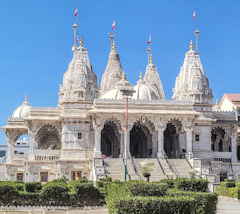
THE SWAMINARAYAN TEMPLE in Mandvi (Kutch, Gujarat) was constructed between 1991 and 1999 to replace a smaller Mandir on the site. Without going into the details of its very fine architectural and decorative features, this edifice was financed by local Kutchi followers of Swaminarayan. The Rajasthani Marble that forms the temple’s structure was hand carved by workmen, all of whom were followers of Swaminarayan. The stones that make up the building were carved in Rajasthan, transported to Mandvi where they were put together to make the edifice. This is similar to how the great temple in London’s Neasden was constructed.
Swaminarayan Mandir in Mandvi
The temple at Mandvi looks very similar to ancient Hindu temples I have seen elsewhere in India. As you look around it, you can see how the very old temples looked when they had just been built many centuries ago. Apart from the fact that Mandvi’s Swaminarayan Mandir looks recently built, a layman like myself, would find it difficult to age the building.
In 19th century England, many new churches were built in the gothic style. Like the newish temple at Mandvi, may of them faithfully reproduce the churches built in mediaeval times. The only thing that differentiates the 19th century Gothic Revival churches from their mediaeval predecessors is that they look too new to be as old as them.
In a book about Gothic Revival written by the art historian Kenneth Clark (1903-1983), he suggests that in England the use of gothic style in architecture never actually died out, and this suggested to me the Gothic Revival was really gothic survival. As far as I can gather, the same is the case for Hindu mandir architecture. If this is really the case, new temples such as Mandvi’s Swaminarayan Mandir is not the revival of the use of an ancient style of architecture, but an example of its survival. Put another way, the new temple at Mandvi is a reincarnation of its predecessor.
AIR TRAVELLERS CAN FLY to the former Kingdom of Kutch (Kachchh), now part of Gujarat, by two routes. There is a scheduled flight between Ahmedabad and Bhuj, and another between Mumbai and Kandla, whose airport is close to Anjar.
Kandla, was developed as a seaport on the early 1950s at the instigation of a member of the by then former royal family of Kutch. It lies on the coast of Kutch southeast of Karachi, a port that was incorporated into Pakistan in 1947, and northwest of Mumbai. It is now the largest port in India when measured by the volume of cargo handled there.
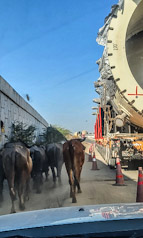
Cattle on the road
From Mandvi to Kandla Airport is 95 Km by road. We set off from Mandvi three hours before our flight to Mumbai was due to depart from Kandla. Our hosts, who use the airport frequently, told us that on average the road journey is 1 ½ hours. For the first hour of our journey, the highway was almost devoid of traffic. Along the way, we frequently switched lanes because heavy vehicles often move slowly along the outside lane without giving way to faster vehicles. We wove our way between slower vehicles, constantly overtaking and ‘undertaking’. Then after speeding along steadily, we headed towards a static queue of heavy lorries.
QuIck as a flash, our driver made a three point turn and we drove in the opposite direction tobthe rest of the traffic until we reached a gap in the central divider of the dual carriageway. We were not alone in making this manoeuvre. There were even some of the heavy goods vehicles making cumbersome manoeuvres to head away from the traffic jam. We continued our journey on the wrong side of the divider until we reached a turn off that allowed us to go under the highway and back into the correct lane.
Soon, we encountered another jam. A transporter carrying a tank as wide as one side of the motorway was inching its way onto the main road. Our driver took us off the road onto a dirt track, but this was also blocked. Another u-turn and we drove beneath the highway to a narrow, poorly tarmacced road that ran parallel to the highway. This led to a bridge beneath the main thoroughfare to reach another narrow lane that ran alongside the part of the highway running towards Kandla.
This lane offered other obstructions including large trucks and a herd of slow moving cattle. We squeezed past them and eventually rejoined the highway.
Meanwhile, the time was ticking away, and we wondered whether we would miss our flight. My spirits rose when we turned off the highway and on to a road leading to the airport. Soon, my hopes were dashed. We encountered yet another jam. However, our skilful driver managed weave his way between them. Soon, we arrived in front of the tiny airport terminal building.
Kandla Airport is primarily a military air base. Passengers use it for the one flight a day to and from Mumbai. When we disembarked there a few years ago, we walked from the aircraft to a shelter, where passengers’ check-in baggage was ready to be retrieved.
The check-in and security check is carried out in a part of a small room, the rest of which is part of the departure lounge (with a snacks stall). This hall leads to another room with seating. It is here that the departure gate is located. This simple departure lounge reminded me of Venice’s Marco Polo Airport as it was in the early 1960s.
We boarded the Spicejet two engined propellor plane after walking across the apron. The aircraft (a Q400 made by the Bombadier Company) has its own retractable staircase that we used to enter and later leave the ‘plane. After an uneventful flight lasting 1 hour and 15 minutes, we disembarked at Mumbai.
We were lucky only to have arrived a few minutes later than the scheduled time. Only three days earlier, my wife’ cousin’s flight from Mumbai to Kandla was delayed by almost 5 hours because of a technical problem discovered on the ‘plane minutes before it was due to take off. We were also fortunate because our quick-witted driver skilfully reduced the time spent stuck at significantly awful traffic jams.
I HAVE VISITED the famous Grand Canyon in the USA, and seen it after a heavy snow fall. I have also seen a fabulous canyon in New York State, a few hours drive away from Buffalo. However, it was not until the first of February 2023, that I heard of, and then visited a grand canyon in Kutch, which is now part of the Indian State of Gujarat.
The canyon, named Kadiya (aka Kaliya) Dhro, is 73 Km north of the coastal city of Mandvi, and 33 Km northwest of Bhuj. Although the canyon is many, many thousands of years old and had been known to locals forever, its existence only became widely known in 2020. It was then that Varin Suchday, founder of the Kutch Travel Club stumbled across it. He had heard it discussed by local tribes people, whilst he was assisting them during the covid19 crisis, and with considerable difficulty, he managed to find it in the midst if the poorly mapped, arid semi-desert countryside.
We drove from Mandvi to a dusty parking area about 4 Km from the canyon. Several battered jeeps wait there to take visitors to the site. We boarded a well-worn Mahindra jeep, which was driven by a young fellow who looked to be about 15 years old; his voice had not yet broken. He drove us skilfully along sandy tracks strewn with rocks, precarious slopes, potholes, and other hazards. We held on to the Mahindra’s metal structural elements to avoid being thrown out of the constantly jolting and tilting vehicle, which had neither doors nor seatbelts. The tortuous track threads its way across dried up beds of streams; over boulders and sharp projecting stones; and past branching cacti and thorny bushes. Every now and then, other faster jeeps overtook us on this perilous, winding path. Other vehicles travelling in the opposite direction either waited for us to pass or vice-versa. After about thirty minutes of this exciting journey, we reached a parking area near the canyon.
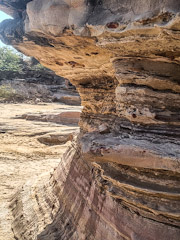
The canyon is in the district of Ulat village, which we did not visit. A fast-flowing river, in which our driver spotted a crocodile, has over the millennia formed the canyon. Like the Grand Canyon, but far smaller, its walls are horizontally striated. The striations vary in colour. Here and there, you can see roundish rock formations that look like huge mushrooms. Their stalks are also striated. Parts of the riverbed that are not submerged are rocky platforms with patterns of grooves resembling crazy paving. The striations result from the alternate layers of shale and sandstone combined with the effects of sea air (for more detail, see: https://zeezest.com/travel/kaliya-dhrow-in-kutch-is-a-geological-wonder-to-behold-zee-zest-1054).
We visited the canyon on a Wednesday morning during the school term, so the place was not crowded. I have been told that on Weekends and during school holidays, large crowds of people come to view the interesting geological formations. We saw less than twenty other tourists, mostly Indian. Many were standing precariously on the rocks close to the water, posing for pictures probably destined to appear on Facebook and/or Instagram. I took many photographs of this lovely place.
I am extremely grateful that my wife’s cousin, who lives in Mandvi, arranged for us to visit the canyon, a geological jewel hidden deep in the Kutch desert. Although far off the ‘beaten track’, it is a highly worthwhile destination. A word of advice: the ride in the jeep is not a good idea for those with unhealthy backs!
DURING MY TWENTIES AND THIRTIES, I enjoyed slow moving, European ‘art house’ movies, in which little or nothing happened. Good examples of these included “Claire’s Knee” and “Kings of the Road”.
Poster for the film PATHAAN
After marrying my Indian wife in 1993, my tastes in film changed radically. She introduced me to Bollywood films. These visually dazzling productions are brilliant. Most of them incorporate moral and political messages; romance; religion; adventure; tragedy; comedy; music and song; dancing; daredevil acts; and much more. As they are designed to be seen all over India by people who speak a wide variety of differing languages, they are produced in such a way that they can be followed by audiences who cannot understand even one word of Hindustani. In fact, because of this and their visual appeal, they are popular all over the world.
Recently, we saw the new Bollywood film PATHAAN in Bhuj. It is one of the most exciting action films I have ever seen; it makes James Bond films seem static in comparison. The audience in the Surmandir cinema screamed and yelled at every possible moment, especially when the principal male star Shah Rukh Khan appeared on the screen. Both the film and the audience were fun to experience. The film was so gripping that we left the cinema feeling exhausted.
WHILE WANDERING THROUGH the large rambling bazaar in Mandvi, which is in the former Kingdom of Kutch (now part of Gujarat), we came across a workshop where bandhani textiles for clothing were being made.
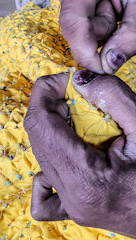
Making a knot for bandhani dyeing
Bandhani is a method of producing patterned dyed silks and cotton. Put simply, a piece of cloth, already dyed one colour or not at all, is prepared as follows. Parts of the cloth are gathered up to form tight bundles fastened by fine threads. The bundles, which look like small pimples are distributed to form patterns. The tied cloth is then dyed. The dye reaches all parts of the cloth except those enclosed in the tiny bundles. When the bundles are untied the patches of the cloth that had been shielded from the dye remain the original colour. This process can be repeated several times using different dyes to create an interesting pattern.
The shop the looked at, Khatri Ibrahim Siddik & Co, is the oldest bandhani workshop in Mandvi. It has been run by the same family for fifteen generations .
During our recent visit (January 2023), we have come across several businesses that have passed from generation to generation. In Bhuj, the Shivam Daining (sic) restaurant is run by chefs whose great grandfathers, grandfathers, and fathers, have all been cooks to the Maharaos of Kutch. Likewise, there is a bakery in Bhuj with an ancient wood fired stove. This business has passed through at least four generations. Nearby, there is a knife, scissors, and sword maker, who is the fourth or fifth generation of a family, which has been in this trade for over more than a century.
I am certain that there are plenty more examples of families in Kutch specialising in skills that have been passed from one generation to the next. I wonder whether these skills are in the genes, or simply taught by one generation to the next, and so on.
THE GUJARAT CLUB, the oldest club in Ahmedabad, stands opposite the Ahmed Shah Masjid, the oldest mosque in the city. The club was founded in 1888 by Rao Bahadur Nagarji Desai. With over 1000 members, the much used clubhouse is in an unmodernised condition. Located next to the recently constructed (2020) City Civil and Session’s Court, the Club is a ‘hang-out” and informal meeting place for many senior advocates. In former times, the place was frequented by Ahmedabad’s wealthy Mill owners and high ranking Britishers. It was the first Indian club that admitted Indians as well as Europeans from the moment it was established.
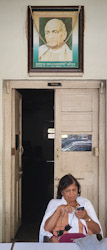
Vallabhai Patel above a doorway at the Gujarat Club
The Club is located close to a house where Sardar Vallabhai Patel (1875-1950) lived. Patel frequented the Club regularly and played bridge there. It was where he first met Mahatma Gandhi in 1916. A tree marks the spot where they chatted.
After having passed the Bar Examination at London’s Middle Temple, where my wife achieved the same thing many years later, Patel came to live in Ahmedabad. The first meeting with Gandhi at the Club marked the start of Patel’s attachment to the Mahatma’s cause. Years later, Patel played a key role in uniting the former Princely States with what had been British India to form the India of today. An important freedom fighter for Indian independence, he became a senior member of the country’s government after 1947. A close associate of Gandhi, the two men chose to differ on how to deal with certain issues, for example the creation of Pakistan.
We sat under the verandah of the Gujarat Club and enjoyed cups of tea. From where we sat we could see a large rectangular open space, which was being used as a car park. The ground was marked out with tennis court lines and a couple of nets were stretched between rows of parked cars.
We began conversing with an advocate at the next table. When he learned that my wife was a barrister, he kindly offered to show us around the neighbouring court building.
We spent well over an hour sitting in various court rooms. Most of these had two layers of glass screens, separating the judges and the court officials from the rest of the room: a covid precaution.
Several things impressed my wife as being different from what happens in British courtrooms. First, the plaintiffs are permitted to speak directly with the judges, rather than via intermediaries such as barristers. Secondly, the judges seemed to be handed the papers of a case at the moment it was about to be heard, rather than in advance. Thirdly, each judge was able to switch seamlessly between fluent Gujarati, Hindustani, and English. Also, they made decisions far more rapidly than their counterparts in the UK.
After our fascinating visit to the court house, our host and a charming advocate from his firm invited us to return to the court and the Club to celebrate Republic Day on the following morning, the 26th of January 2023. We accepted, and I will describe the events in another essay.
Our visit to the vibrant Gujarat Club proved far more exciting than we had anticipated. What was once a place where mill owners rubbed shoulders with British officers and officials, where Patel first met Gandhi, is now a congenial place where advocates meet, converse, read, and relax.
ON TUESDAY THE 24th of January 2023, we arrived in the city of Ahmedabad in the Indian State of Gujarat. That evening, we visited a friend who had been the curator of a building in Ahmedabad, which had been designed by the architect Le Corbusier. Our friend was pleased to see us but was upset because a close friend had died that morning at the age of 95. That friend had been a disciple collaborator of Le Corbusier.
Our friend’s friend was Balkrishna Vithaldas Doshi, who was born in Pune in 1927. He worked with Le Corbusier in Paris between 1951 and 1954. He returned to Ahmedabad to supervise Le Corbusier’s architectural projects in that city. In 1955, Doshi established his own studio in Ahmedabad, and was working there until the day before he died.
Clearly influenced by Le Corbusier and Louis Kahn, with whom he designed the campus of the Indian Institute of Management (Ahmedabad), his (some might say Brutalist) architecture embodies the ideals of Le Corbusier in a much more user-friendly form than that which his mentor produced.
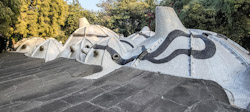
Amdavad ni Gufa
Next door to CEPT University in Ahmedabad much of which was designed by Doshi, there stands Doshi’s most unusual edifice, the Amdavad ni Gufa (the Ahmedabad Cave), which was completed by 1990. Its is difficult to describe this structure, but I will try. Covered in a mosaic of black and white ceramic tiling, it resembles an enormous caterpillar partially submerged in the ground. It is a giant caterpillar punctuated by bulbosities of various sizes, some of which have hemispherical windows at the end of short stalks that project from the dome-like bulbosities.
Steps descend to the two entrances of the Gufa. Originally designed as an art gallery, its irregular shape and wavy floor deemed it unsuitable for its intended purpose. Within the Gufa, the ceiling is supported by irregularly shaped columns that resemble stalactites with have joined with stalagmites beneath them. The strange space, which was too odd to be used as a gallery, is now decorated with sculptures and murals painted by the celebrated Indian artist MF Husain (1915-2011).
The Gufa is one of the ‘must-see’ sights of Ahmedabad. With the recent demise of Doshi and the earlier death of Husain, the Gufa makes a fitting memorial to these two great creators.
VINCENZO MARIA CORONELLI (1650-1718) who was most likely born in Venice (Italy) was not only a Franciscan friar but also a cartographer. Recently, I spotted one of his maps hanging in a frame in a friend’s home. It is a beautiful work of art, bearing the title (translated from French): “Maritime route from Brest to Siam and from Siam to Brest”. It was made between 1685 and 1686, based on information provided to Coronelli by six Jesuit priests sent out to the Indies by the King of France. Coronelli, based in The Republic of Venice, drew the map.
I was particularly interested to see what of modern India is represented on the map. On the coast of “Guzararatte ou Cambaje” (i.e. Gujarat or Cambay), the Island of Diu, then a Portuguese settlement, is marked, as are “Surate” (Surat) and “Bombaim” and “Chaul” (also Portuguese settlements). Further south, Goa is marked, and yet further south along the west coast, we can see Calicut and Cochin. On the east coast of India, we can see “Fort S. Thomé” and “Mahapur”, being old names for a place immediately south of Chennai and Mahabalipuram respectively.
The map becomes more interesting when you look at the “Bouches du Gange” (the mouths of the Ganges). Coronelli draws a complex collection of island’s that depict the Ganges delta, but where one would expect to find Calcutta (Kolkata) on modern maps, there is only a small inset town plan of a place called “Louvo”. This is not a place in India but in modern Thailand (once known as ‘Siam’): its modern name is Lopburi.
The reason that Calcutta is not marked on Coronelli’s map is simple: the place with that name did not exist when the Jesuit priests reported back to Coronelli. Had they made their survey only a little later, they would have been able to report its existence because in August 1686 Job Charnock (c1630-c1692/3) established a trading post (‘factory’) on the River Hooghly, and that became known as Calcutta. I have visited his grave and mausoleum in central Kolkata.
THE PAINTER MAHESH BALIGA was born in the south Indian state of Karnataka in 1982. He studied painting at The Chamarajendra Academy of Visual Arts (CAVA) in Mysore, and then received a postgraduate qualification at the prestigious Faculty of Fine Arts, MSU, in Baroda (Vadodara in Gujarat). He has taught at various art schools in India and exhibited in several countries including India. Currently, he lives and works in Baroda. Between the 12th of April 2022 and the 28th of May 2022, some of his works are being exhibited in a solo exhibition, “Drawn to Remember”, at the David Zwirner Gallery in Grafton Street (in London’s West End).
The paintings on display were created using casein tempera. This kind of paint has a glue-like consistency, but it can be thinned with water. According to Wikipedia, artists like this kind of paint because:
“… unlike gouache, it dries to an even consistency, making it ideal for murals. Also, it can visually resemble oil painting more than most other water-based paints …”
At first glance, it is difficult to discern whether the Baliga’s paintings on display at Zwirner’s resemble water colours or oil paintings; some of them seem to look halfway between the two mediums. All of them, except one, are quite small canvases and without exception they are all attractive. The subject matter depicted in the works is varied, from studies of plants and animals to everyday scenes (often with depictions of Indian life) to the slightly unusual. An example of the latter is in the only large canvas of the show in which there is an image of a man with sticky plasters over his left eye. Another odd subject shows a man with flowers growing out of his shirt. This is appropriately named “Flowering Self”.
The small size of most of the paintings, which the artist described as ‘lap-sized’, has a reason. Many of them were executed on the journeys the artist made when commuting to and from Surat (in the south of Gujarat), where he held a teaching position for a while. Though they are not large paintings, each one of them provides a window on the artist’s experiences and and his take on them. Although the paintings are far from mundane, they are not over-dramatic or excessively visually challenging. The exhibition is well worth seeing. I would be happy to hang any one of the works I saw at his exhibition on my walls at home.
IN CENTRAL AHMEDABAD, a large city in India’s state of Gujarat, there is a curious café called Lucky. This popular eatery is not unusual because it does not serve coffee but because its tables and chairs are placed between Moslem graves. Lucky’s is sited on an old Moslem graveyard, but this does not put off a steady flow of customers from enjoying a wide variety of vegetarian snacks in this eatery. Closer to home, near the south side of London’s Lambeth Bridge, there is another café sited on a former graveyard. Unlike Lucky in Ahmedabad, which is housed in an architecturally unremarkable building, the café in Lambeth, The Garden Museum Café, is a marvellous example of contemporary architecture.
Café at The Garden Museum in London
The café, completed in 2018, is at the east end of the Church of St Marys, Lambeth, which now serves as the home of The Garden Museum. The church stands next to the main Tudor entrance of Lambeth Palace. The tower was built in about 1378. The rest of the church contains structural elements that were built in later eras. Appropriately for a museum dedicated to gardening history, the repurposed Church of St Mary’s is the burial place of the famous gardener and plant collector, John Tradescant the Elder (c1570s-1638). It is also the final resting place of Captain William Bligh (1754-1817) of The Bounty Mutiny (1789) fame. This famous mariner owned a house in Lambeth. Customers of the café do not sit on the graves of these two well-known persons, but on gravestones that, unlike the graves at Lucky in Ahmedabad which are raised above the ground, are level with the rest of the café’s floor.
The graves at Lucky in Ahmedabad are coffin shaped and probably contain the remains of the deceased. I am not sure whether there are human remains beneath the grave slabs in the floor of the café in Lambeth. A young waiter, whom I asked, was concerned to reassure me that he believed that there are no skeletons beneath the gravestones upon which customers walk and sit. I wonder whether this is really the case.
The Garden Museum was founded in 1977 by Rosemary and John Nicholson in order to preserve the church, which was due for demolition (https://gardenmuseum.org.uk/the-museum/history/). In 2015, the museum was closed for a year and a half whilst it was being redeveloped. Part of the improvements made was the construction of an extension at the eastern end of the retired church. The new construction, designed by Christopher Bradley-Hole and Dan Pearson, includes the café and other structures that together surround a new courtyard that contains a lovely garden, The Sackler Garden designed by Dan Pearson. It contains several tombs including that of the Tradescant family and of Captain Bligh.
The café borders the western side of the courtyard. Its mainly glass walls provide good views of the garden, the buildings across the river and the leafy remains of the churchyard west of the café. Where there is no glass, the walls are covered with overlapping brown coloured metal panels. Serving great coffee and both snacks and meals, the legs of the chairs and tables rest on the gravestones that form part of the floor.
Compared with Lucky, which is in a very busy part of Ahmedabad, the Garden Museum café, although close to a busy main road, is far more peaceful. However, both are delightful places to enjoy refreshments.




 yamey
yamey 