In the footsteps of the ancients

OSTIA ANTICA, THE PORT of Ancient Rome is constructed mainly with baked clay bricks. When I visited it some years ago, I remember thinking that it looked like a recently built place because of the brickwork that looked so contemporary. Ostia dates back no further than the 4th century BC. The port at Lothal in Gujarat (western India) thrived long before Ostia, probably between 2500 and 1900 BC, but like the Roman port, the remains of Lothal are mainly (sun baked) clay bricks, giving them a far from ancient appearance. Lothal, excavated in the 1950s, was a port inhabited by people of the Bronze Age Harrapan (or Indus Valley) civilisation that thrived between about 3300 to 1300 BC.

We drove to Lothal from Ahmedabad along a good highway that runs through flat landscape with numerous tidy looking factories. We arrived after about 75 minutes of steady driving. The archaeological site, maintained by the Archaeological Survey of India (ASI), is in the middle of very flat fertile agricultural land far from the nearest village. Unlike most other ASI sites that charge an entrance fee, that at Lothal is the same for both foreigners, who are usually charged a high fee and Indians. Each ticket cost only 5 Rupees.

The ticket gives access to a small but well laid out museum, whose exhibitsand information panels demonstrate how Lothal fits into current understanding of Harappan civilisation and what life might have been like in the ancient port. A fairly simplistic video was shown. It concentrated mainly on Mohenjo-Daro, a large Harappan site now in Pakistan. The evidence dug up at Lothal and other Harappan sites shows that the civilisation was both technically and artistically sophisticated. On display, were systems of weights and ingeniously crafted fine jewellery, both examples of products that could only have been produced by people of great intellectual ability.

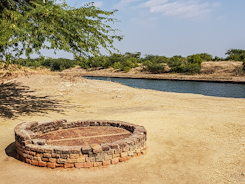
The ruins are, as already mentioned, mostly made of brick. A low mound, known as the ‘Acropolis’, is covered with structures that might have been warehouses or residences of the upper echelons of Lothal. The mound overlooks what looks like a huge rectangular brick lined swimming pool, now filled with rainwater. When Lothal was thriving, this dock was connected to the nearby sea (now the Gulf of Khambat) by a channel along which vessels could sail. Over the millennia, the coastline has shifted and what was once Lothal is separated from the sea, far away from it. The ASI keep the dock filled with rainwater to show what the dock must have looked like in its heyday.

Various other structures outlined by brickwork, including circular wellheads, can be visited. These include the former bead factory, a cemetery (where all the skeletons discovered were from people who died aged 30 or less; maybe older people were cremated), and a ‘lower town’. What little that has been excavated is well looked after, but without the explanations provided in the museum the casual visitor would have no idea of what he or she was seeing or how ancient these remains are. With a little background information it was thrilling to walk in the footsteps of townsfolk and traders who lived and thrived so many, many years before us.

We met only three other visitors while wandering around the ruins. They were all from Bangalore. They were touring Gujarat but lamented the fact that most signs are only in Gujarati script. In Karnataka, where they live and where we visit often, signs are often not only in the local script but also in English and/or Hindi.

There are no refreshments available at the Lothal site. An employee suggested that we might get tea in the modern village of Lothal, a few kilometres away. Our driver had his doubts about this and so did I when we drove along the winding dusty road through the small village. There were no shops or stalls to be found.

We parked outside a pair of wrought iron gates separating two houses. A lady appeared in the door of one of them, and my wife asked (in Gujarati) whether tea was available in the village. The lady said she would make some for us.

We followed her through the gates and into a long wide alley lined with houses. Two ladies were embroidering gold thread, jewels, and sequins onto long silk saris spread out along the incredibly clean concrete floor of the alley. Other ladies were sitting around.

Our hostess brought us each a plastic chair from her home. We sat chatting with the ladies while we awaited our tea. The alley was lined with houses that a farmer had built for his sons. Each of the ladies was one of his daughters in law.

Our hostess arrived with a large metal cup filled with tea and two china saucers. Each of us was handed a saucer, which she filled with hot tea. We slurped the tea from the saucers as is the custom when sharing tea in Gujarat (often one person drinks from a cup and the other who is sharing it drinks from the saucer: a system known as ‘cutting chai’).

The ladies doing the embroidery take about a day to decorate a whole sari with a complex design. The silk is sent to Lothal from Surat, where the decorated saris are later sold. An old lady with barely one tooth in her smile, the mother in law of the women we were talking with, joined us. This wizened relative asked if it was true that a man’s haircut would cost 1000 rupees in the USA, as she had seen on YouTube. We told her that it would cost at least that. She was then told to go back to rest on her charpoy in the nearby farmyard.

We asked where the menfolk were. They answered: “In the fields. What else could they be doing?”

Our hostess, who seemed to be the brightest of the very hospitable women, took us to see the cow whose milk had been used to make our tea. We thsnked her calf for sharing his mothers milk. She also proudly showed us the two fine horses the family owned.

Just before we left, my wife asked our hostess whether we could leave a small gift for her children. She said that they were at school and there was no need for a gift. She told us that she was very keen that they should do well at school, and hoped that they would be able to study in the USA, because she said: “There is no future for them, nothing here anymore.”

As we drove away from our new acquaintances through the village, people waved to us. We waved at three old men on a bench. They waved back. We felt that we had received a warm welcome at ground level in Gujarat.

High flyers

Today, 7th January 2020, we bought tickets for onwards bus journeys at Ahmedabad’s Geetamandir bus station. The young man at the ticket counter was an excellent salesman.

We stopped at the Raipur Gate, one of the several gates on the now demolished city wall. Only the gates remain as mementos of this wall.

Next to the gate, there were several spinning kite cord winders. They were preparing the cords that would be attached to the kites flown to celebrate the festival of Uttarayan (end of winter), which is celebrated all over Gujarat.

White thread is fed through a basin of coloured dye and then coated with finely ground glass and glue before being wound onto large spinning bobbins. The thread, when dried, is wound onto smaller bobbins that are sold to kite flyers. The ground glass is added to the thread so that kite flyers can use their kites to cut through the strings of other kites while they are airborne. The men making the threads were not Gujaratis, but from outside the state, from Bihar and UP, for example.

Ahmedabad now hosts an annual International Kite Festival.

The kites, made mostly of paper, are sold along a street leading away from the Raipur Gate. Kite flyers need to buy their kites and reels of thread (to attach to them) separately. We spotted numerous small stalls selling adhesive tape. One of the vendors of these explained that pne wraps this tape around fingers to stop them being injured by the very abrasive glass coated kite threads. Masks were also on sale. These are worn during the kite festival.

When we asked someone where we could watch the kites being flown, we were told: “In the air, up in the sky”. On further questioning, we were told, as if we were idiots, that the kites can be seen flying in the heavens.

Some years ago we visited Ahmedabad in late March. Even so long after Uttarayan, the branches of trees were filled with the remains of kites that had been caught in them.

BUS TO MOUNT ABU

WE SPENT MUCH OF NEW YEAR’S 7 Its driver was a friend of our driver. They were pleased to meet and wanted to chat. The other driver suggested to ours that he drove alongside ours so that he could chat with our driver. This did not happen but I liked the idea. Locating which bus we were to travel on proved a bit hair raising because everyone we asked suggested a different part of the bus station from which our bus might depart.

Much of the first half of the bus journey involved travelling northwards through flat cultivated terrain liberally sprinkles with small factories and large villages. We had a ten minute stop at Himatnagar, a small busy city in northern Gujarat.

Beyond Idar, the road began climbing out of the plain. We had a 30 minute break in Ambaji, an important temple town on the Gujarat side of the border of Rajasthan, which we entered immediately after lraving the town.

After Ambaji, our road climbed steadily and with increasingly tight bends through a mountainous landscape with plenty of trees. I was glad we were on a bus rather than a smaller vehicle like a car or jeep because many of these were driven as if their drivers had a suicidal tendency.

After about seven hours we arrived at the ramshackle, seemingly abandoned bus station at Mount Abu. There have been settlements in this area since time immemorial. It is mentioned in ancient Hindu texts, the Puranas. In the 19th century is was the summer capital of the Rajputana State. Many of the Rajput royalty built summer palaces in Mount Abu.

Our hotel is close to the still used polo ground. A beautiful late Victorian polo pavilion built in 1894 overlooks the vast polo playing field and is now used as a library.

The temperature at Mount Abu, which is about 4000 feet above sea level, dropped dramatically as the sun set. The air became icy cold and we were forced to purchase warm jackets. These are sold at stalls at the so-called Nepali Market, which is also called the ‘Tibetan Market’. Nepali or Tibetan, whichever it is, is situated amongst trees to which are attached strings of colourful Buddhist prayer flags such as we have seen fluttering in Darjeeling and Sikkim.

We dined at a simple halal restaurant. My wife asked for a soup listed on the menu. At first, the restaurant owner did not seem so keen on serving it. After a while, he said reluctantly : “If you really want it, I suppose I will have to make it for you”

Familiarity does not always breed contempt

FAMILIARITY BREEDS … CONTENTMENT. We have just landed in Ahmedabad. It is our third visit to this city in Gujarat within less than two years. We received a warm welcome from the staff at the small hotel where we have stayed twice before.

After settling into our room, we ate a good meal of Mughlai food at the Food Inn, which is opposite the 16th century Sidi Sayeed Mosque. Then, we travelled to the Gita Mandir bus station, where a very helpful booking clerk arranged tickets for various intercity trips we are planning to make soon.

The noisy, bustling traffic in Ahmedabad is typical of the city’s general feeling of vibrancy and exciting vitality. So bad was the congestion on the roads that our autorickshaw driver suggested that we abandoned our plans to visit the Jumma Masjid near the Manek Chowk. He explained that being the 30th of December, everyone was in a holiday mood and out on the streets spending money.

We disembarked at Khwaja Bazaar, a frenetic market place between the three arched Teen Darwaza and the Badra Fort, where the early rulers of Ahmedabad had their headquarters. We strolled along a street leading away from the market, admiring occasional old looking buildings along it. I imagine that the oldest of these is about a hundred or so years old.

Eventually, we reached a post office just across the road from an ageing Parsi ‘dharamshala’. Apart from a vigilant watchman, who looked at us suspiciously, the place looked rather dead. We took tea at a pavement stall. Typical of the kindness of people in this city, the ‘chaiwallah’ specially prepared tea without sugar for us instead of the very sweet beverage that is usually served. We sat on a bench, sipping tea and watching the world go by. It felt good to be back in Ahmedabad, a city, where kite flying is a popular pursuit. A city that is becoming familiar to us and makes us feel content.

First published on http://www.gujarat-travels.com

One book, two titles

COVER GUJ a blog

The prices of books varies greatly from one country to another. In India, many books cost far less than their equivalents sold, for example, in Europe. Readers in India buying books that have to be imported from ‘the West’ often face high charges due to delivery from afar. I have tried to address this problem with a couple of books, which I have written. My solution is outlined after the following introduction to one of my books about India:

My wife, who is a fluent Gujarati speaker, was born in Bombay. Her father’s family originated in Gujarat and her mother’s in the former Princely State of Kutch, which became part of the State of Gujarat after India became independent.

Both my wife and I have visited India regularly from our home in the UK, yet neither of us had ever been to Gujarat until early in 2018. We felt that it was high time that we visited the parts of India connected with her heritage. I have published a book that describes that first trip. We did not visit everywhere in Gujarat, but the places we saw, our experiences, and the people we met ranging from autorickshaw drivers to former royalty, and our experiences, are described my book. All of these have made us want to visit the region again and to explore it further.

I have long been fascinated with tiny enclaves. I have visited places such as Andorra, San Marino, Mahe (in Kerala), Pondicherry, and Llivia (a part of Spain surrounded by France). Gujarat contains two such places, the former Portuguese colonies of Daman and Diu, territories surrounded by Gujarat but separated from it by borders. We included them on our journey and discovered that though small in area, they are filled with interest.

Gujarat was the birthplace of many celebrated persons, including Narsinh Mehta (poet), Dayanand Saraswati (philosopher), Shyamji Krishnavarma (Sanskrit scholar and freedom fighter), and politicians such as: Mahatma Gandhi, Dadabhai Naoroji, Vallabhai Patel, Morarji Desai, and Narendra Modi. Yet, undeservedly, it is a part of India less frequented by tourists than many other places in India (e.g. Goa, Kerala, Rajasthan, and the ‘Golden Triangle’). I hope that what you will read in this travelogue will whet your appetite and encourage you to make plans to visit Gujarat.

The idea of my book is to unwrap the attractions of Gujarat to make them better known to those who have not yet visited this region of India.

What I have written above is to introduce you to a book I published in 2018 with the title “TRAVELS THROUGH GUJARAT, DAMAN, and DIU”. This book is available from on-line booksellers such as lulu.com, Amazon, and bookdepository.com. When you buy my books from these suppliers, they are produced in Europe or the USA and then shipped to the buyer. If they are bought by people living in India, their prices become very large (in comparison with average Indian book costs) because of additional postal charges. For example, TRAVELS THROUGH GUJARAT, DAMAN, and DIU can cost up to 1500 Indian Rupees (‘INR’) and another book, which I have recently published, “IDEAS, BOMBS, and BULLETS” can cost purchasers in India over 800 INR.

To make my books more affordable in India and priced at a rate closer to comparably sized books in the Indian market, I have re-published the two books mentioned above with an Indian print on demand outfit called pothi.com. The travel book has been revised and I hope improved. I have renamed it “GUJARAT UNWRAPPED”. My book about Indian patriots in early twentieth century London, “IDEAS, BOMBS, and BULLETS” retains its original name.

When ordered through pothi.com and delivered in India, GUJARAT UNWRAPPED is priced at 296 INR (plus minimal postage) and IDEAS, BOMBS, and BULLETS comes to 395 INR (plus minimal postage).

To order GUJARAT UNWRAPPED FROM POTHI.COM,

click: https://pothi.com/pothi/book/adam-yamey-gujarat-unwrapped

To order IDEAS, BOMBS, and BULLETS FROM POTHI.COM,

click: https://pothi.com/pothi/book/adam-yamey-ideas-bombs-and-bullets

IMPORTANT:

It is worth nothing that purchasers ordering the books from pothi.com BUT not having their books delivered in India, face huge postage charges.


Hooked on rugs

burke


I would never have thought that I would have enjoyed reading a book about rug-making cottage industry in Nova Scotia, but I have. Recently, a Canadian friend brought me a book that focusses on hooked rugs and their promotion by a lady called Lillian Burke (1879-1952), who was born in the USA.

Just in case you (like me before reading the book) have no idea what comprises a hooked rug, let me explain by quoting from Wikipedia: “Rug hooking is … where rugs are made by pulling loops of  yarn or fabric through a stiff woven base such as burlap, linen, or rug warp. The loops are pulled through the backing material by using a crotchet-type hook mounted in a handle (usually wood) for leverage.” 

Edward Langille’s book discusses in detail Lillian Burke’s significant involvement with the hooked rug manufacture carried out by housewives in small settlements in the remote Cape Breton district of Nova Scotia. Ms Burke, who was born in Washington DC, was  highly acccomplished in teaching, music, and art. During both world wars, she helped pioneer what is now known as ‘occupational therapy’. She was a highly-regarded teacher. It was this skill that brought her into contact with the family of Alexander Graham Bell, the scientist and inventor of telephony. The Bells employed Lilian Burke as a tutor for their offspring. She developed a lasting friendship with the extended family, who owned a country retreat in the region of Nova Scotia where hooked rug making was a prevalent occupation of the local housewives.

Langille describes how Ms Burke helped to develop what had been a local craft into a viable money-making venture. Using her highly developed artistic skills, she helped the housewives produce rugs with artistically sophisticated designs that made them appealing to fashionable interior decorators in the USA (mainly). 

Traditionally, the housewives of Cape Breton wove their rugs with scraps of  coloured material. Ms Burke designed the patterns and the housewives did the ‘hooking’. She encouraged them to begin using locally-produced wool which they had dyed. One thing that particularly interested me was that Ms Burke showed the ladies how to use knots and paper masking to dye a skein of wool in varying colours, so that a single thread of wool would vary in colour along its length. This technique is used in Patan in Gujarat (Western India) to produce the silk threads with patterns of varying colour, which are used to produce the highly valuable woven Patola textiles. I would be curious to know whether Ms Burke had been aware of this century’s old method of dyeing.

Langille’s book is a remarkable, well-written, and readable biography of a remarkable woman, who is probably hardly known outside of Nova Scotia and beyond a few enthusiasts of hooked rug making. She deserves to be better known, especially in the light of what Langille’s book reveals about her dedication to the development of rehabilitation and occupational therapy. Professor Langille’s detailed and carefully researched book may well help give Lilian Burke the wider recognition she deserves.

REVIEW BY AUTHOR OF “IDEAS, BOMBS, and BULLETS”, about Indian patriots in London between 1905 and 1910


ISBN: 9781926448404

Breathing the past

CHARLIE


I always enjoy visiting places with interesting historical associations. For example, it gave me a thrill to enter the room in a house in Porbandar (Gujarat, India) where Mahatma Gandhi was born, and to stand in Sarajevo at the very spot where Gavrilo Princip shot the Austrian Archduke and his wife in 1914.

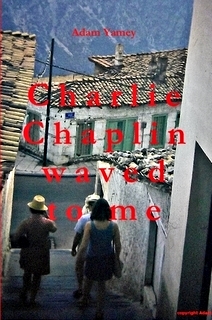
I hope that the following excerpt from my book “Charlie Chaplin waved to me” can begin to explain my fascination for visiting places with great historical significance either for me or the world in general:

“To reach Oxford Circus, the starting point of our trips to the West End,
we used to take the Northern Line of the Underground to Tottenham
Court Station, and change there to the Central Line. In the 1960s, there
were signs that directed the passengers from the Northern line to the
Central, but these involved using a number of staircases and walking
quite a distance. My mother ignored the signs, and headed straight for a
passageway at one end of the southbound Northern Line platform. This
was clearly labelled ‘No Entry’. My mother knew better than to obey
this because she knew that it was a shortcut to the Central Line
platform. Today, it is the recommended route. Whenever I walk along
this once ‘forbidden’ passageway, I wonder whether amongst the
billions of molecules that make up the air in that circular passage there
is maybe at least one molecule of the carbon dioxide or nitrogen that
was once breathed out of my late mother’s lungs. And, do the echoes of
her footsteps still reverberate even ever so faintly in this busy
passageway?“

It is the thought that I might be sharing even one molecule of the air breathed by the persons who gave a place the historic interest for me that gives me an irrational thrill. It is for this reason that I feel unable to visit places like Auschwitz and Dachau. I do not wish to breathe the air that might possibly have been around when the Nazis and their unfortunate victims occupied such places. 

This might seem a bit ridiculous as the chances of breathing the same molecules of air that say my mother or the Archduke of Austria inspired are extremely miniscule, but what is the joy of life if not full of quirkiness.


“Charlie Chaplin waved to me” by Adam Yamey is available from:

Amazon, Lulu.com, and bookdepository.com, as well as on Kindle

Better on a camel

While travelling through Gujarat in western India, I have seen many camels (? dromedaries) working as beasts of burden. They are well suited to the arid semi desert climate of Gujarat. The camels remind me of airline jokes I learnt in my childhood. Each joke gives another meaning to an airline’s name or acronym.

BEA was British European Airways. The joke version was Big Empty Aeroplanes;

TAP, Portuguese Airlines became Take Another Plane;

The Greek company Olympic became Only Like Your Money Pay In Cash;

EL AL, the airline of Israel, became Every Landing Always Late.

And this brings me to humped beasts of burden.

BOAC, which was British Overseas Airways Corporation, became Better On A Camel.

Postscript

When the petroleum company ESSO first became established in India, workers in Indian companies worked half day on Saturdays. Esso workers got a whole day off on Saturdays. So, ESSO became known as Ever Saturday Sunday Off.

Mashed potatoes

Some restaurants in India serve both veg (vegetarian) and non-veg (meat, fish, eggs) food. Recently, my wife and I were sitting near to a young lady in a very good Italian restaurant in Vadodara in Gujarat.

Our young neighbour is a vegetarian. She ordered a veg pasta and asked the waiter if she could have a portion of mashed potatoes. I know that pasta and mashed potatoes are an unusual combination, but that is what she wanted.

The waiter told her that she could not order mashed potatoes with a veg pasta. Puréed potatoes, which are pure veg, could only be served with a non-veg dish.

We overheard the waiter telling this to our neighbour. My wife, who always tries to be helpful, interrupted the waiter and told him to bring a small dish of mashed potatoes with the pasta. Eventually, and somewhat reluctantly, the waiter did as asked. Our neighbour was so happy to receive the mash with her pasta that she got up and gave my wife an affectionate hug.

I am not a vegetarian.

Although I have met numerous pure vegetarians during the 25 years I have been visiting India, I still find it hard to believe that there are so many people, who have never tasted meat, eggs, or fish.