A socialist and a vegetarian by the seashore on the Isle of Wight

A DISTINCTIVE BUILDING stands opposite the Art Deco Winter Garden (built by 1936) high above the seashore of Ventnor on the south side of the Isle of Wight. With a tower overlooking the sea, the edifice facing the Art Deco structure was which was built in 1846 by the Reverend Richard John Shutte (1800-1860), who had once been a canon at St Paul’s Cathedral. It was named St Augustine Villa (see photograph below), and now houses a hotel and restaurant.

Several Russians opposed to the Imperial Romanov regime, including the writer Ivan Turgenev(1818-1883) visited Ventnor during the 19th century. Amongst these was Alexander Herzen (1812-1870), who was the ‘father’ of Russian Socialism’. In 1852, he and his family began living in England for several years. During this sojourn, he made some visits to the Isle of Wight. In September 1855, Herzen stayed in Augustine Villa, which he had rented. However, he was not alone as the commemorative plaque on the Villa notes. He stayed there with Malwida von Meysenbug (1816-1903).

Now, I had already heard of Herzen. I became familiar with his name when watching a trilogy of plays by Tom Stoppard about 19th century Russian Socialism. However, I had never come across Malwida von Meysenbug until I saw that plaque in Ventnor. A writer, she was born in Kassel (Germany) and was a friend of both Friedrich Nietzsche and Richard Wagner.  By the time that Herzen and Malwida had their holiday in Augustine Villa, she was living with Herzen’s family and helping to look after his children. Alexander’s wife Natalia had died in 1852, and he had hired Malwida to educate his children.

Malwida was much more than a mere governess as the UCL academic Sarah J Young explained in her excellent, highly informative article (http://sarahjyoung.com/site/2011/11/10/in-herzens-footsteps-a-visit-to-ventnor/). In this essay, Dr Young gives excerpts from Malwida’s published “Memoirs”. The following is particularly interesting:

“We spent happy days in beautiful Ventnor. In the evenings we were usually with the Pulszkys, who were spending the summer there. Therese’s mother, an educated and intelligent Viennese lady, had come to visit them, and this made for many a pleasant hour with her keen humor and wit. The Kossuths were also there, and he was much more pleasant in a more intimate setting than he had been at the formal gatherings in London. At the time, our thoughts were preoccupied by the war Russia had started with Turkey. Herzen, more so than the others, was very excited. He prophesied the Russian defeat and wished for it, since he believed it would lead to the downfall of autocracy.”

The Kossuths, were members of the family of the Hungarian revolutionary Louis Kossuth, whom Herzen was extremely excited to have met during his stay in Ventnor. Another exiled Hungarian revolutionary, Ferenc Pulszky (1814-1897) was also staying with his family in Ventnor at the same time as the Herzens and the Kossuths. Pulsky’s wife, Theresa, and Malwida spent time drawing together in Ventnor, and made several competent sketches of Ventnor and its surroundings,

Dr Young also quoted Herzen, who noted in his diaries that Malwida:

“… spent all her time in the water …”

From what Dr Young and others have discovered during their research, Malwida was out of the sea long enough to create works of art depicting the seaside resort.

Herzen liked Ventnor but had some reservations as he wrote in a letter (quoted from Dr Young’s article):

“For three days the weather has been like June – and I’m bathing recklessly in the sea. But before that there were four days of storms, rain and bitter cold … If it were not so boring, I would live here, but there are no resources at all. And getting to Ryde is expensive … “

Many years have passed since Herzen and Von Meysenbug holidayed in Ventnor. Slightly less time has elapsed since the future Mahatma Gandhi visited Ventnor in 1890 and 1891. According to one source (www.bonchurchvillage.co.uk/post/bonchurch-gandhi), Gandhi:

“… had wanted to study medicine but his father had objected, and his studies were in law.   He was a prominent member of the London Vegetarian Society, and that may have led to his staying at Shelton’s Vegetarian Hotel at 25 Madeira Road in Ventnor, in January 1890 and again in May 1891, on the second occasion addressing a Vegetarian meeting in Ventnor.”

In his autobiography, Gandhi wrote of the following experience in Ventnor:

“My cowardice was on a par with my reserve. It was customary in families like the one in which I was staying at Ventnor for the daughter of the landlady to take out guests for a walk. My landlady’s daughter took me one day to the lovely hills round Ventnor. I was no slow walker, but my companion walked even faster, dragging me after her and chattering away all the while. I responded to her chatter sometimes with a whispered ‘yes’ or ‘no’, or at the most ‘yes, how beautiful!’ She was flying like a bird whilst I was wondering when I should get back home. We thus reached the top of a hill. How to get down again was the question. In spite of her high-heeled boots this sprightly young lady of twenty-five darted down the hill like an arrow. I was shamefacedly struggling to get down. She stood at the foot smiling and cheering me and offering to come and drag me. How could I be so chicken hearted? With the greatest difficulty, and crawling at intervals, I somehow managed to scramble to the bottom. She loudly laughed ‘bravo’ and shamed me all the more, as well she might.”

I do not think that Gandhi made any other visits to Ventnor or elsewhere on the Isle of Wight.

Today, Ventnor is still delightful and although much has been modernised since the Victorian era, it still retains an almost unspoilt old-world charm. I fancy that were it possible for Herzen and Malwida and their revolutionary friends to return today, they would find much in Ventnor that they would easily recognise.

Seeing the plaque on Augustine Villa made me curious about Herzen’s stay in Ventnor and the identity of Malwida von Meysenbug. By reading up about it, I learned of other noteworthy visitors to the town, and as I did so my interest in Ventnor has increased considerably.

PS: a list of some more of the famous visitors to Ventnor can be found at /www.ventnortowncouncil.gov.uk/about-ventnor/famous-residents/
Seeing India through the eyes of a Londoner

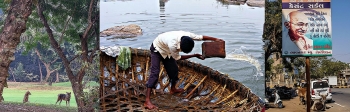
AMONGST THE 101 diverse topics in my book about travelling in India, you will find the following four: observing a padlock made by a company called Hitler; encountering jackals on a golf course; travelling in coracles on crocodile-infested waters; and having spectacles made by Gandhi’s optician. Since getting married in India in early 1994, I have made over fifty visits to the country during which I have spoken to many people and explored a multitude of places – both well-known and hardly known except to locals. My book, “The Hitler Lock & Other Tales of India”, contains a selection of my experiences in the country. The book aims to fulfil the idea of great Jean Molière (1622-1693), namely, “If you want to edify, you have to entertain.” I hope that you will find that I have achieved that.

You can purchase my book from Amazon (either as a paperback or a Kindle e-book) by clicking on the picture below:

In the Shadow of Freedom: Indians in Nazi Germany

Subhas Chandra Bose (1897-1945) is probably the most famous Indian to have spent time in Nazi Germany. Less well-known is Ayi Ganpat Tendulkar (1904-1975), who spent much longer in Germany than his illustrious compatriot. While studying in Paris, he married Sasha Alexandra Passini in about 1924. Soon after this, the marriage ended, and Tendulkar began studying in Berlin. He married one of his professor’s daughters – Eva Schubring. In 1933, after Hitler had come to power and Tendulkar had divorced again, he began a close relationship with the screenwriter Thea Von Harbou (1888-1954). Thea had just divorced her second husband, the great film director Fritz Lang (1890-1976) – one of my favourite film directors.  The relationship between Tendulkar and Von Harbou was very close, and had Hitler’s racial laws (against marriages between ‘Aryans’ and others) not been enacted, there is a good chance that they would have married.

Tendulkar returned to India just as WW2 broke out. There, he met and fell in love with Indumati Gunaji (died 2006). From the start, her family were against the relationship, and Indumati ran away from home to live with Tendulkar. Both were followers of Mahatma Gandhi – she more than he. Soon, Tendulkar, who had published anti-British articles in Berlin and elsewhere and was under suspicion because of his long stay in Germany, was imprisoned by the British. Meanwhile, Indumathi helped the villagers where she lived. Her life was not easy, and she missed Tendulkar greatly.

Eventually, Indumathi and her family, who were concerned about her and her romantic attachment to Tendulkar, became reconciled to some extent. Her father, a Gandhian, suggested that they ask Mahatma Gandhi what he thought of the relationship. His reactions to the situation were far from simple, as is revealed in the pages of “In the Shadow of Freedom” by Laxmi Tendulkar Dhaul – the daughter of Indumathi and Tendulkar.

Ms Dhaul’s well-researched book is a fascinating read. It covers the extraordinary lives and relationships between Tendulkar, Indumathi, and Thea Von Harbou, both in Germany and in India – before and after independence. Despite some unfortunate errors missed by the proofreader, this is an un-put-downable book. It opened my eyes to the interesting subject of Indians living in Nazi Germany as well as Gandhi’s rather intriguing views on the purpose of marriage.

Mahatma on Madeira

UNTIL AIR TRAVEL really ‘took off’, travelling between South Africa and London involved a long sea voyage, either via the Suez Canal or via the Atlantic Ocean. Boats carrying passengers up and down the Atlantic often called in at Funchal in Madeira. Aged three, I travelled with my parents to South Africa by sea. I have seen a photograph of me dressed in a toga made from a sheet from our cabin. I was taking part in a fancy dress party to celebrate crossing the Equator.

Many years before that – in 1906 – a barrister, Mohandas Karamchand Gandhi, travelled by ship from London to South Africa. He was on his way back to South Africa, having petitioned young Winston Churchill, then Under Secretary of State for the Colonies, against the Black Act – a law promoting racial segregation. Apparently, when his ship docked in Funchal, the future Mahatma received news that his efforts had been successful, but this news turned out to be false.

On the 5th of September 2019, a bust of Gandhi was unveiled on the seafront in Funchal, close to the harbour where liners dock today. The bust, which unusually shows Gandhi without his characteristic round lens spectacles, was sculpted by Ram Vanaji Sutar (born 1925 in Gondur, Maharashtra). Sutar is also the sculptor of the massive Statue of Unity, depicting Sardar Vallabhai Patel in Gujarat. Beneath the bust there is a quotation incorrectly attributed to Gandhi; it was actually said or written by the Dutch American pacifist AJ Muste (1885-1967). The artwork was unveiled by HE Miguel Albuquerque, President of the Regional Government of Madeira and HE Nandini Singla, Ambassador of India to Portugal. It celebrates the 150th anniversary of Gandhi’s birth.

I am grateful to our friend Claus for telling us about the bust, which is not easily visible despite its position so near the waterfront: it is partially hidden by plants.

Over the years, I have visited Porbandar where the Mahatma was born; Rajkot where he went to school; Bhavnagar where he went to college; West Kensington where he lodged when studying for the Bar; Mumbai where he attempted to work as a lawyer; and the Gujarat Club in Ahmedabad where he first met Vallabhai Patel, and also set up his ashrams. So seeing him on Funchal has added to my attempts to follow in his footsteps.

Three Indian men in London’s Bloomsbury

MAHATMA GANDHI IS commemorated by a statue in Tavistock Square in London’s Bloomsbury. He is probably the most famous of three Indians with statues in Bloomsbury. Crafted by the sculptor Fredda Brilliant and presented by the Indian High Commission, it was unveiled by Prime Minister Harold Wilson in 1967.

The next most famous Indian represented by a sculpture in Bloomsbury is a Nobel Prize winner, the celebrated writer and polymath from Kolkata (Calcutta), Rabimdranath Tagore (1861-1941). The memorial depicts Tagore’s head. It was created by the sculptor Shenda Armery, and unveiled by the Prince of Wales, now King Charles III, on Tagore’s 150th birth anniversary year in July 2011. The bust stands in Gordon Square, close to University College London, where Tagore studied law briefly. His face looks away from the college towards the southeast. – towards India, his homeland. On one side of the plinth, there are some words written in Bengali script. On another side, there is a translation of this brief text (by Tagore) in English:
“Thou hast made me endless, such is thy pleasure. This frail vessel thou emptiest again and again, and fillest it ever with fresher life. This little flute of a reed thou hast carried over hills and dales and hast breathed through it melodies eternally new. At the immortal touch of thy hands my little heart loses its limits in a great joy and gives birth to utterance ineffable. Thy infinite gifts come to me only on these very small hands of mine. Ages pass and still thou pourest and still there is room to fill.”
This is from Tagore’s collection of poems – “Gitanjali”, translated into English from Bengali by the author in 1913. It was this collection that led to Tagore being awarded the Nobel Prize for Literature in 1913. In 1915, King George V awarded him a knighthood, but following the Jallianwala Bagh massacre of 1919, he renounced his knighthood to express his horror at the murders that had been perpetrated on innocent Indians by British troops in the Punjab.

Thiruvalluvar

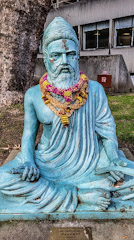
Call me ignorant but I had never heard of Thiruvalluvar, whose bust stands in a garden next to the School of Oriental and African Studies in Bloomsbury. According to a plaque next to the bust, this man was author of “Thirukkural”, which was a classic of Tamil philosophy and ethics. The bust was donated by the Governent of Tamil Nadu in 1996, and unveiled by the then Indian High Commissioner Dr ML Singhvi. Celebrated as he is in Tamil Nadu, little is known about his life. It is possible that he was born or lived in Mylapore (now a district of Chennai) in the south of India. According to Wikipedia:
“His work Tirukkuṟaḷ has been dated variously from 300 BCE to about the sixth century CE.”
As for his great work “Thirukkural”, the online version of Encyclopaedia Britannica remarked:
“…Tirukkural (“Sacred Couplets”), considered a masterpiece of human thought, compared in India and abroad to the Bible, John Milton’s Paradise Lost, and the works of Plato.”

I have described monuments to three notable men from India, but omitted one woman, whose memorial is close to those already described. The WW2 heroine Noor Inayat Khan (1914-1944) is commemorated by a bust, which, surprisingly, I have never noticed, in Gordon Square. Sculpted by Karen Newman, it was placed in the square in 2012. This artist also sculpted a bust of Violette Szabo (1921-1945), which is on the embankment of the Thames near Lambeth Palace. Both Noor and Violette worked for the British SOE, and perished in Nazi concentration camps.
Once the epicentre of the British Empire, it is not at all surprising that one comes across memorials to notable Indians whilst wandering about in London and other places in the UK.

Meeting Mahatma Gandhi in 2023

INDIA BECAME A REPUBLIC on the 26th of January 1948. Every year since then the 26th of January has been a public holiday known as Republic Day. On the 25th of January 2023, we met a senior advocate sitting in the Gujarat Club, which is next door to Ahmedabad’s Civil & Sessions Court. After showing us around the court building, he invited us to join him and his colleagues for the next day’s celebration.

The Republic Day celebrations began in the garden of the Court building at 9 am. A few soldiers, some of them armed with automatic rifles, arranged the flag raising. At 9 o clock, the Indian flag was unfurled by one of the senior judges, wearing a colourful pugree on her head, in front of a large group of senior advocates and some of the court’s staff. Many of the female advocates were attractively dressed in saris decorated with the colours of the Indian flag (green, saffron, and white). One of the ladies told us that 25 of these had been specially ordered from Agra.

When the flag was unfurled at the top of the flagpole, everyone sung the national anthem,”Jana Gana Mana”. Then everyone began taking photographs of one another. After this, we moved en-masse from the court garden to the compound of the Gujarat Club, where Mahatma Gandhi met Vallabhai Patel for the first time.

You can imagine my astonishment when I saw an elderly man who looked just like Mahatma Gandhi, both in physiognomy and in his manner of dressing. Holding a wooden staff and dressed in a white dhoti, sandals, and a shawl, he was a highly credible Gandhi lookalike.

Residing in the USA, this Gandhi impersonator has attended many Indian patriotic ceremonies. To date, he has appeared in 35 in the USA and about 60 in Ahmedabad. His presence was a huge success. Everyone wanted to be photographed alongside him. With his sturdy staff in one hand, he held his mobile phone in the other. Had they been available, I wonder whether the real Mahatma would have been happy to use one.

The lookalike took part in the Club’s flag raising ceremony, giving a short speech. After the ceremony was over, we were invited to join the advocates for a special breakfast in the Club. We were served jelebis, ganthia, kadhi, and shredded raw papaya with whole green chillies.

We were very happy to have been invited to join the advocates in their extremely enjoyable celebration of Republic Day at the Gujarat Club. This occasion increased my already great affection for the lovely city of Ahmedabad.

Where Mahatma Gandhi met Vallabhai Patel in Ahmedabad

THE GUJARAT CLUB, the oldest club in Ahmedabad, stands opposite the Ahmed Shah Masjid, the oldest mosque in the city. The club was founded in 1888 by Rao Bahadur Nagarji Desai. With over 1000 members, the much used clubhouse is in an unmodernised condition. Located next to the recently constructed (2020) City Civil and Session’s Court, the Club is a ‘hang-out” and informal meeting place for many senior advocates. In former times, the place was frequented by Ahmedabad’s wealthy Mill owners and high ranking Britishers. It was the first Indian club that admitted Indians as well as Europeans from the moment it was established.

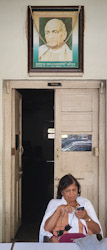
Vallabhai Patel above a doorway at the Gujarat Club

The Club is located close to a house where Sardar Vallabhai Patel (1875-1950) lived. Patel frequented the Club regularly and played bridge there. It was where he first met Mahatma Gandhi in 1916. A tree marks the spot where they chatted.

After having passed the Bar Examination at London’s Middle Temple, where my wife achieved the same thing many years later, Patel came to live in Ahmedabad. The first meeting with Gandhi at the Club marked the start of Patel’s attachment to the Mahatma’s cause. Years later, Patel played a key role in uniting the former Princely States with what had been British India to form the India of today. An important freedom fighter for Indian independence, he became a senior member of the country’s government after 1947. A close associate of Gandhi, the two men chose to differ on how to deal with certain issues, for example the creation of Pakistan.

We sat under the verandah of the Gujarat Club and enjoyed cups of tea. From where we sat we could see a large rectangular open space, which was being used as a car park. The ground was marked out with tennis court lines and a couple of nets were stretched between rows of parked cars.

We began conversing with an advocate at the next table. When he learned that my wife was a barrister, he kindly offered to show us around the neighbouring court building.

We spent well over an hour sitting in various court rooms. Most of these had two layers of glass screens, separating the judges and the court officials from the rest of the room: a covid precaution.

Several things impressed my wife as being different from what happens in British courtrooms. First, the plaintiffs are permitted to speak directly with the judges, rather than via intermediaries such as barristers. Secondly, the judges seemed to be handed the papers of a case at the moment it was about to be heard, rather than in advance. Thirdly, each judge was able to switch seamlessly between fluent Gujarati, Hindustani, and English. Also, they made decisions far more rapidly than their counterparts in the UK.

After our fascinating visit to the court house, our host and a charming advocate from his firm invited us to return to the court and the Club to celebrate Republic Day on the following morning, the 26th of January 2023. We accepted, and I will describe the events in another essay.

Our visit to the vibrant Gujarat Club proved far more exciting than we had anticipated. What was once a place where mill owners rubbed shoulders with British officers and officials, where Patel first met Gandhi, is now a congenial place where advocates meet, converse, read, and relax.

Art deco discovered

BOMBAY IS RICH in fine examples of buildings in the art deco style, which flourished roughly between the end of WW1 and the end of the 1930s. There is a good collection of buildings in this style along Marine Drive in Bombay, the Oval Maidan, and elsewhere in the city. London has some fine examples of structures that exhibit features of this kind of decorative style, but, apart from along a stretch of the A4 road, there are few concentrations of art deco buildings in London, such as can be found in Bombay. In London, the art deco buildings are mostly scattered around the city.

At the end of December 2021, we were walking with friends along the bank of the Thames between the London Apprentice pub at Isleworth and Richmond Bridge when I spotted a row of houses built in the art deco style. I had never seen them before. They line the south side of Park House Gardens in Twickenham. The detached house nearest the river, number 66, is larger and more attractive than the others in the street. The rest of the art deco residences on the street are rather mundane pairs of semi-detached homes, constructed to a pattern that I have seen elsewhere in London’s suburbs. Most of them have curved art deco period Crittall windows, which have panes of glass framed in metal rather than wood.

Park House Gardens was laid out in the early 1930s when:

“…gravel pits were filled in with, according to the local people, rubble and other material from the foundations of the Old Hotel Cecil in the Strand. The first houses were then built in Park House Gardens at prices of up to £1600 for semi-detached with garages, about the price of a garage today.” (www.twickenhampark.co.uk/a-brief-history.html)

The Cecil Hotel was in the Strand. Of its many guests, one was Mahatma Gandhi.

Another source (https://haveyoursay.citizenspace.com/richmondce/easttwickenham-spd/supporting_documents/East%20Twickenham%20SPD_Oct%2015.pdf) dates the houses differently:
“The buildings are semi-detached with Art Deco details though they do not appear to have been built until c. 1950s.”

Apart from the above information, I have found nothing else about these art deco style houses and would love to learn more.

Mahatma Gandhi in Hampstead

WHEN I USED TO visit Hampstead with my parents in the early 1960s, we always walked past a place that intrigued me when I was a youngster. It was the still standing Hampstead Quaker Meeting House, which has a lovely front garden. The latter is overlooked by its neighbour, the late 18th centuryMansfield Cottage, which in the 1960s housed a tearoom or restaurant. The Meeting House with art nouveau (Arts and Crafts) features was built in about 1907 to the designs of Fred Rowntree (1860-1927). According to James D Hunt in his detailed book “Gandhi in London”, Mohandas K Gandhi (1869-1948), the future Mahatma, spoke in this meeting house on the 13th of October 1909:

“… perhaps travelling there by the recently opened underground line … The Society of Friends (Quakers) were not at this time much interested in Indian affairs … The 1909 meeting was sponsored by the Hampstead Peace and Arbitration Society”

The speech, as recorded by Robert Payne in his “The Life and Death of Mahatma Gandhi”, was entitled “East and West” and outlined the evils of the British occupation of India and the sufferings of Indians in South Africa. I knew nothing of this or about the house when we used to stroll down Heath Street.

In the footsteps of Mahatma Gandhi

RECENTLY, I WALKED in Mahatma Gandhi’s footsteps, neither in India nor in South Africa nor in London, but in southeast England.

I am sure that many years ago, at least once, I travelled by ferry across the English Channel from Folkestone in Kent to a port in France. Whether I was travelling by car or by train I cannot recall. Had I been travelling by rail I feel sure that I would have remembered the pier at Folkestone, but I cannot now recall it. If I reached the ferry by train, it would have had to have been before 2001, when the last ferry sailed from Folkestone.

The first ferry service from Folkestone to Boulogne began in 1843 (https://folkestoneharbourarm.co.uk/history/the-harbour-in-the-19th-century/). Passengers reached the boat from the mainline railway station by local transport. In 1847, a long viaduct was constructed to take a steeply inclined mile long branch line from the main line, which was 111 feet above sea level, to the shoreline. This track crossed the viaduct and a swing bridge, which still exist and separate the Inner harbour from the Outer Harbour. At the seashore, the track ran onto a newly constructed pier, The Harbour Arm, from which passengers and freight could be embarked and disembarked. The pier, which was only fully completed in 1904, had a station, a customs house, and warehousing facilities.

During WW1, the Harbour Arm played an important role in the conveyance of military personnel and materials between war-torn Europe and the UK. In December 1915, the famous spy Margaretha Geertruida Zelle (‘Mata Hari’; 1876-1917) was prevented from boarding a vessel at Folestone bound for France by Captain S Dillon of the Secret Intelligence Service. Another famous person, of far greater historical significance than Mata Hari, stepped of a vessel, the SS Biarritz, onto the Harbour Arm on the 12th of September 1931. This passenger was a Gujarati, the only member of the Indian National Congress, Mohandas K Gandhi (1869-1948), going to London to attend the Round Table Conference. A picture taken at the time (www.alamy.com/mahatma-gandhi-alighting-at-folkestone-kent-england-united-kingdom-uk-12-september-1931-old-vintage-1900s-picture-image346793736.html) shows him, dressed in white robes and a dhoti, stepping along a gangplank. The curved platform of the station on the pier, which still exists, is clearly visible in the picture. He is shown walking towards a group of policemen and reporters, some of whom are holding unfurled umbrellas. His arrival at Folkestone on a rainy day is also recorded in a short but amusingly commentated newsreel film (https://youtu.be/P6njRwz_dMw), which also illustrates the rapturous reception he received in the streets of London.

Far more recently, another arrival at Folkestone has hit the headlines. On the 19th of October 2021, a large puppet called Little Amal (‘amal’ meaning ‘hope’ in Arabic), over ten feet in height, first made its appearance in the UK in Folkestone. Little Amal has been carried on foot all the way across Europe from Turkey (www.creativefolkestone.org.uk/whats-on/the-walk-one-little-girl-one-big-hope/) as part of an exercise to raise the public awareness of the plights of refugee children fleeing their native lands. On British soil, she plans to tour the country for a while. Little Amal did not arrive, as Gandhi did, on a cross-channel ferry bound for Folkestone, but she did make her first an appearance on the Harbour Arm (www.kentonline.co.uk/folkestone/news/little-amal-coming-to-town-255932/). She was greeted by the actor Jude Law.

Folkestone harbour was heavily bombed during WW2 and then the pier was repaired after the war ended. Passenger services to France resumed in 1946, but limitations of the harbour’s depth, which prevented the docking of larger ferries, and the development of roll, on roll-off ports elsewhere, led to Folkestone’s gradual decline as a port. These factors and the completion of the nearby Channel Tunnel resulted in the ending of Folkestone’s life as a passenger port by 2000. After this date, the Harbour Arm and its buildings fell into decline and became dilapidated.

In 2014, the Department of Transport closed the railway line ad the facilities on the Harbour Arm. The following year, it was acquired by the Folkestone Harbour & Seafront Development Company (www.folkestoneseafront.com/). This organisation has tastefully restored the Harbour Arm and its buildings as well as the viaduct leading to it across the water. The rails on the viaduct have been preserved but submerged in the walkway in such a way that their top surfaces can be seen. The sinuous platforms and their canopies have been repaired, as have the signal box (now a café) and the old Customs House. Beyond the station, the pier runs out to sea towards a lighthouse. All along the pier, there are several eateries. Also, there is an artwork by Antony Gormley.  What was once a busy transport hub has now become a delightful leisure facility, which along with Folkestone’s transformation as an artistic ‘creative hub’ has turned the town into a place well worth visiting, a far cry from what it was when Gandhi set foot on its pier. My wife and I wondered whether Little Amal, who is quite tall, will have as much influence on the future of the world as did the short man from India, who arrived in his dhoti at Folkestone in 1931.

I am pleased to have walked where Gandhi once stepped in Folkestone because I have also followed in his footsteps in various places in India including his birthplace Porbandar in Gujarat, Rajkot, Bhavnagar, Bombay, Madras, and Bangalore. In London, I have often walked by Friends House on Euston Road, passing the very door through which he left the building to greet his admirers back in 1931. In all these places, there are ample monuments and other reminders of the Great Soul (the Mahatma), but, as far as I know, Folkestone is yet to materially commemorate his brief presence there.