
Call it a gherkin
Or a pickl’d cucumber
Tasty by any name

UNTIL I WAS ABOUT 18, I drank a pint of chilled milk in the morning and another when I came home from school. I did not drink all the varieties of milk that were supplied by the milkmen who worked for the Express Dairy Company, but chose the ‘homogenised’ variety, which did not have cream at the top of the bottle. Never once whilst drinking this refreshing slightly watery liquid did I ever imagine that I would one day visit an exhibition about milk. Today, the 29th of July 2023, I viewed an exhibition called “Milk”, which is being shown at the Wellcome Collection in London’s Euston Road until the 10th of September 2023. Amongst the numerous exhibits displayed in this beautifully curated show, the following particularly interest me.

There were plenty of other exhibits that were both visually interesting and thought provoking. A theme that I felt pervaded the exhibition is related to the colour of milk – white. Because milk is often perceived as being healthy, pure, and virtuous, it may also nourish the malevolent ideas of white racists. One of the exhibits showed a video of Trump supporters cavorting around, each one of them waving large bottles of white milk whilst shouting racist and anti-Semitic slogans. Yet, the ancestors of racists like these were perfectly happy to snatch the newborn babies of black slaves away from their mothers, so that these unfortunate women could be forced to breast-feed the babies of the white women of the families who owned them. Their milk was white, but not their skin colour. To compensate for these and other harsh reminders that all is still not well in the racial tolerance scene, the exhibition includes a satirical film from You Tube ( https://youtu.be/cevXg_SlT-Q ), which makes fun of people with racist tendencies.
Well, it never occurred to me that milk and racism might be considered in the same brackets until I visited the splendid show at the Wellcome Collection. It is well worth seeing not only because of its historical and scientific aspects, but also for its artistic and sociological content.
DESPITE THE PRESENCE of many distinctive buildings constructed on the south bank of the River Thames since the end of WW2, the OXO tower built in about 1929 is still a noteworthy and unusual landmark. OXO, just in case you do not already know, is a company that is most famous for its meat extract cubes, which can be dissolved to make soups, nutritious teas, and gravies. The company uses a process for making meat extract (in liquid form) that was invented in 1840 by the German scientist Baron Justus von Liebig (1803-1873). In 1866, Liebig’s Extract of Meat Company (‘LEMCO’) was founded in Britain. At first it produced the liquid form of the meat extract, which was quite costly. So, they developed a cheaper solid form, which was sold as OXO cubes, and they are still available today.
In the 1920s, LEMCO acquired the riverside building (opposite St Paul’s Cathedral), which had been first used as a power station for the Post Office. The company modified it considerably to produce an edifice with Art Deco features. This was designed by the company’s architect Albert Moore between 1928 and 1929. LEMCO wanted their effectively new building to include a tower with illuminated advertising signs. However, at that time, planning permission for skyline advertising near the riverfront was refused. The architect came up with a brilliant solution to get around the planning regulations.

The square tower was designed with three windows on each of its four external walls. Each set of windows were shaped as a pair of circles separated by a cross shaped like an ‘X’. Thus, each of the four sets of windows spelled the name ‘OXO’. Even during daytime, when there are no lights switched on behind the windows’ glass panes, the name OXO can be seen from quite a distance. Because they were designed as windows, the planning authorities were in a weak position to object, and LEMCO got away with their attempt to use the tower to advertise.
By the 1970s, the OXO building had fallen into disuse. In the 1990s, the building along with its distinctive tower began to be redeveloped for use as housing, retail, and recreational purposes (including a now famous restaurant). At night the windows on the tower now are surrounded by neon lighting and the windows spelling out ‘OXO; can be seen from afar. OXO still exists, but it is now owned in the UK by Premier Foods.
THE FIRST PLACE I practised dentistry was in Rainham, Kent. Every Thursday, we climbed into my then boss’s open-topped TR 7 sports car, and drove down the High Street to a pub called The Cricketers. There, we used to enjoy a hearty meat and two veg lunch. One of the waitresses, a middle-aged woman, was a patient at the practice and always made sure that we were given large portions. On other days, I used to eat either in the practice or in one of the other local eateries. Sometimes, I would go into the local branch of Tesco’s supermarket to buy myself a few items for lunch. These always included either a Mars bar or a chocolate covered honeycomb caramel called a Crunchie. All the cashiers in the supermarket knew where I worked, and often, whilst I was paying, they would raise the Mars or Crunchie in the air, and shout:
“Look what the dentist is eating!”
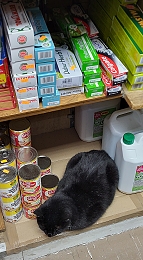
Recently, I entered a grocery shop near Portobello Road. I noticed a black cat resting on a shelf surrounded by tins, bottles, and boxes containing tubes of toothpaste. Seeing this creature reminded me of my days long ago in Rainham. There was a small ‘corner shop’ across the road from our surgery. The lady who owned it made very acceptable, generously filled sandwiches. Every now and then I used to buy one of her sandwiches for lunch. I used to accompany this with a packet of potato crisps. These packs were kept in an open topped cardboard box in no particular order. I used to rummage through its contents and select the pack that I fancied.
One day, I entered the shop to buy my lunch. When I turned to look at the box containing the packs of crisps, I saw a very plump cat comfortably curled up on top of the packets of crisps. Despite the fact that the crisps were sealed in their packets, I did not feel like choosing one. As I left the shop, I wondered where else that cat chose to rest during the day. Thinking about that put me off ever entering that little shop again.
AFTER AN INTERESTING visit to the Bank of England’s museum, we headed north east to Brick Lane. Our destination was Beigel Bake at number 159. Not to be confused with its near neighbour, Beigel Shop, the far superior Beigel Bake, which is open 24 hours a day, was established in 1974. Although now a separate business from the Beigel Shop, the two places were originally the same business, as is recorded in an online article (https://londonist.com/london/food/things-you-probably-didn-t-know-about-beigel-bake):
“Although widely seen as rivals, the two shops were originally owned by the same family. Brothers Asher and Sammy Cohen started off working for another brother at The Beigel Shop next door, but eventually branched out to 159 Brick Lane in 1976. When the brothers aren’t putting in a shift, Nathan Cohen, one of two sons can be seen overseeing the sale and production of the 2,000-3,000 beigels baked in-house every day.”
I am uncertain whether the brothers are still with us or whether Nathan still oversees the place. In any case, Beigel Bake is well worth a visit. We did so today, the 4th of April 2023.
A few weeks earlier, we ate salt beef (Reuben)sandwiches at Selfridge’s Brass Rail eatery, which I have described elsewhere (https://adam-yamey-writes.com/2023/03/25/the-brass-rail/). We went to Brick Lane both because we were hungry and, also because we wanted to compare the salt beef on offer there with that we ate at Selfridges. After waiting in a long, but fast-moving queue, we were served our beigels, stuffed full of warm salt beef, some mustard, and slices of pickled gherkin.
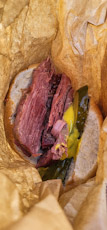
As the Beigel Bake does not offer any seating, one has to eat the generously filled beigels elsewhere. At the Brass Rail, you can sit at a comfortable table, where a waiter brings the salt beef sandwich to you. The salt beef served at Beigel Bake is much tastier than that at the Brass Rail. Unlike the latter, Beigel Bake does not put sauerkraut and cheese into the sandwich. Without those ingredients, the salt beef tastes far superior to when they are present. In addition, the beigel suits the salt beef much better than the rather soft bread used at the Brass Rail. In brief, to my taste the Beigel Bake offering is far superior in all respects to that of the Brass Rail.
As mentioned, at the Brass Rail you can sit and eat your sandwich comfortably. However, currently the sandwich costs £14.95 to take-away (more if you eat-in). In contrast, a salt beef beigel with pickle and mustard, currently costs £6.00 at Beigel Bake. What you get at the Brass Rail is definitely not worth £8.95 more that at the less pretentious Beigel Bake, and it seemed like there was more beef in the latter’s offering than in the former.
A word of advice: do not bother with the nearby Beigel Shop even if there is a long queue at Beigel Bake – it is well worth the wait.
I WAS FOURTEEN IN 1966. That year, Selfridges in London’s Oxford Street opened the Brass Rail restaurant on the ground floor, with windows facing Orchard Street. Its speciality was then, and still is, salt beef. I recall visiting the place once or twice with my mother back in the 1960s. In those days, I did not particularly care for the taste of salt beef. For some reason, maybe the cost of the place, we did not frequent the Brass Rail.

Winding the clock forwards several decades, I now enjoy eating salt beef occasionally. Today, the 22nd of March 2023, we needed to go to Selfridges for something, and as we were there, I suggested that we ate at the Brass Rail. Unsurprisingly, the eatery has changed its appearance considerably since the 1960s, but it is still located in the same part of Selfridges as it was originally. Its tables are enclosed in an area lined banquettes upholstered with red fitted cushions. The service was brisk and attentive. We ordered Reuben sandwiches in rye bread. These are generously filled with warm salt beef, sauerkraut, Swiss cheese, gherkin, and Russian dressing.
The Reuben was enjoyable, filling, and quite tasty. However, I felt that the taste of the salt beef was overpowered by that of the dressing and the other ingredients. Good though it is at the Brass Rail, I prefer eating the bagels crammed full of salt beef, which are served at the 24 hour Beigel Bake in Brick Lane. At half the price of the Brass Rail, but without the great service, they are more than twice as enjoyable.

Lunch on a leaf
Eat it using your five fingers:
An Andhra thali
AFTER A VERY DISAPPOINTING experience at a café we have often enjoyed when staying in Fort Kochi, we went to another eatery, which had been recommended by our friend Sharada S , when we visited Kochi at Christmas in 2019.
Our friend had introduced us to Oceanos. In this pleasant but unpretentious restaurant, we have enjoyed some of the best prepared sea food in Kochi. The dishes served at Oceanos are not only tasty but also authentic, by which I mean that they are not prepared to be ‘fine dining’ fancy; instead they give a good experience of genuine Keralan food.

Currently (February 2023), In addition to an á la carte menu, there is a seafood set lunch – a seafood thali. This included deep fried mackerel; clams (vongole) out of their shells; Aleppey fish curry; roasted prawn curry; sardine steamed in a banana leaf; Malabar paratha; rice; chhaas (buttermilk); and payasam (a local dessert). Every item was exquisitely prepared and tasted very fresh. This wonderful, faultless meal was 390 INR (£3.90) per head. We plan to explore the rest of the menu at Oceanos in the next few days.
Had it not been for the incompetent management at Kashi Art Café today, we would have eaten lunch there. However, as we had not been served our food for almost one our after ordering it, we asked for an explanation of the delay, and were told that there was a problem with the gas in the kitchen. Having been told that we would have our food “in about 10 minutes”, we walked out. If we had been served our food sooner, or been given an explanation without having to ask for one, we might have missed out on the superb lunch at Oceanos.
THE SHARAD BAUG HOMESTAY is in the extensive, luxuriant, verdant grounds of the Sharad Baug Palace. Badly damaged in the 2001 earthquake, the palace is a short walk from the excellent homestay. This accommodation is owned and run by members of the royal family of the former Kingdom of Kutch.
Close to the homestay in the middle of a field, there is another ruined edifice. This was formerly used as a guesthouse by important guests of the ruler, the Maharao. For some time, the poet Dara Shiko (1615-1659) hid from his brother (the future emperor Aurangzeb) in this building.
Near the ruined palace, there is a building, which was the last Maharao of Kutch’s sitting room and dining hall. Now, the building houses a small museum filled with exhibits relating to the royal Jadeja family. Amongst these, there are several items connected with the last ruler of independent Kutch when he spent some time in Norway.
After Kutch had joined India soon after 1947, its last Maharao, Madansinhji (1909-1991), was appointed India’s ambassador to Norway. There are photographs relating to his stay in Norway in the museum. There is also a Christmas card in Norwegian and a certificate issued by the Oslo Tennis Club. He served in Norway between 1957 and 1960.
While in Norway, Madansinhji was served by his chef from Bhuj, a member of the Yadav family. For many generations, the Yadavs have been chefs, specialising in non-veg food.
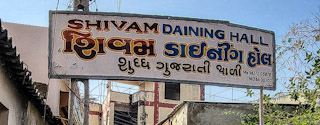
When we first visited Bhuj, in 2018, we were recommended to eat in a simple, small restaurant in the bazaar of Bhuj. Named Shivam Daining (sic), it serves very tasty pure vegetarian food. We returned to eat there several times during our recent (January 2023) stay in Bhuj. While chatting with its chef and his relatives, we learned that the man who produces the excellent food is a grandson of the Mr Yadav, who cooked for Madansinhji in Norway. Although the family have a tradition of cooking meat and fish, they do not offer it at Shivams because they rightly feel that there is little demand for non-veg food in the mainly vegetarian city of Bhuj.
Without knowing it when I booked the Sharad Baug homestay, it turned out that it and one of our favourite restaurants in Bhuj had at least one common connection, and that is Norway.
BANGALORE IS ABOUT 4800 miles from Paris (France). The French capital is noted for its gourmet delights, but on the whole the same cannot be said for Bangalore. One exception to this statement is Sunny’s restaurant currently located on Lavelle Road.
Arjun Sajnani created Sunny’s at least 25 years ago. Then, it was in a tall narrow house on a lane leading off Lavelle Road. The kitchen was on the ground floor and there were dining areas in the two floors above it. Often, Arjuna could be standing, working in the kitchen. Back in those early days, Sunny’s was one of Bangalore’s few suppliers of imported Western European cheeses, such as genuine parmesan.

Later, Sunny’s shifted to larger premises on the corner of Lavelle and Vittal Mallya Roads, next to a petrol filling station. The dining area was elegant.
For a brief period, Arjun ran a restaurant serving delicious Sindhi dishes in his original premises. Sadly, he decided to discontinue this interesting eatery.
Even later, Arjun shifted his restaurant to its present location – a two storey villa constructed about 20 years ago. The balconies on the upper floor are supported by stout carved timber pillars which remind one of pillars that you can see in much older traditional South Indian edifices. Diners can sit at tables within the building, or in the garden surrounding it, or on the first floor balconies. At lunchtime on Christmas Day 2022, every table was occupied.
At each of Sunny’s different locations, the food has been magnificent. As our daughter correctly said, eating at Sunny’s is as good as eating in a good Parisian restaurant. Also, Sunny’s Italian food (mainly pasta and pizzas) is above average in quality.
Arjun is an actor and director of theater and films, in addition to being a restaurateur. Dramatic productions require many skills. The same is the case for running a restaurant. Some of the required skills are the same for restaurants and for stage/screen. A restaurateur has to perform well both in the kitchen and the dining room to satisfy his or her clientele. Arjun achieves this successfully. If you have never been to Sunny’s, give it a try!
 yamey
yamey 