
The beer refresh-es,
The food is mediochre:
A quaint pub in Hampstead

The beer refresh-es,
The food is mediochre:
A quaint pub in Hampstead

Why does fish and chips
Taste much better by the sea?
Something in the air?
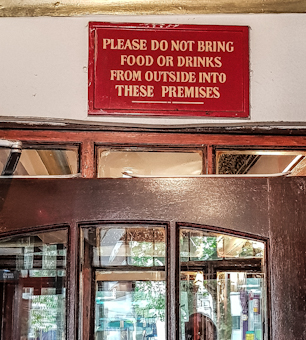
The Coffee Cup café in London’s Hampstead has been in business since 1953, and has been very popular since I first remembered it in the early 1960s. I have visited it several times, but never before noticed the sign at its entrance, which reads: “Please do not bring food or drinks from outside into these premises.” This instruction is not seen frequently in restaurants and cafés in the UK. Seeing this sign reminded me of what is very common in eateries in India, namely, signs reading: “Outside food not allowed.” Customers are forbidden to bring into the estblishment food or drink they have obtained elsewhere. That is fair enough, I suppose.
Cinemas in India, like in many other countries, try to sell food and drink to their customers, often at outrageously high prices. Apparently, watching a film is for many people more enjoyable if you are stuffing popcorn into your mouth at the same time as spilling it on the floor in the dark.
Back in 2001, my family, my in-laws, and my wife’s brothers family went to watch the recently released Bollywood blockbuster Kabhi Khushi Kabhie Gham at a large cinema in Bangalore (India). After purchasing the tickets, we had to wait in a queue before all of our baggage, shopping baskets, handbags etc., were searched by uniformed security personnel. I wondered what these officials were looking for. Was it guns or explosives, I asked my sister-in-law after we had reached the auditorium. No, it was not that, she replied. They were looking for food and drinks brought from outside the cinema. She told me that outside food was not allowed into the cinema, and then showed me inside her shopping basket, All I could see was a shawl (some cinemas are too cool because of air-conditioning). She moved the shawl aside to reveal that her bag was filled with sufficient drinks and snacks to easily satisfy all eight of us during the three and a half hour film. So much for the security check! Had we been carrying anything more dangerous than ‘outside food’, this would have also been missed by the not so vigilant security people.
It is odd how a chance sighting of something like the sign in the Coffee Cup can bring back distant memories.
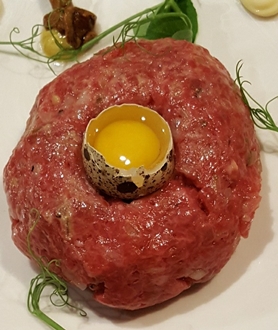
Eat it fresh and raw
Flavour’d feistily
There you have it: steak tartare

My earliest recollection of eating Chinese food was in a restaurant called ‘Tung Hsing’ in Golders Green almost opposite the old Hippodrome Theatre. It opened in the 1960s and was one of the first restaurants in London to serve Pekinese food, rather than the then usual Cantonese cuisine. The restaurant was owned by a retired ambassador from Chiang Kai-shek’s nationalist China and his wife, whom I believe was responsible for the very excellent food served.
Although I am sure they were available, I am not sure whether I used chopsticks when eating at the Tung Hsing. Maybe, I learned to use them there, but I really cannot remember. Whatever the case, I have been eating Chinese food with chopsticks for many decades. I would not say that I am 100 percent proficient with them, but I feel that using them to eat Chinese food satisfies me.
Chinese-style food is very popular in India. Most Indians eat in Chinese restaurants using western utensils such as plate, fork and spoon. If you ask for chopsticks, they are usually available, but they are not supplied as default table settings.
Some years ago, early this century, a new Chinese restaurant opened in Museum Road in Bangalore. We visited soon after its inauguration. It was a lovely restaurant and the food was good by Indian Chinese restaurant standards. As usual, we asked for bowls and chopsticks. The waiter disappeared for a while, and then returned empty-handed.
“There are no chopsticks,” he told us.
“Why not?” we asked.
“I will ask the manager.”
The Manager came over, and explained:
“We have been so busy since we opened, and many of the guests have taken them home as souvenirs. So, we have run out of them”
“It’s estimated that 8.5 million people in the UK have now gone “gluten free” and it’s a very fast-growing section of the supermarket with an expanding (and expensive) range of gluten-free alternative foods on sale.” (https://www.bbc.co.uk/news/magazine-37292174)
Food intolerances can very debilitating to those who suffer from them. Take gluten intolerance, for example. It can cause a variety of uncomfortable and sometimes dangerous symptoms. The incidence of gluten-related medical problems is uncertain. It may be as high as 1 in a 100 people according to one source (https://glutenintoleranceschool.com/gluten-intolerance-statistics/#2), or, possibly not nearly so high. A study published in 2015 (Digestion, 2015;92(1):8-13) found that 86% of patients complaining that they had non-coeliac gluten sensitivity were found to have neither Non Coeliac Gluten Sensitivity, nor Coeliac Disease, nor Wheat Allergy. Whatever the actual figures may be, it is estimated that the incidence of Coeliac Disease in the UK is 1 in 100.
To summarise, the greater majority of people in the UK are unlikely to be intolerant to gluten. You may wonder why I am ‘going on’ about gluten intolerance in this blog. Well here is the reason.
Recently, I visited the superb William Morris Gallery in Walthamstow in north London. It has a beautiful cafeteria overlooking the extensive gardens behind the lovely house where William Morris once lived. I was looking forward to having a hot beverage with a cake or pastry. When I looked at what was on offer, I was surprised. All of the cakes and pastries were labelled as being ‘gluten free’ The only gluten containing item on offer was an unexciting looking scone. I tried a gluten free orange polenta cake, which was just about acceptable.
Afterwards, I wondered why the majority of the baked goods on offer were gluten free when most of the public in the UK are not gluten intolerant. Is there an abnormally high incidence of gluten intolerance in Walthamstow, or does this lovely place attract a large number of visitors who believe themselves to be gluten intolerant without having taken the trouble to have medical tests to confirm or dispel their beliefs?
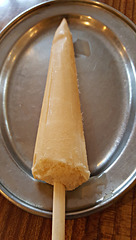
Kulfi: an Indian sweet,
Frozen joy:
Exquisitely enjoyable
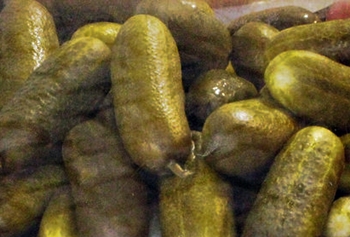
As a child and teenager, I did not like gherkins (pickled cucumbers). My parents ate them, but refused to buy them if they were made behind the Iron Curtain, for example in Bulgaria, Czechoslovakia, Hungary, or Poland. They would only by jars of these green, wet vegetables if they were made in Western Europe, say in West Germany or Holland. You may well wonder why my parents were so fussy about the origin of their gherkins. The answer is simple. They were unwilling to buy anything from Soviet-dominated parts of the world because they felt, rightly or wrongly, that every penny they paid for goods from these areas would help the Soviet Union pay for yet another atomic bomb or some other military equipment that could be used against the West.
I did not worry me where my parent’s gherkins were grown and bottled, as I did not eat them. This was true until the late 1970s when McDonalds opened a branch of their hamburger restaurant chain in London’s Haymarket.
At first, I felt that I was too superior to enter a McDonalds, and developed an irrational prejudice against the company. Eventually, some friends decided to eat at the Haymarket branch andas I was with them and also a little curious about McDonalds, I joined them. I cannot recall which burger I ordered, but whatever it was, it contained slices of gherkin. I did not remove the gherkin as I might have done had I been served it a few years earlier. I bit into the burger and realised that it was the gherkin that made the rest of the burger sandwich delicious. From that moment onwards, I have become a gherkin afficionado.
I am happy eating gherkins anywhere. However, some of the nicest gherkins that I have found are those often served in fish and chips shops. These large, very tasty specimens often come Holland. Served from large glass jars, these gherkins are often known as ‘wallys’ (pronounced ‘wollees’) in London and South-East England.
Finally, here is something that you might not know about gherkins. The south of India, which I visit often, hasbeen a major producer and exporter of gherkins since the early 1990s. The soil condition in that region are perfect for growing the cucumbers that will be pickled. For more information, see: http://igea.in/. Had these been around in the days before the fall of the Iron Curtain, I wonder whether my parents would have bought them.
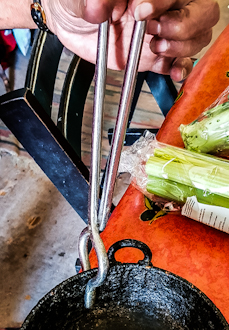
Just in case you have not got one in your kitchen, here is an implement that is extensively used in Indian kitchens and tea stalls.
The sandasi (pronounced roughly like ‘sun-er-see’ said fast), which is is also known as a pakad (from the verb ‘to hold’ in Hindustani) or a chimta (from the verb ‘to pinch’ in Hindustani), is essentially a pair of sturdy hinged metal (stainless steel) tongs. The handles of the implement are several times as long as the gripping elements. This means that quite heavy things may be lifted with the beaks of the tongs without any risk of them slipping out of their grip.
The sandasi’s long handles also mean that the user’s hands can be kept at a safe distance from the hot cooking vessels that are lifted with this pair of tongs. For example, the tea maker can lift and manipulate with ease the huge pots containing several litres of a bubbling, boiling mixture of milk, tea, and spices.
I find the sandasi very useful for gripping the edges of large casseroles when I am stirring hot food like stews or curries.
Cooking tongs are, of course, available in countries other than India, but the sturdy construction and long handles of the sandasis have much to reccommend them.

When I was a child, I spent a great deal of time with my aunt and her children. They lived a few minute’s walk from our family home and I enjoyed spending time with them. Often, my sister and I used to spend a whole day at my aunt’s house, sometimes over night especially when my parents were away on a trip.
My aunt fed us. Sometimes she made us fried eggs. Then, I was a very fussy eater. In those far-off days, I only liked the white part of the fried egg, not the central yellow bit. One of my cousins only liked the central yellow part, but disliked the white surrounding it. My aunt was an extremely down-to-earth individual, laden with more than a fair share of common sense. Her solution to the fried egg situation was that after making the fried egg, she used to carefully dissect the yoke portion of the finished product and serve it to my cousin. I was given the white portion of the egg with a neat hole in it where the yellow had been.
Today, many decades later, I am not keen on any part of a fried egg and do not eat eggs prepared in this way. I much prefer omelettes and hard-boiled eggs. However, I do enjoy making them for other people, The challenge is to avoid breaking the yoke.
 yamey
yamey 