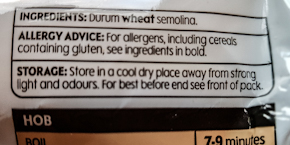
Going without …


“It’s estimated that 8.5 million people in the UK have now gone “gluten free” and it’s a very fast-growing section of the supermarket with an expanding (and expensive) range of gluten-free alternative foods on sale.” (https://www.bbc.co.uk/news/magazine-37292174)

Food intolerances can very debilitating to those who suffer from them. Take gluten intolerance, for example. It can cause a variety of uncomfortable and sometimes dangerous symptoms. The incidence of gluten-related medical problems is uncertain. It may be as high as 1 in a 100 people according to one source (https://glutenintoleranceschool.com/gluten-intolerance-statistics/#2), or, possibly not nearly so high. A study published in 2015 (Digestion, 2015;92(1):8-13) found that 86% of patients complaining that they had non-coeliac gluten sensitivity were found to have neither Non Coeliac Gluten Sensitivity, nor Coeliac Disease, nor Wheat Allergy. Whatever the actual figures may be, it is estimated that the incidence of Coeliac Disease in the UK is 1 in 100.

To summarise, the greater majority of people in the UK are unlikely to be intolerant to gluten. You may wonder why I am ‘going on’ about gluten intolerance in this blog. Well here is the reason.

Recently, I visited the superb William Morris Gallery in Walthamstow in north London. It has a beautiful cafeteria overlooking the extensive gardens behind the lovely house where William Morris once lived. I was looking forward to having a hot beverage with a cake or pastry. When I looked at what was on offer, I was surprised. All of the cakes and pastries were labelled as being ‘gluten free’ The only gluten containing item on offer was an unexciting looking scone. I tried a gluten free orange polenta cake, which was just about acceptable.

Afterwards, I wondered why the majority of the baked goods on offer were gluten free when most of the public in the UK are not gluten intolerant. Is there an abnormally high incidence of gluten intolerance in Walthamstow, or does this lovely place attract a large number of visitors who believe themselves to be gluten intolerant without having taken the trouble to have medical tests to confirm or dispel their beliefs?
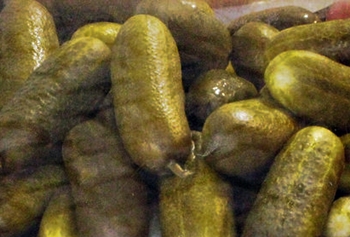
Green and wet

The heart of Central Europe_800


As a child and teenager, I did not like gherkins (pickled cucumbers). My parents ate them, but refused to buy them if they were made behind the Iron Curtain, for example in  Bulgaria, Czechoslovakia, Hungary, or Poland. They would only by jars of these green, wet vegetables if they were made in Western Europe, say in West Germany or Holland. You may well wonder why my parents were so fussy about the origin of their gherkins. The answer is simple. They were unwilling to buy anything from Soviet-dominated parts of the world because they felt, rightly or wrongly, that every penny they paid for goods from these areas would help the Soviet Union pay for yet another atomic bomb or some other military equipment that could be used against the West.

I did not worry me where my parent’s gherkins were grown and bottled, as I did not eat them. This was true until the late 1970s when McDonalds opened a branch of their hamburger restaurant chain in London’s Haymarket.

At first, I felt that I was too superior to enter a McDonalds, and developed an irrational prejudice against the company. Eventually, some friends decided to eat at the Haymarket branch andas I was with them and also a little curious about McDonalds, I joined them. I cannot recall which burger I ordered, but whatever it was, it contained slices of gherkin. I did not remove the gherkin as I might have done had I been served it a few years earlier. I bit into the burger and realised that it was the gherkin that made the rest of the burger sandwich delicious. From that moment onwards, I have become a gherkin afficionado.

I am happy eating gherkins anywhere. However, some of the nicest gherkins that I have found are those often served in fish and chips shops. These large, very tasty specimens often come Holland. Served from large glass jars, these gherkins are often known as ‘wallys’ (pronounced ‘wollees’) in London and South-East England.

Finally, here is something that you might not know about gherkins. The south of India, which I visit often, hasbeen a major producer and exporter of gherkins since the early 1990s. The soil condition in that region are perfect for growing the cucumbers that will be pickled. For more information, see: http://igea.in/.  Had these been around in the days before the fall of the Iron Curtain, I wonder whether my parents would have bought them.

Getting to grips in the kitchen


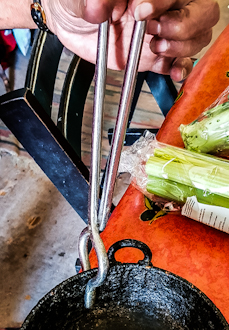
Just in case you have not got one in your kitchen, here is an implement that is extensively used in Indian kitchens and tea stalls.

The sandasi (pronounced roughly like ‘sun-er-see’ said fast), which is is also known as a pakad (from the verb ‘to hold’ in Hindustani) or a chimta (from the verb ‘to pinch’ in Hindustani), is essentially a pair of sturdy hinged metal (stainless steel) tongs. The handles of the implement are several times as long as the gripping elements. This means that quite heavy things may be lifted with the beaks of the tongs without any risk of them slipping out of their grip.

The sandasi’s long handles also mean that the user’s hands can be kept at a safe distance from the hot cooking vessels that are lifted with this pair of tongs. For example, the tea maker can lift and manipulate with ease the huge pots containing several litres of a bubbling, boiling mixture of milk, tea, and spices. 

I find the sandasi very useful for gripping the edges of large casseroles when I am stirring hot food like stews or curries.

Cooking tongs are, of course, available in countries other than India, but the sturdy construction and long handles of the sandasis have much to reccommend them.

Tastes differ


food toast meal morning


When I was a child, I spent a great deal of time with my aunt and her children. They lived a few minute’s walk from our family home and I enjoyed spending time with them. Often, my sister and I used to spend a whole day at my aunt’s house, sometimes over night especially when my parents were away on a trip.

My aunt fed us. Sometimes she made us fried eggs. Then, I was a very fussy eater. In those far-off days, I only liked the white part of the fried egg, not the central yellow bit. One of my cousins only liked the central yellow part, but disliked the white surrounding it.  My aunt was an extremely down-to-earth individual, laden with more than a fair share of common sense. Her solution to the fried egg situation was that after making the fried egg, she used to carefully dissect the yoke portion of the finished product and serve it to my cousin. I was given the white portion of the egg with a neat hole in it where the yellow had been.

Today, many decades later, I am not keen on any part of a fried egg and do not eat eggs prepared in this way. I much prefer omelettes and hard-boiled eggs. However, I do enjoy making them for other people, The challenge is to avoid breaking the yoke. 


Photo by Pixabay on Pexels.com

The first time I ate rice

rice


I had a difficult birth. Both my mother and I nearly died when I was born. For the first few weeks of my life, I was not a healthy baby; my future was uncertain. Then, as I grew a little, I was a poor eater. My mother, who worried about me greatly, felt that it was best that I only ate what I liked. As a result, I became a fussy and unadventurous eater. My immediate reaction on being offered something that was outside the tiny range of foods that I was prepared to eat, was to refuse it.

Although at an early age, I was happy to eat tomato sauce either with pasta, which I still enjoy, or with baked beans, which I now dislike intensely. I recall eating a fresh (i.e. uncooked) tomato for the first time when I was about 13.

When I was 20, I joined some friends on a camping trip in France. We travelled around the country by car, camping at night. We would eat picnics for lunch and visit restaurants in the evening. One of our camping places was at Banyuls on the Mediterranean coast of France close to the Spanish border. One evening, we drove across the border to Port Bou in Spain. Naturally as we were in Spain, my friends ordered paella.

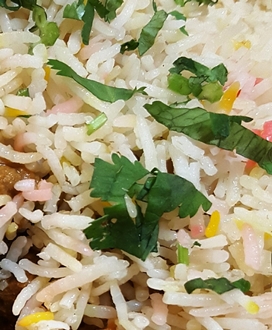
Paella, as many people know, is a rice based dish. I was a bit skeptical because I had managed to avoid eating rice (and rice pudding) prior to this brief trip to Spain. Something attracted me to the paella, maybe it was hunger or its delicious appearance, and I tried a portion. As for the rice, it was love at first bite. Since then, I have been a great fan of rice, which I had never tried during the first 20 years of my life. I still dislike rice pudding as it is made in the UK. In contrast, I really enjoy phirni, an Indian version of rice pudding.

Since that trip to Port Bou, my tastes have become quite adventurous. I rarely refuse trying something new, even if only once.

Looking back on my childhood, I now realise that my very conservative tastes deprived me of the delights of many of the gourmet meals, which my parents enjoyed while travelling with me and my sister. They would enjoy fine French or Italian food whilst I stuck to my ham or steak and chips. 

Well, as the French say À chacun son goût. I am glad that mygoût has become more exciting.


Time zones and … O Juice

clock


I am writing this on the 30th of March,  the day after that on which the UK was scheduled to leave the EU, but did not. This day, Saturday,  is in the last weekend of March. Early on Sunday morning, we shift from Greenwich Mean Time to British Summer Time, by advancing our clocks by one hour.

In late 1994, while we were on holiday in California, we decided to drive over to the State of Arizona to see Lake Havasu City. After London Bridge was dismantled in 1968, its stones were carefully labelled and sent to Lake Havasu City, where it was reconstructed. By 1971, the bridge had been re-built in a picturesque lakeside position where it has become one of Arizona’s major tourist attractions.

After settling into a motel, we wandered over to a restaurant. For the duration of our evening meal we were the only diners. I ordered ‘New York Steak’, which turned out to be strips of beefsteak. Soon after taking our order, the waitress returned and asked: “D’ya want it with or without O Juice?”

I had never heard of eating steak with orange juice, so I said:

“Excuse me, what did you say?”

She replied, slightly impatiently: 

“O juice, you know kinda gravy.”

What sounded like ‘O Juice’ was the waitresses attempt to pronounce the French culinary term ‘au jus‘.

After eating our meal, it was only eight o’clock. We asked the waitress where were all of the other diners and why was she clearing all the tables and stacking the chairs, getting ready to close the eatery.

“It’s  getting late you know”

“But it’s only eight,” we retorted.

“Nope, it’s nine,” she informed us.

We had not realised that by crossing from California to Arizona, we had moved into a time zone one hour ahead of California.

What? No kitchen…

During my early years in dental practice, I came across two instances of people living in houses without  kitchens.


antique burn burning close up


The first instance concerned one of my fellow dentists. He bought a house from a lady, who only used a microwave oven. Her home had no kitchen. My colleague had to convert one of the rooms in his new home into a kitchen. 

The second example was also connected with dental practice. It was the home of one of my dental nurses, whom we shall call ‘S’. She was a delightful young lady, who worshipped the late Marilyn Monroe. Sadly, her eyesight was not quite adequate enough for working in a dental surgery. She and the senior dental surgeon in the practice decided that she should seek another type of employment, which she did.  On her last day of working with me in my surgery, I gave S a small bottle of Chanel No 5 perfume as a ‘thank you present’. S was thrilled. I could not have chosen a better present. S told me that Chanel No 5 was all that her heoine Marilyn Monroe wore in bed. Well, I had no idea about the filmstar’s habits, but I was pleased that inadvertantly I had chosen the right gift for my visually-challenged dental assistant.

If you are now thinking that I have strayed from my subject, you are wrong. While S was working in our practice, she revealed that her mother hated cooking, so much so that there was neither kitchen nor dining room in the house where S lived with her family. S told me that the family ate every meal, including breakfast, at restaurants and cafés near their home.

Maybe I am too conventional, but I was surprised to learn that people who are able to afford accomodation with a kichen or kitchenette choose not to have one. In complete contrast, my wife told me that some of her ancestors lived in homes (in India) with two widely separated kitchens: one for meat and one for vegetarian food.


Photo by Fancycrave.com on Pexels.com

Dining in Kerala

gecko

While eating our dinner one tropical evening in a lovely restaurant in Fort Cochin (Kerala, India), I looked up and noticed that high up on the wall overlooking us there was another diner, definitely not a vegetarian.

Clinging to the wall

An insect in its jaws:

A gecko stares at me

Cheese is nice


Once, we spent a weekend with a German friend living in Germany. She was a great cook and spent much time preparing delicious meals for us in her kitchen. 

I was sitting in the living room, which was next to the kitchen when I heard our hostess angrily shouting what sounded to me like “cheese is nice”. Now, I would be the first to agree with that sentence. However, she kept repeating it angrily whilst crashing about in the kitchen. I could not see why anyone except possibly a vegan could possibly use that sentence so angrily.

After a while, it dawned on me that our friend was not talking to herself about cheese, but about Jesus, whose name she pronounced as ‘Cheesus’. What she was really saying angrily in her strong German accent in English was ‘Jesus Christ’.