Just desserts

Art of gelato_240

Not long ago, we visited a restaurant. To save it from being emabarassed, I will not mention its name or location. On its dessert menu, it had the following item: “Mango”. This was described as coconut ice cream with mango sorbet, topped with a single raspberry, a lychee, and a fruit sauce. 

One of our party wanted to try the “Mango” as described on the menu. A friend and myself wanted, if possible, a scoop or two of mango sorbet without the other trimmings. We asked one waitress if it would be possible to have the sorbet on its own. She went away to consult, but never returned.

After a while we asked a waiter, who appeared not to be fluent in English, whether we could have the mango sorbet solo. We asked him several times. He kept on replying:

“Strawberry?”

He appeared not to be able to distinguish the word ‘strawberry’ from ‘sorbet’.

Not willing to give up, we called the manager to repeat our wish. He told us that he would speak to the chef. He returned quickly and assured us that our wish would be granted.

The desserts arrived. The person who ordered the “Mango” as described on the menu received a lump of mango sorbet fused to a lump of coconut ice cream. This was topped with a single raspberry and a piece of frozen kiwi fruit, but not a lychee in sight. This was covered with a sweet red fruit sauce.

Those who had sought mango sorbet on its own, my friend and I, received not plain mango sorbet, but a deconstructed version of what was on the menu. The mango sorbet was fused to the coconut ice cream, and the other ingredients, including the frozen kiwi piece, were neatly arranged around the inseparable icecream and sorbet. The sauce was placed in a small dish.

Two things occurred to me later. First, the restaurant only had the mango sorbet inseparably fused to the coconut ice cream. Secondly, the restaurant had no idea how much to charge us had we been served the ice cream/sorbet without the trimmings.

To compensate for the delay and confusion, the manager provided us with an extra portion of the “Mango” dessert ‘on the house’. That would have been kind had the unasked for extra portion not appeared on our bill!


Weightless

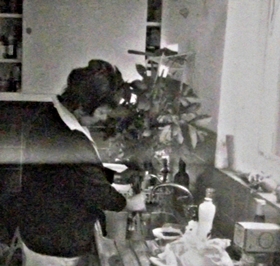
HBY Kitchen 1960s

My late mother (see picture above, taken in the 1960s) was averse to weighing machines.

When she visited the doctor and had to be weighed, she did not want to be told or in any other way infrormed of her weight.

Her dislike of weighing machines extended into the kitchen. There were no kitchen scales in our home. A good cook, she managed without them. However, she did use a conical measuring device made by the Tala company. This contains printed markings that allow the user to dispence known amounts of powdered ingredients such as, for example, flour, rice, and sugar.

Years after my mother died, I married a lady from India. She told me that in the olden days, professional cooks of Indian origin often measured out cooking ingredients by feel rather than using a weighing device. For example if a cake required an equal weight of egg and flour, the cook would hold the egg in one hand and estimate its weight by feel and then measure the required amount of flour, also assessing its weight be feel alone. I do not know whether my mother possessed this skill, but regardless of that she was widely recognised to have been a competent cook.

If you are there, you must try…

TAHARI blogg

I had always wanted to visit Gulbarga (now ‘Kalaburgi’) in northern Karnataka (India), not far from Hyderabad, because of the richness of its medieval Islamic architectural heritage.

When my friend in Bangalore, Mansour, a great gastronome and connoisseur of fine foods, knew we were in Gulbarga, he said:

If you’re there, you must try tahari

Well, we had no idea what this dish comprised, but if Mansour reccomended it, it must be worth trying. A search on Google revealed that the Limra Tahari was highly rated. We rang to make a reservation and were told that was unnecessary. Also, we learnt that the place only took cash payments.

One evening, we hired an autorickshaw to take us to Limra. However, the driver had no idea how to find it, and eventually dropped us near a different restaurant, saying;

This is a restaurant. You can eat here.

It was a totally unsatisfactory eatery.

Next evening, we were fortunate. A rickshaw driver knew where to find the Limra. When we arrived, he told us that he would wait for us as we would not be long and, also, it was difficult to find autorickshaws in the area in the evening. We wondered why, but soon found out.

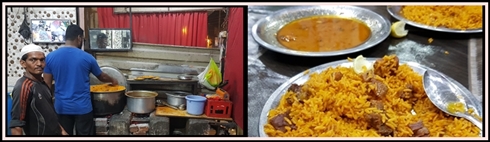
The front of the restaurant was unprepossessing, to put it mildly. The place was separated from the street by a pair of ageing red curtains, rather like that found at a theatre stage. The steps leading up to it from the street were littered with old newspaper and other rubbish. I looked at my wife questioningly. She seemed happy to enter, so we parted the curtains and stepped inside. The interior was spotlessly clean.

To the left of the entrance, an old man sat behind a small cash desk. To the right, there were a couple of men preparing food in huge metal post heated by smouldering charcoals. Limra’s dining area was simple. There were several long narrow rectangular metal tables, which were probably screwed to the floor. All of the diners were men, except my wife.

Before we had time to ask for a menu or what was on offer, a boy slid two metal plates across our table towards us. Each plate was laden with tahari. He added a third plate that contained an unappetising looking greasy sauce. We ordered a couple of bottles of mineral water and began our exploration of tahari.

The tahari consisted of spicy yellow rice which contained a few lumps of well-cooked tender meat. The sauce turned out to be delicious and not at all greasy. The tahari was very tasty and delicately spiced – a real treat. Tahari is, I later discovered, an Awadhi dish from the region of India where Lucknow is located. It is typical of a certain style of Mughal cooking. It is, as we saw when we entered Limra, slow-cooked.

When we finished our tahari, we noticed the menu on the wall behind us. It consisted of two items: tahari: full plate, and tahari: half plate. No wonder, we were served our food immediately. There was nothing to choose from here! Our bill for two full plates and two bottles of water came to only 80 Indian Rupees (about £0.90 sterling). It took us no more than 10 minutes to finish our scrumptious meal. We understood why our driver decided to wait for us, and we understood why the restaurant did not accept anything but cash as payment. So, if you are ever in Gulbarga, you must try tahari!

Learning the lingo: Italian

aerial photography of city


Until I was 16 years old, I accompanied my parents on annual holidays in Florence (Italy). We always stayed at the Pensione Burchianti, which was run by two ageing sisters. Almost every evening, we ate dinner in a nearby restaurant (the Buca Mario). This excerpt from my book CHARLIE CHAPLIN WAVED TO ME describes how I began to acquire some limited skill in speaking Italia. Here is the excerpt:

” … After dinner we would walk back to the Burchianti. It might have been during one of these evening strolls that my father came up with a new version of the saying ‘a penny for your thoughts’, namely: ‘a penne for your sauce’. The traffic in the streets would have quietened down by the time that we had eaten, and all of the traffic signals, or ‘robots’ as my South African parents called them, had flashing amber lights instead of the usual sequence of three coloured lamps. The pedestrian signals, which alternated between the red ‘Alt’ and the green ‘Avanti’ during the day, simply flashed both messages at the same time at night.

When we arrived back at the Burchianti, the residents, who had been eating supper, were usually still lingering at their tables. Many of them almost lived in the Burchianti. There was an elderly commendatore, who took all his meals there but slept elsewhere. There were also a number of business people who spent the week working in Florence, but resided some distance away in the weekend. They lived in the pensione during the week. One of these was a lady pharmacist from Parma who spoke Italian with a curious accent, rolling her ‘r’s in an exaggerated way.

On entering the dining room, we would be greeted like old friends, which I suppose we were. We would be invited to sit at the sisters’ table, and then I had to perform. One of the sisters would ask me in Italian what I had eaten for dinner, and I had to reply in Italian. Everyone listened to my reply which usually went something like this:
Primo piatto o mangiato spaghetti con pomodoro. Dopo o mangiato bistecca con patate fritte. E dopo, profiterole.”

It was not difficult to relate what I had eaten because every dinner I ordered the same thing or substituted lombatina di vitello (veal chop) for the bistecca. This nightly recitation gave me the confidence to try to speak in Italian, even if badly. When I did not know a word, I tried using a Latin word but pronounced it in a way that I believed made it sound Italian. Often, this worked! ...”


If you want to know whether Charlie Chaplin really did wave to me, grab a copy of my book from:

https://www.bookdepository.com/Charlie-Chaplin-Waved-Me-Adam-YAMEY/9781291845051

OR

http://www.lulu.com/shop/adam-yamey/charlie-chaplin-waved-to-me/paperback/product-21611544.html

OR Amazon or Kindle store


Photo by Josh Hild on Pexels.com

Veggie burgers and other creatures

veggie

The popularity of vegetarianism and its relative veganism has greatly increased in the western world in recent years, and is still increasing. Popular reasons for abandoning the consumption of meat and/or products derived from animals (e.g. milk and eggs) include seemingly virtuous reasons such as love of animals and a desire to protect the world’s climate.

On the 23rd of July 1939, one world-famous vegetarian wrote a letter to another equally well-known vegetarian. Mahatma Gandhi wrote to Adolf Hitler. Here it is in a much abbreviated form (from: https://www.mkgandhi.org/letters/hitler_ltr1.htm):

DEAR FRIEND,
That I address you as a friend is no formality. I own no foes.

… We have no doubt about your bravery or devotion to your fatherland, nor do we believe that you are the monster described by your opponents. But your own writings and pronouncements and those of your friends and admirers leave no room for doubt that many of your acts are monstrous and unbecoming of human dignity, especially in the estimation of men like me who believe in universal friendliness

… I, therefore, appeal to you in the name of humanity to stop the war. You will lose nothing by referring all the matters of dispute between you and Great Britain to an international tribunal of your joint choice

You know that not long ago I made an appeal to every Briton to accept my method of non-violent resistance.

During this season when the hearts of the peoples of Europe yearn for peace, we have suspended even our own peaceful struggle. Is it too much to ask you to make an effort for peace during a time which may mean nothing to you personally but which must mean much to the millions of Europeans whose dumb cry for peace I hear, for my ears are attended to hearing the dumb millions? …

I am,
Your sincere friend,
M. K. GANDHI
The letter never reached Hitler; it was intercepted by the British in India.

I have no idea what the monster Adolf Hitler had to say about vegetarianism, but the saintly and peace-loving Gandhi wrote much about his abstinence from meat. For example, in 1932 he wrote:

I do feel that spiritual progress does demand at some stage that we should cease to
kill our fellow creatures for the satisfaction of our bodily wants. The beautiful lines
of Goldsmith occurs to me as I tell you of my vegetarian fad:

‘No flocks that range the valley free
To slaughter I condemn;
Taught by the Power that pities me
I learn to pity them’

(see: https://www.mkgandhi.org/ebks/moralbasis_vegetarianism.pdf)

And at another time:

“It is very significant that some of the most thoughtful and cultured men are partisans of a pure vegetable diet.”“.

Maybe, he was thinking of the man of culture, Bernard Shaw, rather than Adolf Hitler!

Returning to the present day and the increasing appetite for meatless and dairy-free food, let us consider the current desire for vegetarian products to resemble meat products. Supermarket shelves are filling up with veggie burgers, meatless steaks, meatless meat balls, meatless shawarma, and many other products made to resemble meat without containing it. Recently, I was in a Chinese restaurant, which offered diners vegetarian chicken and vegetarian duck dishes. This yearning for vegetarian products to be named like and to look like meat products is absurd,

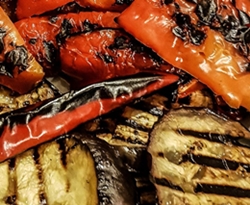
There are plenty of delicious vegetarian dishes that are not made to resemble foods that usually contain meat. Middle-Eastern and Turkish cuisine, for example, offer vegetarian eaters delights such as: humous, fattoush, Imam Bayildi, Mutabbel (an aubergine dish), falaffel, stuffed peppers,etc. Even the French, who until recently have not been overly attracted to vegetarianism, have a traditional dish perfect for vegetarians: ratatouille. As for Indian cuisine, there is a plethora of dishes that are vegetarian and do not try to appear like meat. In India, the land where Gandhi was born, vegetarianism is a way of life, rather than a changed lifestyle, for hundreds of millions of people. This has been the case in India for many millennia.

To conclude, what I am trying to say is that if you wish to abandon eating meat for whatever reason, then you might as well abandon the desire to eat things that look like meat, but are not. If you are adopting vegetarianism, then enjoy meatless dishes for their own sake, not because they remind you of meat! Bon apetit!

Picture source: tesco.com

Shrinking cabbages


Golborne Road intersects London’s famous Portobello Road. I practised dentistry in a clinic on Golborne Road between 1995 and 2001. In those days, Golborne was far less chic than it is today. Every day I used to pass E Price and Sons, a vegetable shop on Golborne.

The shop had a disorderly display of vegetables outside it and was run by a very old couple. I never entered their shop because it seemed to be impenetrable.

On the rare occasions that I purchased anything there, either the old lady or the old man would hurl the produce onto the scales and hardly waited to see the true weight. Then, they would mention a price, always adding the word ‘alright’, pronouncing it as if they were asking the question “is that alright?” They said the word ‘alright’ in such a way that suggested that something was not alright.

My lasting memory of this vegetable shop is of watching either of the man or woman sitting outside the shop removing withered outer leaves from the cabbages. Every day, I noticed that the cabbages on display got smaller and smaller; they seemed to be shrinking.

The shop closed a few years ago, and was later reopened by younger members of the Price family. Sadly, their lovely shop went out of business and the premises are awaiting their new reincarnation.

Burgers

Everyone, who eats them, can reccommend a place that serves the very best beef burgers. Naturally, most people have their own favourites. So, it would seem that there are many places that serve the ‘very best burgers’.  I havetried a few of these highly reccommended places and have with one exception (Gourmet Burger Kitchen – a chain that originated in New Zealand) been disappointed. Most ‘very best burgers’ turn out to be ok (usually) but an anti-climax (mostly).

Now, I am going to seem very conceited. That is because I believe that I make the ‘very best burgers’ myself in our home, and so should you. My recipe is dead simple. I take minced beef with a lowish fat content (10% or less), add a pinch of salt and a small spoon of oil (sunflower or olive) and, after washing my hands, mush the three ingredients together before hand shaping patties of the  sizes preferred by those who will eat them. Then, I cook them on a griddle. That’s all. No egg or breadcrumbs are added.  Try this for yourself and you will no longer be wasting your money on overpriced, mediochre burgers.


ham burger with vegetables


A patty of minced beef 

Mould-ed by hand

Enjoy burger perfection


Photo by Valeria Boltneva on Pexels.com

A sandwich

lgbt

While looking for something to eat on the train between Cambridge and London, I spotted a sandwich in a colourful wrapping (illustrated above). It was a ‘LGBT’ sandwich containing Lettuce, Guacamole, Bacon, and Tomato. Well, the initials ‘LGBT’ usually refer to  ‘lesbian, gay, bisexual, and transgender’. The colours of the sandwich’s  wrapping are those associated with the LGBT ‘community’. 

I wondered whether M&S, the suppliers of this colourfully wrapped sandwich were:

  1. trying to appeal to LGBT customers
  2. trying to be ‘politically correct’
  3. both of the above
  4. neither 1 nor 2
  5. having a laugh at the expense of the LGBT ‘community’
  6. or, all of the above  

Who knows? I did not buy this sandwich, but selected a similar one, the BLT, which lacks guacamole.