Transported from Florence (Italy) to South Kensington (London, UK)

WHILE WAITING FOR an item to be delivered to me at the National Art Library, which is housed within the Victoria and Albert Museum (‘V&A’) in South Kensington, I had time to look around the museum. The V&A is a treasure house filled with fascinating exhibits from all around the world. Today, I noticed something that had not caught my eye before. It is an entire Italian Renaissance chapel, which was transported from Florence to its present location in the V&A.

This chancel chapel used to be part of the Santa Chiara convent in Florence. The convent belonged to the Poor Clares, who were female branch of the Franciscan order. Mass used to be held in this small chapel, which was constructed in the first half of the 15th century. Following the 1808 Napoleonic suppressions (of Italian religious orders), the chapel became used as a sculptor’s studio in the 1840s and 1850s. The V&A’s website (https://collections.vam.ac.uk/item/O17758/chancel-chapel-from-church-of-chapel/#object-details) revealed:

“In 1860, J. C. Robinson bought the chapel on behalf of the V&A, and it was dismantled and shipped to London, whereupon it was reassembled in the North Court of the Museum … In 1908 the chapel was moved from the North Court to the eastern apsidal end of the Aston Webb wing of the museum, parallel to Cromwell Road, where it remains today.”

Because of its relocation to London, the chapel is the only example of an Italian Renaissance chapel to be seen outside Italy. Moving this chapel was a less ambitious achievement that what can be seen at the Met Cloisters in Manhattan. At this museum, several entire cloisters, which had been removed from France, have been reassembled for visitors to see. Heaven forbid that the Italians will begin demanding to return the chapel, and that the French will seek repossession of their cloisters. I feel that these repatriations are even less likely than the Elgin Marbles being sent back to Greece.  

An interesting intersection

WHERE BURLINGTON GARDENS meets the south end of New Bond Street and the north end of Old Bond Street, there are two things that reminded me of my late mother.

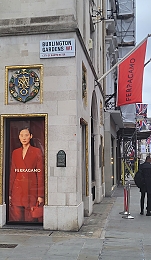
One of them is a shop in a colourfully decorated building. This edifice used to be the home of Atkinson’s – a firm that sold perfumes and beauty products. Founded in 1799, it moved to the building on the corner of Burlington and Old Bond Streets in 1832. The decorative building is surmounted by a carillon of 23 bells, which is played by hand occasionally – to celebrate both public and private special occasions. Currently, the ground-floor is occupied by a branch of Ferragamo’s. And this firm has a connection with memories of my mother.

Salvatore Ferragamo (1898-1960), born in Italy, was a designer of luxury shoes. His clients included the Maharani of Cooch-Behar, Eva Peron, and Marilyn Monroe. He died in Florence (Firenze), where he had a shop on the Via dei Tornabuoni. This shop was close to Via del Giglio, where we as a family used to spend a fortnight in the city every year until I was about 15.

One of my clearest memories of our sojourns in Florence was not the Uffizi or the famous Duomo or the Medici Chapels, or even Michelangelo’s statue of David, but Ferragamo in Via dei Tornabuoni. You might wonder why. It was not that I have a shoe fetish or any great interest in footwear. It was because of my mother. Hardly a day passed without us having to enter Ferragamo’s to watch my mother trying on several pairs of shoes. For a youngster like me this was not an interesting way to spend my precious school holidays. And what is more, I cannot recall my mother ever buying a pair of shoes in that shop.

Facing Ferragamo’s on the corner of New Bond Street and Burlington Gardens, there is a small paved open space. In the middle of it, there is a bronze sculpture of a horse and rider. This was sculpted by Elisabeth Frink (1930-1993). My mother was also a sculptor and met Frink (or ‘Liz Frink’, as we knew her) at St Martins School of Art (in Tottenham Court Road), where they both worked in the Sculpture Department. They became close friends. I used to meet Liz Frink when she was invited to our house for dinner occasionally.

The Frink sculpture has been on Bond Street since 2018. Before that, it was located at the corner of Dover Street and Piccadilly, where it was placed in about 1975. As for the branch of Ferragamo’s that faces it across Burlington Gardens, I am not sure how long it has occupied its present site. However, it was only today that it occurred to me that the intersection of the two Bond Streets with Burlington Gardens has a connection with recollections of my mother.

Freshly painted frescos at Tate Britain

FRESHLY PAINTED FRESCOS

UNTIL I WAS SIXTEEN, my parents took me to Florence (Italy) every year, except in 1967 – the year after the city had been devastated by a flood. My parents were crazy about Italy, the Italians, and Italian art. In Florence, we used to view many frescos in churches and palaces and even those removed from their original locations and placed in museums.

Traditional fresco painting was a laborious process, which produced durable images on walls and ceilings. To create a fresco, first a couple of layers of plaster are applied to a surface (wall or ceiling) and allowed to dry. Then, the artist(s) sketch the image that will eventually be created. Next, a part of the sketch is covered with fresh plaster. The extent of this is the area which the artist can paint during one day. While the plaster is damp, the artist paints that section of the picture with water-based coloured paints. As the plaster dries, the paint becomes incorporated within it, producing a surface more durable than if the paint had been painted onto dry plaster. Day by day, section by section, the process is continued until the whole image has been finished.

I mentioned that some frescoes have been moved into museums. The Italians developed a method for doing this. The fresco to be moved is covered with a cloth sheet coated with adhesive, Then the cloth is pulled away from the wall or ceiling. As it is peeled away, it takes with it that layer of the fresco that contains the paint-absorbed layer of plaster. When this layer has been removed, the artist’s sketch becomes revealed. This is of great interest to historians of art, who can learn how the artist developed his final product from his original sketch. This whole process fascinated me when I was a child, and still amazes me.

Most of the great Italian frescos were created many centuries ago, and the process has fallen out of fashion. Well, at least that is what I believed until I visited a lovely exhibition at Tate Britain. On show until the 7th of May 2023, it is a display of works created by Hannah Quinlan (born 1991) and Rosie Hastings (born 1991). They have created six large, colourful images depicting, to quote the Tate’s website:


“…street scenes showing groups of people portraying various power dynamics, class and social relations and positions of authority.”


Attractive and fascinating as these works are, what really intrigued me is the way that they were made. The paintings, which have been created during the last few years, have been executed using traditional fresco technique such as I described above. In an interview recorded on the Tate website, they were asked why they used this archaic technique, and they replied:


“Fresco painting is often found in places of political, legal and educational importance and is executed at a monumental scale. Traditionally, frescos depict scenes loaded with ideology and symbolism while presenting themselves as neutral or universal. A fresco often represents the moral code of the time within which it is painted, intended as an instructional and educational medium that reinforces dominant perceptions.”


I can understand this, and like their reasoning. I enjoyed the exhibition, and encourage others to take a look. Enjoy the frescos, but do not omit to examine the lovely drawing the artists created using graphite.

Don’t even think about doing these things

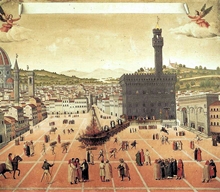
AS A SPECIAL TREAT when I was a young child, I was allowed to feed the pigeons on Piazza Signoria in Florence (Italy), a city we visited annually during my childhood. My parents used to purchase paper cones filled with corn kernels for my sister and me. We used to put a few of these in the palms of our hands and allow the pigeons to perch on our fingertips whilst they fed on the corn. Looking back on this activity, which gave me great pleasure, I am surprised that my health and hygiene conscious mother allowed what the former Mayor of London, Ken Livingstone, called ‘rats with wings’ to risk sullying our hands and harming our health.

Oddly, when we were kids, we fed the pigeons in Florence but never fed their cousins that flocked around Trafalgar Square in London. Today, the 25th of April 2022, my wife and I walked across Trafalgar Square and observed that nowadays there are signs that indicate that feeding pigeons is forbidden. However, this activity, which I enjoyed as a child on holiday in Florence, is not the only thing forbidden in Trafalgar Square. The lovely fountains in the square now contain signs in the water, on which the words “No Entry” are written. Yet another activity in the square is no longer allowed. There are signs to deter visitors from climbing on the sculptures of the lions that lie at the base of Nelson’s Column. So, when you next visit Trafalgar Square with plans of feeding the pigeons, or bathing in the fountains (even to celebrate New Year), or straddling a lion, do not realise any of them: they are all outlawed.

Buried no longer

THE ITALIAN WRITER and patriot, Ugo Foscolo (1778-1827) was born on Zakynthos when it was part of the Venetian Republic. He became a political activist in what is now Italy and came to London in 1816. In London, he was regarded as a literary celebrity, but this did not always keep him out of trouble. For example, in about 1813 he faced Mr Graham, the editor of the “Literary Museum” in a duel at Primrose Hill. The dispute that led to this was about his ‘Three Graces’.  These three ladies were sisters working in Foscolo’s home near Regents Park. Two of them turned out to be prostitutes, and one of them ran off with his former translator. This led to a duel, whether in Regent’s Park or Primrose Hill is not clear; fortunately, no blood was shed.

Foscolo’s monument in Chiswick

Foscolo lived another few years until 1817, when he died in Turnham Green in west London. He was buried in the lovely churchyard next to the Chiswick church of St Nicholas, where the artist William Hogarth was also interred. The cemetery contains Foscolo’s elegant, well-maintained grave, which is surrounded by a cast-iron railing.

However, Foscolo’s remains are no longer in the old cemetery at Chiswick.

In June 1871, ten years after the Unification of Italy, Foscolo’s remains were dug up and transported to Florence (Firenze). There, they were reburied but within the church of Santa Croce. This is all recorded by words carved on the monument in the Old Chiswick Cemetery.

Bridges over troubled waters: the Florence Flood 1966

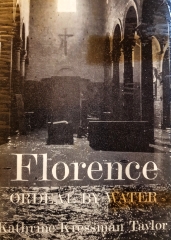
I HAVE JUST finished reading a book about an incident that made a great impression on me and my close family many years ago. The slender volume, “Florence. Ordeal by Water” was written by Kathrine Kressman Taylor (1903-1996), who was an eye-witness to the event that troubled our family so much. The book was first published in 1967.

During my childhood, my parents, who were keen on the art of the Italian renaissance and Italy in general, took my sister and me to the city of Florence every year (until about 1969), except 1967. Visiting churches, museums, and art galleries was not exactly my ‘cup of tea’ when I was a child, especially when I knew that my best friend was enjoying what sounded to me like a far more exciting holiday than mine. Now with the benefit of hindsight, I realise that the experiences that my parents gave me were actually far more valuable than anything I could have gained from annual holidays at a seaside resort in North Wales, where my friend went every summer.

I mentioned that in 1967, we did not make our annual visit to the city on the River Arno, Florence (Firenze). This was because the city was severely affected by a flood in November 1966. This inundation was caused by heavy storms and ill-advised opening of a dam on the River Arno upstream from Florence. The water caused much damage. I remember that when my parents heard that it had happened, they appeared to be as devastated as if a close, much-loved friend or relative had died suddenly.  They decided that visiting the stricken city in 1967 was inadvisable, so we returned in 1968. What we found in 1968 was distressing. The flood water, which had become mixed up with central heating fuel oil, had stained the walls of the city’s buildings, leaving a tide line at the often-high levels that it had reached. These marks remained for several years. In low-lying parts of the city, the water had reached the upper floors of buildings. In addition to damaging the buildings, the water also destroyed many irreplaceable works of art. Dad was particularly upset about the heavy damage suffered by a crucifix painted in about 1265 by Cimabue, which hung in the Church of Santa Croce. He used to mention this often. I felt that this affected him more than the damage to the rest of the city.

Miraculously, the surging waters of the Arno in spate and laden with tree trunks and other heavy debris did not significantly damage any of the many lovely bridges that cross the river. This is unlike what happened at the end of WW2 when the retreating Germans destroyed all the bridges except the Ponte Vecchio.

Kathrine Kressman Taylor, whose book I have just read, was living in a palazzo in Florence when the great flood hit the city. Her book is a diary of what she and the Florentines experienced when the waters of the Arno almost destroyed the city, and the aftermath. It is a compelling account of the tragedy, filled with vignettes and anecdotes that illustrate the true horror of what happened. What shines out in her account was that despite overwhelming odds, the Florentines refused to be defeated by the events that rendered many homeless and caused an even greater number to lose all their worldly possessions and their livelihoods. As soon as the oil-filled, filthy waters began to subside, the citizens of Florence as well as foreigners who had become trapped there began to work on restoring the city.

Reading Kressman Taylor’s account has given me a much clearer idea of the extent of the disaster than I had as a youngster just after it had happened.

By the way, I must mention how I ‘stumbled’ across this marvellous book about Florence. A friend had given me a copy of the recently republished novella, “Address Unknown”, by Kressman Taylor. First published in 1938, this book subtly drew her readers’ attention to the plight of Jewish people in Nazi Germany. Having read and enjoyed it, I looked to see what else the author had written. When I saw that she had written about the flood that had upset us so much in 1966, I had to read it, and I am pleased that I did.

Cups of ice-cream and…

Remembering the 1960s in Florence, Italy

florence

The short Via dei Tavolini was another of our regular morning destinations in Florence. Situated in the heart of the city between the Duomo and the Uffizi, we visited this street frequently during each visit to the city. It contained 3 important shops: the ice-cream shop called Perché No? (‘Why not?’), a dress material shop, and a shop with the name  ‘Busti Biondi’. It was in the latter that my mother had her brassieres made to measure.

During my earlier visits to Florence, when my parents were less confident of their spoken Italian, they were assisted by Giorgio, who owned the material shop between the ‘bra’ shop and the ice-cream parlour. Giorgio, who had learnt English from British soldiers during WW2, translated for my parents. Like so many Italians, he was fond of children, and we grew to like him. For years, he used to send my sister first day covers of newly minted Italian postage stamps. His patience must have been impressive because my mother was not an easy customer. She and my father spent what seemed like hours in Busti Biondi whilst the bras were tried on, discussed, and returned for endless
alterations.

My mother was buxom, a trait shared by many ladies in her family, and extremely particular that things should be just right. As far as I was concerned, the positive feature of these visits to the Via dei Tavolini was seeing and talking with Giorgio as well as the chance to enjoy cups of some of Florence’s best ice-cream. We thought that Perché No? was the best ice-cream place in the city, but others favoured Vivoli, a gelateria close to the church of Santa Croce. We did try that place, but it failed to change our high opinion about our favourite place close to my mother’s bra shop. If it had not been for my mother’s breasts we would not have met Giorgio and might have never discovered Perché No.


This is a brief extract from my book “Charlie Chaplin waved to me” available on Kindle and also as a paperback by clicking HERE


photo source: wikipedia

Learning the lingo: Italian

aerial photography of city


Until I was 16 years old, I accompanied my parents on annual holidays in Florence (Italy). We always stayed at the Pensione Burchianti, which was run by two ageing sisters. Almost every evening, we ate dinner in a nearby restaurant (the Buca Mario). This excerpt from my book CHARLIE CHAPLIN WAVED TO ME describes how I began to acquire some limited skill in speaking Italia. Here is the excerpt:

” … After dinner we would walk back to the Burchianti. It might have been during one of these evening strolls that my father came up with a new version of the saying ‘a penny for your thoughts’, namely: ‘a penne for your sauce’. The traffic in the streets would have quietened down by the time that we had eaten, and all of the traffic signals, or ‘robots’ as my South African parents called them, had flashing amber lights instead of the usual sequence of three coloured lamps. The pedestrian signals, which alternated between the red ‘Alt’ and the green ‘Avanti’ during the day, simply flashed both messages at the same time at night.

When we arrived back at the Burchianti, the residents, who had been eating supper, were usually still lingering at their tables. Many of them almost lived in the Burchianti. There was an elderly commendatore, who took all his meals there but slept elsewhere. There were also a number of business people who spent the week working in Florence, but resided some distance away in the weekend. They lived in the pensione during the week. One of these was a lady pharmacist from Parma who spoke Italian with a curious accent, rolling her ‘r’s in an exaggerated way.

On entering the dining room, we would be greeted like old friends, which I suppose we were. We would be invited to sit at the sisters’ table, and then I had to perform. One of the sisters would ask me in Italian what I had eaten for dinner, and I had to reply in Italian. Everyone listened to my reply which usually went something like this:
Primo piatto o mangiato spaghetti con pomodoro. Dopo o mangiato bistecca con patate fritte. E dopo, profiterole.”

It was not difficult to relate what I had eaten because every dinner I ordered the same thing or substituted lombatina di vitello (veal chop) for the bistecca. This nightly recitation gave me the confidence to try to speak in Italian, even if badly. When I did not know a word, I tried using a Latin word but pronounced it in a way that I believed made it sound Italian. Often, this worked! ...”


If you want to know whether Charlie Chaplin really did wave to me, grab a copy of my book from:

https://www.bookdepository.com/Charlie-Chaplin-Waved-Me-Adam-YAMEY/9781291845051

OR

http://www.lulu.com/shop/adam-yamey/charlie-chaplin-waved-to-me/paperback/product-21611544.html

OR Amazon or Kindle store


Photo by Josh Hild on Pexels.com

My artistic mother

HELsculpt2


My late mother died at the age of 60 in 1980. Her mother, who was born late in the 19th century in South Africa, held an old-fashioned opinion that girls should not attend university however bright they were. My mother would certainly have been able to cope with a university course of study, but, instead, she enrolled in the prestigious Michaelis  School of Fine Art in Cape Town. Founded in 1925, it is now ironically a department of the University of Cape Town.

Mom studied commercial art. Her first employment was hand painting posters, advertising cinema films. When I began visiting India in the 1990s, many film posters were still being painted by hand. Often, we saw workers perched on rickety bamboo scaffolding, painting the details of huge posters. Two years ago while visiting Bhuj in Kutch (part of Gujarat), we found a workshop where two men produced hand painted posters. They told us that the demand for these was dying out rapidly. It is interesting to note that, like my mother, the great Indian artist MF Hussain began his creative life as a painter of cinema posters.

Returning to my mother, she designed and painted advertising material for the Red Cross in Cape Town during WW2. In 1947, she followed her fiancé, my father, to the UK. She married in 1948, and I arrived a few years later. According to my father, Mom took painting classes with the the famous Sir Stanley Spencer (1891-1959).  Sometime after that, she began creating sculptures.

When I was born, I had a torticollis (twisting of muscles of the neck beyond their normal position) that caused my head to be bent to one side. At that time in the early 1950s, the doctors told my mother that there was nothing to be done about this, and we would just have to live with it. My feisty mother refused to believe this. Every day, she manipulated my head and neck and gradually corrected the situation. Whether it was this manipulation that caused my mother to become a sculptor, I cannot say. However, one of her first sculpures was a terracotta mother and child, which she reproduced much later as an alabaster carving (see photo above).

When I was a young child, my mother used to attend the sculture studios at the St Martin School of Art in London’s Tottenham Court Road. She was not a student; she used the facilities and received advice from other sculptors including Philip King and Antony Caro. At that time, she became a close friend of the sculptor Dame Elizabeth Frink, who visited our home regularly. At St Martins, Mom learnt how to weld and work with metal. She created several quite attractive abstract metal artworks. Being a perfectionist, she destroyed much of what she made, but not before having it photographed by a competent photographer. Sadly, these photos have gone missing.

By the time I was a teenager, my mother had ceased working at St Martins, possibly not of her own volition. She rented a large garage in Golders Green and used it as a studio, where she created huge abstract sculptures in timber. She found working on her own to be lonely. However, without the benefit of proper lifting equipment, she produced quite a few sculptures.

Around about 1970, Mom began complaining of back pains, which she thought were the result of the heavy work she was doing in her garage. She abandoned the garage and more or less stopped creating any artworks except for a very few abstract pen and ink drawings, which she considered good enough to be framed.

The back pains continued. My mother became disillusioned with the contemporary art scene. She was familiar with the great renaissance  works of art which she visited every year in Florence (Italy), and comparing these with what she and her contemporaries were producing added to her disinclination to produce any more art of her own. For the last ten years of her life, Mom continued to search (unsuccessfully) for an interest to replace the creation of art. Tragically, she died young because of a cancer, which might well have been contributing to her long-lasting back pain.

Whatever the reason, if an artist loses the urge to create, it must produce a huge hole in his or her life, something like losing a loved one.

A suitcase of memories

Memories of childhood. Here is the introduction to a travel book, “CHARLIE CHAPLIN WAVED TO ME”, which I published several years ago:

charlie

The attic of my parents’ house in north London contained a number of old Revelation suitcases. These were plastered with ageing colourful paper stickers bearing the names of shipping lines and also of places such as: Cape Town, Southampton, Harwich, New York, Montreal, and Rotterdam. Had they been animate and able to speak, what tales they would have been able to tell!

If, as a child, I had become a suitcase, I too would have been covered with an exotic assortment of stickers including some of those mentioned above. But, I did not become a piece of baggage, and the stickers that I carry are not made of paper. Instead, they are memories stuck in various compartments of my brain. Unlike the inanimate objects in the attic in the eaves of our house, I am able to speak: to divulge my impressions of the places that I visited in my childhood; to describe the remarkable people I met in those places; and to reveal the unusual experiences that resulted from travelling with my learned father and my talented mother.

This book contains my memories of the holidays and trips that I took with my parents, mostly during the first eighteen years of my life. They are worth relating because they differed markedly from the kinds of holidays that most people took during the 1960s and 1970s. Rather than exposing their children to the sun on the beach, my parents preferred to expose my sister and me to cultural experiences that, they hoped, would benefit us in the future. This was due to my father’s great interest in the history of art, which resulted from my mother being an artist. Whereas now I appreciate what they did for me then, I did not always do so at the time.

Please join me now as I examine the stickers in my memory – the souvenirs of many years gone past. Let them reveal to you how interesting school holidays can be even if they only include the rarest of glimpses of the sea and an almost total absence of ‘child-friendly’ activities.

These memories of my childhood travels are illustrated with photographs, all of which were taken by me or with one of my own cameras unless otherwise stated. I was given my first simple camera when I was about 6 or 7 years old. It was not given to me by my parents, who never took photographs, but by my uncle Sven who was a keen photographer. His grandfather had been a pioneer of professional photography, as I will describe below. I will begin my narrative by choosing a label that could have been pasted on to my suitcase of reminiscences during the late 1950s or any time in the 1960s. It bears the name “Soho”. I have chosen it amongst all of the others because it provides a good introduction to my mother, who affected so much of what we did as a family and what will be related in this book.


CHARLIE CHAPLIN WAVED TO ME

(ISBN: 9781291845051)

is available at:

Amazon, bookdepository.com, lulu.com , and on Kindle