A BOOK FROM A LIBRARY IN SOUTH AFRICA AND AN ANCESTOR

IN AUGUST 2003, we spent a day in Aliwal North (now called ‘Maletswai’). This small town on the northern border of South Africa’s Eastern Cape Province is not on many tourists’ itineraries. We went there for a special reason. It was originally named after the Battle of Aliwal (1846), a British victory during the First Anglo-Sikh War.

The town was laid out in 1849. When this happened, the Jewish mercantile firm, Mosenthals, opened a branch in the newly established town. After a few months, they sent a young man, Heinrich (later ‘Henry’) Bergmann (1831-1866), to manage the new store and to help sell land in the embryonic township. Very rapidly, Bergmann became one of the most prosperous people in Aliwal North. He owned much land and managed a bank in the town. Soon, he was so successful that he took over the town’s other two banks. For reasons that are not altogether clear, but they might have had something to do with a financial problem, Bergmann shot himself. Having committed suicide, neither the small Jewish cemetery nor the Christian one was prepared to bury him. In the end, his friends the De Wet family, who farmed in the district, buried him in their private family cemetery, and that is where we saw his gravestone when we visited Aliwal North in 2003.

Henry Bergmann was my mother’s grand uncle.

Arriving in what was then the Cape Colony in 1849, he was the first member of my family to migrate from Germany to southern Africa. He was also amongst the small number of Jewish people who came to that part of the world in the first half of the nineteenth century. The majority of Jewish migrants to what is now South Africa began arriving after the late 1860s, as I have described in my book “Exodus to Africa”.

We visited Aliwal North in 2003 as part of my research into the life of Henry Bergmann. Apart from meeting members of the De Wet family, descendants of those who buried Bergmann, who showed me family histories containing details of my ancestor’s life and fields that were once owned by him, we spent some time with Mrs Joubert, the librarian of Aliwal North’s public library. She was extremely helpful and took a great interest in my research.

Aliwal’s library was selling a few books that were no longer needed. My wife bought a few novels, one of which was “Mr Mirakel” by E Phillips Oppenheim (1866-1946). The book we bought contains the words: “First printed  … 1943”. It is a first edition. Inside the book, there are labels inserted by the library. They are printed both in English and Afrikaans. There are also four imprints of an inked rubber stamp. Each one reads: “Aliwal North. Public Library. Cape of Good Hope.”

Just before 1910, when the Unification of South Africa occurred, what had been known as the Cape Colony became known as ‘The Cape of Good Hope Province; (‘often shortened to ‘the Cape Province’). In 1994, this vast territory was divided into the Northern Cape, Western Cape, and Eastern Cape provinces. Given that the book can only have been acquired in or after 1943, the words ‘Cape of Good Hope’ on the stamp intrigued me. Although they do refer to a geographic entity, they have never, as far as I can see, referred to an administrative area, and did not do so on or after 1943 when the book was published.

Had we not been sorting out our books recently, we would not have come across the book from Aliwal North. Seeing it and its library labels and stamps brought back memories of our visit to Aliwal North 22 years ago.

Footpaths in the Painted City: a journey of discovery

HERE IS A BOOK which I have found fascinating. It is “Footpaths in the Painted City” by Sadia Shephard. It was published in 2008. The American born author’s father was an American Protestant, and her mother a Muslim from Pakistan. Her mother’s mother, Nana, converted to Islam when she married in Pakistan. However, early in the book, Sadia reveals how she discovered that Nana was born Jewish in pre-independence India.

What made the book especially interesting is that Nana was born into a Beni Israel family. Nobody is sure of the origins of the Beni Israel Jews, who reside mainly in the western Indian state of Maharashtra. It is commonly said that they are the descendants of Jewish people who left Israel after the destruction of the Second Temple in Jerusalem, and made their way by land and sea to the western coast of the Indian Subcontinent. They have adhered to all the rituals followed by members of other Jewish communities for many centuries. Until some European traveller in India recognised their adherence to Jewish religious ways of life during the nineteenth century, it is said that the Beni Israel community were unaware that they were Jews.

In her book, Sadia tries to discover more about Nana’s life story and the Beni Israel community into which she was born. To do this, the author travelled to both Pakistan and India. Her account of her time in India, investigating what remains of the country’s Beni Israel communities is fascinating and gives the reader a good idea of what a young lady experienced while living on her own for several months in India.

I have greatly enjoyed reading this engaging and moving book, and can recommend it to anyone interested in Judaism in India, the Beni Israel community, family history, travel, and any combination of these.

Hitler, Stalin, Mum and Dad

I have just finished “Hitler, Stalin, Mum and Dad” by Daniel Finkelstein.

Based on the true story of his parents and other family members, this is a page-turner. His mother’s family, German Jews, were caught up in Hitler’s genocidal activities. His father’s family were sucked into Stalin’s notorious Gulag system. Many members of the author’s family lost their lives during WW2. However, some of them survived. Finkelstein guides the reader effortlessly through the history of this horrific period of Europe’s history. Meticulously researched, this is an engaging read and very fascinating.

I can strongly recommend this book.

Bushy eyebrows running in the family

PEOPLE WHO HAVE met me often remark on my bushy eyebrows. Barbers are always keen to trim them, but I will not let them do that.

Many years ago, sometime in the 1980s if I remember correctly, my father and I were invited to a birthday party to celebrate the 70th birthday of my Dad’s step-brother Frank Walt. It was a large gathering held in a house in London’s St Johns Wood. Apart from my father, there was nobody at the occasion, whom I had met before. While I was wandering about rather aimlessly, a small lady came up to me, and declared in a North American accent:

“You must be a Halperin. You have the Halperin look.”

At that time, I had no idea what she meant by this. Even though I had no clue about what she was talking about, what she said made me feel good – I felt it was special to be recognised as part of a ‘clan’ by someone who did not know me ‘from Adam’, as the saying goes.

I now know about the Halperin family. Put simply, my father’s mother was Leah (née Halperin). She was one of the six children of Joseph and Deborah Halperin. A few days ago (in February 2024), a cousin sent me a photograph of Leah’s brother Wolf Halperin. I looked at it, and immediately realised what my fellow guest at Frank’s party had meant by the ‘Halperin look’. Wearing a Fedora hat, Wolf’s eyebrows immediately reminded me of mine and those of other members of the Yamey family. Seeing this was uncanny.

Wolf Halperin died many years ago, long before I began visiting India. Last November (i.e., 2023), we visited a small shop in Baroda (Gujarat). It was not our first visit. We had been there once about 5 years earlier. The shopkeeper recognised us immediately. As he said (in Gujarati) “I remember you”, he pointed at my eyebrows.

A beneficient ruler of a kingdom now part of Gujarat

THE AINA MAHAL (‘Palace of Mirrors) in Bhuj (Kutch, Gujarat) was constructed in about 1750, and badly damaged during the terrible earthquake of 2001. Luckily, some of the palace survived, and several rooms containing an intriguing variety of objects can be visited by the public. Above these, there is another floor, which is not accessible to the public. A prominent member of the royal family of Kutch, with whom we have become friendly, kindly showed us around these rooms, which include the old Durbar Hall where the ruler, the Maharao, used to hold audiences. After 1868, when a new palace, the gothic revival style Pragmahal, was built, the rulers of Kutch used its larger durbar.

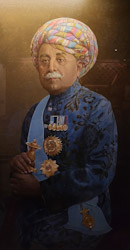
The old durbar Hall in the Aina Mahal contains fine painted portraits of some of the previous Maharaos. One of these depicts Maharao Desarji II, who ruled from 1819 to 1860. Amongst his many achievements he encouraged the study of mathematics, geography, and astronomy. He developed schools and hospitals. And he also put an end to slave trading in Kutch. In addition, he put an end to the practice of sati (‘self’-immolation of widows during their husbands’ cremations).

His son Pragmalji II, who ruled from 1860 to 1875, not only had the Pragmahal place built but also encouraged education. It was during his reign that the Alfred School was built. It was named in honour of Queen Victoria’s son Prince Alfred, who visited India in 1869/70.

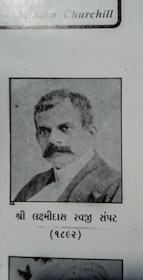
My wife’ great great grandfather, Laxmidas Ravji Sapat, was the 11th headmaster of the Alfred High School between 1888 and 1892. This was during the reign of Maharao Khengarji III, who ruled Kutch from 1876 to 1942. He loved wildlife and took an interest in education. Amongst the many things he did was establishing the Museum of Kutch and the Jubilee Hospital – both in Bhuj. He also helped Laxmidas Ravji Sapat.

After being headmaster of the Alfred School, Laxmidas and his son-in-law went to London to study law, Mr Thacker, at Middle Temple. Going to London to study was expensive. As both Laxmidas and his son-in-law, Mr Thacker (my wife’s great grandfather) were bright, their community, the Kutchi Bhatias, clubbed together to help finance the education of these two promising men. Additional money was donated by the Maharao (Khengarji III), who, as already mentioned, was keen on promoting education.

I am grateful that we were privileged to have been shown around a part of the Aina Mahal not open to the public. Apart from seeing something new and having a member of the royal family to explain things, we managed to see portraits of his ancestors, each of which was accompanied by labels that summarised their achievements.

LOOKING FOR A HEADMASTER IN BHUJ: FURTHER EXPLORATION OF FAMILY HISTORY

AT THE END OF January 2023, I wrote:


“My wife’s mother’s great grandfather was one Laxmidas Ravji Sapat (aka Sampat), who was born in the mid-19th century, or a bit earlier. Along with Gokaldas Parekh, Laxmidas was one of the first teachers in the Alfred High School in Bhuj (founded by Rao of Cutch, Pragmalji II in 1870). It is likely that he was its headmaster for a time. I have yet to see it, but his portrait hangs in the school. One of my wife’s relatives, also a descendant of Laxmidas, arranged to have it restored a few years ago.
In 1890, Laxmidas left the school. Later, along with his son-in-law, Cullyanji Murarji Thacker, he went to London (UK) to become a barrister. He studied for the Bar at Middle Temple and was called to the Bar on the 27th of June 1900, along with his son-in-law, Mr Thacker, who was my wife’s mother’s grandfather.” (https://adam-yamey-writes.com/2023/02/02/running-in-the-family/)

Laxmidas Ravji Sapat

Today, the 25th of November 2023, we visited the Alfred School in Bhuj in search of the portrait of Laxmidas Ravji Sapat. We were shown a board on which the headmasters of the school were listed. On it we discovered that Laxmidas had been headmaster between 1888 and 1892. He was the school’s eleventh headmaster. It appears that he left the school two years later than I had been told.

As for the portrait of Laxmidas, the officials at the school had no knowledge. They suggested we try the museum next door. Part of this now owns the school’s original building, which was restored after the 2001 earthquake that destroyed much of Bhuj. Despite being part of the museum, the old school building stands disused and being renovated.

At the Bhuj Museum, we asked about the portrait. We were told that it is not in the museum. So where is it? In a few days time we will return to the school to visit its current headmaster. Maybe, he might know where it is. Until then, watch this space!

A small town in South Africa

B 11 Barkly East evening BLOG


MY MOTHER AND THREE OF HER four siblings were born in King Williams Town (South Africa) in the home of their grandfather Franz Ginsberg, who became a Senator in the South African parliament in 1927. They spend the first few years of their lives in the tiny town of Barkly East in the Eastern Cape. Their father, who ran a general store, was also the town’s Mayor until he died in the early 1930s.

My mother migrated to England in 1947. Her sister, my aunt, and one of her brothers arrived in England in the 1950s. Both of them had vivid memories of their childhood in Barkly East, which they happily shared with me.

In 2003, we made a trip to South Africa in order to see places associated with my ancestors, who migrated there from Europe during the 19th century. We hired a car to travel between these scattered places. One of them was Barkly East.

Before leaving England, I discussed Barkly East with my aunt and noted what she told me. During one of these discussions, she drew a sketch map of Barkly East,  marking on it various places she recalled. I took her map to South Africa with me.

Barkly East was established in 1874. In 1885, my maternal grandfather’s uncle Sigmund Seligmann, who came to South Africa from Ichenhausen in Bavaria in about 1865. His nephew, my mother’s father, took over Seligmann’s store in the first decade of the 20th century and ran it along with Mr Blume.

Barkly East was an important commercial centre for the many sheep farmers and wool producers in the district. It began to decline greatly when the usage of motor vehicles increased and farmers were able to reach the far larger centre the town of East London.

When we arrived in Barkly East in 2003, we found a town with almost empty streets that gave little or no feeling of its once prosperous past. It looked like a place on its ‘last legs’, a bit like London is now during the Coronavirus ‘lockdown’.

On our first day we visited the office of local newspaper,  the Barkly East Reporter,  which was then run by the two Mollentze brothers. They welcomed us and told us a lot about Seligmann’s shop, a place where you could buy everything from a needle to a tractor.

I showed my aunt’s map to the brothers. Despite the fact that she had left the town on the early 1930s, they said her map was very accurate.

Using her map, we found the location of her father’s store, which burnt down in the 1960s. The firm’s wool storage warehouse still stood. It was near to the small street where my mother and her siblings spent the first few years of their lives. It stands next door to the house once owned by Mr Blume.

We were keen to see inside my mother’s childhood home. A young man, probably a teenager,  was sweeping the front porch. His name was Frikkie. We explained our interest in the house. Without hesitation, he showed us around the house despite his parents being at work in their café located near a bridge named after my mother’s father.

It made my spine tingle wandering around the building where my mother was a child. Not having seen it before I was unaware that many internal changes had been made to the building since my mother’s family sold it after my grandfather,  the Mayor of Barkly East, died at an early age.

After my mother’s family left Barkly East, their large house was used for a time as a nursing home before being reconverted to a family residence. My aunt’s two children visited Barkly East in late 2019. They found the old family home, but were unable to enter it. Currently, it houses the offices of the local branch of the African National Congress (ANC). How the tide has changed! In my mother’s childhood, the only non-Europeans who would have entered the house were domestic servants.

We also visited the tiny museum in Barkly East,  where we were welcomed by its curator. Like other curators of local museums in other small South African towns we visited, the curator in Barkly East was concerned about their future in the light of lack of both funding and footfall. She told us about the six or so Jewish families in Barkly East. The last of these, the Bortz family, to leave the town had moved elsewhere a few years before our visit.

The curator said that the Bortz family home had stood empty since they left. Then, after rummaging in a drawer,  she showed us a small metal object in the palm of her hand, and said:

“I know I shouldn’t have done it, but I prised this off the frame of the front door of their empty house long after they left. I took it for the museum. Had I left it there, it would have been taken by someone else eventually. Are you able to tell me what it is?”

It was an empty mezuza, a casing for a prayer scroll that Jewish people attach to the doorframes of their homes and sometimes also within them.

On the last day of our visit to Barkly East,  we visited its extensive cemetery, overlooked by a sad looking shanty town. The small Jewish cemetery containing 11 graves, mostly damaged but identifiable was surrounded by a fence, separated from the resting places of white skinned gentiles. Even after death, apartheid exerted its unsavoury influences. The graves of non-Europeans were in a part of the cemetery well separated from the final resting places of the Europeans.

We left Barkly East, the place where my grandparents enjoyed dinner parties, fly fishing, tennis, and golf, as the snow began to fall on the town. We met many lovely people there during our brief but moving visit to the place where my mother lived for the first decade of her life. I am only sad that she died 23 years before our visit. I would have loved to talk with her about what we saw so long after her childhood.


Why I started to write

Cuneiform_240


Well over 10 years ago, I came across a website specialising in genealogy relevant to my background. I was curious about my ancestry, but knew very little about it. So, I registered with the site.

One of the sections of the website allowed members to insert surnames alongside towns with which the surnames were associated. So I put my mother’s maiden surname next to the name of a small town in South Africa, where she lived with her parents as a young child. I did the same with my father’s surname. The idea behind this particular section is fo researchers to see if any of the surnames that they are looking into match entries that other researchers had entered. For example, I might have entered ‘Goldberg’ alongside ‘Cape Town, South Africa’. If another person was interested in ‘Goldberg’ families either in Cape Town or South Africa searched this section of the website, they would find all of the Goldbergs in Cape Town or South Africa, which had been entered by other researchers, alongside a link for contacting the person who had entered the information.

So, I entered the two names as described earlier, expecting very little or nothing to happen. My skepticism mas ill-founded. Two days later, I received a message from someone, whose name I did not recognise. He had found my mother’s maiden surname alongside the small town where she lived in South Africa. My new correspondent had worked out that he and I are second cousins. Subsequently, he sent me a family tree for my mother’s father’s family. 

When I told my mother’s brother about this beginner’s luck, he added to it by giving me the family tree for another of my ancestors. One thing led to another, and soon I had compiled an enormous composite family tree. 

My wife commented that it was all very well collecting ever increasing numbers of names to add to my family tree, but that it was not particularly interesting. She suggested that what would be far more interesting would be to look into what the individuals on the tree did when they were alive. This proved to be fascinating, and was the reason that I began writing and publishing books and articles. I fell in love with writing. Regular readers of this blog will know by now that my interests are no longer confined to tales about my ancestors.


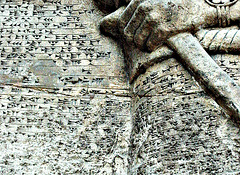
Picture shows Cuneiform writing at the British Museum