Eradicating the ego: the art of Masaomi Yasunaga

DURING OUR TRIP to India in late 2023 and early 2024, we saw works of art that have been created using ceramics. The creators of these ceramic artworks shape clay into a form that they have in mind, glaze it, and fire the object in a kiln. The artists hope that what emerges from the kiln after firing and cooling will resemble what they had in mind. The resulting sculptures and other artworks bear the conceptual imprints of the artists’ visions – usually with considerable accuracy.

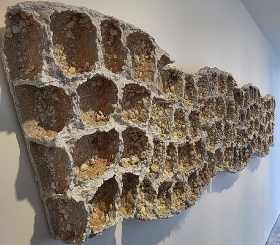
Today, the 7th of February 2024, we visited an exhibition in London’s Lisson Gallery in Paddington. On until the 10th of February 2024, it is a display of the creations of the Japanese sculptor Masaomi Yasunaga (born 1982), who works in Japan. All the exhibits are bizarre but beautiful – quite unlike anything I have ever seen.

Yasunaga is part of an avant-garde group of Japanese artists, Sodeisha, which was formed after WW2. The movement rejected and challenged previous Japanese artistic traditions. It also introduced non-functional ceramic objects as an artform. The objects on display at the Lisson Gallery were created as follows. Yasunaga used glaze rather than clay as his starting material. Combining it with raw materials such as feldspar, whole rocks, metal and glass powders, he created artistic forms. Then, he buried the creations in layers of sand and kaolin, before subjecting the whole lot to heat in a high temperature kiln. After the firing and cooling, the sculptures were carefully excavated from the beds (of kaolin and sand) in which they were fired.  

Apart from fusing the various elements of each artwork, the heat of the furnace also produces unexpected transformations (both chemical and morphological) of the work so that although it bears some resemblance to what existed before firing, it has acquired characteristics that the artist would not have been able to foretell. The action of the fire in destroying the artist’s original conception is described by Yasunaga as follows:

“…melting the material and letting gravity take hold of its shape once again, eradicating the ego along the way …”

Further, he explained:

“… the ultimate goal of my art is not self-expression but what’s left of self, after being filtered through fire.”

The effects of the heat are uncontrollable, but as the website of the Lisson Gallery explained:

“… Yasunaga describes how beauty can be discovered in the most uncontrollable situations, referring to the process of his sculptures transitioning in the fire, evolving from something artificial to natural, and yielding a beauty that is perfectly pure.”

Regardless of how and why these sculptures have been created, they are a joy to behold. One of the many roles of an artist is to show us the world in a new light and to open our minds to new ideas. Yasunaga has achieved both aims in a wonderful way.

An artist from Bengal and the freedom struggle of Mahatma Gandhi

BENGALI ARTIST NANDALAL Bose (1882-1966) was chosen as the artist to provide illustrations for the ceremonial manuscript of the Constitution of India. A few copies of these images are currently (January 2024) on display at Bangalore’s National Gallery of Modern Art (‘NGMA’).

Bose was part of an international group of artists who were endeavouring to revive classical Indian culture and art. Because of this, he came into contact with Japanese artists. Their painting techniques influenced the way Nandalal painted. This can be seen in many of his works on display at the NGMA in a temporary exhibition of a selection of his Haripura Panels, which is on until April 2024.

The ear cleaner at work

In 1938, the 51st session of the Indian National Congress was held in Haripura (now in Gujarat). Mahatma Gandhi asked Nandalal Bose to paint a series of panels depicting Indian village life in such a way that the images would be easily accessible to the common people (villagers etc.). Bose obliged, creating about 400 colourful paintings on handmade paper, using organic (rather than industrial) coloured paints. 77 of these are in the exhibition at Bangalore’s NGMA.

Each of the 77 panels is a delight to behold. They look as if they have been done quickly and highly competently by an artist with a decisive mind. On many if them, the influence of Japanese painting can be discerned. However, on every panel the subject matter is unmistakably Indian. Some of the panels depict scenes from village life (fir example, a potter at work, a tailor, wrestlers, making butter, etc) and others show animals and mythological scenes. One panel depicts an ear cleaner – a man is shown cleaning a lady’s ear with a long thin instrument. Villagers visiting the pandal (temporary shelter), which was decorated with these panels, would have had no trouble recognising Bose’s scenes of daily rural life. And political delegates would have been reminded of Gandhi’s professed allegiance to the ‘common’ people of India. Seeing these wonderful panels made me think of Socialist Realism images, but Bose’s paintings have a human touch that is lacking in politically inspired art such as Socialist Realism.

The exhibition at the NGMA is well hung and nicely lit. The panels hang in the galleries which were once rooms in the elegant Manikvelu Mansion. Several informative panels provide interesting information about Bose, his art and his association with Gandhi and his attempt to rid India of British domination.

A collection of colourful saree textiles in Bangalore

ONE OF THE THINGS that struck me when I first visited India in January 1994 was how everyone was wearing clothing far more colourful than anywhere else I had been before. Wherever I have been in the country, there is a feast of colourful clothing to be seen. Whether the colourful garments are worn purely for aesthetic reasons and/or for ceremonial or group identity reasons, everywhere there is much to please the eye.

I am not alone in noticing the Indian penchant for wearing bright colours. In 1956, the famous style ‘diva’ Diana Vreeland noted in British Vogue magazine: “… pink is the navy blue of India …”. Following from this, an article in India’s “Economic Times” of January 2022, pointed out that “Red is the Indian beige and yellow is the Indian grey…”. In other words, that the exuberant colours worn by Indians contrast dramatically with the much more drab colours currently worn in the West. Actually, as my wife pointed out, long ago in Europe (eg the 18th century and before) clothes – especially those worn by the wealthy and the aristocracy – were far more colourful than now.

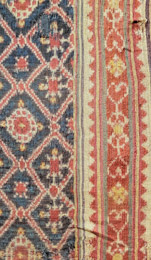
On the 23rd of December 2023, we were fortunate to get admission to an exhibition of sarees on its last day. Intriguingly entitled “Red Lilies, Water Birds”, the show was hosted by The Registry of Sarees in a house on Hayes Road in Bangalore. The Registry (established in 2016) is a trust set up by the Mysore Saree Udyog (founded in 1932). Its purpose is to promote the study, design, and conservation of handspun and handwoven textiles.

The nine rooms of the exhibition contained about 84 examples from the Registry’s much larger collection. Each room concentrated on either a particular region of India, or a specific method of creating the textiles. Every room was filled with sarees, which filled the viewer’s eyes with richly coloured, intricately patterned delights.

Many of the visitors to the exhibition, and the staff looking after, and explaining, the show were wearing clothing that demonstrated what I mentioned at the outset – namely, the preference of many Indians to dress colourfully.

Pop Art on show in a gallery in Bombay

DURING THE FEW DAYS we have been in Bombay, we have visited 10 art galleries. With one exception, the exhibitions have been both beautifully displayed and contained exciting works of art. The exception is an exhibition of Pop Art being held at the recently constructed Nita Mukesh Ambani Cultural Centre in the Bandra Kurla district of Bombay.

The spacious gallery occupies parts of four floors of a glitzy cultural centre-cum-shopping mall. To view the exhibition, one needs to book a time-slot, and part with 800 Rupees (about £8) per person. When we visited on a Sunday afternoon, the few visitors to the gallery were vastly outnumbered by security personnel and charming, but seemingly poorly informed, young ladies who are employed to provide information about the exhibits.

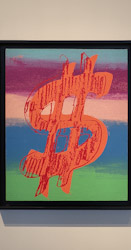
The flyer for the exhibition promises the visitor the opportunity to see works by 12 exponents of Pop Art. However, the majority of the items were creations of Andy Warhol. Almost my favourite piece was a large creation by Robert Rauschenberg.

Each of the very spacious, well-lit galleries had surprisingly few artworks. Of the four galleries, I thought that the one on the third floor was best. It contained, amongst a few other things, the Rauschenberg, and a work by Claes Oldenburg, and yet more Warhol images.

Would I recommend making a visit to this exhibition? Probably, I would not. If you are familiar with Pop Art it offers little to add to what you already know and/or like. If you are not familiar with this kind of art, I am not sure that the exhibition would provide you with much if any insight. And at 800 Rupees per person, you might be better off buying a decent book about this exciting era of art.

Bengali art before it was affected by influences of Europe and the Far East

THE INDUSTRIALIST KASTURBHAI Lalbhai (1894-1980) filled his Ahmedabad home (built 1905) with works of art. One of his relatives had married a member of the famous Tagore family of Calcutta. When the Tagores decided to sell their fabulous collection of Indian art in the 1940s, Lalbhai purchased it and thereby saved it from being sold to buyers who did not live in India. These works are on display in the house, which is now known as the Kasturbhai Lalbhai Museum.

The Museum houses works of Indian art dating from as early as about the 4th century AD to the 1940s. Visitors to the museum are obliged to go on a prebooked informative guided tour through the rooms of the museum. Although a bit of a speedy experience, one leaves having seen an enlightening cross-section of the history of art in India. Photography in the museum is not allowed.

In the special exhibition

In the beautiful grounds of the museum, there is a recently constructed annex, where temporary exhibitions are held. We were treated to a show entitled “The Babu and The Bazaar”. It is a collaboration with the Delhi Art Gallery.

This fascinating exhibition contains a display of images created by Bengali artists, who painted in traditional styles that prevailed before art in Bengal became influenced by British art schools, Western European art, and the art of China and, especially, Japan. These external influences were most famously introduced by figures such as Rabindranath Tagore and his nephews Gagendranath and Abanendranath.

During my visits to India, I have seen plenty of paintings by Bengali artists who incorporated non-Indian artistic styles into their creations, but I cannot remember having seen such a large collection of Bengali paintings and other works in vernacular styles derived more from tradition than from outside influences. Most, but not all, of the artworks depicted Hindu religious subject matter. Many of the paintings were by artists I had never heard of, or were by unidentified painters. The well-labelled exhibits, which were beautifully displayed, were refreshing eye-openers.

His fame as a scientist was eclipsed by Charles Darwin

A SHORT CARRIAGEWAY leads from Piccadilly into the courtyard of London’s Royal Academy of Art. It passes beneath a magnificent tall archway with a curved ceiling. Within the arch there are two doorways leading from the carriageway. The one to the west is the entrance to the headquarters of the Linnaean Society. This organisation was founded in 1788 by Sir James Edward Smith (1759–1828). It is named after the pioneer of modern taxonomy, Carl Linnaeus (1707-1778). It was he who ‘invented’ the modern method of classifying and naming animal and plant species. For example, human beings form the species Homo sapiens. After Linnaeus died, Sir James Smith purchased some of his collections of specimens, books, and other items. These are now preserved by the Society (see www.linnean.org/), which is the world’s oldest surviving organisation dedicated to the study of natural history. Its mission is to understand, disseminate information about, and protect, the natural world.

Alfred Wallace in the Linnean Society library

On the first of July 1858, a paper was read to the members of the Linnaean Society. Its title was “On the Tendency of Species to form Varieties; and on the Perpetuation of Varieties and Species by Natural Means of Selection”. Its authors were Charles Darwin (1809-1892) and Alfred Russel Wallace (1823–1913). Both men had come up with the same idea independently – namely, that evolution was based on what is now known as ‘natural selection’.  With his publication of “On the origin of species by means of natural selection” in 1859, Charles Darwin eclipsed Wallace as far as being recognised as the ‘father of modern evolutionary theory’. However, the two men continued to be good friends until the end of Darwin’s life. They are both amply celebrated for their achievements by the Linnaean Society.

Apart from making adventurous trips to study species and their variations in the Malay Archipelago – studies that led him to develop his ideas about evolution – Wallace became famous for his other endeavours. His work made him the founder of a discipline known as biogeography – the geographical distribution of species. He was also one of the first people to discuss the deleterious impact of man on the environment. His “Tropical Nature and Other Essays”, published in 1878 warned about the dangers posed by man’s activities (e.g., deforestation). In 1904, he published a work in which he made a serious scientific study of the possibility that there was life on Mars. Wallace’s deep interest in spiritualism, mesmerism, and his views on vaccination (he was against vaccination), led to the downfall of his reputation amongst his contemporaries in the scientific establishment. Sadly, after his death, his name was barely remembered until more recently when several biographies were published. These rehabilitate his reputation as a scientist of great importance.

During our recent visit to the Linnean Society, we viewed a small but fascinating exhibition about Wallace. It is being held in the Society’s magnificent library until the 20th of December 2023. The exhibits include Wallace’s personal library and other exhibits relating to his life and work. Everything is beautifully explained by good labelling, and the library staff were very friendly and informative.

A Brazilian artist and the River Ganges at Varanasi

MARINA RHEINGANTZ IS an artist whose works I had never seen until today, the 31st of October 2023. Her exhibition, “Maré”, which means ‘tide’ in Portuguese, is on at the White Cube Gallery in London’s Masons Yard until the 11th of November 2023. Most of the exhibits are painting, but there are also an embroidery and a tapestry.

Marina was born in 1983 at Araraquara in Brazil. She lives and works in São Paulo, Brazil. The works on display at White Cube tend towards being abstract, but they are not completely devoid of naturalistic content. As the gallery’s handout explained:

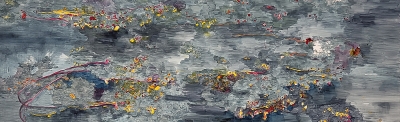
“Guided by observations of tidal rhythms, ocean beds and meteorological conditions, Rheingantz infuses landscapes of water with a quasi-sentient vitality … Expansive in scale and richly textured, Rheingantz’s landscapes deconstruct topography into its loosest arrangements.”

Although separated from him by many years, Marina’s paintings are almost as atmospheric as the great JMW Turner’s most impressionistic works. However, she has gone further than Turner in her almost abstract depiction of natural phenomena.

For example, this is evident in two paintings (detail from one of them above) she created following a recent visit to Varanasi (‘Benares’) on the Ganges River in India. These depict in an impressionistic way the orange embers that bodies being cremated on the burning ghats spit out onto the surface of the river. Other pictures on display express her perceptions of places as far afield as Brazil, Mexico, and Morrocco.

Not far from Piccadilly and the Royal Academy, White Cube Masons Yard is well worth a visit, It would be a shame to miss viewing the artworks created by Ms Rheingantz.

An old Mughal painting in an altered format

THE PADSHAHNAMA WAS created by Abdul Hamid Lahori (and others) and completed in between 1630 and 1637. It is an illustrated history of the reign of the Mughal Emperor Shah Jahan I (1592-1666). In 1799, a copy of this valuable manuscript was sent by Saadat Ali Khan II, the Nawab of Awadh as a gift to the British King George III. This edition has been preserved in the Royal Library at Windsor. It contains 44 intricately painted Mughal miniatures. In 1997, reproductions of the paintings in this version of the Padshahnama were published in a catalogue produced to accompany the precious book as it travelled the world in an international touring exhibition. As with many publications, the illustrations in it are subject to copyright.

One of the paintings in the Windsor Padshahnama depicts the arrival of the gifts for Nadira Banu, the bride of Shah Jehan’s son, the ill-fated Dara Shikoh. They married in 1632, a year after Shah Jehan’s wife – Mumtaz Mahal – died.  The Taj Mahal was built in her honour. This painting has been lent by the Royal Collection to be displayed in a brilliant exhibition, “Beyond the Page – South Asian Miniatures and Britain, 1600 to Now”, which is being held at the M K Gallery in Milton Keynes until the 28th of January 2024. This lovely painting hangs in the first of the gallery’s five rooms.

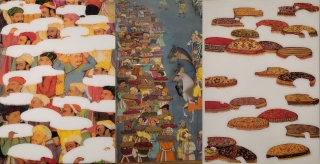
In another room, the viewer will encounter a work by Hamra Abbas (born 1976 in Kuwait). Her artwork consists of four panels. The two central panels are enlarged copies of two pages of the catalogue of the above-mentioned exhibition. One of them is the title page of the catalogue, and to its left is the “all rights reserved” page, which warns the reader that no part of the publication may be reproduced in any way at all.  These two pages are flanked by two images (illegally) reproduced from the images of the original miniature in the catalogue, and then modified.

Ms Abbas has reproduced the part of the page in the Padshanahma which depicts the crowd of men bearing the bridegroom’s gifts to his bride. To the left of the two middle panels, we see the image of these bearers, but the gifts they were carrying have been removed from the image, leaving white spaces with the outlines of the shapes of the gifts, On the right side of the middle panels, we see the depictions of the removed gifts arranged against a white background. The artist has named this work “All Rights Reserved”. She devised it in 2004. By removing the gifts from the bearers, the artist has made her own interpretation of the removal of the Padshahnama from India in 1799.

The Padshahnama was not the only gift that Saadat Ali Khan II gave the British. He was crowned in 1798 by the British Governor General of Bengal, Sir John Shore. In gratitude, he ceded half of the Awadh (Oudh) kingdom to the British. Now that colonialism is being examined critically (at last), Ms Abbas’s intriguing artwork makes a subtle but powerful statement.

Creating art with wood and a chainsaw

BORN IN WHAT BECAME EAST GERMANY in the town of Deutschbsaselitz, the artist christened as Hans-Georg Kern (b. 1938), is better known by the name of Georg Baselitz. His first education in art was at Hochschule für Bildende und Angewandte Kunst in East Berlin, commencing in 1955. After two semesters, he was expelled from this academy because of his lack of compliance with the socialist diktats of the German Democratic Republic. By 1957. he was a student at the Hochschule der Künste in West Berlin. In 1961, he changed his name to Georg Baselitz in honour of the town where he was born. In 1979, he began creating sculptural works, some of which are on display at London’s Serpentine South Gallery until the 7th of January 2024.

The works being shown at the Serpentine are all made of wood. They were created between 2011 and 2015 as models (maquettes) for finished works, and as such were not originally intended for public display. The wood has a rough finish and is pitted with many saw marks. After making preliminary drawings, some of which are displayed at the exhibition, Baselitz used axes, chisels, and chainsaws to fashion huge bits of timber into intriguing sculptural forms. These works are beautifully displayed in the various spaces of the gallery.

Although Baselitz’s timber sculptures are more figurative and much more complicated than those produced by my mother, seeing them reminded me of her. After leaving the sculpture workshops of St Martins School of Art, my mother hired a garage near Golders Hill Park, and used it as her studio. There, she worked on huge pieces of wood, creating abstract sculptures. Unlike Baselitz, she had no power saws, but only chisels and a power drill. I recall that when she wanted to create a ring-shaped piece of timber, she would first trace circles on the wood and then using a power drill she would drill holes around the circumference until the circle was complete. After that, she had to smooth the edges to produce a perfect circle. It was laborious, and lifting the heavy timber (without lifting gear) damaged her back.

The works on display in the Serpentine  (and one outside it) appear to be crudely finished when looked at closely, but as semi-abstract sculptures they seem to mock the grandeur of classical Greek or Roman sculptures. Born a rebel, the artist has produced attractive works that comfortably go against the grain of traditional sculpture.

Wild silk beside the East Sussex sea shore

THERE IS A NIGERIAN woven fabric called ‘sanyan’. Made mostly by the Yoruba people, its principal ingredient is a type of wild silk. The fabric is thick and resembles denim or canvas in texture. Strips of sanyan are sewn together to make garments and other items. During a recent visit to the Hastings Contemporary Art Gallery, which stands close to the seashore, we saw an exhibition of paintings made on sanyan cloths.

The creator of these images is Nigerian born Nengi Omuku who was born in Lagos (Nigeria) in 1987. It is there that this artist, who trained at the Slade School of Fine Art in London, now works. Before becoming an artist, Nengi worked in her mother’s florist shop, eventually coming into contact with art when she began making preparatory drawings for customers’ garden planning.

Nengi’s exhibition at Hastings is called “The Dance of People and the Natural World”and is on until the 3rd of March 2024. The artist took large sheets of sanyan fabric, consisting of strips of sanyan sewn tightly together, and then coated them with a gesso ground. When this was ready, she then used oil  paints to create images. Whether it was her painting technique or some property of the material upon which she applied the colours, the resulting images have a uniquely haunting, other-worldly quality that I have not seen in other artists’ works.  

The paintings are well displayed. They have been hung away from the walls so that one can look at their backs. By looking behind the paintings, you can see the stitching that holds the pieces of sanyan together as well as beads of the gesso ground that had oozed between the adjoining strips. By looking closely at the paintings, the joins between the constituent strips of sanyan can easily be detected (see photograph above). These create an interesting surface texture quite unlike the canvas usually used by painters.

I enjoyed the exhibition not only because the artwork was attractive but also because I became aware of an interesting fabric, which is in common use in Nigeria.