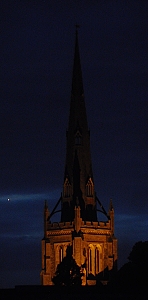
WHILE ELTON JOHN was performing in front of thousands in London’s Hyde Park in late June 2022, a small ensemble was performing works by the baroque composers Pergolesi and Purcell in the large medieval gothic church in Thaxted (Essex). The superbly performed concert in Thaxted starring the Armonico Consort ended well after 9 pm. This was not a problem for the many well-healed members of the audience in the church, who lived locally and were able to feed themselves in their own homes.
Thaxted, Essex
We could have eaten before the concert, which commenced at 7 pm, but were not hungry before that early hour. The pubs in Thaxted informed us that their kitchens stopped taking orders for food before 845 or 9 pm.
At a pub called the Star, someone hearing us asking about food after 9 pm, recommended we should head for Farouk’s. The bar attendant and several bystander’s agreed with our informant. The bar attendant kindly said that we could bring food from Farouk and she would save a table for us at which we could sit and eat after the concert.
Farouk is the owner of a caravan parked in a yard behind a petrol filling station in Thaxted. He and his colleagues, all from Turkey, prepare and sell Turkish food in the caravan. And, his eatery closes not at 845 or 9 pm, but at 11 pm.
After hearing superb renderings of Pergolesi’s “Stabat Mater” and Purcell’s “Dido and Aeneas” (semi-staged), we headed for Farouk’s caravan and the Star pub.
While waiting for our food to be prepared at about 9.40 pm, Farouk explained he had come from Gaziantep. He said that in his part of Turkey, which is quite close to Cyprus, Turkish is spoken with an accent that is very similar to that spoken by Cypriot Turks. During the ten minutes it took to prepare our food, Farouk took many food orders over the phone, which goes to show that in Thaxted there is a healthy demand for food after 9 pm.
We enjoyed our food at the table reserved for us at the Star. This welcoming pub is popular with locals. I suspect that its lively clientele was a different segment of Thaxted’s population from that which attended the concert in the church.
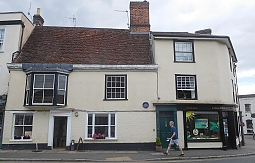
COGGESHALL IN ESSEX is an attractive place to visit. The small town contains over 300 buildings of historical interest, all of which have given protected status. Amongst these is Paycockes House, which I will describe another day. One of the many other old buildings in the centre of the town is a large house, once the home of Thomas Hawkes.
House of Thomas Hawkes in Coggeshall
Hawkes was a retainer of John de Vere (1516-1562), the 16th Earl of Oxford, who became a supporter of the Roman Catholic Queen Mary, who became the monarch in 1553 (following the deaths of the Protestant King Edward VI and the unfortunate Lady Jane Grey). Mary decreed that England should return to Roman Catholicism and the Earl of Oxford concurred with this.
Thomas Hawkes, a fervent Protestant, decided to leave his ‘employer’, who had become sympathetic to Mary’s religious cause. He returned to his home (known as ‘Constantynes’) in the centre of Coggeshall. Unwilling to partake in any Roman Catholic practices and a vocal opposer of that branch of Christianity, Hawkes soon became regarded as heretic by the Catholic authorities.
Under great suspicion by those then in power, Hawkes did something that got him into really bad trouble: he refused to have his newly born son baptised into the Catholic faith. He was arrested and taken to Newgate Prison in London. From there, he was taken to the palace of Bishop Edmund Bonner (c1500-1569) several times, and asked to recant. Having refused each time, on the 9th of February 1555, Bonner condemned him to be burnt at the stake. After Bonner had given him one last chance to recant, he is believed to have said:
“No, my lord, that I will not; for if I had a hundred bodies, I would suffer them all to be torn in pieces, rather than I will abjure or recant.” (https://coggeshallmuseum.org/thomas-hawkes/)
After some months, Hawkes was taken to Coggeshall, where on the 10th of June 1555 he was burnt at the stake.
Hawke’s house still stands and is marked with a commemorative plaque. It was built in the mid-15th century, but has been much modified since then.
TOLLESBURY IN ESSEX on the Blackwater River estuary is a village just over 5 miles southeast of Tiptree, a small town close to the Wilkinson jam factory and museum. This charming village, where a good friend of ours lives, has a venerable parish church, St Mary the Virgin.
Roman bricks used to construct the arch above the south entrance of St Mary’s in Tollesbury, Essex.
In common with most of the parish churches we have visited during our extensive roamings around the English countryside, this church, whose construction had begun by the 11th century, contains a rich selection of interesting features. These are well described in a copiously illustrated booklet about the edifice published by the Friends of St Mary’s Tollesbury in early 2020. Amongst the interesting things we saw within St Mary’s, one of them particularly intrigued me: the incorporation of Roman bricks in the fabric of the church.
Archaeologists have uncovered the remains of a Romano-British cemetery near the village. They have concluded from their findings that in about 200 AD, there was a significant rural settlement located near Tollesbury at that time. Other remains are evidence that the district around the estuarine village has been the site of human activity since the Neolithic era (4000-2000 BC).
As if to prove that recycling is not simply a recent trend, the church of St Mary incorporates bricks made whilst the Romans occupied England. These can be seen clearly above the south doorway within the church. The 11th century arch above this portal is made entirely of recycled Roman bricks. Some more brickwork made with Roman bricks can be seen exposed above the gothic archway in the western wall of the nave, which is also part of the late 11th century bell tower.
Although the re-used Roman bricks have been ‘highlighted’ in St Mary’s, the structure of the parish church in the nearby village of Goldhanger also contains recycled Roman bricks. Making bricks at the time when these churches were built would have been far more laborious than making bricks using today’s industrial techniques. So, re-using bricks that had already been made would have been very sensible.
FROM A FIELD on my friend’s farm in Essex, I could see the mid-morning sun glistening on the water of the estuary of the River Blackwater. Moored out on the water, there was a trawler with a red hull and white superstructure. A tall aerial mast, just about visible through the heat haze, was mounted on its deck in front of the bridge housing. When my friend saw me taking a photograph of the vessel, she mentioned what it is, and this caused distant memories to surface in my mind.
When I was a child in the early 1960s, I had a Phillips radio in my bedroom. I was a keen listener and enjoyed exploring the various stations broadcasting from all over the world. It was during this period and with this radio that, for example, I was able to tune into the propaganda-rich programmes transmitted from Albania by Radio Tirana. Less exotic than this was Radio Luxembourg, which unlike the few rather straightlaced, advert-free BBC stations, pumped out a stream of non-stop ‘pop’ music, punctuated by commercials for products, which were not aimed at audiences in little Luxembourg but instead at consumers in the UK. In those days, I was not much interested in pop music, but I enjoyed the commercials. The only one that I can remember was for a particular football pool company.
Radio Luxembourg was founded in 1933, long before I became one of its listeners. Located outside the UK, it was not subject to any of the legislation that ensured the BBC had a monopoly as a broadcaster in Britain.
In 1964, the Irish businessman Ronan O’Rahilly (1940-2020) and Alan Crawford came up with the idea of broadcasting to the UK from a ship moored in international waters. This way both the restrictive laws that protected the BBC, and the record company’s control of pop music broadcasting in the UK, were overcome. Radio Caroline was born and began broadcasting non-stop pop music from beyond Great Britain’s territorial waters. Caroline was soon followed by other radio stations, such as Radio London, which all made use of the same wheeze to get around the restrictive legislation in the UK. Radio Caroline has had a long and sometimes difficult history since its formation. This is described in great detail on the company’s website (www.radiocaroline.co.uk).
Our friend in Essex told me that what I was photographing is the boat from which Radio Caroline transmitted. I was surprised because, for no good reason, I had believed that Caroline was a thing of the past. The boat moored in the Blackwater is the Ross Revenge, formerly used as a fishing trawler. It was not the first boat to house Radio Caroline; it served this purpose between 1983 and 1991. A radio station bearing the name Caroline still functions. What is important about Radio Caroline and other so-called ‘pirate’ stations is that their existence had some considerable influence in causing the BBC to commence broadcasting pop music. Radio 1, which replaced the BBC’s Light Programme, was started in 1967 in response to the popularity of the pirate stations amongst the listening public.
I am glad that we were shown around our friend’s farm and that I spotted that boat in the estuary. Although I did not often listen to Radio Caroline, seeing the vessel made me recall my early radio receiver (‘wireless’) and the joy it gave me during my early teens.
THE COUNTY OF ESSEX is immediately east of Greater London. Parts of it are heavily built-up and not particularly attractive. The rest of the county is both varied and delightful to explore. So near to London, many parts of it retain rural characteristics, which one might not believe existed so near to the huge city of London. Recently, we visited Goldhanger, a small village close to the River Blackwater’s estuary.
Sculpture by Horace Crawshay Frost in the parish church in Goldhanger, Essex
The village near Maldon (famous for its salt) has been known as ‘Goldanger’, ‘Goldangra’, and ‘Goldangre’. According to Maura Benham (1913-1994) in her history of Goldhanger, the place’s name has always had ‘gold’ as its first part. The gold probably referred to a yellow flower. The second part might either originate in the word ‘hanger’ meaning hill, or ‘anger’ meaning grassland. It is not known exactly when the settlement, which is at the head of a small creek, was first established but there is archaeological evidence suggesting it was already inhabited in the Iron Age around 500BC. One reason for the village’s existence might have been for making salt from seawater. The local saltworks came to an end in the early 19th century.
The heart of the small village is The Square, where Church, Fish, and Head Streets meet. We ate a hearty, tasty lunch in the Chequers Inn. This was listed as the only alehouse in the village in a document dated 1769. It might have been used by smugglers long ago. The building housing it has been used as a pub for at least 250 years. Prior to that it was built about 250 years earlier as a residence. Constructed in stages, the earliest part was probably built in 1500 (http://past.goldhanger.org.uk/Chequers.htm#:~:text=The%20Chequers%20has%20been%20an,landowner%20as%20his%20private%20ressidence.) Inside, the pub, built on several different levels, with an abundance of ageing timber beams, has an authentic ‘olde worlde’ atmosphere and appearance.
The pub is the southern neighbour of the attractive St Peter’s parish church. According to the architectural historian Nikolaus Pevsner, the church originated in the 11th century and some evidence of this can still be observed. The south aisle was built in the 14th century and the west tower in the 15th. Pevsner makes special mention of a tomb chest with a black stone cover plate which has indentations where several brasses used to be. This stands in the South Chapel, which was built by the local Higham family, whose farm was in Goldhanger, in the early 1500s. The chest tomb contains the remains of Thomas Heigham who died in 1531,
Although the church has many other interesting features to enjoy, I will mention only one of them. Located close to the Higham tomb, I noticed a curious wooden carving, a sculpture depicting two forearms with hands clutching or gripping something I could not identify. This was sculpted by Crawshay Frost. According to a short history of the church, this artwork was dated “1960s”. Whether that means it was placed in the church then, or created then, is not stated. I had not encountered the name Crawshay Frost before visiting Goldhanger. A fascinating web page (http://past.goldhanger.org.uk/Frost.htm) described a notable inhabitant of the village, Horace Crawshay Frost (1897-1964), who lived in Fish Street between 1926 and 1964.
Horace graduated in History at the University of Oxford. During WW1, in which he suffered injuries (both physical and psychological), he took many photographs, some of which are now kept in London’s Imperial War Museum. After leaving the army in the early 1920s, he taught at a school in Brentwood (Essex). Soon after that, he moved to Goldhanger, where he gave private tuition to the children of the curate. In Goldhanger:
“… he involved himself in local history, archaeology, art, sculpture, music, ornithology, horticulture, photography and writing, and also established a reputation as a local philanthropist of extreme intelligent. Whether it was because he was sufficiently wealthy, or because he was too ill, or both, it appears that for most of the time he lived in the village he did not engaged in any kind of full time employment, but rather he spent his time enthusiastically pursuing various hobbies and pastimes, and paid others to help him with them.”
On the basis of this information provided on the webpage, I feel that it was Horace, who produced the sculpture I saw in the church. Further evidence of his interest in wood carving comes from a book, “Celebration”, the autobiography of Graham David Smith. He recalled visiting Horace in Goldhanger in 1955, during the time of the so-called Mau-Mau Uprising in Kenya. Smith wrote:
“We had come to work and earn money. Mr Frost had a perfect job for us. Laid out in front of the open kitchen door were several mahogany beams ordered through local woodyards and a large satchel of finely honed steel chisels from Harrod’s. Mr Frost, deeply disturbed by any stories about war, had come by what he thought would be a perfect solution of that awful Mau-Mau business in Kenya: art to soothe the savage breast. To get the Africans started, he had sketched out the wood scenes and motifs he thought conducive to a peaceful and pastoral life.”
On our way from the church back to the car, I noticed three pumps on Head Street, near to the Chequers pub. Two of them, standing side by side, were old-fashioned petrol pups bearing the ‘Pratts’ logo. These well cared for objects were installed in about the 1930s, but maybe originally in Church Street. Opposite these and next to the village car park, there is another pump. This was installed to supply water.
The water pump is above a water well that was dug in the hot summer of 1921. According to a notice affixed to the hand operated pumping mechanism, the well is 70 feet deep “with a further 100 feet of artesian bore, making 170 feet in all.” In 2012, to celebrate the Diamond Jubilee of Queen Elizabeth II, Goldhanger Parish Council restored both pump and well to working condition.
Once again, a brief outing to rural Essex, albeit a small part of it, has proved to be most interesting.
MOST OF SOUTHEND in Essex was built after the Victorian era. The town on the estuary of the River Thames was and still is the nearest seaside resort to London. According to “Encyclopaedia Britannica”, Southend:
“…became fashionable as a seaside resort when visited by Princess Charlotte of Wales in 1801 and by her mother, Princess Caroline (wife of George IV), in 1803.”
Originally, Prittlewell, once a village north of Southend but now one of its suburbs, was the only settlement in the area now occupied by the modern town of Southend. South east of it on the coast was a tiny village called Leigh, which is now the much larger Leigh-on-Sea. The resort now known as Southend-on-Sea was developed at the end of the 18th century in Prittlewell’s southern district of South End. Today, more than seven miles of buildings extend from Leigh-on-Sea through Southend to Shoeburyness.
The High Street, part of a road heading south from Prittlewell, runs from near Southend Victoria Station towards the sea, ending at the edge of a steep slope that falls to the seashore below. Various roads and a lift can be used to descend this incline. At the top of the slope, the High Street meets the eastern end of Royal Terrace. At the corner where these two streets meet, stands the Royal Hotel. Next to the hotel and lining Royal terrace, numbers 1 to 15 were built in the 1790s at the same time as the hotel. These were backed by the Royal Mews, a road still in existence. These constructions were part of a then new phase of development of the town, which was known as ‘New Town’.
The hotel, a fine Georgian edifice, opened with a grand ball in 1793. Princess Caroline House that adjoins the hotel. number 1 the High Street, is a listed building, which looks as if it is contemporary with the hotel. The gardens on the slope in front of the hotel and the Terrace are known as The Shrubbery and were originally for the exclusive use of residents in the Terrace, but now they are open to the public. According to www.southend.gov.uk/historic-southend/history-southend/2:
“The Terrace was named “Royal” following visits by Princess Caroline, wife of the Prince Regent, in 1803 and for a short time attracted fashionable society. But difficult access from London by road and river discouraged further development until the construction of the railway in 1856. Royal Terrace is the only surviving Georgian terrace in Southend.”
Just east of the High Street and dominating the shoreline is the massive Park Inn Palace hotel, formerly the The Metropole. Built in 1901, this hotel that looks like an oversized liner had 200 rooms, a billiard room, and a splendid ballroom. During WW1, it was temporarily used as a Royal Naval Hospital. An online article (http://beyondthepoint.co.uk/first-world-war-southend-the-palace-hotel/) related:
“The Palace Hotel was built in 1901 and served great use in the war effort. Messrs Tolhurst; the owners of the hotel, were generous enough to offer the building up for free as a naval hospital for the rest of the war. Its glorious five star interior would’ve been quite bizarre with hospital beds placed amongst its lounges and ballrooms. It held possibly the world’s first purpose-made x-ray department. It recently underwent refurbishment by Park Inn to bring it back to its former glory.”
Both hotels overlook both the sea and Southend Pier. The older, Royal Hotel, is less of a blot on the landscape than the Palace hotel.
UNTIL WE WENT to Southend (in Essex) in February 2022, it was not the first place to spring to mind when thinking about art galleries. To my mind, Southend was mainly associated with its spectacular pier, which is over one mile in length. Now, to the pier I will add the Beecroft Art Gallery to the good reasons for visiting Southend.
The gallery has been housed in a distinctive 20th century building on Victoria Avenue since 2014. Its current home was formerly Southend’s Central Library. The edifice was designed by Borough Architect R Horwell and opened in 1974. Prior to moving there, the gallery was housed in a large Edwardian house on Station Road in nearby Westcliffe-on-Sea.
The permanent collection of art in the gallery was donated to the town in 1952 by a local collector, a solicitor called Walter Beecroft, who worked in Leigh-on-Sea. His paintings ranged from the 17th century to the late 19th, and a few from the 20th. A selection of these was on display in the first-floor gallery of the Beecroft when we visited. Newer additions, mainly on long-term loan, to the gallery’s collection were hung alongside examples donated by Beecroft.
We went to the Beecroft to see a temporary exhibition of 20th century artists from London’s East End. It was excellently curated. I will write about this in the future. There were also temporary exhibitions of Pakistani wedding outfits and feminism during the covid19 lockdown. The basement of the Beecroft is currently dedicated to the history of jazz.
All in all, the Beecroft Gallery is well worth visiting. The quality of the exhibitions we saw there puts to shame a few of the better-known art galleries in London.
THE FIRST TIME I visited Southend in Essex was in about 1960. I was invited to go there on a day trip with my best friend, his younger brother, and their father, who was a senior official in London Transport. We went by car, stopping on the way at several London Transport bus garages, where we saw a few vintage busses. I remember two things about Southend on that first visit. First, we ate fish and chips. It was the first time I had sampled this cuisine because my parents were too snobbish about food to have been seen dead in a fish and chip shop. I have enjoyed fish and chips ever since that time in Southend. The other thing that sticks in my mind was travelling along Southend Pier in a special train that carried passengers almost to its furthest point from the seafront. It was not until the 11th of February 2022 that I made my second visit to Southend.
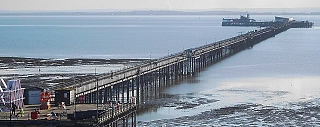
Southend Pier
Southend Pier is the longest pleasure pier in the world. It is 1.34 miles (2.16 kilometres) in length. The present pier, which replaced an earlier wooden one built in the early 1830s, was completed in the late 1880s. it was opened to the public in 1889. At about this time, the single-track railway running along it was also ready for use. It was extended by 1898. The trains were then electrically operated. In 1978, the electric railway was closed. By 1986, it had been re-opened using trains that were driven by diesel engines. It was on one of these that we took a return trip this February.
I enjoy piers. They provide a way of going out to sea without leaving land and without risking seasickness. In addition, like the one at Southend, most of the piers in England are visually satisfying when viewed from the shore. At the sea end of Southend Pier, there are various structures ranging from painted wooden shacks to the beautiful contemporary-style Royal Pavilion, opened in 2012. Despite being a complete contrast to the other constructions on the end of the pier, it enhances to visual attractiveness of the area.
Although the pier was not the primary reason for our excursion to Southend, it certainly enhanced our enhancement of the place as did our lunch at a local fish and chips shop.
DURING A SHORT VISIT to Chelmsford in Essex, we noticed an old hotel The Saracens Head. Situated in the centre of the city – yes, Chelmsford is a city; it has a fine cathedral – it bears a commemorative plaque which states that the inventor of radio Guglielmo Marconi (1874-1937), founder of the Wireless Telegraph Company, stayed at the hotel between 1912 and 1928, when he made visits to his New Street factory in Chelmsford. Marconi made the city a place that was to change the world. It is hard to imagine how our world would be today without radio signals.
I wondered why he had chosen Chelmsford to site his factory. The only explanation I can find is that Marconi needed electricity for his factory and that Chelmsford had a good supply of it. In any case, his factory provided work for many (up to 6000) people in the city.
As for The Saracens Head hotel, I have not yet stayed there, which might be a good thing as it receives many poor reviews on Tripadvisor.
Prior to establishing his factory in Chelmsford, he lived in a terraced house near London’s Westbourne Grove, at number 71. He lived there between 1896 and 1897. That was 2 years after he had made the world’s first demonstration of radio transmission. He arrived in London from Italy in 1896 because few in his native land could see much of a future in what he had demonstrated.