MERSEA ISLAND IS south of Colchester in the mouth of the Blackwater River, which flows through the south of Essex. Connected to the mainland by a cuseway, which gets submerged twice a day when it is high tide, Mersea Island feels like it is many hundreds of miles away from London, even though it is about 60 miles from Trafalgar Square and only a few miles from Chelmsford and Colchester. The island has two settlements: West Mersea and the much smaller East Mersea.
Although there are some working people on the island, many of its residents are retired. We did spot a few (less than five) people, who did not look as if their heritage was white British, but the island cannot be described as having a multi-ethnic population. The island is an outpost of the Anglo-Saxon heartland. It seems to be a friendly community. People with whom we spoke were very amicable. Having said this, a surprise greeted us when, out of curiosity, we stepped inside West Mersea public library, which is run by Essex County Council.
The library is a modern structure with a simple but pleasant, spacious reading room. Immediately after entering, we spotted a bookshelf with a notice above it. This had the words “Author of the Month”. The author whose books were prominently displayed on the shelves were by Vaseem Khan. He was born in east London in 1973, and studied at the London School of Economics. Then, he worked for ten years in India. His experience of India led him to begin writing detective novels set in India. My wife, Lopa, has read and enjoyed many of his books.
I am not sure why we were so surprised to see Vaseem Khan’s books given pride of place in the library in West Mersea. Maybe, it was because our experience of the island is that its population is far from being cosmopolitan. Lopa spoke to the librarian, saying how pleased she was that Vaseem Khan had been highlighted, and then began mentioning other British Indian authors such as Abir Mukherjee and Imran Mahmood. The librarian had read books by all these authors and spoke knowledgeably about them. She had chosen Vaseem Khan to be the author of the month because she had met him at a literary festival, and then invited him to speak in her library. We left the library having been highly impressed by what she had discussed with us.
One thing we forgot to ask her was how often Vaseem’s books were borrowed in comparison with other fiction writers’ volumes on the shelves. I would liked to have discovered whether her display of Vaseem’s books attracted much attention from the local, seemingly Anglo-centric, users of the library.
THE ISLAND OF MERSEA is connected to the mainland of Essex by a causeway, which was originally constructed before the medieval era. It is the only way that vehicles, motorised or otherwise, can travel between Mersea and the rest of Essex.
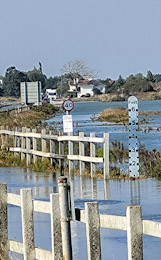
Twice a day, the tide rises. When it does, not only do the mudflats close to the island become submerged beneath the sea but also the causeway.
The flooded causeway
After visiting East Mersey, we drove to the causeway and had to stop in a long queue of traffic. It was high tide, and the water had not only covered the causeway but also about 200 yards of the roadway approaching it. It was interesting to see how even in the 21st century, a simple thing such as high tide can bring life to a standstill.
THE MEDIAEVAL CHURCH of St Edmund King and Martyr in the tiny village of East Mersea, on an island close to the coast of Essex, is a joy to visit.
The south wall of the church has some relatively modern windows, which are mostly glazed with clear glass. However, parts of the windows contain small pieces of stained glass, which look quite old. Chris Parkinson at the museum in West Mersea told us that these small fragments of what had once been larger window range from the 15th to the 18th centuries. They were brought to Essex from Devon by the Sunnock family, who came from Topsham and nearby Exeter.
The Sunnocks were a prosperous family. In the 19th century, after the Napoleonic Wars, English gentlemen toured France and the Low Countries, buying up antiques including bits of stained glass from religious establishments. The Sunnocks acquired a large collection of old stained glass this way, and brought it with them when they bought a home on Mersea Island.
During WW2, their Essex home was requisitioned by the military, and the glass was stored in a truk. After the war, some of the glass was restored in Norwich, and then installed in the windows of the church in East Mersea, where it can be seen today.
LAST NIGHT I ENJOYED a pint of Moretti beer in a pizzeria on Mersea Island (Essex). The beer company was formed in 1859 in a town in northeast Italy: Udine. The company logo is a man wearing a hat and holding a glass tankard of beer.
In the 1960s, a young lady from Udine, Adriana, came to London to teach Italian at the LSE, where my father was a professor of economics. My parents, who loved Italy and Italians, used to invite Adriana to our home. Soon, she became a family friend.
After her return to Italy, we used to visit Adriana and her hospitable parents in Udine. In Udine and all over the region of Friuli-Venezia Giulia, in which the city is located, there were advertising hoardings for Birra Moretti. The images of the hatted beer drinker were as ubiquitous as were images of Tito in Yugoslavia or of Lenin in the USSR.
As I drank my pint of Moretti in West Mersea, happy memories of Adriana, her family, and trips made to Udine came back to me.
By the way, the Waterfront Pizza in West Mersea, where I drank the Moretti, is a superb place to enjoy an evening. Not only are the pizzas high quality, but also the ambience and management of the place is excellent. Although we were eating on an island next to the coast of Essex, it felt as if we were hundreds of miles away on the shores of the Mediterranean.
SOME PEOPLE SAY that the Ancient Romans in Rome enjoyed consuming oysters that had been harvested along the coast of Essex. It is said that these tasty molluscs were transported live from Essex to ancient Rome. A website (www.bbc.co.uk/news/uk-england-humber-69051462) noted:
“Oysters were highly prized by the Romans with some reports suggesting they played a key part in Julius Caesar’s decision to invade the British Isles. Many of the oysters were exported to Italy with Roman Emperors reportedly paying for them by their weight in gold.”
This quote refers to finding a Roman oyster processing site on the Humber estuary. Other places where oysters are cultivated include parts of the coast of Essex. These places are famous for the quality of their oysters. One of them is West Mersea on the island of Mersea, a few miles south of the city of Colchester. Today, this place is an important source of oysters. The gardens of houses in West Mersea are full of discarded oyster shells, both for decorative purposes and as a ground covering.
An oyster pit and the Packing Shed (in the distance)
Oysters are ideally cultivated in the brackish saline waters of estuaries. They feed by siphoning a large amount of seawater through their bodies, extracting nutrients from it. Sometimes, they collect sand and other impurities as the water passes through them. West Mersea sits at the mouth of the Blackwater River, and oysters have been grown and harvested there since Roman times. When oysters are mature enough to be harvested, they are placed in tanks filled with clean water which passes through them as they filter the water. This ensures that by the time they are sent to market, impurities such as sand have been removed from their digestive systems. Today, this purification process is carried out in sophisticated mechanised tanks, some of which irradiate the water with ultra-violet light to kill microbes. In the past, after being sorted for size, they were placed in wood-lined tanks filled with clean water. The remains of some of these now disused oyster pits can be seen rotting along the coastline at West Mersea.
In about 1890, a shed, now known as the ‘Packing Shed’, was constructed on an islet close to West Mersea. This building was built to be used for cleaning and sorting oysters before they were sent to destinations all over the world. Soon after it was built, it was blown away in a storm. In 1897, it was replaced by a new building, which remained in use until the 1950s. After that, it was hardly used and began to rot. Despite this, it survived the great storm of 1987. It became a picturesque ruin until 1992, when it was fully restored. Owned by the Tollesbury & Mersea Native Oyster Fishery Company, it is rented to the Packing Shed Trust, which uses it for a variety of purposes (including bird watching, weddings, art classes, parties, and celebrating special occasions). You can see this long, low building from many points on the seashore of West Mersea. On the day we were in West Mersea, we saw groups of young school pupils going on an excursion to visit the Packing Shed.
Several companies dealing in oyster cultivation and sales have sheds in West Mersea. There are plenty of eateries where you can sample these highly prized delicacies. We used to enjoy consuming them in the past before one of us had an extremely unpleasant reaction after eating some oysters at a good restaurant in London’s Kensington. The reaction was so bad that hospitalization was necessary. After that, both of us have, reluctantly, decided not to eat oysters again. Regardless of that, West Mersea is a delightfully peaceful place to visit – providing it is during school term time. We were told that during school holidays, Mersea Island becomes overcrowded and far from relaxing.
THE AVAILABILITY OF water is essential for human life. Since 8400 BC, or even earlier, mankind has been digging wells to access sources of groundwater. In England today, usable wells are few and far between because water is supplied by various other means. Occasionally, one comes across wellheads of now disused wells. One of these has become a minor visitors’ attraction on the lovely small island of Mersea, which is south of Colchester on the north side of the mouth of the Blackwater River.
The well head, which in in West Mersea and has been recently restored looks like a square wooden crate. It has a commemorative bronze plate on its square covering. Known as St Peter’s Well, it was an important source of water from ancient times until the early 20th century. It may have been associated for a while with a West Mersea Priory (founded 1046, dissolved 1542) that once stood nearby.
In April 1884, Mersea Island was struck by an earthquake. A crack in the ground opened near St Peters Well, and for a short time the water in it:
Today, there is little to see but the restored wooden wellhead that stands on a slope overlooking the wide sandy beach, which appears when the tide is out, The metal plate contains quotations from the Bible and the information that the well, which had served the people for over 1000 years, was one of the main sources of fresh water for the islanders, and had never run dry.
Judging from the contents of rubbish bins awaiting collection from the street entrances of houses in West Mersea, an important source of fluid intake is nowadays bottles and cans obtained from the booze shelves of off-licenses and supermarkets.
IN THE YEAR 991 AD, the Anglo-Saxons fought a battle with Viking invaders in Maldon (Essex). The Vikings, who often raided for looting and plundering rather than conquest, won. Rather than continue to struggle with the Vikings, the Anglo-Saxon king Æthelred the Unready was advised by the Archbishop of Canterbury to pay them off. He paid the Vikings an enormous sum of money, which satisfied them.
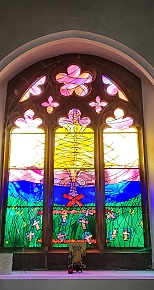
Recently, we visited the church of St Mary the Virgin in Maldon. It stands on a small hill that overlooks the mudflats and rivulets of the Chelmer River where the battle was fought. In its north wall there is a striking, colourful modern stained-glass window. Designed by Mark Angus, it was installed in 1991to commemorate the 1000th anniversary of the Battle of Maldon. It is a great addition to an otherwise unremarkable church.
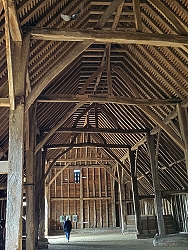
IF WE HAD NOT MISSED a turning at a road junction in Essex, we might never have visited Prior Hall Barn (near Widdington). Maintained by English Heritage, this well-preserved, huge timber-framed, wood-cladded 15th century barn. Constructed entirely of timber – without any metal, it has been estimated that its 900 pieces of timber were derived from 400 trees. Some metal structural elements have been added since the barn’s original construction, which judging by the date of the timbers commenced no later than about 1472. It remained in use as a barn until 1976.
A mediaeval barn such as this one is fascinating enough. However, the land on which it stands has a most interesting history. Just before William the Conqueror set sail for England, he assembled his fleet in the river port of Saint-Valery-sur-Somme. It is believed that he was made welcome in the town’s priory. As a gift of thanksgiving for his successful conquest of England in 1066, he gave the farm on which the barn stands to the priory in St Valery.
In the 14th century, lands owned in England by foreign owners became a drain on the economy, and properties such as the village of Widdington were confiscated by King Edward III. In 1377, the land where the barn and village stand were given to William of Wykeham, the Bishop of Winchester. In 1379, Wykeham founded New College Oxford and endowed it the farm, The college owned the farm from 1379 until 1920, when a local farmer purchased the freehold. It was resold in 1950, and in 1976 its owner, Mr Jeremy Dillon-Robinson placed the barn into the care of the Department of the Environment. Now, it is cared for by English Heritage.
Although I have no idea whether William the Conqueror ever set foot in Widdington, the place’s connection with St-Valery-sur-Somme adds to the excitement of seeing this historic barn. Had we stuck to the ‘beaten track’, we might well never have even heard of the barn, let alone the land’s interesting ownership history.
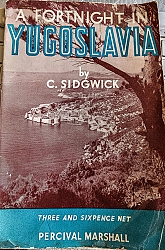
I FOUND A SHELF of rather tatty looking second-hand books for sale outside an antique shop in Great Dunmow (Essex). Each was being sold for 50 pence. Among them, I picked up a copy of a slender volume by Christopher Sidgwick with the title “A Fortnight in Yugoslavia”. Having visited the former Yugoslavia numerous times between 1973 and 1990, I was curious to see what was written about it when the guidebook was published in July 1955. This was only about 7 years after the country detached itself from Soviet Russian domination. In relation to this, the author wrote:
“Since the war ended, the Yugoslavs have I think been acting in perfect character. They are not a people … to be impressed by other people’s size. The war brought them victory on the side of Russia … and they set out with immense courage to re-form their way of living on copybook communist lines. But before long, of course, they found that the printed dogma of Marx did not turn out at all as they were led to expect: and instead of cooking the argument, as other communists have frequently done … their honest Yugoslav common sense came conveniently to hand: when Tito, in Moscow, realised that he was now to toe the line as a satellite country, to live in virtual starvation, while the country’s raw materials were sent off to Russia … he said to Stalin: ‘Rubbish! In that case, we might as well still be under the Habsburgs!’”
Under Tito’s leadership, Yugoslavia went its own distinct way. In his text, Sidgwick asked:
“Is the country a dictatorship? In the sense that it is nothing like Hitlerite Germany, nihilist at root, the answer is ‘no’. In the sense that it is a one-party country, with the state controlling the police, the radio, the press, and education, the answer must of course be ‘yes’.”
Further on, he added:
“… it is clear that broader and broader opinion, differing from the party line, is being permitted and even encouraged.”
And this was as early as 1955. By the time I began visiting Yugoslavia, liberal and alternative voices were becoming quite prevalent.
Although Sidgwick did not discourage the individual traveller, he believed that there was much to be said in favour of organised group travel. Visas were then required, and could be obtained for 11 shillings (55 p) at the Yugoslav Consular Department in Kensington (48 Phillimore Gardens). In 1955, £1 sterling would buy you about 840 Yugoslav dinars, and on entering the country, “…any note exceeding 100 dinars in value is liable to be confiscated from you, so don’t buy higher-value notes even at a good rate of exchange: it’s black money.”
Amongst things you were advised to pack in 1955 were: sunglasses; toilet soap (“cost up to 7/6 (37.5p) a tablet”); half a pound of tea; ear-plugs (“invaluable while travelling or while waiting for the dance-band to close down for the night”); pipe tobacco; an inflatable cushion; and a universal bath plug.
Regarding food in Yugoslavia, Sidgwick mentioned that pancakes were good, and:
“… they have no disgusting dishes – frog, snails, and so on – and local national dishes are always worth trying. Ražniči is veal on toothpicks. Ćevapčići is meat and little mince rissoles. Djuvec is a Serbian edition of Irish stew, highly seasoned with paprikas.”
Well, I have eaten frog in Yugoslavia and I had friends who harvested snails for gastronomic reasons. Sidgwick added:
“Meal-service is almost always slow by our standards, largely, I think because Yugoslavs themselves are in the habit of taking their time over food, enjoying it as a social occasion. In busy restaurants it is unwise to expect to get through dinner in less than ninety minutes.”
I have always eaten well in Yugoslavia, and with my many Yugoslav friends every meal was a joyous social occasion.
The guidebook dedicates most of its travel advice to Croatia and the Dalmatian coast (pages 32 to 51). The rest of the country was described between pages 51 and 62. In the short section on Serbia (pages 58 to 60), Sidgwick wrote:
“To describe Serbia in a page or two is like describing London on a cigarette card: insulting to the inhabitants”
He did it to keep the book short, and I suspect, because in the 1950s few British travellers to Yugoslavia ventured much further inland than the coastal regions.
Who was Christopher Sidgwick? He lived from 1915 until 1978. He wrote several guidebooks to places such as Germany and Greece. His “German Journey” was published in 1936 and his guide to Greece in 1974. “German Journey” was one of several books written by British writers who visited Nazi Germany to find out about Hitler’s regime and the effect it was having on the country. Unlike others, who judged the country mainly by what had been shown them in Berlin and reported favourably on the regime, Sidgwick wanted to avoid “… ‘thinking that what is seen in the capital […] is representative of that country’” (quoted from “Britain and the Weimar Republic” by Colin Storer). This is probably why he reported on a visit to Dachau’s concentration camp before WW2.
Sidgwick also wrote “Manhunt in Dalmatia”, published in 1959. Amongst his many other books, he wrote “Whirlpools on the Danube”, which was published by in 1937. This was reviewed in the journal of the Royal Institute of International Affairs by no less a historian than Carlile Aylmer Macartney (1895-1978), a specialist in the history and politics of Central Europe. I guess from this that Sidgwick must have been a significant traveller and observer in his time.
Finally, although I paid only 50 pence (in Great Dunmow) for this book about a country that exists no longer, its cheapest price on bookfinder.com is 20 times as much. My own recollections of the country and its people are published in my book “Scrabble with Slivovitz”, which is available from lulu.com, bookdepository.com, and Amazon (https://www.amazon.co.uk/Scrabble-Slivovitz-Once-upon-Yugoslavia/dp/1291457593).
RAINHAM IN THE London Borough of Havering, but formerly in Essex, has an attractive and venerable parish church: St Helen & St Giles. Helen (c247-c330) is mistakenly believed to have been British. Probably born in Asia Minor, she was mother of Constantine the Great. Giles was a 7th century saint of Greek origin. Much of the body of this building was constructed in the 11th century. A small doorway on the south side, which has a fine carved stone Norman arch, was added in the 12th century, and is known as the Priest’s Entrance. The main entrance is via the South Porch, which was restored or recreated in 1897. As with so many old parish churches, Rainham’s is filled with interesting features, some of which I will describe.
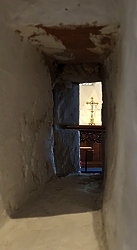
View through the squint (hagioscope) in Rainham parish church
The simple stone font bowl is from the 12th century. Almost as old as the church, it stands on a carved stone pedestal, created in the 15th century. The nave is flanked by sturdy square columns that support semi-circular arches typical of the pre-gothic era. The arch above the chancel has geometric carvings (chevrons), a fine example of Norman architecture. At the southeast corner of the nave, there is an old wooden door, covering the entrance to a spiral staircase that used to lead up to a no longer existing gallery. The door was originally located in the above-mentioned Priest’s Entrance, and was constructed in the 13th century. On the floor near this old door, there lies the black gravestone of John Harle, who built nearby Rainham Hall in the 1720s. His wife and son are also buried beneath it. Near to the grave, there are a couple of memorial brasses set in the floor.
Close to Harle’s gravestone on the wall of the south aisle, there is a niche in the wall and below this, part of a late 12th or early 13th century piscina. This small basin was used by the clergy for washing sacred vessels used during a service. The nave receives natural light through several clerestory windows. In Rainham’s church, these are shaped like human eyes. Probably installed in the 13th century, their shape is extremely unusual in English churches.
The lady, who was kindly showing us around the church, pointed out a slit in the north side of the western end of the chancel. The slit, which passes through the thick wall, is not perpendicular to the wall. It runs from the northwest to the northeast. It is what is known as a ‘squint’ or a ‘hagioscope’. These were incorporated into churches to allow worshippers a view of the high altar when their view was obstructed by the walls of the side aisles in churches where the width of the chancel was considerably less than that of the combined aisles and nave.
Our guide suggested that the squint in Rainham’s church might have been used by diseased worshippers such as those suffering with leprosy. She believed that these unfortunates would have been admitted to the church by the small north door and confined to the northern aisle. By peering through the squit, they could glimpse the crucifix on the high altar in the chancel. Where or not this was really what happened, I cannot say, but I like the story.
We were extremely lucky to have been able to enter the church because, as we learned later, it is often closed. We happened to arrive when our self-appointed guide and her colleauges, all volunteers, were decorating the building with flowers.




 yamey
yamey 