Ten places to breathe and relax

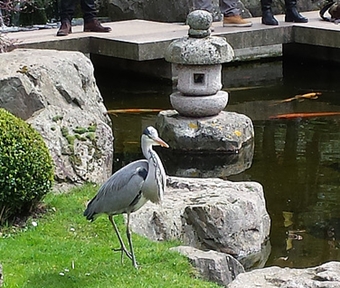
Heron_500


Another list for you, now that the weather is improving.

Here are ten open public spaces in London north of the River Thames. These are places, which I particularly enjoy. They are listed in no particular order:

1 Golders Hill Park

2 Kenwood

3 Kensington Gardens

4 Regents Park

5 St James Park

6 Holland Park

7 Hampstead Heath

8 Thames Barrier Park

9 Postmans Park

10 Soho Square


Picture taken in the Kyoto Garden at Holland Park

The months of May are ending

197px-Theresa_May_portrait

Cameron has gone,

May will be ending,

Can Brexit now be resolv’d?


Image source: https://www.gov.uk/government/uploads/system/uploads/attachment_data/file/588948/The_United_Kingdoms_exit_from_and_partnership_with_the_EU_Web.pdf

Poetry

Steaming_240


I have never been able to enjoy reading poetry and enjoy it. However, if it is read out aloud by someone else, I usually love what I hear.  Poetry is like music made with words.

Here is a poem that I have enjoyed ever since I was a young teenager. It is Adlestrop by Edward Thomas (1878-1917). He was killed in France during WW1. His poem captures the essence of the world that reveals itself gradually when a train stops at a small country station.
 

Yes. I remember Adlestrop—

The name, because one afternoon

Of heat the express-train drew up there

Unwontedly. It was late June.

The steam hissed. Someone cleared his throat.

No one left and no one came

On the bare platform. What I saw

Was Adlestrop—only the name

And willows, willow-herb, and grass,

And meadowsweet, and haycocks dry,

No whit less still and lonely fair

Than the high cloudlets in the sky.

And for that minute a blackbird sang

Close by, and round him, mistier,

Farther and farther, all the birds

Of Oxfordshire and Gloucestershire.

Gandhi, Lenin, Stalin

gandhi

Non-violent Gandhi 

Beside three leading men

Who faced fate with force


This mantle-piece at Shaw Corner, the home of George Bernard Shaw at Ayot St Lawence in Hertfordshire, bears the portraits of (from left to right) Mahatma Gandhi, Felix Dzerzhinsky, Vladimir Lenin, and Josef Stalin. Shaw met all of these men.


A carved Crusader

A life no longer,

Remember’d in timber:

Farewell, Crusader knight


14th century wooden effigy in church at Paulerspury in Northamptonshire, England


For more information about this rare mediaeval carving, see: History of Paulerspury

website from which this information was extracted:

Under the arcade between the chancel and the north chapel, on a freestone tomb panelled with cusped ogee blind tracery enclosing shields, are wooden effigies of a lady (c. 1340) and an armoured man (c. 1346-9), now placed side by side but not necessarily originally associated with each other. The male figure may represent Sir Robert de Paveley.  The monument was restored by Frederick H. Crossley of Chester in 1920, following a report on its condition by the S.P.A.B. in 1915

A myth


Recently, I renewed my Reader’s Card at the British Library, currently housed in superb premises on Euston Road, next door to the Victorian Gothic St Pancras railway station. This building was opened by Queen Elizabeth II in about 1998. Prior to this, the library’s Reading Room was a huge circular structure in the heart of the British Museum.

When our daughter was at primary school, she was taught about the Ancient Egyptians  including a female Pharaoh called Hatshepsut. One Saturday, I took our daughter to the British Museum in the hope of finding an image of the pharaoh in the Egyptian Galleries. After a desultory search, we gave up and walked acoss the the lovely covered Great Court, created relatively recently. The central circular structure within it contains the unused but well-preserved round Reading Room, which was designed by Sidney Smirke and opened in 1857, the year of the First Indian War of Independence. 

We entered the old Reading Room and I asked the attendant sitting there:

“Where exactly did Karl Marx used to sit when he used the library?”

“It’s a myth, sir,” replied the attendant, “He did not have a particular place because it has always been the library’s policy that places can not be reserved from day to day.”

I was a bit disappointed with his reply, but had to accept it.

When we got home, my wife asked our child how we had got on. She replied:

“You know Mummy. Daddy asked about his friend at the big old library?”

My wife asked which friend. Our daughter replied:

“I don’t know, but the man said he was a myth really.”


Picture shows foyer of current British Library in Euston Road


Curious ‘cookies’

GARIBALDI

In 1860, Giuseppe Garibaldi commenced his famous invasion of Sicily. This led to the downfall of the House of Bourbon’s rule in Sicily and Naples and, ultimately, to the Unification of Italy.

Many people who live in the UK will be familiar with Garibaldi biscuits (‘cookies’ in US English). They consist of a paste made with currants sandwiched between two layers of thinnish baked biscuit dough. Because of their appearance, they are sometimes called ‘squashed flies’.  Garibaldi biscuits were first made in 1861 by the Peek Frean Company in London and have been popular ever since. Garibaldi, who visited England in 1854, became very popular amongst the British at that time.

garib bisc

Garibaldi biscuits (from Wikipedia)

In 1910, the Peek Frean Company designed a biscuit that consists of a chocalate flavoured paste placed between two rectangular chocolate flavoured biscuits. This now very popular biscuit was named the ‘Bourbon Biscuit’.

I wonder how many of the millions of Garibaldis and Bourbons are eaten by people, who know the historical significance of their names.

Ignorance is bliss

Many decades ago, ‘M’ and his then young wife ‘F’, both Indian Hindus, settled in the UK. F observed Hindu dietary practices far more than her husband. In the early days after their arrival in England, the couple were not well off. Consequently, if they treated themselves to a meal in a restaurant, they chose one which was not costly.

M used to take his wife out to a Wimpy Bar for a treat. For those of my younger readers, let me explain that the Wimpy Bars were fast food joints, rather like a very inferior version of McDonald’s.

M and F used to order hamburgers. F ate them quite happily, believing that they contained ham and not beef, which contravened her Hindu dietary restrictions. M said nothing to disabuse his wife’s misconception about the ingredients of the burgers, as she greatly enjoyed them.

Many years later, M inadvertantly revealed to F that the hamburgers that she had been enjoying during many visits to Wimpy Bars, contained beef rather than ham. She was horrified to learn this.

Nowadays after decades of happy marriage, the couple have become quite prosperous. I guess that now they would not be seen dead in a Wimpy Bar.