Just before leaving Bangalore (for Bombay), my friend Mansoor Ali took me to see the BLR Design Centre. It is located on the top floors of a building on the corner of Church Street and Museum Road, and is a fine example of good modern design.
According to the centre’s website, the institution is: “A collaborative workspace focussed on transforming urban living environments through architectural partnerships, cultural dialogue and design-driven solutions.”
The views from the centre’s roof terrace are wonderful. What particularly intrigued me were the reflections of buildings that can be seen on the glasswork of the Sobha Mall, which is across the street from the BLR Design Centre.
THE HUMBLE BRICK is a much used material in the construction of many kinds of building. It can be used unimaginatively, as it often is, or imaginatively to create visually intriguing textures.
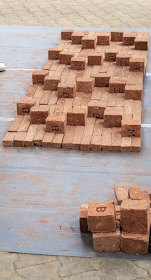
During a visit to one of Bangalore’s art schools, the Chitrakala Parishath, we watched architecture students participating in an outdoor “brick techtonics” workshop. This was being supervised by the noted Indonesian architect Andy Rahman.
We watched small groups of students arranging bricks so as to make interesting patterns, following plans drawn up by Andy Rahman. As they worked, Mr Rahman moved from group to group, discussing with them what they were doing.
All around the area where the workshop was taking place, labourers were working noisily on a construction site where new buildings were being built for the art school. Thus, the architects working on realising theoretical bricklaying design ideas were surrounded by real life applications of established building practices.
I hope that when the budding architecture students begin designing ‘for real’ that they will recall the interesting brickwork creativity that Mr Rahman was introducing to them. For he was showing them that even the humble brick can become a component in a visually fascinating design.
While strolling through London’s Green Park, I came across the bench illustrated above. It looked quite new, and is an unusual design, which I have never seen before. It can accommodate four adults providing they are all fairly slim.
SEVERAL MONTHS AGO, I watched a wonderful film set in Japan and directed by Wim Wenders: “Perfect Days”. Set in Tokyo, the main character is a man who cleans the city’s public toilets. Each of the public conveniences he cleans is of a different design. And each of them, like so many things designed in Japan, is a beautiful work of art. Making things and places look special and visually pleasing seems to be an important feature of the Japanese philosophy of life, and has been since time immemorial. Yet, unlike many other countries, Japan has not yet established a dedicated national design museum.
Until the 8th of September 2024, the Japan House in High Street Kensington is hosting an exhibition called “Design Discoveries”. The website of the Japan House (www.japanhouselondon.uk/whats-on/design-discoveries-towards-a-design-museum-japan/) explained:
“This exhibition brings together seven major designers, from filmmakers to architects, to consider what they would put into a permanent collection of design treasures. Their personal responses capture Japan’s regional diversity and 10,000 years of history.”
The beautifully laid out exhibition is not merely educational but also a feast for the eyes. Examples of Japanese design (and technology) dating from about 4500 years ago to the present century are beautifully displayed and intelligently explained.
Should the Japanese eventually get around to creating a museum of design, I am certain that visiting it would be a very exciting experience. Meanwhile, if you can get to Japan House – a beautifully designed place – you should not miss visiting the exhibition in its basement.
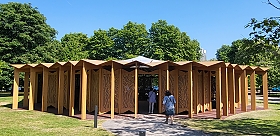
EVERY YEAR SINCE 2000, the Serpentine Gallery in London’s Kensington Gardens has commissioned the construction of a temporary pavilion in its garden. These pavilions have two things in common. One is that they contain a café and the other is that it must be designed by a noteworthy architect who has never had one of his or her creations constructed in England. Almost all the pavilions constructed to date have been examples of adventurous and exciting architecture. This year’s architect is Lina Ghotmeh, who was born in Lebanon and now works in her studio in Paris.
Given the French name “À table”, the circular timber pavilion was conceived as a place for people to sit together and chat, just as they would around a dinner table. Given this aim of the architect, it succeeds. To enhance her aim, the specially designed tables and chairs are arranged in a circle. As my wife said, it is the homeliest of all the pavilions built to date. Unlike some of the earlier pavilions, one does not feel that one is entering an unfamiliar, or even alien, environment. Despite its welcoming nature and very human scale, the pavilion’s design is far from mundane. Although it is far from being amongst the most visually spectacular of the temporary buildings, it is pleasing to the eye. I will certainly visit it again before it is dismantled on the 29th of October 2023.
THE ARCHITECT EDWIN LUTYENS, who designed a set of important government buildings in India’s New Delhi, was also one of the principal planners of Central Square and its surroundings in London’s Hampstead Garden Suburb (‘HGS’). Here is a little bit about this that I have published about this in my book “Golders Green & Hampstead Garden Suburb: Visions of Arcadia”:
“Designed to be the throbbing communal heart of HGS, Central Square is a failure. Pevsner and Cherry noted in their “Buildings of England: London 4: North”:
“Unwin’s first plans had included shops along the approaches, but as built by Sir Edwin Lutyens, appointed consultant architect in 1906, the shops were omitted and the square became a high-minded enclave of churches and public buildings with a fringe of smart houses.”
The writers pointed out that without shops, the square never became a true social centre. In fact, most of the time it is an almost deserted open space. Lutyens (1869-1944) did not get on well with Henrietta Barnett. In her book “The architect and his wife: a life of Edwin Lutyens” (published in 2002), Jane Ridley wrote:
“Lutyens was no progressive. He had no interest in using architecture to change the way people lived, to eliminate servants or smooth social divisions … He disliked the bossiness of social reformers such as Mrs Barnett. Ugly, squalid towns such as Manchester depressed him, but he didn’t see town planning as a motor for change. All he wanted was to build beautiful buildings: ‘Loveliness alone is akin to godliness and whilst ugliness is countenanced and excused Hell is possible.’”
Later in her book Ridley recorded that Lutyen’s wife Emily had written to him after he had fled abroad in 1908 (having had disagreements with Henrietta):
“‘I am glad you went,’ she wrote, ‘as you needed rest and change, only you must work up the Hampstead affair and not let grass grow under your feet, or Mrs Barnett will put you in the wrong again.’”
Despite his differences with Mrs Barnett, Lutyens left his architectural mark on the square. These are his buildings built before he drew up plans for most of his buildings in British India, notably in New Delhi. As Mary Lutyens described in her book “Edwin Lutyens” (published in 1991), his work in the suburb was of importance for his future career:
“At the beginning of 1912 Lord Crewe, Secretary of State for India, approached Reginald Blomfield, President of the Royal Institute of British Architects, to recommend an architect to serve on a commission of three experts to advise the Government of India on the siting and laying out of the new capital. Blomfield recommended Lutyens on the strength of his country houses …his work in Johannesburg … and for Hampstead Garden Suburb. Sir Richmond Ritchie, Permanent Secretary for India, then sent for Lutyens and asked him if he would be willing to serve on the Commission. Incidentally, in connection with the above, Lutyens was already married to the daughter of a Viceroy of India…”
Central Square and its surroundings remain a rather sterile centre of what its founders hoped would be a garden suburb with a vibrant community spirit. If you are lucky, you can spot someone walking a dog or a few children playing on the lawns. Otherwise, this part of London is peaceful and, dare I say it, rather dull.
You can read more about Hampstead Garden Suburb in my book, which is easily available from Amazon:
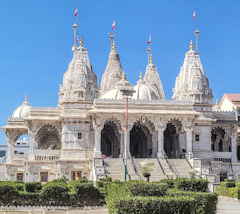
THE SWAMINARAYAN TEMPLE in Mandvi (Kutch, Gujarat) was constructed between 1991 and 1999 to replace a smaller Mandir on the site. Without going into the details of its very fine architectural and decorative features, this edifice was financed by local Kutchi followers of Swaminarayan. The Rajasthani Marble that forms the temple’s structure was hand carved by workmen, all of whom were followers of Swaminarayan. The stones that make up the building were carved in Rajasthan, transported to Mandvi where they were put together to make the edifice. This is similar to how the great temple in London’s Neasden was constructed.
Swaminarayan Mandir in Mandvi
The temple at Mandvi looks very similar to ancient Hindu temples I have seen elsewhere in India. As you look around it, you can see how the very old temples looked when they had just been built many centuries ago. Apart from the fact that Mandvi’s Swaminarayan Mandir looks recently built, a layman like myself, would find it difficult to age the building.
In 19th century England, many new churches were built in the gothic style. Like the newish temple at Mandvi, may of them faithfully reproduce the churches built in mediaeval times. The only thing that differentiates the 19th century Gothic Revival churches from their mediaeval predecessors is that they look too new to be as old as them.
In a book about Gothic Revival written by the art historian Kenneth Clark (1903-1983), he suggests that in England the use of gothic style in architecture never actually died out, and this suggested to me the Gothic Revival was really gothic survival. As far as I can gather, the same is the case for Hindu mandir architecture. If this is really the case, new temples such as Mandvi’s Swaminarayan Mandir is not the revival of the use of an ancient style of architecture, but an example of its survival. Put another way, the new temple at Mandvi is a reincarnation of its predecessor.
RAINHAM HALL IN the London Borough of Havering is a fine example of a house built in the early 18th century for a prosperous merchant. Owned and managed by the National Trust (‘NT’), the house stands at one side of its large garden. Across the yard next to the house, there stands the recently restored 18th century combined stable block/coach house and brewhouse. The ground floor of this building contains the NT reception area, a small second-hand bookshop, toilets, and a café. The upper storey contains a large exhibition/community space beneath a timber roof. The restoration of this edifice was completed in October 2015.
There are two ways to reach the upper floor from the lower one. And it is the design of these that really impressed me. There is a spiral staircase, whose treads are cantilevered from a central timber cylinder. Bands of metal surround the cylinder in the same way that similar bands can be found binding the timber elements of wooden barrels. This design was chosen to commemorate the former existence of Rainham Hall’s brewhouse (brewery).
The lift at the upper floor level
The cylinder not only supports the staircase, but it also contains a lift shaft. The circular lift is entered on the ground floor through a barely discernible door in the cylinder. The lift consists of a circular platform without a ceiling. A mechanism below it raises the platform to the first-floor level, where it is surrounded by the top edge of the central cylinder. A door opens to allow access to the upper floor from the lift.
“The restoration of the stable block to provide essential facilities, included a visitor café and community room, required sensitively designed interventions and additions. Amongst these were a new bespoke lift and staircase in the brew house to provide access to the hayloft. The ambition was for the modern insertions to reinforce the understanding of the buildings’ original use.”
I believe that the architectural firm’s ambition has been fulfilled. Although the 18th century Rainham Hall is well worth seeing for its antiquity, the ingenious new combined lift and staircase should not be missed.
THE VICTORIAN GOTHIC Westbourne Grove Church (with a Baptist congregation) is on the corner of the Grove and Ledbury Road. Built on the site of an earlier church, this building was constructed in 1866. On examination, it is obvious that it has been modified considerably. According to the church’s website, westbournegrovechurch.org, in 2001:
“… the church worked with the Manhattan Loft Corporation to redevelop the site. Our vision was to use the church building to serve the local community, as an expression of God’s generosity and love. The church retains space spread over the entire ground and first floors of the building, while the project was funded by development of apartments in the top four floors of the converted building.”
The church now shares its building with retail outlets and residential units, the rents from which help finance the church’s activities and maintenance.
The parts of the ground and first floors used by the congregation have been redesigned imaginatively and beautifully in a simple contemporary idiom. Airy spaces simply but attractively decorated, flow neatly between each other giving the interior of the church a cubist sculptural feel. The rooms at the base of the two towers on the south façade of the church are used for exhibitions and meetings. In short, the spaces used for ecclesiastical and pastoral purposes provide a wonderful example of successful modern interior design. The current vicar is Chris Thackery. His wife Charlotte is an architect, and was involved in overseeing, and advising on, the modernisation of the church.
A visit to see this wonderful new church is well worth making. It is not far from Portobello Road and is a treat for lovers of imaginative architectural design.
FROM THE LATE 19th century until a few years ago, High Street Kensington was a healthily flourishing retail centre. In its heyday, it boasted of three large department stores, Pontings, Barkers, and Derry & Toms. The impressive buildings that housed the latter two still stand and are fine examples of art deco architecture located close to the Underground station, which has been in service since the late 1860s. In recent years, the advent of on-line shopping, high rents, and the proximity of the Westfield Mall at Shepherds Bush (opened 2008), which has good parking, have conspired together to make High Street Kensington less appealing to shoppers. Consequently, at any one time a large proportion of shops remain empty awaiting new tenants. Sadly, what was once (especially in the 1960s and ‘70s) a bustling high street with trendy shops like Biba and the ‘funky’ Kensington Market, both gone, has become slightly dreary.
Barkers building
Barker’s former shop, a lovely art deco edifice, which opened in 1933, was designed by Bernard George (1894-1964). Between 1928 and 1962, he was the chief architect for Barker’s of Kensington in-house design group. It is worth examining this building closely to enjoy is many attractive details.








 yamey
yamey 