Hanging on the walls at a house in Hammersmith

FACING THE THAMES near to The Dove pub in Hammersmith, there is an interesting little museum dedicated to exhibits relating to William Morris. In my book “BEYOND MARYLEBONE AND MAYFAIR: EXPLORING WEST LONDON”, I wrote about the museum as follows:

“ … Kelmscott House. Built on the site of an old warehouse, this became the home of Sir Francis Ronalds (1788-1873) in the early 19th century. Sir Francis, an inventor, laid eight miles of insulated electrical cable in the house’s extensive garden, which in his time stretched as far inland as King Street, and with that he demonstrated the use of telegraphy for the first time in history in 1816. When he reported his discovery to Lord Melville, the First Lord of The Admiralty, he was told (by Melville) that telegraphs were totally unnecessary, because the semaphore did the job of communication just as well.

In 1878, Ronalds’s house, known then as ‘The Retreat’, was bought by the writer and artist William Morris (1834-1896), who was a leading exponent of the Arts and Crafts Movement and a social reformer. According to his biographer Fiona MacCarthy, Morris did not like its name because ‘Retreat’ suggested that it might be regarded as an asylum.  So, he renamed it Kelmscott House (the name of Morris’s Thames side dwelling in Oxfordshire).”

I wrote that the museum is housed in the:

“… long narrow coach house attached to the west side of Kelmscott House which was used as a lecture hall in William Morris’s time. It hosted many meetings of groups sympathetic to socialism, including one that which Morris joined in 1883: the ‘Democratic Federation’, later known as the ‘Social Democratic Federation’. Like some of today’s leading British socialists, Morris was also far wealthier than the people whom he hoped to help with his left-wing political sympathies.

Today, the coach house, which bears a plaque in memory of Sir Francis Ronalds, houses the offices of the William Morris Society and a small museum.”

Recently (June 2024), we visited the museum, which has a temporary exhibition called “The Art of Wallpaper: Morris & Co. in Context”. It will remain in place until the 11th of August 2024. According to the museum’s website (https://williammorrissociety.org/whats-on/):

“This exhibition focuses on William Morris (1834–1896), placing his wallpaper designs within the context of the radical changes in taste witnessed during the Victorian era. His distinctive patterning is set against a backdrop of the fanciful, naturalistic patterns that typified fashionable English and French papers in Morris’s youth.”

The visitor can admire a collection of framed, highly decorative wallpaper samples, including many designed by Morris and his associates. Apart from the Morris designed wall papers, there are examples of styles that were fashionable in the 19th century: French style, Reform Movement Styles (e.g., by Pugin), Japanese-influenced designs, and the Arts and Crafts Movement. The most interesting exhibit was a wooden printing block, which would have been carefully inked up in different colours, and used to create the wall papers. Next to this, there were a couple of pages from the Morris logbook used to record the colours and designs of the papers produced by Morris and his company.

The small museum is well worth a visit. It is a shame that the main house to which it is attached is not open to the public at present.

PS The book is available as a paperback and a Kindle from AMAZON

Black and white housing

WHEN DRIVING HOME after leaving our vacuum cleaner for repair at a small shop in Ealing, we passed a tidy estate consisting of houses and blocks of flats, all decorated with mock half-timbering painted in black and white. Near to West Ealing Underground station, this housing colony is called Hanger Hill Garden Estate.

During the period between the two World Wars, much residential building work was undertaken in London’s suburbs. Often, estates were built with features that mimicked rusticity. The idea was that the commuters, who lived there, might imagine that they were enjoying a village atmosphere, without being far away from the inner city, where many of them worked. To create this illusion, house builders adorned their constructions with decorative features that were supposed to make them seem older and more traditional than they were. The use of mock half-timbering on external walls was a commonly used decorative trick designed to evoke suggestions of ‘ye olde England’.

At Hanger Hill Garden Estate, there is a uniformity of style, which makes the use of half-timbering eye-catching rather than suggestive of rustic traditions. Interestingly, the mock half-timbering does not extend to cover the dull, pebble-dashed rear walls of some of the blocks of flats. These surfaces are less easy to see from the roads than the mock half-timbering. Overall, the result is attractive. When I first saw this well-maintained estate with neat gardens, I thought of early 20th century garden suburbs rather than old country villages, which are often delightful because they lack uniformity in their layouts.

The opening of the branch of the Central Line, which runs from Shepherds Bush to Ealing Broadway, in 1920, and especially the opening of West Acton Station three years later, were the stimuli for the construction of residential estates in the area. In 1925, the first bit of land was acquired by Hanger Hill Garden Estate Ealing Limited. The estate was built between 1928 and about 1932. The buildings, flats and houses, were all designed by the architectural practice of Douglas Smith & Barley. The resulting layout has considerable uniformity, and is attractive without being monotonous. A good feature in the estate’s design is that the blocks of flats stand in spacious lawns.

The Residents Association’s website has a good history of the place (www.hhgera.com). It noted that in the 1930s:

“…times were clearly pleasant and peaceful ones for all the tenants on the Estate. Occupiers of some of the four-bedroomed houses employed a maid, the fourth bedroom having been designed with this in mind. Whilst all the houses and many of the flats had garages, only a small number of people on the Estate owned cars … These were the days when goods were delivered to the home. Tradesmen were not allowed to call at the front doors of the houses or flats, but had to call at back doors using the service roads. Bakers, butchers, fish salesmen and greengrocers all called weekly, some attending earlier in the day or week to take orders. In the parking bays behind the flats, vans from Harrods, Dickens & Jones and the like, were to be seen drawing up.”

However, life on the estate was not free from regulations:

“Tenancies of flats were refused to people who had young children. No animals were allowed to be kept in the flats … House tenants were allowed to hang out washing only on Mondays and Tuesdays; flat tenants were not permitted to hang out washing at all.”

Currently, so two friendly residents informed us, the estate is subject to strict conservation regulations. This is a good thing because it would be a shame to spoil the appearance of this charming and unusual enclave of residential accommodation in this part of west London.

READ more about west London in Adam Yamey’s book “BEYOND MARYLEBONE AND MAYFAIR: EXPLORING WEST LONDON”, which can be bought from Amazon https://www.amazon.co.uk/BEYOND-MARYLEBONE-MAYFAIR-EXPLORING-LONDON/dp/B0B7CR679W/

The naked ceiling at Osterley Park

WHEN THE BANKER Sir Francis Child (1642-1713) acquired Osterley Park in the 18th century, its Elizabethan manor house was in a poor state of repair. His grandsons, Francis and Robert, employed the famous architect, Robert Adam (1728-1792) to give the house a major ‘makeover’ including adding a grandiose neo-classical front portico. And that is what he did on a grand scale. Adam was no ordinary architect. Not only did he plan buildings (and modifications to them), but he also designed their interiors: everything from ceilings and wall decorations to furniture and doorhandles. Osterley Park offers a magnificent display of his wide-ranging skills.

Long gallery at Osterley Park

The visitor to Osterley Park, now managed by the National Trust, usually gets to see a series of wonderful rooms on the ground floor of the house. All the rooms except one have beautifully decorated ceilings, all designed by Adam. Some of them have paintings created by Adam’s favourite painter, the Venetian Antonio Zucchi (1726-1795). Amongst my favourite ceilings are those in the Etruscan Dressing Room and the Drawing Room. The latter has a fantastic ceiling that was inspired by drawings in “The Ruins of Palmyra otherwise Tedmor in the Desert” by James Dawkin and Robert Wood (published in 1753).The ruins were those that were recently badly vandalised by the IS group. In each of the rooms, except the long gallery, the visitor’s attention is dominated by the eye-catching ceilings.

The ceiling of the long gallery is devoid of decoration. It was in this room that the Child family’s collection of fine paintings used to be displayed. The gallery’s ceiling was left plain, without decoration, deliberately, so that the viewer’s attention would be concentrated on the paintings.  Sadly, the paintings are no more. After WW2, the house’s owner, George Francis Child-Villiers, 9th Earl of Jersey (1910 -1998) gave the house and its grounds to the National Trust. He moved to Jersey, taking with him most of the paintings that had hung at Osterley. Unfortunately, many of these works were destroyed in a warehouse fire soon after he donated the house. The artworks in the gallery have since been replaced with other paintings and because the ceiling is naked, you can give them your full attention.

Black and white beneath your feet

WHEN WALKING IN central Funchal, it is worth looking down at the pavements. Like those in Lisbon and other towns in Portugal, their surfaces are covered with small black and white stones arranged to create pleasing patterns. I imagine that these compositions created using irregularly sized stones must be laid by hand rather than by using a machine.

Funchal

Often the stones are laid on the pavements as well as on large open spaces in such a way that fascinating optical effects are achieved. By making such lovely places on which to walk, the cities and towns become beautiful in whichever direction you look.

A charming chapel preserved

WHEN RUDYARD KIPLING (1865-1936) died in London’s Middlesex Hospital, his body was placed in the hospital’s chapel before being taken to be cremated at the Golders Green Crematorium, Charles Carrington wrote in his biography of Kipling that just as his coffin, draped with the Union Jack flag, arrived at the crematorium:

“… the followers of Saklatvala, the Indian Communist who had been cremated just before Rudyard Kipling, were singing the Red Flag.”

Kipling was not a sympathiser of Communist ideas and ideals.

Middlesex Hospital in the Fitzrovia area of London, where Kipling breathed his last, no longer exists. Founded in 1746, it provided medical care on a square plot of land bounded one one side by Mortimer Street between 1757 and 2005. In 2008, almost all of the hospital was demolished. The only part of the complex, which was preserved, is the Fitzrovia Chapel, in which Kipling’s body reposed briefly. Between 2012 and 2016, a new development, Fitzroy Place, consisting of flats and offices, was constructed on the hospital’s site.

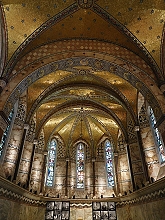
The small Fizrovia Chapel, beautifully restored, stands in a small garden in the middle of the new development, dwarfed by the buildings around it. This gem of a Victorian ecclesiastical construction was designed by the Gothic Revival architect John Loughborough Pearson (1817-1897) and was ready for use by 1892 (although the interior decoration was not fully completed until 1929). The chapel’s spectacular colourful interior must be seen to be believed. Its magnificent appearance is the result of skilful use of mosaic, marbles of different types and colours, and amazing decorative motifs inspired by early Italian, Byzantine, and Moorish architecture. Some of the metal lampshades that hang from the decorative ceiling seemed to have been influenced by the types of lamps typical of Turkish tradition.

The chapel is maintained by The Fitzrovia Chapel Foundation. It is open on most Wednesdays for public viewing as well as during the occasional exhibitions and concerts that are held within it. This charming place is also available for hire for weddings, fashion shoots, book launches, and other events.

Until we attended an exhibition in the Fitzrovia Chapel in late May 2022, we had no idea that this small architectural gem existed. Along with nearby All Saints in nearby Margaret Street, the Fitrovia, a treasure chest with its sparkling golden ceiling, should not be missed by lovers of Victorian architecture and/or fine mosaic work  (as well as masterful use of inlaid stonework).

Lift your eyes

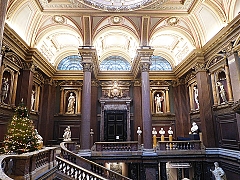
IT IS TEMPTING to concentrate on the wonderful collection of exhibits in Cambridge’s Fitzwilliam Museum, but you should spare some of your attention for the magnificent decoration of some of its galleries. Look up from the paintings and display cases to see superb ceiling decorations above you, and also around you when using the grand staircase. You are sure to be amazed.

The museum is housed in a neo-classical edifice initially designed by George Basevi (1794-1845), architect of London’s Grosvenor Square. After Basevi’s death, the planning of the structure was completed by Charles Robert Cockerell (1788–1863). Built to house the collection bequeathed to the University of Cambridge by Richard FitzWilliam, 7th Viscount FitzWilliam (1745-1816), the present museum was opened to the public in 1848. Over the years since then, the museum has been enlarged by adding newer buildings and now it is home to about 500,000 artefacts.

Years ago, I remember reading (I cannot remember where) a comparison of a museum in the USA designed by Ludwig Mies van der Rohe (1886-1969) with another one, the Guggenheim in Manhattan, designed by Frank Lloyd Wright (1867-1959). Both buildings are elegant but that by Mies Van der Rohe modestly allows the exhibits to grab the viewer’s attention more than the architecture, whereas the unusual design of Wright’s building competes with the artworks for the viewer’s attention. The internal decoration of the older galleries of the Fitzwilliam are sufficiently eye-catching to be able to compete with the exhibits housed in them, but somehow, they hardly do this. That is why I am asking you to take your eyes off the exhibits if only to glance briefly at the décor of the galleries,

Catching the wind

Cambridge, UK

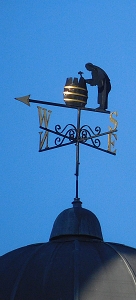
LOOK UP AND if your eyesight is reasonably up to scratch, you might well be lucky enough to see a weathervane on top of a church steeple or some other high point on a building. The ‘vane’ in weathervane is derived from an Old English word, ‘fana’, meaning flag (in German the word ‘Fahn’ means flag). Weathervanes are simple gadgets that indicate the direction of the wind. They usually consist of an arrow attached by a horizontal straight rod to a flat surface that catches the wind. The rod is mounted on a vertical support in such away that it can rotate as the wind catches the flat surface. The horizontal rod with the arrow rotates so that it offers the least resistance to the prevailing wind. Beneath the rotating arrow are often indicators that are labelled with letters denoting the four points of the compass. If, for example, the wind begins to blow from east to west, the horizontal rod will rotate so that the arrow is above the ‘E’ denoting east. Some weathervanes substitute the horizontal rod with a single flat asymmetric object that can catch the wind and rotate. Often the object seen above churches is a cock or other bird, whose beak will indicate the direction of the wind. I suppose that for birds wind direction is quite important.

The weathervane is not a recent invention. It was invented in the 2nd century BC both by the Greeks and the Chinese but separately. Some of the oldest Chinese weathervanes were shaped as birds and later, at least by the end of the 9th century AD, bird shaped vanes became used in Europe. Although avian weathervanes are still very common, a wide variety of other shapes have been used. Sundials, weathervanes, now archaic, only give an approximate indication of time and wind direction respectively. However, unlike sundials, which do not work when the sun is not shining, weathervanes work in all weather conditions and in day and night, although they are somewhat difficult to see at night-time. Despite their relative inaccuracy compared with modern instruments for measurements of  wind, weathervanes are attractive adornments to buildings both old and new.

Organs and archaeology

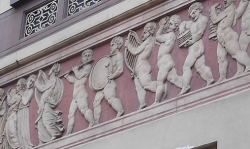
THE EYES OF MOST VISITORS to Kensington Gore are attracted to the spectacular Royal Albert Hall and, opposite it, the monument to Albert, Queen Victoria’s consort. Immediately to the west of the Royal Albert Hall, there stands the comparatively less impressive twentieth century building housing the Royal College of Art (‘RCA’), designed by H T Cadbury Brown and opened in 1962. Next to this geometric structure of concrete and glass and on its south side, there is an edifice whose appearance is a dramatic contrast to it. The walls of the RCA’s southern neighbour are covered with figurative illustrations, created in the ‘sgraffito’ technique.  Bands of ‘putti’ carrying musical instruments, scrolls of paper, or singing, appear to be scurrying across the walls of the building. Maybe this is not surprising because once this place housed The Royal College of Organists (‘RCO’).

Founded in 1864 by the organist Richard Limpus (1824-1875) to promote advanced organ playing, it received its Royal Charter in 1893. The building next to the present RCA and facing the Royal Albert Hall was designed by Lieutenant Henry Hardy Cole (1843-1916) of the Royal Engineers, and the ‘sgraffiti’ decorating it was created by Francis Wallaston Moody (1824-1886).

Lieutenant Cole was a son of Sir Henry Cole (1808-1882), a civil servant who had an extremely important role in organising the Great Exhibition of 1851. His building, erected 1874-75, was originally constructed to house The National Training School for Music. It was paid for by Sir Henry Cole’s friend, music lover, and a fellow member of the Society of the Arts, the developer Charles James Freake (1818-1884), who lived in Cromwell Road (www.londonremembers.com/memorials/sir-c-j-freake).

The architect, Lieutenant Cole had little practical architectural experience as is revealed in “The Survey of London Vol.38” (www.british-history.ac.uk/survey-london/vol38/pp217-219):

“Lieutenant Cole had returned in 1871 from India, where he had been Superintendent of the Archaeological Survey, North-West Provinces, and his previous architectural work seems to have been confined mainly to publications on ancient Indian architecture and archaeology, and the preparation of casts for the Indian section of the South Kensington Museum, which he catalogued.”

Consequently:

“He was not left to design the school on his own. It was evolved in consultation with his father and was subjected to criticism by members of the Science and Art Department. A committee of management was appointed in July 1873 …”

Moody was a protégé of Sir Henry and a teacher at the National Art Training School, a forerunner of the RCA.

Between 1883 and 1896, the building was used by the newly founded Royal College of Music, which moved into its new premises south of the Royal Albert Hall in about 1896. The large variety of musical instruments that have been depicted on the building’s walls reflect the place’s first occupants.  Between 1896 and 1903, it stood empty. Then it was leased to the RCO for 100 years at a ‘peppercorn’ rent. When it was learnt that after expiry of the lease the rent would be increased considerably, the RCO moved into new accommodation in 1991. Currently, at least in 2018, it is owned by an entrepreneur, Robert Tchenguiz.

The Lieutenant, who designed the RCO building, became the Curator of Ancient Monuments in India. His “First Report Of The Curator Of Ancient Monuments In India” was published in 1882 in Simla. This contains some of his views on dealing with archaeological items and sites. For example, he wrote:

“Experience has shown that the keenest investigators have not always had the greatest respect for the maintenance of monuments. Archaeological research has for its object the elucidation of history, and to an enthusiast the temptation to carry off a proof of an unravelled mystery is undoubtedly great. If there were no such things as photographs, casts, and other means of reproducing archaeological evidence, the removal of original stone records might perhaps be justified …”,

and, regarding the now controversial British possession of some famous sculptures in the British Museum:

“Sometimes, indeed, the removal of ancient remains is necessary for safe custody; and in the case of a foreign country, we are not responsible for the preservation in situ of important buildings. We are not answerable for keeping Grecian marbles in Greece; neither were we concerned for the rights of Egypt when Cleopatra’s Needle left Alexandria for the Thames embankment.”

However, regarding India, the Lieutenant wrote:

“In the case, however, of India—a country which is a British possession—the arguments are different. We are, I submit, responsible for Indian monuments, and that they are preserved in situ, when possible. Moreover, as Mr. Eergusson remarks, Indian sculpture is so essentially a part of the architecture with which it is bound, that it is impossible to appreciate it properly without being able to realise correctly the position for which it was originally designed …”

In order to satisfy the needs of museums in Europe, the lieutenant suggested that perfect replicas of artefacts can be made as is well demonstrated by the superb life-like plaster casts that can be seen in the Cast Courts of the Victoria and Albert Museum, which were opened in 1873 and established by Sir Henry Cole and the art collector John Charles Robinson (1824-1913). In general, Sir Henry’s son was against moving historical remains from British possessions. To make his point, he wrote:

“The removal, for instance, of Stonehenge to London would, I imagine, provoke considerable excitement in England, and be condemned by a majority in the scientific and artistic world.”

I am not sure that Lieutenant Cole’s views were shared by the American sculptor and collector of antiques George Grey Barnard (1863-1938), who bought and whole cloisters and other architectural items in France and then had them shipped to New York City. There, they were reassembled and displayed in the superb Cloisters Museum at the northern tip of Manhattan.

Looking at the outside of the former RCO building, I could not detect anything that reflected its architect’s experiences in India except, if I stretch my imagination, for the upper storey windows that faintly recall the projecting windows that can be found on ‘havelis’, for example, in Gujarat and Rajasthan. But maybe I am letting my imagination run a little wild.

Oliver Cromwell in Essex

YOU CAN NO LONGER ENJOY a tankard of ale at the Sun Inn in the Essex town of Saffron Walden. However, you can still enjoy the fine pargetting (moulded sculptured plasterwork) that adorns it.

The building that housed the former Sun Inn was built in the 15th century. Late in the 16th or early in the 17th century, an upper floor was added. Indeed, one of the gables with fine pargetting bears the date 1676. This might have been the date when the present pargetting was created or when the upper floor was added, or even both. The former inn has an opening that allowed wagons and other traffic to enter the yard behind it.

The pargetting is described well in a website (www.british-history.ac.uk/rchme/essex/vol1/pp228-260) as follows:
“… in the middle bay are two late 17th-century panels in plaster, one with a design of foliage and birds, and the other with a stocking; in the S.W. gable is a design of the same date in plaster, which consists of a circular panel divided into twelve segments; on each side is the figure of a man in a long coat, knee-breeches and high-heeled shoes; one figure holds a sword and buckler, the other a long club.”

One of the panels, that with the man with a sword and the other with a long club, respectively represent Thomas Hickathrift and the Wisbech giant (https://heritagerecords.nationaltrust.org.uk/HBSMR/MonRecord.aspx?uid=MNA108635). Thomas (‘Tom’) Hickathrift was a mythical East Anglian giant-killer, a giant of a man, whose exploits included slaying the Wisbech Giant.

Today (late 2020), the group of beautifully decorated houses that includes the former Sun Inn is empty. The ground floor of part of the building bears a shop sign ‘Lankester Antiques & Books’. Run by Paul Lankester of Thaxted in Essex, the shop closed after 48 years of business in July 2015. Another sign near it reads ‘The 14th century Old Sun Inn. Oliver Cromwell’s Headquarters 1647’. In 1647, when Cromwell’s New Model Army had won the first civil war for the Parliamentarians, they gathered in Saffron Walden. For various reasons the war weary army was becoming dissatisfied. Cromwell and his officers arrived in Saffron Walden on the 2nd of May 1647 to try to satisfy the troops’ various demands and to deal with their grievances (www.saffronwaldenreporter.co.uk/news/a-lasting-place-in-history-1-377880). He was unable to do so and returned to London after staying in the town for 19 days. 

Although the town has many other attractions, seeing this old building with its exquisite external decorations is on its own an excellent reason to pay a visit to Saffron Walden.