A teetotal private club by the seashore in Fort Kochi (Kerala)

DURING BRITISH RULE in India, the (white) colonisers formed clubs to which Indians, apart from those who worked in them as servants,  were excluded. Many of these colonial era clubs are still in business,  but now serve as refuges to which (mainly) upper middle class and upper class Indians can escape from the other Indians that surround them in daily life.


One of these clubs is the Cochin Club in Fort Kochi (Kerala). It stands on land close to the seafront. Prior to the establishment of the club in 1914, this land was formerly Schulers Shipbuilding Yard, and later Grieves Beach Yard. It was given to the founding secretary of the club,H Baechtold,  by Volkhart Brothers.


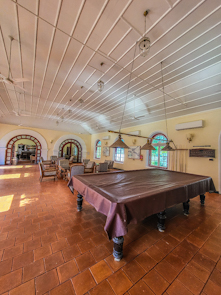
It was only in the 1960s and ‘70s that the club ceased to be exclusively for ‘white’ people. Many of the club’s buildings are fine examples of colonial architecture.  The bar is magnificent, as are the rooms adjacent to it (the lounge-cum-billiards room, the library, and another smaller bar).


Although the bar is a marvellous example of  colonial era design, there is now a problem. In the early years of the club, members and their guests used to enjoy alcoholic beverages at the bar, this is no longer the case. Exactly when alcohol ceased to be available I do not knoe.


For many years, the club has not had a liquor licence, and given the very high cost of such licences in the State of Kerala  there is little likelihood that an  alcohol licence will be purchased by the club. We were told that if a special occ  such as a wedding reception,  takes place within the lovely grounds of the club, whomever is organising it can purchase (at great cost) a temporary booze licence for the day.


Because of the absence of a liquor licence,  the club is often very empty – almost like the famed Marie Celeste. The club has five wonderful, spacious guest rooms, and the income from the guests hiring these is an important source of income for the establishment.  In addition, the club rents out space to other businesses. Currently (January 2026), one of these is a café,  and the other is  a boutique.


Outnumbering the usual number of members and room guests in the club are the white egrets that stride around the grounds in a most proprietorial manner.


Because we are members of a club affiliated to the Cochin Club, we can use their facilities and hire their bedrooms. The Cochin Club is today, as it was in the past, a peaceful place to escape from the hustle and bustle of Fort Kochi,  which seems to increase each time we visit the town.

Ukrainians from Canada

LONDON IS RICH in memorials. Some of them commemorate well-known figures and events and others make the observer aware of lesser-known aspects of history. One of these obscurer memorials is on number 218 Sussex Gardens, next to St James Church and not far from Paddington Station. It was placed on the building, which was rented by the Ukrainian Canadian Servicemen’s Association (UCSA) [Союз Українських Канадійських Вояків] in 1943.

According to an informative website (www.ukrainiansintheuk.info/eng/03/ucsa-e.htm), the UCSA was:
“…formed on 7 January 1943 in Manchester, to cater for the social and cultural needs of Ukrainian Canadians serving overseas. Initially the association had 37 members. By the end of the war there were 1,500 active members and over 3,000 additional names on the association’s mailing list.”
That is clear enough, but I wondered about the story of the Ukrainian Canadians. In 2016, there were more than 1.4 million Canadians with Ukrainian ancestry. Canada has the third largest population of Ukrainians after Russia and Ukraine. Almost certainly, 1891 marked the start of the migration of significant numbers of Ukrainians to Canada. Back in those days, the territory, which is now the republic of Ukraine was divided between the Austro-Hungarian and Russian Empires. They were welcomed in Canada as the country needed workers to populate and cultivate the prairies.

The UCSA occupied the house in Sussex Gardens from late 1943 until early 1946. The website quoted above revealed that the UCSA:
“… organised social gatherings, or “get-togethers”, for its members, initially in Manchester and later also in London. A choir and a dance orchestra were organised at the London club, and a library and reading room were maintained there. The association’s activities also included visiting sick and wounded Ukrainian Canadians, compiling lists of those who had died or were taken prisoner, and looking after the graves of the dead (at various cemeteries in the UK, including Brookwood Military Cemetery near Woking, Surrey). From September 1943 the association published an UCSA Newsletter.”
As WW2 drew to a close, the UCSA also provided assistance to Ukrainian displaced persons and refugees from mainland Europe.

The memorial plaque on 218 Sussex Gardens was placed in September 1995, long before Russia began its current conflict with Ukraine. Unlike the statue of the Ukrainian Saint Volodmyr, which stands in Holland Park Avenue, the building near Paddington did not have any pro-Ukraine flags or other patriotic items affixed to it. The plaque is a discrete memorial to an aspect of the history of WW2, about which I knew nothing until today.

Winston Churchill and a newspaper reading stand

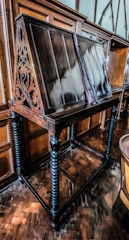
THERE IS A LOVELY old wooden newspaper reading stand is located in the formerly men only bar in the Bangalore Club. It bears the insignia “US” at one end, the S being back to front. Before about 1947, the club was the United Services Club.

Winston Churchill, who was never too fond of India, was briefly a member of the Club (in the late 1890s) , and incurred a small, but never paid debt there. I wonder whether the reading stand is old enough to have been used by Churchill.

Unintended tranquillity

THE COCHIN CLUB’S main, long, single-storey building is a lovely example of British colonial architecture. The club, located near the sea in a large well-maintained garden was officially recorded as having been established in 1914, but might have been in existence before that.

Originally established as “The English Club”, its members were mainly the British elite of Kochi and European tea planters. Some individuals, high level Indians, might have also been welcome. The Club’s Presidents all had British surnames until at least 1969. However, there was one exception – Honourable Justice P Govindan Nair who was President 1963-64. After 1969, the Presidents had Indian surnames.

Today, the Club is a tranquil spot. Usually, there are more crows and egrets than humans in its compound. The Club has five spacious, bedrooms, which can be hired. Their occupants are almost the only people using the Club. There are plenty of staff members, but few people for them to serve.

The Club has a splendid bar with windows overlooking the sea in one direction and the garden in the other. But it is a bar with a difference. Instead of shelves being lined with bottles of booze, they are used to display cups and other prize trophies. And this might be a clue as to why the Club is so often so empty.

The Club does not have a liquor licence. Therefore, it cannot sell alcoholic drinks. The cost of buying an annual licence is so prohibitively high in Kerala that the Club might not be able to break even. The availability of alcohol is one of the factors that brings life to the exclusive clubs of India.

On special occasions such as Diwali and Christmas and Onam, the Club buys a costly 24 hour licence. The rest of the time, the Club is ‘dry’. However, food and soft drinks are available in the bar. The South Indian filter coffee served there is the best we have found in Fort Kochi (Fort Cochin).

Largely because liquor is not available and because there are few members (about 500), this charming Club has acquired a certain unintended (undesired?) tranquillity.

Where Mahatma Gandhi met Vallabhai Patel in Ahmedabad

THE GUJARAT CLUB, the oldest club in Ahmedabad, stands opposite the Ahmed Shah Masjid, the oldest mosque in the city. The club was founded in 1888 by Rao Bahadur Nagarji Desai. With over 1000 members, the much used clubhouse is in an unmodernised condition. Located next to the recently constructed (2020) City Civil and Session’s Court, the Club is a ‘hang-out” and informal meeting place for many senior advocates. In former times, the place was frequented by Ahmedabad’s wealthy Mill owners and high ranking Britishers. It was the first Indian club that admitted Indians as well as Europeans from the moment it was established.

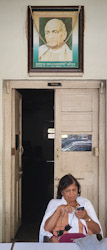
Vallabhai Patel above a doorway at the Gujarat Club

The Club is located close to a house where Sardar Vallabhai Patel (1875-1950) lived. Patel frequented the Club regularly and played bridge there. It was where he first met Mahatma Gandhi in 1916. A tree marks the spot where they chatted.

After having passed the Bar Examination at London’s Middle Temple, where my wife achieved the same thing many years later, Patel came to live in Ahmedabad. The first meeting with Gandhi at the Club marked the start of Patel’s attachment to the Mahatma’s cause. Years later, Patel played a key role in uniting the former Princely States with what had been British India to form the India of today. An important freedom fighter for Indian independence, he became a senior member of the country’s government after 1947. A close associate of Gandhi, the two men chose to differ on how to deal with certain issues, for example the creation of Pakistan.

We sat under the verandah of the Gujarat Club and enjoyed cups of tea. From where we sat we could see a large rectangular open space, which was being used as a car park. The ground was marked out with tennis court lines and a couple of nets were stretched between rows of parked cars.

We began conversing with an advocate at the next table. When he learned that my wife was a barrister, he kindly offered to show us around the neighbouring court building.

We spent well over an hour sitting in various court rooms. Most of these had two layers of glass screens, separating the judges and the court officials from the rest of the room: a covid precaution.

Several things impressed my wife as being different from what happens in British courtrooms. First, the plaintiffs are permitted to speak directly with the judges, rather than via intermediaries such as barristers. Secondly, the judges seemed to be handed the papers of a case at the moment it was about to be heard, rather than in advance. Thirdly, each judge was able to switch seamlessly between fluent Gujarati, Hindustani, and English. Also, they made decisions far more rapidly than their counterparts in the UK.

After our fascinating visit to the court house, our host and a charming advocate from his firm invited us to return to the court and the Club to celebrate Republic Day on the following morning, the 26th of January 2023. We accepted, and I will describe the events in another essay.

Our visit to the vibrant Gujarat Club proved far more exciting than we had anticipated. What was once a place where mill owners rubbed shoulders with British officers and officials, where Patel first met Gandhi, is now a congenial place where advocates meet, converse, read, and relax.

The bodies which came back to life

AT ABOUT FIVE in the morning, a taxi dropped us off at the Madras Gymkhana Club in Chennai. It was late February 1994, and we had just disembarked from an overnight train from Bangalore. We were going to rest at the Club before taking a flight to Colombo in Sri Lanka.

Today, the 8th of January 2023, we revisited the Gymkhana Club, and seeing the place reminded me of a strange experience we had there back in February 1994. The Club, which was founded in 1884, has as its main building an edifice gifted by the Rajah of Venkatanagiri in 1886. Compared with the Madras Club, south of it, its architecture is far less refined.

When we got out of our taxi before daybreak in February 1994, we entered the main building, which was unlit at such an early hour. The night watchman at the reception desk asked us to sit in some armchairs near the entrance until the morning receptionist arrived. After sitting for a while in the hot, humid reception area, the sun began to rise and the Club’s interior began to become visible slowly.

I noticed that we were sitting close to a very large room. As the light improved, I saw that the room was filled with tables. The tables were covered with napkins, cutlery, and plates of unfinished food. Alongside the tables, there were bodies lying on the floor. Soon after dawn, these bodies came to life. They belonged to the Club’s staff – waiters and so on. These people then proceeded to clear up the remains of the previous night’s banquet. Maybe, they had finished too late at night to make it worthwhile to return to their homes for a few hours.

Seeing these people lying in the gloomy light of daybreak and then coming back to life was a memorable experience. Visiting the Gymkhana Club today, 29 years later, evoked this memory powerfully.

Our brief visit to the Club today was quite different. The place seemed far from sleepy, and we received a warm welcome.

A Modulor in Bangalore

THE BOWRING INSTITUTE is a private members’ social club in central Bangalore (Bengaluru). It was established in 1868, and has been standing on its present site since 1888. The club has recently undergone a tasteful restoration and improvement. The old 19th century buildings can be seen in their full glory, looking as if they have only just been constructed.

One external wall of a club building has been adorned with a huge panel decorated with two Modulors. The Modulor is a symbol created by the great pioneer of 20th century architecture, Le Corbusier. It looks like a man with one arm raised and was designed by Le Corbusier to be “ a visual bridge between two scales: the metric and the imperial…” It was also connected with his philosophy that the proportions of structures should be related to those of the human body.

Le Corbusier had several connections with India. For example, he was intimately involved in the design of the city of Chandigarh and created a few wonderful buildings in Ahmedabad.

That said, I have yet to discover why the Modulor was placed twice on a panel at the Bowring Institute so long after its creator’s death. I would like to think that it is a fitting reminder of the considerable influence that Le Corbusier has had on 20th century Indian architects, including Balkrishna Doshi, whose studio and offices are in Ahmedabad.

A refreshing breeze in Goa

I SHOULD NOT BE TELLING you about a wonderful place in the heart of Panjim in Goa, but I will.

The Clube Vasco da Gama is situated on the first floor of a building beside Panjim’s lovely Municipal Garden. Founded in 1909, it occupied other buildings before it moved to its present site. With a pleasant decor, which evokes times long past, the Clube serves a wide range of drinks and superbly prepared Goan food. Today, we enjoyed baby squids stuffed with minced vegetable and chopped up squid, served in a tasty sauce. We also ate croquettes filled with a mildly spiced prawn purée. In addition, we consumed fried fish served in a very spicy sauce. Everything tasted wonderful, and as we will be in Panjim for several days, we will work our way through the menu.

We first came across the Clube in April 2018, when the weather was almost unbearable: extremely hot and humid. Quite by chance we came across the Clube and decided to enter it. We discovered that it has two small balconies, each overlooking the Gardens. Each of them has a small table with three chairs. All day long, there is a lovely, cooling breeze blowing across these two tables, making them the coolest places to sit in central Panjim (without resorting to finding places with air-conditioning).

It is because there are only two of these wonderfully positioned tables, it is with some trepidation that I am telling you about them. I do not want to turn up at the Clube to find them occupied by those who have just read this!

Czech it out

JAN GARRIGUE MASARYK was born in Prague (Czechoslovakia) in 1886. Son of the first President of Czechoslovakia, Tomáš Garrigue Masaryk (1850-1937), Jan was Foreign Minister of his country between 1940 and 1948, when two things happened. First, the Communists began tightening their grip on Czechoslovakia and possibly connected with that, Jan Masaryk was found dead in his pyjamas in the courtyard of the Foreign Ministry in Prague on the 10th of March. By 1948, Prague already had a reputation for defenestration. Whether or not Jan was pushed out of a window remains uncertain. Two years earlier, a large non-descript house in Hampstead’s West End Lane became home to the recently formed National House, a meeting place for Czechoslovaks (mainly war veterans) in London. Now, it is known as Bohemia House. Its website (https://bohemiahouse.london/beginning-of-national-house/) explains:

“After communist revolution in 1948 and the USSR invasion to Czechoslovakia in 1968, providing the homely atmosphere as well as traditional cuisine. Converted into public house in mid 80’s, the National House serves also as a traditional restaurant showcasing Czech & Slovak cuisines to the public.”

It was in the 1980s that I first began visiting the place to sample Czechoslovak food and drink. After many years, I revisited the place recently (in March 2022).

If it were not for the sign advertising Pilsner Urquell beer projecting above a tall privet hedge, most passers-by would hardly notice that they were passing what is now a bar and restaurant. Immediately after entering via the front door, I noticed several commemorative plaques. One of them honours the British historian RW Seton-Watson (1879-1951), who fought for the rights of the Czechs and Slovaks and other subject people/nations of the former Austro-Hungarian Empireafter WW1. Next to that, there is a large metal plate remembering the Czechoslovak “soldiers, airmen, and patriots”, who fell in WW2. It makes special mention of the Czechoslovak men who flew from Leamington Spa and were parachuted into their Nazi-occupied country to assassinate Heydrich (see https://adam-yamey-writes.com/2021/11/25/leamington-spa-heydrich-and-the-tragedy-at-lidice/).

A doorway from the hallway leads into a front room used as a formal dining room. This is decorated in a mildly baroque style. A gold-framed portrait of TG Masaryk faces the door. Various other framed portraits including one of Queen Elizabeth II hang on the walls. A metal bust of TG Masaryk stands on a mantlepiece next to a credit card machine and a metal sculpture of a Czech airman and there is an old-fashioned gramophone with an LP on its turntable between the two metal sculptures. The formal dining room is separated by a folding screen from a much larger room behind it. The latter, with tables and chairs, a pool table, and a table-football unit, is a less formal space, which I do not remember from the 1980s. In those days, food was served to ‘outsiders’ in the formal front room.

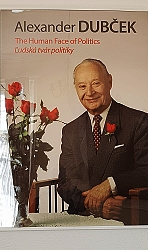
The larger, rear room with windows overlooking the back garden has several interesting objects on its walls. A sombre-looking metal plate covered with many names lists those who “gave their lives for Freedom” between 1939 and 1945. On the wall facing this, there are two posters with photographs of Alexander Dubček (1921-1992), a Slovak Communist politician, who tried to reform the Communist government during the Prague Spring of 1968, which ended after a few months when the Soviet Army invaded his country. On a wall behind the table-football unit, there are two large, colourful, framed maps. One is of the Czech Republic and the other of the Slovak Republic. Between the end of WW1 and 1993, the two now independent countries were parts of one country: the former Czechoslovakia.

A visit to the toilet involves climbing the stairs to the first floor. After ascending the first flight of stairs, the next short flight approaches a huge painting depicting TG Masaryk dressed in a flowing light beige coat and sporting a straw hat with a black ribbon tied above its rim.

Today, Bohemia House continues to welcome guests, both from the lands, which were once Czechoslovakia, as well as others. Its bar offers a range of beers, spirits, wines, and soft drinks, from that region of Central Europe. I sampled a can of Kofola, a carbonated Czech soft drink, whose taste vaguely resembles Coca Cola. The pint of Pilsner Urquell beer was more enjoyable. We also tried a variety of dishes typically cooked in the Czech and Slovak republics. They were enjoyable enough, but I prefer the cuisines of both Poland and Hungary. However, do not let this comment put you off paying a visit to Bohemia House, where you will receive a warm welcome from its charming staff. And … if you wish to know more about Hampstead’s Czechoslovak, other Central European, and Soviet historical associations, you could do no better than to read my new book about the area, available from Amazon [https://www.amazon.co.uk/dp/B09R2WRK92] and bookdepository.com [https://www.bookdepository.com/BENEATH-WIDE-SKY-HAMPSTEAD-ITS-ENVIRONS-2022-Adam-Yamey/9798407539520]).

Sir Anthony Blunt sat here often

HOME HOUSE IN London’s Portman Square was completed in 1777 for the wealthy Elizabeth Home, Countess of Home (c1703-1784). Born in Jamaica into a slave-owning family, her wealth was produced by the unpaid labour of slaves imported from Africa. The house is remarkable, especially for its intricately detailed interior décor designed by the architect Robert Adam (1728-1792).

In 1933, Home House became home to the Courtauld Institute of Art, now part of the University of London. A close friend of mine, now sadly deceased, studied at the Courtauld for both his bachelor’s degree and his doctorate. Whilst writing his doctoral thesis, my friend was supervised by Sir Anthony Blunt (1907-1983). Blunt was the director of the Courtauld from 1947 to 1974. He was also in charge of the Royal Collections of art from 1945 onwards. In addition, he carried out much important scholarly work in the field of history of art. Blunt, as director of the Courtauld, was given a flat in Home House.

Until 1979, few people knew, or even suspected, that Blunt had been involved with spying for the Soviet Union.  When this came out into the public domain, Blunt’s downfall commenced. He was stripped of his knighthood and his Honorary Fellowship at Cambridge’s Trinity College was rescinded. Also, Blunt resigned as a Fellow of the British Academy. Soon after his exposure as an espionage agent, who worked against his own country for the Soviet Union, Blunt ceased residing at Home House. In 1989, the Courtauld Institute shifted from Home House to larger premises in Somerset House in the Strand. Home House remained vacant until 1998, by which time it had been beautifully restored and adapted to become a private social club. During a recent visit to Home House when we were entertained by a friend, our host, a member, took us to see an interesting exhibit, which is housed in the wash basin area of one of the Club’s unisex toilets. We were shown a glass-fronted display case containing a wooden furniture item. It bears a label with the words: “From the bathroom of Sir Anthony Blunt”. The labelled object is the toilet seat on which Blunt must have sat numerous times, and its wooden lid. Another case in the room contains Blunt’s telephone. Although the loo seat and the ‘phone are unremarkable except for their provenance, the rest of Home House is a visual delight.