
TRAGICALLY, my friend the art historian and author, Michael, died twelve years ago. I had known him since 1964, when the film “Goldfinger” was released in the UK. By a strange coincidence he was born on the same day in October as my mother, and his mother was born on the same day in May as I was. He studied art history at London’s Courtauld Institute, where he also completed his doctorate. His doctoral supervisor was the Director of the Courtauld, the art historian and Keeper of the Queen’s Pictures, Sir Anthony Blunt (1907-1983), who was eventually unmasked as a Soviet Russian agent. When Michael was studying at the Courtauld, it was housed in Home House on London’s Portman Square. I never managed to visit Michael there, but since his demise, I have been there three times.
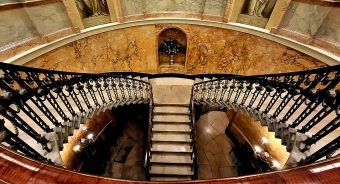
Originally, Home House was built for Elizabeth, Countess of Home (c1703-1784), a Jamaican born heiress. The edifice, which was completed during her lifetime, was designed by the famous architect Robert Adam (1728-1782). He is famed for having designed not only buildings, but also their interior décor and furniture as well as many small details (e.g., door handles). After a series of owners, Home House was leased in 1926 by the industrialist and art collector Samuel Courtauld (1876-1947) to house his then growing art collection. In 1931, following his wife’s death, he gave Home House to the then young Courtauld Institute of Art, which he helped to found.
The Institute remained in Home House until it shifted to its current home, Somerset House, in 1989. Home House stayed unoccupied until 1998, when it was extensively and beautifully restored and became a private members’ social club, called, unsurprisingly, Home House.
Of all the Adam designed structures I have visited, and these include Kenwood House, Osterley Park, Kedleston Hall, Pountney Bridge, The Adelphi Buildings, and Lutin Hoo, the restored Home House has the best set of Adam designed interiors I have seen. Today, unless you are a member of the club or a member’s guest, it is not otherwise possible to enter this gorgeous mansion; And it was an honour that a friend of ours, a member of the club, has invited us there on several occasions.
After our most recent visit to Home House, I could not help wonderin whether its present reincarnation would have met with my friend Michael’s approval. I have a sneaking feeling that he would have enjoyed what it has become.


