English Church in Madeira

THE FIRST RECORDED Anglican service in Madeira was held on a British ship passing by in 1774. Randomly occurring services were officiated by chaplains of passing ships until about 1807 when some British soldiers were stationed on Madeira as part of the war against Napoleon. Thereafter, the British garrison’s chaplain held services for British residents in the island’s British consulate.

In 1813, a plot of land was purchased close to the already established English Cemetery. The land is where the English Church stands today. Designed by Henry Veitch, the church was completed by 1822.

From the outside, the domed neoclassical building does not much resemble a church. Square in plan, inside it contains two concentric circles of supporting pillars. The top of the dome is above the central point of the church’s floor. The interior of the church is simple but elegant. Veitch, who was a freemason, might have been influenced by freemasonry in his choice of design, or possibly by the round style of temples favoured by the former Knights Templar.

When the church was built, it was attended by members of Madeira’s British residents, who numbered about 700 in 1822. Currently, there are only about 70 British residents. It was not until William Reid opened his hotel in the 1890s that the flood of tourists from Britain and elsewhere began in earnest.

Currently, the English Church, set in its lovely gardens, hosts many musical events – classical and otherwise.

Queen of Hearts maybe?

HOLY TRINITY CHURCH in the Suffolk Town of Long Melford is a grand perpendicular gothic affair built in the 15th century when the town was prospering because of the then thriving wool trade. Fortunately for us today, several of the original stained glass windows have survived in reasonably good condition.

On one of these mediaeval windows, which survived the iconoclastic behaviour instigated by Henry VIII, depicts Elizabeth Talbot, the Duchess of Norfolk, who was born in about 1442. Her daughter was married as a child to Richard, one of the two princes murdered in the Tower of London in about 1483.

It has been suggested that John Tenniel, the Victorian illustrator of Lewis Carroll’s “Alice’s Adventures in Wonderland”, might possibly have visited Long Melford, seen the portrait of Elizabeth Talbot, and then modelled his illustration of the Queen of Hearts on that image on the window. Whether this was actually the case or just pure coincidence is up to the viewer to decide. I remain undecided.

Adeline and James in Calcutta

THE CHURCH OF ST JOHN in central Kolkata was built by the British East India Company in the 18th century. Its foundation Stone was laid by Warren Hastings in 1784. We had visited it today, the 13th of January 2023, mainly to see the magnificent painting of the Last Supper by Johann Zoffany (1733-1810). We also spent time looking at the memorials that line the walls of the church. Suddenly, my wife pointed at one of them, which is of great interest to me at the moment. It commemorates James Pattle, who died in 1845 aged 68, an his wife Adeline, who died the same year aged 52. Whereas James is buried in London, Adeline was lost at sea.

My interest in this couple is related to a book I am writing about one of their daughters, who became one of the most famous British photographers during the 19th century. You will learn more about her after I publish my book.

James was born in Calcutta, as the city was named in his time. He was educated in England, and returned to Calcutta, where he became a High Court Judge. Adeline was born in French Pondicherry. Her maiden name was De l’Etang. Her father was a French nobleman who has fled from France to French India after the Revolution. He had been in charge of the French Royal stables and became important in the welfare of the East India Company ‘s horses in Calcutta . Her mother Therese had some Indian ancestry. James and Adeline married in 1811 at Bhagulpur in India. They had 10 surviving children.

⁸After James died in his home on Chowringee, he was placed in a barrel of preservative spirits so that, according to his wishes, he coukd be buried in London beside his mother in Marylebone Parish Church. Adeline travelled from Calcutta to London on the same ship as her husband’s corpse. Adeline died at sea according to the memorial in St John’s, but this might be incorrect. In any case, Adeline died a few months after James.

James’s remains did reach England, but they are interred at St Giles Church in London’s Camberwell. It is in this church, not the one in Marylebone, where his mother was buried.

The memorial in St John’s Church must have been placed because his fellow British citizens held him in high regard. The memorial was also a token of love given by their sorrowful childrenAs for his famous daughter, I will leave you in suspense!

Armenian script in a church in Chennai

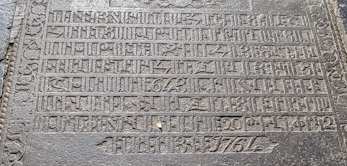
I HAVE VISITED ST THOMAS Mount in Chennai twice so far. The two visits were separated by at least a quarter of a century. Amongst the many interesting things to see and experience on this sacred hill are some examples of Armenian script. This characteristic lettering can be found both on several tombstones and on some framed paintings of saints. Also, there is some Armenian writing inscribed on an ornate pulpit.

The church on the Mount is dedicated to Our Lady of Expectation. There are several sculptures of the pregnant Mary in or near the church, which was constructed close to the spot where St Thomas (the doubter) is supposed to have died. The church was constructed by Portuguese Franciscan missionaries in the 1520s. None of this information provides any clues to the presence of the Armenian lettering.

Armenians began setting in Madras in significant numbers in the mid-17th century. There is an Armenian Street in Chennai, where one can find an Armenian church. This was built in 1712. The two funerary monuments I saw on the Mount are dated after 1712: 1739 and 1764. The paintings with Armenian script are far newer. I am no expert on Armenia, so can say little if anything about their religious practices. Many Armenians are Christians, and a few of them are of the Catholic variety. I can only assume that the graves on the Mount are those of Catholic Armenians, and that some Catholic Armenian donor provided the paintings.

If anyone can give me more information about the presence of Armenian script in this church on the Mount, please share it with me.

Charnock, Kolkata, Chennai, and granite

THE CHURCH OF ST MARY in Fort St George in Chennai (Madras) was constructed by 1680, when it was consecrated. It is the oldest Anglican church east of Suez.

The church contains a memorial to the founder of the famous American Yale College – Eliahu Yale. He had been Governor of Chennai’s Fort St George, where the church is located, between 1687 and 1692. He had also been the vestryman and treasurer of St Mary’s church.

The font within the church is made of a form of black granite known as Charnockite. This stone is named after Job Charnock (c 1630-1693). A member of the British East India Company, he is credited with founding a British settlement at a pre-existing village on the bank of the Hooghly River. Although the place had already been settled long before his arrival, Charnock’s establishment grew into what is now Kolkata (Calcutta).

In about 1678, Job entered a romantic relationship with a Hindu woman, whom he called Maria. They produced a son and three daughters. The daughters were baptised in the font in St Mary’s in Chennai in August 1689. A few years later, Job died. His funerary monument is in Kolkata, where he passed away. Like the font in Chennai, Job’s tomb, which is housed in a mausoleum in Kolkata, is made of Charnockite. This form of granite can be found in the south of India. It was local to Chennai but far from Kolkata. This type of rock was first described in Tamil Nadu and was named in honour of Job Charnock.

Apart from the font and the memorial to Yale, the church of St Mary’s has many fascinating sculpted monuments to Britishers who died in India or on their way to or from it.

Holy Communion and covid19

ST MARKS CATHEDRAL in Bangalore was constructed between 1808 and 1812. It is an elegant late Baroque church standing in its own spacious grounds. We visited it on Christmas Day 2022. There was a service in progress. The congregation was too large to be fully accommodated within the building. Many people were sitting outside the church, some of them under a canopy. The service was conveyed to those outside the building using loudspeakers and a giant television screen.

While the cleric began reciting the words associated with taking communion, he spoke of receiving the body of Christ. As he said that, I noticed a woman in the congregation opening a small container and taking a small flat white object from it, and then slipping it into her mouth.

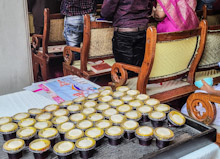
A man nearby asked if we wished to take communion, and then pointed to a table covered with small round plastic containers with lids. Each of these contains a communion wafer fragment and some “communion nectar”, which I imagine represents the blood of Christ.

At St Mark’s, it appears that Holy Communion is self-administered, rather than being handed out by a cleric, as is the case in most churches where I have witnessed Holy Communion. I wondered whether these little pots of Holy Communion ‘ingredients’ are an attempt to reduce the risk of transmitting disease in these times when the covid19 virus is so prevalent.

Some eagles in Old Goa

THE MUSEUM OF Christian Art has been recently been upgraded and is now a truly excellent display of Christian religious artefacts. It is housed in part of the convent of Santa Monica on Holy Hill in Old Goa. The convent Church was built in the early 17th century.

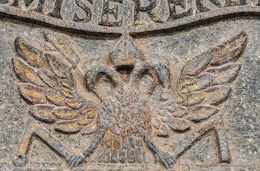
On arrival at the outside (south side) of the church, I spotted a bas-relief carved in stone above the main entrance to the church. It depicts an example of a heraldic creature that has long fascinated me: a double-headed eagle.

Inside the church, we met Natasha, who is the curator of the museum. I asked her if she knew about the reason for the double-headed eagle on the church. She informed us that the convent had been an Augustinian establishment, and that the double-headed eagle is a symbol used by that Order. That was news to me. She also directed me to another depiction of this creature on a carved tablet set into the church’s north wall.

When I returned to our lodging in Panjim, I consulted the internet, and learned about the connection between the Augustinian Order and the bird with two heads. It appears that although the main emblem of the Augustinians was a heart pierced with two arrow, the Hapsburgs allowed this Order to use their emblem, the double-headed eagle.

It will be recalled that there was a significant linkage of the Habsburgs and Spain. And Spain ruled Portugal between about 1580 and 1640. The Convent of Santa Monica was constructed between 1606 and 1627, and that was during the time that Portugal, which colonised Goa, was united with Spain. During that period, the united countries were ruled by Habsburg kings.

Although the museum, which I will describe later, was well worth the visit, discovering yet another example of the use of the double-headed eagle was a great thrill for me.

A thatched church and Alfred Lord Tennyson

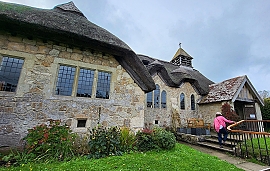
THE POET ALFRED TENNYSON made his home in the village of Freshwater Bay on the Isle of Wight (‘IOW’) from 1853 until his death. His presence there attracted many Victorian cultural figures to the village either as residents or as his visitors. In 1907, fifteen years after Tennyson died, the Bishop of Winchester visited Freshwater and decided that the village needed a better church than the rather primitive one being used at the time. The Reverend AJ Robertson, who was Rector of Freshwater in 1907, made a watercolour painting of the type of church he hoped would be built. It included a thatched roof. Such a church as he had envisaged was designed by the architect Isaac Jones of Herne Hill in London, and constructed on land donated by Tennyson’s eldest son Hallam, Lord Tennyson (1852-1928). It was Hallam’s wife Lady Emily (1853-1931; née Prinsep), who gifted the new church’s porch and suggested that the church be dedicated to St Agnes.

St Agnes is the only church on the IOW to have a thatched roof. Much of the building was built using stones from what had once been the home of the scientist Robert Hooke (1635-1703). The use of old stones makes some people believe that the church is older than it really is. One of the old stones has the date 1694 inscribed on it, a reminder of the origin of the stonework. The interior of the building is well lit by natural light through its many windows. The timber framed ceiling is fine as is the beautifully carved chancel screen. The screen with delicate bas-relief carvings of plants was created by the Reverend Thomas Gardner Devitt, who was curate of St Agnes between 1942 and 1946.

In brief, this thatched church is charming. In appearance, it manages to combine a feeling of mediaeval antiquity with the aesthetics of the Arts and Crafts Movement, which was in its heyday when St Agnes was built. Seeing it was one of many delightful experiences we enjoyed whilst spending a week on the IOW.

Glorious detail in a gothic revival church

I HAD PASSED it often, but never entered it until recently when I attended a concert within it. I am talking about a church on Holland Road in West London not far from Shepherds Bush, St John the Baptist. This Anglican church is an exceptional example of gothic revival style. Designed by James Brooks (1825-1901) with John Standen Adkins (an assistant of Brooks), it was constructed between 1872 and 1910.

Although the façade facing Holland Road is not exceptional, the church’s interior is highly breathtakingly decorative. Unlike mediaeval churches, which took centuries to complete, St John the Baptist was constructed in much less time. Yet, its decorative details, which imitate what is best in many older churches, rival those found within the old ones. The workmanship and fine details in St John’s remind one of the best productions of craftsmen, who flourished many centuries earlier. However, unlike the earlier churches, which inspired the designers of St John’s, the interior of the church on Holland Road looks too good to be true. Completed in a relatively short period, the variety that adds to the charm of gothic churches built in earlier times and more slowly is lacking in St John’s and other fine examples of late Victorian gothic revival buildings. What we see at St John’s is the realisation of the architects’ concept of an ideal ‘mediaeval’ church. What was achieved at St John’s is probably something like the results early creators of (mediaeval) churches hoped to create, but never lived long enough to see fully realised.

The attention to detail in the better gothic revival churches, such as St John’s, is marvellous. The result is an ensemble of decorative features rich in meticulously executed intricate details. While I was listening to the concert in St John’s, my eyes took in the details of the church, and I began thinking it was amazing that the elaborate attention to fiddly ornate minutiae was carried out only a few years before architectural trends turned through 180 degrees from excessively decorative to the greater simplicity of much 20th century architecture.

An uninteresting artist in a Hertfordshire church

SAWBRIDGEWORTH IS AN ATTRACTIVE small town with many picturesque old buildings and a parish church, St Mary’s, whose construction began in the 13th century. It is an unusual edifice, being about as wide as its length, rather than longer than its width as is the case for most English churches. It contains a fine selection of elaborate funerary sculptures.

The most impressive funerary monument is the memorial to John Leventhorpe and his wife Joan, who died in 1625 and 1627 respectively. Within a multi-coloured marble frame, both of the deceased are depicted reclining on their left sides with their heads propped up by their left hands. John holds a sword in his right hand and Joan a small book in hers, Beneath the two statues, the couple’s six sons (one of whom, Arthur, died as a baby) and eight daughters are depicted in bas-relief, all kneeling in prayer. Baby Arthur is also present on the memorial but has been sculpted much smaller than his brothers. The whole sculptural ensemble is magnificent, and if you had time to see only one thing in Sawbridgeworth, this should not be missed.

High on the wall facing the Leventhorpe memorial, there is a smaller one, commemorating Jeremiah Milles (died 1797) and his wife Rose, who died in 1835. It is typical of early 19th century memorial art. It shows a female mourner in Hellenic dress kneeling in front of a sarcophagus. It was sculpted by John Termouth (1795-1849) of Pimlico (London).

The sculptor of the Leventhorpe memorial has been forgotten, but Termouth, who sculpted the Milles memorial, has not been consigned to obscurity. A notice in St Mary’s revealed that Termouth was:

“… an uninteresting artist whose symbolism was always obvious, hackneyed, and uninspired.”